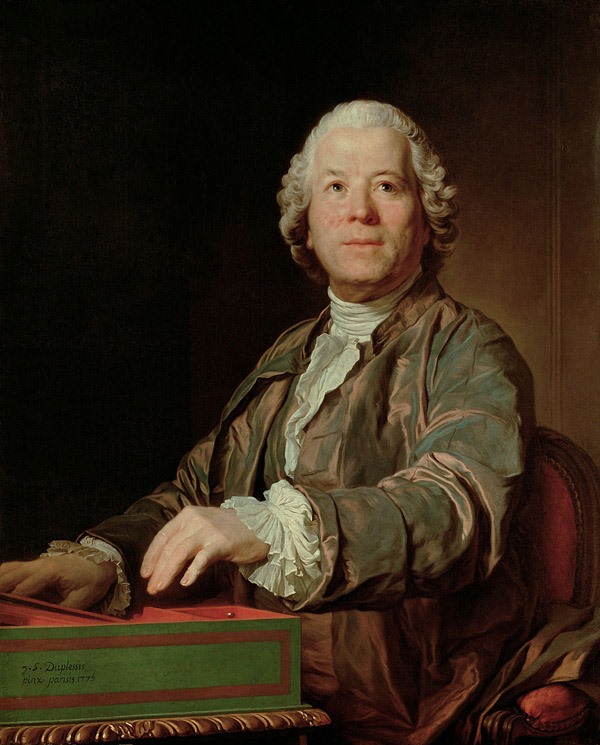
On the anniversary of the birth of Christoph Willibald Gluck (on this date in 1714), here’s Interesting filmed production of his most famous opera, “Orfeo ed Euridice,” complete with Orpheus’ wake-up routine – bereft musicians should not leave home without laurels and lyre – periwigged orchestra and “thanks, Mean Joe” epilogue honoring the emotional truth of the mythological tale while undercutting the composer’s happy ending. American countertenor Bejun Mehta sings Orfeo, Austrian soprano Eva Liebau sings Euridice, and Václav Luks conducts Collegium 1704.
The opera was filmed at the Baroque Theater of Český Krumlov Castle (every castle should have one) in the South Bohemian Region of the Czech Republic. The theater dates from 1767, within five years of the opera’s first performance (at the Burgtheater in Vienna in 1762). Gluck revised the work twelve years later, the better to suit the taste of Parisian audiences.
The opera’s naturalistic expression and dramatic simplicity, with its rejection of the formulaic – ornamental arias interleaved with recitative and scene changes – proved highly influential. Here, the arias subvert formula and avoid grandstanding, serving a coherent drama, with an emphasis on sustained mood (melancholy) and poetry, as opposed to by-the-numbers fiery passions and vocal acrobatics.
Gluck’s reforms, which would have been perceived as radical, pissing off showboating singers of the day and confusing, perhaps even frustrating, audience expectations, influenced sympathetic composers from Mozart to Weber, from Berlioz to Wagner.
If you missed the opening credits of “Il Boemo” (“The Bohemian”), you would be forgiven for wondering if you had just walked into a remake of “The Phantom of the Opera.” The 18th century Czech composer Josef Mysliveček (pronounced MISS-leave-a-check), depicted at the far end of a dissolute life, removes his unnerving doll’s mask to reveal the physical wear-and-tear on a ravaged face. The only thing missing is the organ music and a shrieking maiden. I don’t think I’m spoiling anything by saying so, any more than I would be if I mention Signor Salieri’s suicide attempt at the beginning of “Amadeus.” After all, this is biographical drama, and not a jump-scare horror movie.
“Il Boemo” does not pull any punches as it follows Mysliveček’s Hogarthian trajectory, which is to say morally downward, even as this struggling artist from the provinces (he was born in Prague, coincidentally where Casanova lived out his later years) rises to the pinnacle of Italian opera.
It’s all the more tragic, really, because, as played by the likeable Vojtěch Dyk, Mysliveček’s not really a bad guy. He’s not cutthroat or particularly calculating. He makes some questionable decisions, but he isn’t trying to hurt anyone. At worst, he’s passive when convenient, allowing the influential ladies in his life to do all the heavy lifting. And maybe he’s a little self-absorbed. He makes one trip home and he’s guilted by his twin brother (also played by Dyk) for not being more involved with the family. But come on, it’s a long trip. Back then, travel was really TRAVEL. Okay, and perhaps he’s a little libidinous. After all, he’s only flesh and blood! One thing’s for certain: on his climb to becoming one of the most successful composers in Europe, and certainly Italy, he walks a narrow, often claustrophobic path.
If the film is anything to go by, life in Venice is a perpetual masquerade. Is it always Carnival there? If so, why is there no joy or festivity? Everyone is cloaked in black and veiled in forbidding masks. They traverse miasmic canals in lugubrious gondolas. Chambers are shadowy and adorned with heavy oil paintings. Women are trapped and stifled in loveless marriages. The aristocracy is twisted and its whims must be navigated with care.
To make such a picturesque world seem so confining is a pretty neat trick. The use of handheld cameras for certain scenes contributes to a sense of being boxed in. The sets and costumes are luxurious without ever attracting undue attention to themselves. The film was shot in historical locations in the Czech Republic (as was “Amadeus”), but the focus is always on the characters as human beings. There’s no ogling the scenery, no distracting awareness that these are 21st century actors playing at fancy dress, pitfalls of too many historical dramas.
Nor is this a film strictly for pointy heads. It’s an absorbing, human story that just so happens to be set in the world of classical music. The 143-minute running time goes by very quickly. Yes, it’s subtitled (most of the film is in Italian), but it is never less than thoroughly engrossing. I would think this would be the case anyway, regardless of a viewer’s musical knowledge or interests.
But if you ARE a classical music lover, there is a bonus in Mysliveček’s undeservedly neglected music. On the soundtrack, countertenor Philippe Jaroussky and sopranos Emöke Baráth, Raffaella Milanesi, and Simona Šaturová join the Baroque orchestra Collegium 1704, conducted by Václav Luks. You’ll also hear music by Baldassare Galuppi, Franz Joseph Haydn, Pietro Alessandro Guglielmi, Johann Adolph Hasse, Antonio Vivaldi, and Luigi Boccherini’s famous “Minuet.”
By and large, Mysliveček is a name, I suspect, that is still unknown to many (and unpronounceable to more). In fact, it’s a miracle that the film, an international co-production made possible by at least a dozen Czech, Italian, and Slovakian sources, was even made. Why it was not accepted as a foreign film entry in 2022’s Academy Awards is anyone’s guess. Perhaps it was an exceptionally competitive batch of applicants.
A lot of the film is necessarily speculation. We don’t know much about Mysliveček’s love affairs, but we know he had them, and on a prodigious scale. But the story is dramatically convincing without ever overplaying its hand.
Its depiction of the boy Mozart (for a time, Mysliveček was a close family friend) is more historically believable than Tom Hulce’s glam-rock free-spirit in “Amadeus” (for as much as I love the movie). “Il Boemo” takes a different approach, and Mozart’s “cameo” is one of the film’s highlights. “Amadeus” excels as popular entertainment that manages to float larger questions about human nature and the mystery of art, while transcending slavish adherence to plodding historical fact. “Il Boemo” too shakes off the dust of the research library, but with quite different results.
One thing the film really gets right is the historical reality of what a night at the opera was in those days, with people shouting, jeering, eating, playing cards, attempting suicide, and otherwise behaving badly. And the nobles perhaps worst of all. It’s good to be the king!
I hasten to add, for as good as it is, there are a few moments that are definitely not safe for work and could be a mite disturbing, or at least unsettling, as they are no doubt meant to be. It’s not exactly a movie for family night. There’s some pretty gruesome make-up, at least one orgy, and a very strange scene in which a king engages in some private business in the middle of a conversation in a singer’s dressing room. If you want to introduce the kids to classical music, I’d advise you to stick with Mickey Mouse as the Sorcerer’s Apprentice.
For many, the use of “Bohemian” in the title might suggest artistic or even iconoclastic associations, as in “bohemian lifestyle” or “La bohème.” But to those with a sense of history, it might also indicate someone who is from what is now the Czech Republic. (Think Arthur Conan Doyle’s Sherlock Holmes story “A Scandal in Bohemia.”) You see, the Italians couldn’t pronounce Mysliveček either. Hence the nickname “Il Boemo.”
The director, Petr Václav, also made a Mysliveček documentary in 2015, “Confession of the Vanished,” which I’ll be adding to my watch list. I see it’s available for streaming here.
“Il Boemo” might not be a feel-good romp along the lines of Tony Richardson’s “Tom Jones,” but neither does it leave you feeling grim like “Dangerous Liaisons.” I suppose it’s a little bit of the “Barry Lyndon” school, except “Il Boemo” involves, rather than distances.
The film streams free on Kanopy with a library card. Or at least that’s the case where I am. Maybe it depends on the library. You can find out more at the links.
George Frideric Handel was born 340 years ago, and he’s still as fresh as a rose. Fresher. Actually, come to think of it, there is a climbing rose named after him…
For one thing, the standard of Handel performance has gotten so much better in recent decades. I guess you really don’t hit your stride as a composer until after the first 300 years.
For as much as I hold a nostalgic affection for Hamilton Harty’s ponderous take on the “Water Music” – a concert staple for over half a century – a modern orchestra gives little indication of just how thrilling Handel can be. At its best, his vocal stuff, in particular, can be sublime.
I didn’t always feel this way. When I attended a performance of “Ariodante” in Philadelphia, back in the 1989, even with the dream pairing of Benita Valente and Tatiana Troyanos, I was afraid I was going to give up the ghost. When it really doesn’t connect, three or four hours of Baroque opera can easily start to feel like too much of a good thing. My girlfriend at the time wanted to leave after the second act, but I insisted we stick it out. I was eager to witness the climactic swordfight, described in the synopsis – which, in the end, amounted to a single, slow-motion riposte. The weak pay-off earned me an evil glare.
The experience had the effect of putting me off Handel opera in much the same way that downing a bottle of Inver House whiskey in my teens put me off Scotch. Just as I later discovered, to my surprise and delight, how much I truly appreciate a fine single malt, when I had occasion to reacquaint myself with “Ariodante” at the Princeton Festival in 2010, I was astonished to find that I actually liked Handel opera after all.
A few years ago, when I wandered into a library book sale, I discovered that someone had dumped their entire collection of Handel operas and oratorios. I don’t know how many there were to begin with, but I walked out with everything that was left. Who knows if I’ll ever get through all of them before I die, but I am very happy to have them.
That said, I do find Handel’s operas work best when encountered live, in performance – whether seen in person or on screen – which is the opposite of what I would say about most of the operas I prefer. The images that are formed in my mind by the music far surpass anything that can be realized on a stage. When attending opera, it is the experience of the orchestra, the voices, and the sense of “theater” I enjoy. But the visuals are too mundane for my grandiose vision.
I also tend to get annoyed at modern stagings, with concepts that too often seem forced and undercut the vitality of the music. Again, Handel is different. David McVicar’s production of “Agrippina” must be one of the best things in the Met’s current repertoire.
Of course, there is always the possibility that it is not so much Handel who has changed – despite a pronounced shift toward “authentic” performance practice over the past 40 years or so. It could be that even a paragon such as myself, sprung fully-formed from the head of Zeus, might have evolved. I’m reminded of the famous Twain observation that, when he was 14, his father was so ignorant he could hardly stand it; but when he was 21, he was astonished by how much the old man had learned.
I’ve come a long way since my friends and I spent an ouzo-soaked 24 hours celebrating Handel’s tercentenary back in 1985. I recollect even now the six-mile round-trip I made with one of them, on foot, on a cold February evening, from Temple University campus to Center City Philadelphia and back, with a bottle nestled in his bag to keep us warm for an in-town performance of “Judas Maccabaeus.”
Everything old is new again. Handel grows wiser with the years, but also more thrilling.
Happy birthday, G.F.H.
Amanda Forsythe and Apollo’s Fire, with an aria from “Giulio Cesare”
Danielle de Niese with the same aria, staged:
Of course, there’s always Thomas Beecham, bringing it old school, to prove me wrong:
So many modern opera productions of the classics are radically, even provocatively, reimagined, ill-considered, half-baked, and just plain tiresome. I don’t want to pay big bucks to go to an opera house to have my eyes assaulted by a bunch of grotesque imagery calculated to undermine the glorious music. If I want to feel grim and depressed, it’s much less expensive to go to the movies. It’s the composers’ genius that has kept opera alive all these years, not the desperate antics of flash-in-the-pan directors.
That said, every once in a while, a bold swing for the fences thrillingly connects. Fresh approaches to Baroque opera, in particular, seem to have yielded their share of unexpected delights, perhaps because the old ways often pretty much reflected what Peter Schaffer’s Mozart complained about, in his earthy fashion, when he characterized the kind of opera peopled with classical and historical heroes as being moribund, the characters so lofty that they sound as if they defecate marble.
In some respects, I suppose, I am a product of my time, so I don’t mind a little flash now and again, to keep things lively, even if it is a concession to the eye more than to the ear. I was delighted by David McVicar’s take on George Frideric Handel’s “Agrippina,” for instance, with, in one manic aria, mad Nero cutting cocaine with a credit card.
Now, for Handel’s birthday, here’s one to set aside for the weekend. A traditional production of “Giulio Cesare in Egitto” (“Julius Caesar in Egypt”) opens in 48 B.C. This one, however, is built on the premise of a Howard Carter-like figure uncovering an Egyptian tomb in the 1920s – only to have the contents spring to life. The approach was conceived by George Petrou, artistic director of the International Handel Festival Göttingen.
The production opens with a quote from Carl Jung, rendered in the style of a silent movie intertitle: “Where love reigns, there is no will to power, and where power takes precedence, love is absent. One is the shadow of the other.” Cleopatra emerges from a sarcophagus, the priests are all dressed like Anubis, canine-headed Egyptian lord of the underworld, and there are mummies all over the place. Nireno’s aria that opens Act II is given ‘20s-style jazz inflections. Furthermore, on this occasion, it is sung from the wings while lip-synched and pantomimed by the production’s assistant director, because the scheduled singer was under the weather!
Handel was 39 when he wrote the music. Is the production in line with what the composer imagined? Well, not exactly, but it looks like it could be inventive and fun, in an escapist kind of way. I look forward to sitting down and watching the whole thing. Nothing screams Handel like hot sand, jodhpurs, and pith helmets.
Those who believe gender fluidity is so au courant should have greater familiarity with Baroque opera.
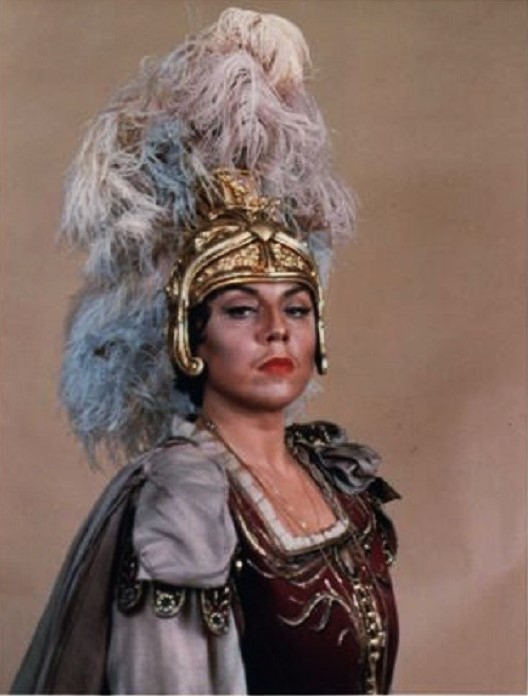
Ewa Podleś’ repertoire was wide-ranging, encompassing Chopin, Offenbach, Tchaikovsky, Massenet, Mahler, Richard Strauss, Shostakovich, and Penderecki. But many of her greatest operatic parts were so-called “trouser roles.” She once cracked that she played so many men that she sometimes looked in the mirror fearing that she might be growing a mustache.
Her vocal range was extraordinary, spanning well over three octaves. She was able to conjure rich chest tones and powerful high C’s, a true coloratura contralto. Her accompanist, the pianist Garrick Ohlsson, was not the only one to describe her as “a force of nature.”
In 1975, she made her operatic debut as Dorabella in Mozart’s “Così fan tutte.” Ten years later, she appeared in Handel’s “Rinaldo” at the Met, but it would be nearly a quarter century before she returned to the New York stage.
Following a run of performances in Donizetti’s “The Daughter of Regiment” in 2017, she announced she would be taking a break to have orthopedic surgery. These turned out to be her final performances.
Her husband, the pianist Jerzy Marchwiński, died in November at the age of 88. Podleś followed on Friday. At the time of her death, she was 71 years-old. R.I.P.
“Cara sposa” from Handel’s “Rinaldo”
Sporting a full-on beard in Rossini’s “Ciro in Babilonia”
She sang women’s parts, too – from Donizetti’s “The Daughter of the Regiment”