Tag: Bedrich Smetana

  • Smetana’s Sweetness Light for 200th Anniversary

    Smetana’s Sweetness Light for 200th Anniversary

    Sadly, even by “great composers” standards, Bedřich Smetana didn’t get to enjoy much in the way of sweetness or light. On the contrary, he suffered much tragedy and turbulence in his life – untimely deaths of family and friends, political instability, an unhappy second marriage, chronic illness, deafness, madness, and his own early demise at the age of 60.

    But he is celebrated as the founder of a Czech national school in music, the composer of abundant characteristic dances and other folk-inflected pieces. So for the 200th anniversary of his birth, on March 2, 1824, we’ll honor these aspects of his legacy with an hour of his “lighter” works.

    Of course, not all of Smetana’s music can characterized as sweet OR light. He was an admirer and acolyte of Franz Liszt, and there is often a substantial Wagnerian influence, in some of his operas, especially. Some of the Czech dances we’ll enjoy wed Bohemian folk tradition with knuckle-busting keyboard Romanticism. And of the operas, we have but one very brief selection, the famous polka from “The Bartered Bride” – however taken from a complete recording of the work, so we’ll get to experience it from a fresh perspective, with the rarely-heard chorus.

    Interestingly, the surname Smetana is also the word for a kind of cream, frequently of the sour variety, or perhaps a crème fraîche. I assure you, the emphasis this week will be on “Sweet Cream,” for the 200th anniversary of the composer’s birth.

    It will be tragedy tomorrow, comedy today, on “Sweetness and Light,” this Saturday morning at 11:00 EST/8:00 PST, exclusively on KWAX, the radio station of the University of Oregon!

    Enjoy it, wherever you are, here:

    https://kwax.uoregon.edu/


    IMAGE: Bedřich Smetana, babe-magnet

  • Smetana’s Heroic Life & Music on WWFM

    Smetana’s Heroic Life & Music on WWFM

    In the latter half of the 19th century, music became a focal point for nations struggling to assert their own identity following centuries of imperial control. Bedřich Smetana mined the history, landscape, and lore of the Czech people for the raw materials from which he would forge a distinctive national sound.

    Unfortunately, Smetana’s life was also marred by tragedy. Political upheavals, professional intrigue, and the deaths of three children and a wife all weighed heavily up him. A second marriage was unhappy. Syphilis robbed him of his hearing, his sanity, and eventually his life.

    Yet he completed some of his greatest works under what should have been cripplingly dispiriting circumstances. By the time he composed “Má vlast” – including the ubiquitous “Vltava” (or “The Moldau”) – he was stone deaf and living in domestic purgatory. (He believed that his second wife hated him, as she was always hounding him about money.) This period also yielded another of his most enduring works, the String Quartet No. 2 “From My Life.”

    Further vindication came when his opera “Libuše” received its belated premiere and was rapturously received. In all, Smetana composed eight operas, but of these only “The Bartered Bride” is still performed regularly outside the Czech Republic.

    Smetana is everlasting in the hearts of the Czech people. We’ll celebrate his independent spirit this afternoon on The Classical Network, on his birthday, alongside composers Marc Blitzstein, John Gardner, George Alexander Macfarren, and Robert Simpson, violinist and composer Eugène Ysaÿe, guitarist and composer Celedonio Romero, and conductor and composer Leif Segerstam.

    The music-making will be positively heroic, from 4 to 7 p.m. EST, on WWFM – The Classical Network and wwfm.org.


    To tide you over, here’s Smetana’s Sonata for Two Pianos, Eight Hands:


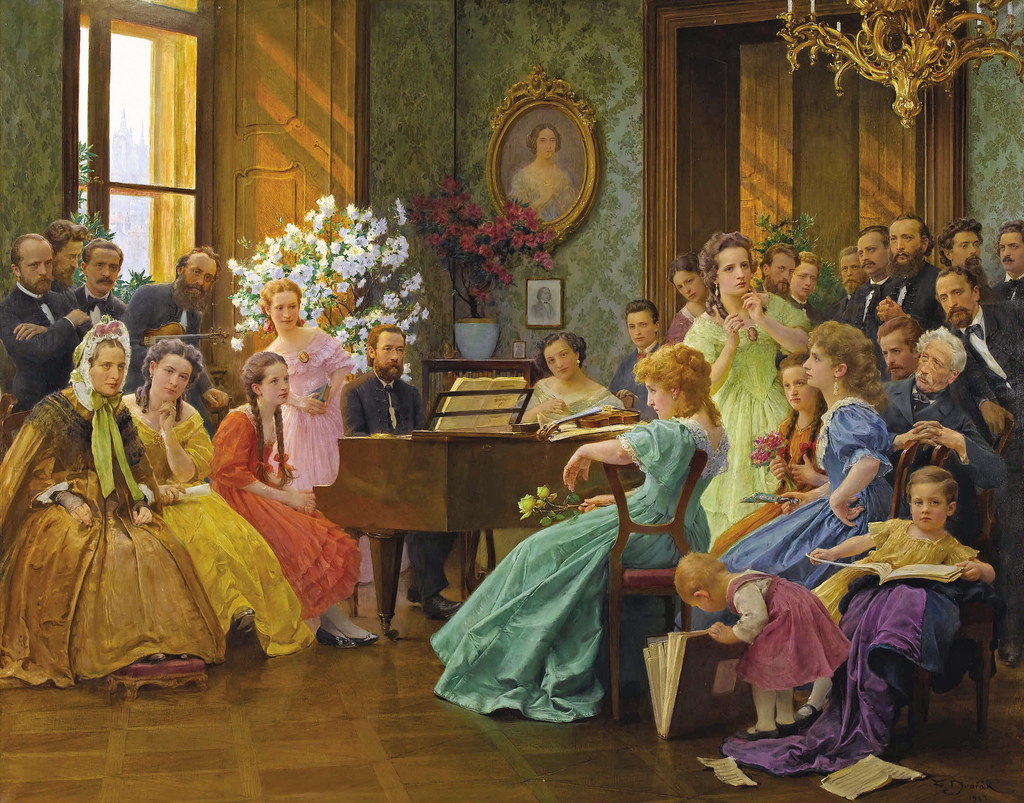
    The chicks dig Czech: “Bedřich Smetana and His Friends in 1865,” by Franz Dvořák (no relation to the composer)

  • Richard III Leighton on The Classical Network

    Richard III Leighton on The Classical Network

    We’ll begin and conclude by putting a little English on it, on The Classical Network.

    At 4:00, we’ll mark the birthday today of Richard III with works by William Walton and Bedrich Smetana. Then at 6:00, we’ll honor English composer Kenneth Leighton.

    Leighton’s “Veris Gratia” (1950) betrays a spiritual kinship with the music of Ralph Vaughan Williams, Herbert Howells, and his champion and friend Gerald Finzi.

    Completed at the age of 21, the suite is scored for oboe, cello and orchestra. Though the musical language is in the tradition of the English pastoralists, gentle, tonal and melodic, Leighton’s yearning to be his own man is already evident in some of the harmonies. The work is based on an earlier cantata of the same name, a setting of Medieval Latin lyrics in English translation. Finzi conducted the suite several times, including its first performance. In gratitude, Leighton dedicated the work to his memory, following Finzi’s untimely death.

    Leighton emerged from a working class background in Yorkshire. He exhibited talent early as a chorister and pianist, before receiving a scholarship to study Classics at Queen’s College, Oxford. Simultaneously, he embarked on a degree in music. There, he studied with Bernard Rose. Finzi and Vaughan Williams interceded on his behalf, facilitating and attending performances of his works. Leopold Stokowski conducted the premiere of his “Primavera Romana” with the Royal Liverpool Philharmonic.

    Soon after, Leighton left for Rome to study with Goffredo Petrassi. This led to his exposure to a wider range of European composers and techniques. In some of his pieces, he even flirts with serialism. He certainly developed a more modern, though generally lyrical and always personal style.

    As a person, he enjoyed family and teaching. He was less fond of the administrative duties that were part of being a university professor. At his core, he was a shy and private man, who cherished peace and quiet.

    Leighton is often reductively referred to as a “church composer,” which is ironic, since he was not overly fond of church or even conventionally religious. He preferred the transcendent qualities of poetry and nature, and enjoyed taking long walks through the Scottish Highlands with his dog. Though he spent much of his adult life in Scotland, on the faculty of the University of Edinburgh, Leighton never forgot his origins. He always regarded himself as a down-to-earth Yorkshireman.

    Watch for Clarence in the malmsey butt, then kick back with the cows, from 4 to 7 p.m. EDT, on WWFM – The Classical Network and wwfm.org.

Tag Cloud

Aaron Copland (92) Beethoven (94) Composer (114) Film Music (117) Film Score (143) Film Scores (255) Halloween (94) John Williams (185) KWAX (228) Leonard Bernstein (99) Marlboro Music Festival (125) Movie Music (132) Opera (197) Philadelphia Orchestra (86) Picture Perfect (174) Princeton Symphony Orchestra (106) Radio (86) Ralph Vaughan Williams (85) Ross Amico (244) Roy's Tie-Dye Sci-Fi Corner (290) The Classical Network (101) The Lost Chord (268) Vaughan Williams (101) WPRB (396) WWFM (881)

DON’T MISS A BEAT

Receive a weekly digest every Sunday at noon by signing up here


RECENT POSTS