Tag: Benny Goodman

  • Contrasts:  Béla Bartók and Benny Goodman

    Contrasts: Béla Bartók and Benny Goodman

    If you want to talk about a study in contrasts, how about Hungarian master Béla Bartók and America’s “King of Swing,” Benny Goodman?

    Goodman’s musical training was classical (he took lessons at the local synagogue and with Chicago Symphony clarinetist Franz Schoepp). But he really caught fire when playing with dance bands. His early influences were New Orleans jazz clarinetists who worked in Chicago.

    He shot to prominence during the Big Band era, but with the decline of swing, he decided to return to his formal studies, this time with English clarinetist Reginald Kell. Goodman developed a lot of bad habits in the intervening years, and he had to rebuild his technique basically from scratch.

    Although a worldwide celebrity who had achieved enormous success, Goodman missed the classics and longed for a little mainstream respectability. Since he was by then in a position to do so, he took up performing and recording Mozart and Weber, and he commissioned or played new works by Copland, Bernstein, and Stravinsky, among others.

    One of these was Béla Bartók, whose birthday it is today. Bartók composed “Contrasts” in 1938, on a Goodman commission. This trio for clarinet, violin, and piano is a raw, fascinating work, inspired by Hungarian and Romanian dance melodies. It contains passages of bitonality and frenzied scordatura (a deliberate mistuning, or alternate tuning, of the violin). Goodman recorded the work, with violinist Josef Szigeti and the composer at the piano.


    Not your glass of pálinka? By way of “contrast,” check out Bartok’s ballet-pantomime “The Wooden Prince,” composed in 1914-17. Much less frequently performed than his subsequent succès de scandale, “The Miraculous Mandarin,” composed in 1918-24, this musical fairy tale for large orchestra bears the influences of Debussy and Strauss, and yes, Wagner too.

    Never understood why it’s not heard more often. Just because it doesn’t have quite the bite of the composer’s mature masterworks doesn’t mean it isn’t worthwhile.

    https://www.youtube.com/watch?v=vYEijXHFY1w

    From the King of Swing to “The Wooden Prince,” happy birthday, Béla Bartók!

    ——–

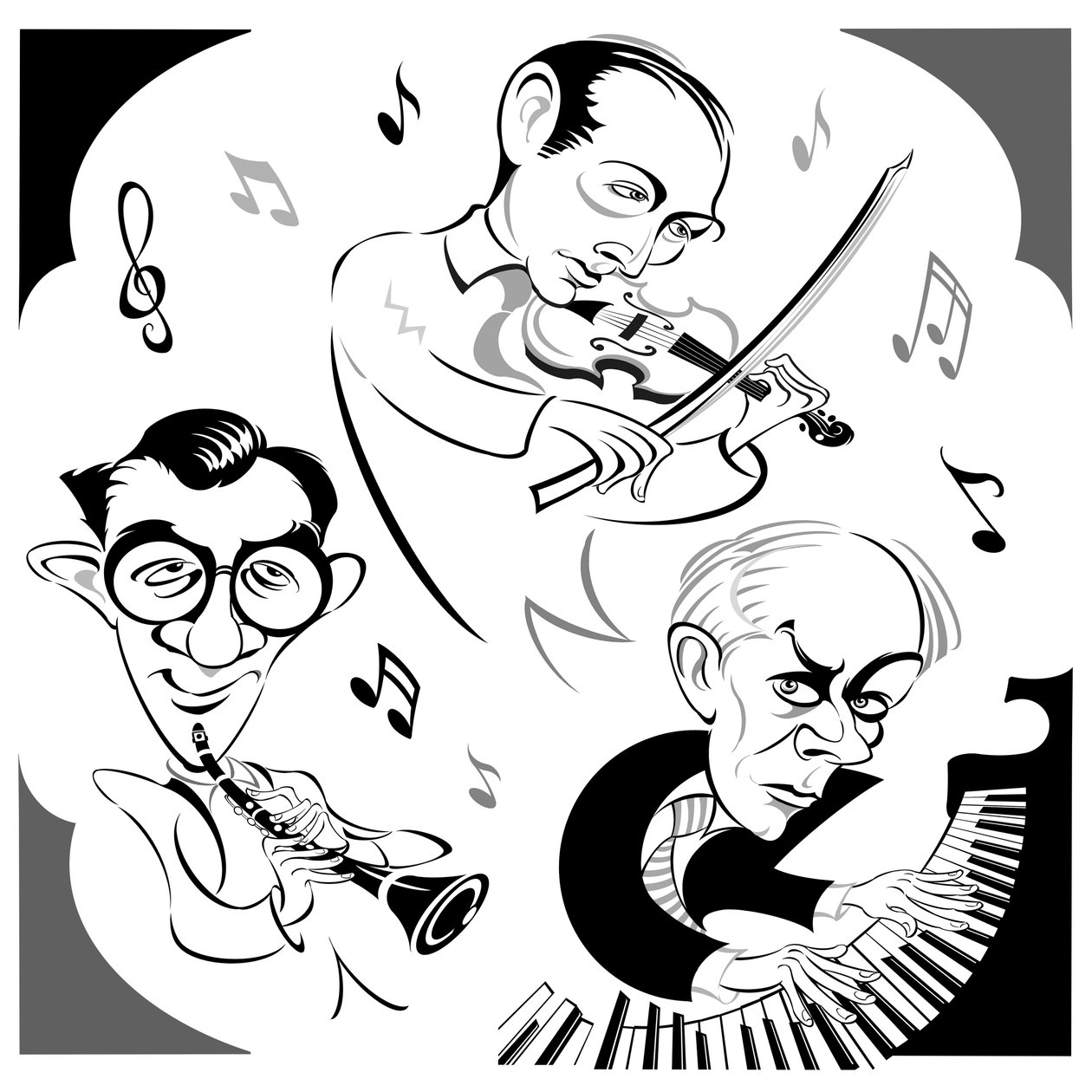
    IMAGE: 1940 illustration of Goodman, Szigeti, and Bartók by Neale Osborne
  • Bartók Goodman Contrasts Happy Birthday

    Bartók Goodman Contrasts Happy Birthday

    If you want to talk about a study in contrasts, how about Hungarian master Béla Bartók and America’s “King of Swing,” Benny Goodman?

    Goodman’s musical training was classical (he took lessons at the local synagogue and with Chicago Symphony clarinetist Franz Schoepp). But he really caught fire when playing with dance bands. His early influences were New Orleans jazz clarinetists who worked in Chicago.

    He shot to prominence during the Big Band era, but with the decline of swing, he decided to return to his formal studies, this time with English clarinetist Reginald Kell. Goodman developed a lot of bad habits in the intervening years, and he had to rebuild his technique basically from scratch.

    Although a worldwide celebrity who had achieved enormous success, Goodman missed the classics and longed for a little mainstream respectability. Since he was by then in a position to do so, he took up performing and recording Mozart and Weber, and he commissioned or played new works by Copland, Bernstein, and Stravinsky, among others.

    One of these was Béla Bartók, whose birthday it is today. Bartók composed “Contrasts” in 1938, on a Goodman commission. This trio for clarinet, violin, and piano is a raw, fascinating work, inspired by Hungarian and Romanian dance melodies. It contains passages of bitonality and frenzied scordatura (a deliberate mistuning, or alternate tuning, of the violin). Goodman recorded the work, with violinist Josef Szigeti and the composer at the piano.

    Not your glass of pálinka? By way of “contrast,” check out Bartok’s ballet-pantomime “The Wooden Prince,” composed in 1914-17. Much less frequently performed than his subsequent succès de scandale, “The Miraculous Mandarin,” composed in 1918-24, this musical fairy tale for large orchestra bears the influences of Debussy and Strauss, and yes, Wagner too.

    Never understood why it’s not heard more often. Just because it doesn’t have quite the bite of the composer’s mature masterworks doesn’t mean it isn’t worthwhile.

    https://www.youtube.com/watch?v=vYEijXHFY1w

    From the King of Swing to “The Wooden Prince,” happy birthday, Béla Bartók!


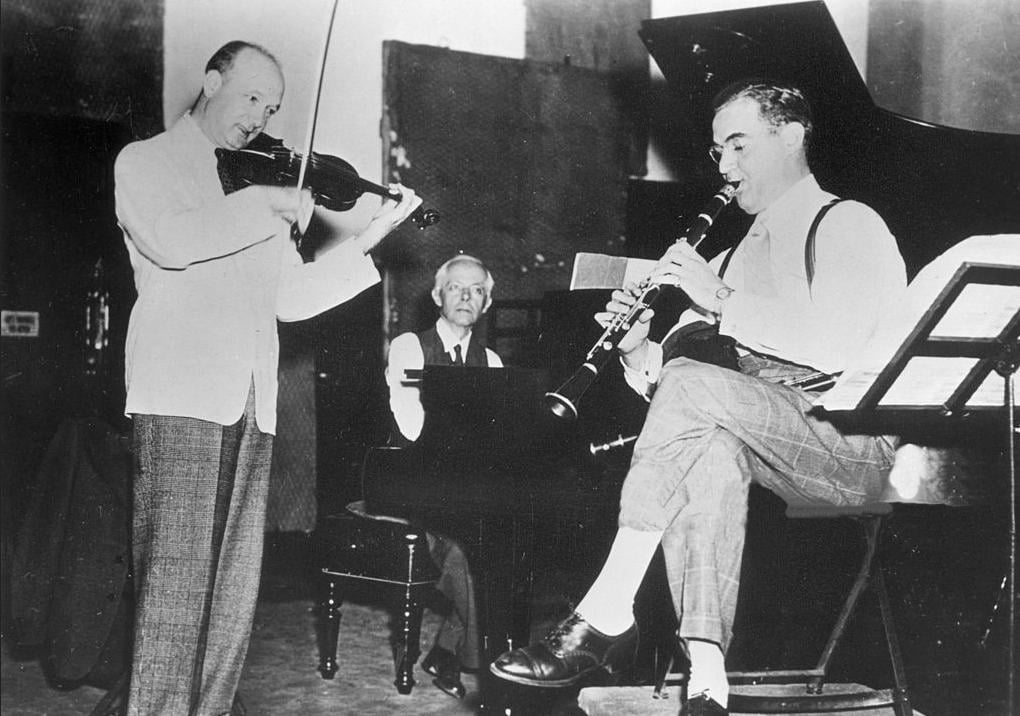
    PHOTO: Bartók at the piano, bookended by Szigeti and Goodman

  • Aaron Copland Birthday Celebration

    Aaron Copland Birthday Celebration

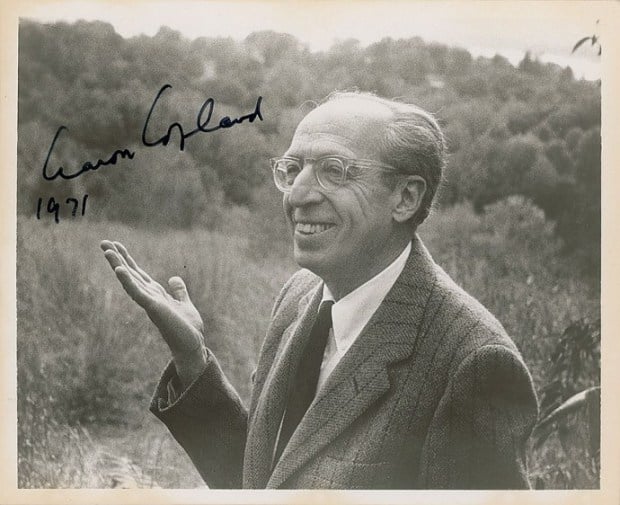
    The world was a better place with Aaron Copland in it. How fortunate that one of our greatest composers lived through an era when so much could be documented on film. With Thanksgiving right around the corner, here’s a Copland cornucopia, for his birthday.

    Copland conducts “El Salón México,” for his 60th

    Bernstein introduces Copland’s Clarinet Concerto

    Copland conducts it in L.A., with Benny Goodman the soloist
    https://www.youtube.com/watch?v=iYwPJrRnGSE

    Copland plays his Piano Concerto, with Bernstein conducting

    Copland conducts “Appalachian Spring” in D.C. on his 80th

    Copland’s 80th birthday concert (complete), hosted by Hal Holbrook; conducted by Rostropovich, Bernstein, and Copland himself. Just listening to the composer’s opening remarks… we don’t have people like this anymore.

    Copland interviewed and playing the coda of “Appalachian Spring” at the piano in his studio

    “Appalachian Spring,” complete 1958 television broadcast with Martha Graham

    “Aaron Copland: A Self Portrait”

    Seiji Ozawa conducts Copland’s arrangement of “Happy Birthday” for Bernstein’s 70th

    Happy birthday, Aaron Copland!

  • Avengers Theme & Classical Music Today

    Avengers Theme & Classical Music Today

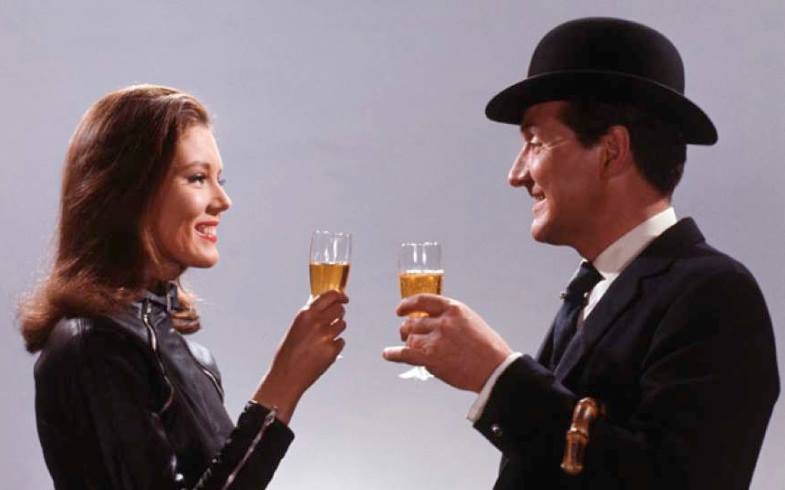
    Are you a fan of “The Avengers?” No, not Iron Man, Captain America, and Hulk, but Patrick Macnee and Diana Rigg.

    If so, perhaps you’d be interested to join me this afternoon on The Classical Network to hear a symphony by the series’ composer, Laurie Johnson. His “Symphony (Synthesis)” achieves what few works of the so-called Third Stream ever do: successfully unite elements of jazz with classical symphonic form. And yes, as an encore, we’ll enjoy Johnson’s snazzy “Avengers” theme.

    We’ll also celebrate the birthdays today of composer Riccardo Zandonai, clarinetist Benny Goodman, harpsichordist Gustav Leonhardt, and pianist Zoltan Kocsis. Since Glenn Smith will be hosting today’s concert broadcast at 4 p.m. EDT – an organ recital from last year’s The Princeton Festival with Kristiaan Seynhave, which will air in place of our usual Noontime Concert – we’ll have a clean slate from noon to 4.

    Jolly good, then. Grab your umbrella and bowler, and join me on WWFM – The Classical Network and wwfm.org.

Tag Cloud

Aaron Copland (92) Beethoven (94) Composer (114) Film Music (116) Film Score (143) Film Scores (255) Halloween (94) John Williams (185) KWAX (228) Leonard Bernstein (99) Marlboro Music Festival (125) Movie Music (131) Opera (197) Philadelphia Orchestra (86) Picture Perfect (174) Princeton Symphony Orchestra (106) Radio (86) Ralph Vaughan Williams (85) Ross Amico (244) Roy's Tie-Dye Sci-Fi Corner (290) The Classical Network (101) The Lost Chord (268) Vaughan Williams (99) WPRB (396) WWFM (881)

DON’T MISS A BEAT

Receive a weekly digest every Sunday at noon by signing up here


RECENT POSTS