Tag: Biblical Epics

  • Biblical Epics on Film Radio Show KWAX

    Biblical Epics on Film Radio Show KWAX

    This week on “Picture Perfect” it’s the second installment in a mini-festival of very big films, as we present another hour of Biblical epics, though this time with a twist. Rather than go directly to the Gospels, these are all films adapted from bestselling historical novels.

    Lloyd C. Douglas’ “The Robe” was given the Hollywood treatment in 1953. Richard Burton plays Marcellus, the Roman tribune who oversees the crucifixion and wins Christ’s robe in a game of dice. Victor Mature (last week’s Samson) is his well-oiled slave, Demetrius, and Jean Simmons, his childhood sweetheart, now betrothed to Caligula (a scene-stealing Jay Robinson).

    “The Robe” holds the distinction of being the first film released in CinemaScope. Allegedly, it is also the only Biblical epic ever to yield a sequel (“Demetrius and the Gladiators”). The score, by Alfred Newman, has always been popular.

    Thomas B. Costain’s “The Silver Chalice” was brought to the big screen in 1954. The film introduced Paul Newman in the lead, as a lowborn artisan commissioned to fashion a decorative casing for the cup from which Christ drank at the Last Supper (i.e. the Holy Grail).

    The film is interesting in that it features quasi-abstract sets by stage designer Rolfe Gerard and a stunning score by Franz Waxman, which incorporates the “Dresden Amen,” also used in Wagner’s “Parsifal.” However, Newman was mortified by his performance and famously took out an ad in Variety, essentially to apologize.

    “Barabbas” is worlds away from the usual Hollywood epic. Based on the Nobel Prize-winning novel of Pär Lagerkvist, the film is a ruminative slog through the guilt-ridden psyche of the title character, played by Anthony Quinn. Barabbas is the thief who is pardoned to make way for the crucifixion of Christ. He spends the rest of his life searching for meaning in a meaningless world.

    In a quixotic attempt at verisimilitude, director Richard Fleischer shot the crucifixion scene during an actual solar eclipse. Mario Nascimbene (who composed the music for last week’s “Solomon and Sheba”) wrote the score.

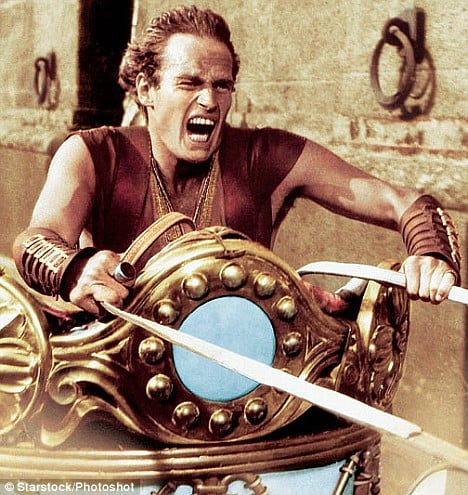
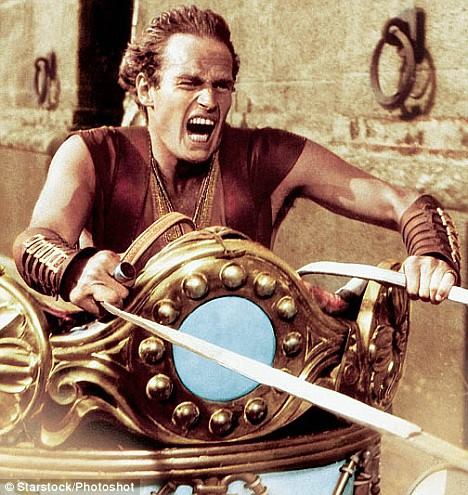
    Finally, we’ll wrap things up with music from one of the all-time Oscar champs, “Ben-Hur,” from 1959. Based on the 1880 novel of General Lew Wallace, “Ben-Hur” was honored with 11 Academy Awards, including those for Best Picture, Best Director (William Wyler) and Best Actor (Charlton Heston).

    The highlight of the film, of course, is the amazing chariot race, but there is a grandeur to the whole which makes it difficult to look away. Miklós Rózsa wrote the magnificent score, arguably the best of any film of its kind. (Parenthetically, today is the composer’s birthday!)

    The “Ben-Hur” Oscar record has been tied twice – in 1998, by “Titanic,” and in 2004, by “The Lord of the Rings: The Return of the King” – but this is before computer generated imagery, folks. They just don’t make ‘em like this anymore.

    The New Testament is all-new, by way of adaptations from historical novels, this week on “Picture Perfect,” music for the movies, now in syndication on KWAX, the radio station of the University of Oregon!


    Clip and save the start times for all three of my recorded shows:

    PICTURE PERFECT, the movie music show – Friday at 8:00 PM EDT/5:00 PM PDT

    SWEETNESS AND LIGHT, the light music program – Saturday at 11:00 AM EDT/8:00 AM PDT

    THE LOST CHORD, unusual and neglected rep – Saturday at 7:00 PM EDT/4:00 PM PDT

    Stream them, wherever you are, at the link!
    https://kwax.uoregon.edu/

  • Movie Music Faith & Film on KWAX

    Movie Music Faith & Film on KWAX

    This week on “Picture Perfect,” in this season of wall-to-wall Biblical epics, enjoy a bit of counterprogramming in the form of music from films about faith, conscience, and grappling with self-abnegation.

    Bruce Bereford’s “Black Robe” (1991), based on a novel by Irish-Canadian writer Brian Moore, tells the tale of a Jesuit priest who treks through 1500 miles of Canadian wilderness on a mission to convert the native tribes of the Huron and the Algonquin. The evocative score is by Georges Delerue.

    “Black Narcissus” (1947), a Powell-Pressburger classic, is one of those startling films that just sort of sneaks up on you. Psychological tension abounds in a tale of repressed nuns struggling to maintain their composure in a voluptuous Himalayan valley. Eventually, the wheels begin to spin off the tracks, to spinetingling effect. The stunning cinematography is by Jack Cardiff. Incredibly, the entire film was shot in England, mostly on soundstages at Pinewood Studios. The music is by Brian Easdale, of “The Red Shoes” fame.

    Audrey Hepburn gives one of her most impressive performances in Fred Zinnemann’s “The Nun’s Story” (1959). A young woman enters a convent of sister-nurses and undergoes many trials in the hopes of becoming a missionary in the Belgian Congo. The film also features Peter Finch, Edith Evans, Peggy Ashcroft, and, in a memorable early role, an unhinged Colleen Dewhurst. The music is by Franz Waxman.

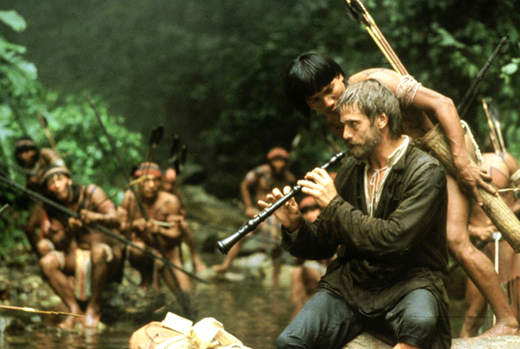
    Finally, Ennio Morricone composed one of his most-beloved scores for “The Mission” (1986). Jeremy Irons plays a Jesuit priest, who ventures into the South American rainforest to convert the Guarani to Christianity. Robert DeNiro is a reformed slave hunter, who seeks redemption. The moving music has received a great deal of exposure over the years through its use in television commercials and by figure skaters, who have made “Gabriel’s Oboe” a recognizable hit.

    Join me in seeking grace in an imperfect world, with music from films about nuns and missionaries this week, on “Picture Perfect,” music for the movies, now in syndication on KWAX, the radio station of the University of Oregon!


    Remember, KWAX is on the West Coast, so there’s a three-hour difference for those of you listening in the East. Here are the respective air-times for all three of my recorded shows (with East Coast conversions in parentheses):

    PICTURE PERFECT, the movie music show – Friday on KWAX at 5:00 PM PACIFIC TIME (8:00 PM EASTERN)

    SWEETNESS AND LIGHT, the light music program – ALL NEW! – Saturday on KWAX at 8:00 AM PACIFIC TIME (11:00 AM EASTERN)

    THE LOST CHORD, unusual and neglected rep – Saturday on KWAX at 4:00 PM PACIFIC TIME (7:00 PM EASTERN)

    Stream all three, at the times indicated, by following the link!

    https://kwax.uoregon.edu/

  • The Shofar in Classical Music and Film

    The Shofar in Classical Music and Film

    The other day, for Rosh Hashanah, I posted a photo of Leonard Bernstein playing the shofar at a rehearsal for his “Mass” at the Kennedy Center in 1971. A lot of Bernstein’s concert music grapples with a crisis of faith in the modern world, so it’s hardly surprising that, in composing, he would often recall and incorporate into his mature works reminiscences of the synagogue and the traditions of his youth and apply them in addressing more universal humanistic concerns.

    The shofar, typically fashioned from a ram’s horn, is especially significant during the Jewish High Holy Days, ten days of awe and repentance, as it is sounded on Rosh Hashanah to welcome the new year and again to conclude Yom Kippur services, marking the end of a day of fasting and prayer.

    More broadly, anyone with a passing familiarity with the Judeo-Christian tradition, even if merely through the viewing of Hollywood biblical epics, likely has had some exposure to the instrument. Generally speaking, whenever you see “trumpet” or “horn” mentioned in an English translation of the Bible, what’s meant is the shofar. The instrument is often associated with the voice of God, the end of the world, or the raising of the dead. Its clarion blast accompanies celebratory or cataclysmic events. Its presence is noted to enhance a sensation of awe in the face of the sublime.

    The opening of Bernstein’s “West Side Story” evokes the call of the shofar – which makes sense when you consider that the show was originally conceived as “East Side Story,” with the clashing factions Jews and Irish Catholics in Lower East Side Manhattan. To bring it more in line with contemporary urban gang warfare of the 1950s, the setting was moved uptown to San Juan Hill (Lincoln Square), and the rival gang membership reimagined as white American and Puerto Rican immigrant.

    Less obvious is the reason Bernstein emulates the shofar in “Candide!”

    Bernstein was far from the only one to recognize the shofar’s expressive potential. The ram’s horn has been embraced by many composers, whether employing the actual instrument or suggesting it, as Bernstein did, in their orchestrations.

    Not surprisingly, some seized upon the shofar when treating biblical subjects. Sir Edward Elgar, a Roman Catholic, employs one in his oratorio “The Apostles” – though the part is usually taken by a flugelhorn.

    Sir William Walton’s cantata “Belshazzar’s Feast” opens with a suggestion of the shofar on the trombones.

    In his Requiem, Hector Berlioz, an atheist, conceived of four spatially separated brass bands to convey the effect of blaring shofars at the end of the world.

    “The Gates of Justice,” David Brubeck’s plea for racial harmony, includes a part for shofar. However, in performance, the part is often taken by a French horn.

    Of course, Elmer Bernstein employed the shofar in his film score for “The Ten Commandments.” John Williams paid homage when he gave Bernstein’s shofar calls to the Ewoks in “Return of the Jedi.”

    Jerry Goldsmith included the instrument in his music for “Planet of the Apes” and “Alien.”

    Another film composer, Franz Waxman, emulates the shofar in his oratorio “Joshua,” during the siege of Jericho.

    Then there’s a whole genre of shofar concerto, explored by a number of contemporary composers, among them Ofer Ben-Amots, Miguel Kertsman, and Meira Warshauer.

    Composers Herman Berlinski, Alvin Curran, and Matthew H. Fields have used the shofar, or suggested the shofar, in their works for their own expressive ends.

    Yes, yes, shofar so good. The instrument’s range may be comparatively limited, but it more than makes up for the fact through its powerful associations.

  • Biblical Epics Adapted from Novels on Picture Perfect

    Biblical Epics Adapted from Novels on Picture Perfect

    This week on “Picture Perfect” it’s the second installment in a mini-festival of very big films, as we present another hour of Biblical epics, though this time with a twist. Rather than go directly to the Gospels, these are all films adapted from bestselling historical novels.

    Lloyd C. Douglas’ “The Robe” was given the Hollywood treatment in 1953. Richard Burton plays Marcellus, the Roman tribune who oversees the crucifixion and wins Christ’s robe in a game of dice. Victor Mature (last week’s Samson) is his well-oiled slave, Demetrius, and Jean Simmons, his childhood sweetheart, now betrothed to Caligula (a scene-stealing Jay Robinson).

    “The Robe” holds the distinction of being the first film released in CinemaScope. Allegedly, it is also the only Biblical epic ever to yield a sequel (“Demetrius and the Gladiators”). The score, by Alfred Newman, has always been popular.

    Thomas B. Costain’s “The Silver Chalice” was brought to the big screen in 1954. The film introduced Paul Newman in the lead, as a lowborn artisan commissioned to fashion a decorative casing for the cup from which Christ drank at the Last Supper (i.e. the Holy Grail).

    The film is interesting in that it features quasi-abstract sets by stage designer Rolfe Gerard and a stunning score by Franz Waxman, which incorporates the “Dresden Amen,” also used in Wagner’s “Parsifal.” However, Newman was mortified by his performance and famously took out an ad in Variety, essentially to apologize.

    “Barabbas” is worlds away from the usual Hollywood epic. Based on the Nobel Prize-winning novel of Pär Lagerkvist, the film is a ruminative slog through the guilt-ridden psyche of the title character, played by Anthony Quinn. Barabbas is the thief who is pardoned to make way for the crucifixion of Christ. He spends the rest of his life searching for meaning in a meaningless world.

    In a quixotic attempt at verisimilitude, director Richard Fleischer shot the crucifixion scene during an actual solar eclipse. Mario Nascimbene (who composed the music for last week’s “Solomon and Sheba”) wrote the score.

    Finally, we’ll wrap things up with music from one of the all-time Oscar champs, “Ben-Hur,” from 1959. Based on the 1880 novel of General Lew Wallace, “Ben-Hur” was honored with 11 Academy Awards, including those for Best Picture, Best Director (William Wyler) and Best Actor (Charlton Heston).

    The highlight of the film, of course, is the jaw-dropping chariot race, but there is a grandeur to the whole that makes it difficult to look away. Miklós Rózsa wrote the magnificent score, arguably the best of any film of its kind.

    The “Ben-Hur” Oscar record has been tied twice – in 1998, by “Titanic,” and in 2004, by “The Lord of the Rings: The Return of the King” – but this is before computer generated imagery, folks. They just don’t make ‘em like this anymore.

    The New Testament is all-new, by way of adaptations of historical novels, on “Picture Perfect,” music for the movies, this Saturday evening at 6:00 EDT, on WWFM – The Classical Network and wwfm.org.

  • Easter Staycation Fred Astaire & Holiday Films

    Easter Staycation Fred Astaire & Holiday Films

    Staying home for Easter this year. Yay!

    That’s right. It’s Fred Astaire and Biblical epics for me.

    Happy Easter!

Tag Cloud

Aaron Copland (92) Beethoven (95) Composer (114) Film Music (120) Film Score (143) Film Scores (255) Halloween (94) John Williams (185) KWAX (229) Leonard Bernstein (100) Marlboro Music Festival (125) Movie Music (135) Opera (198) Philadelphia Orchestra (88) Picture Perfect (174) Princeton Symphony Orchestra (106) Radio (87) Ralph Vaughan Williams (85) Ross Amico (244) Roy's Tie-Dye Sci-Fi Corner (290) The Classical Network (101) The Lost Chord (268) Vaughan Williams (103) WPRB (396) WWFM (881)

DON’T MISS A BEAT

Receive a weekly digest every Sunday at noon by signing up here


RECENT POSTS