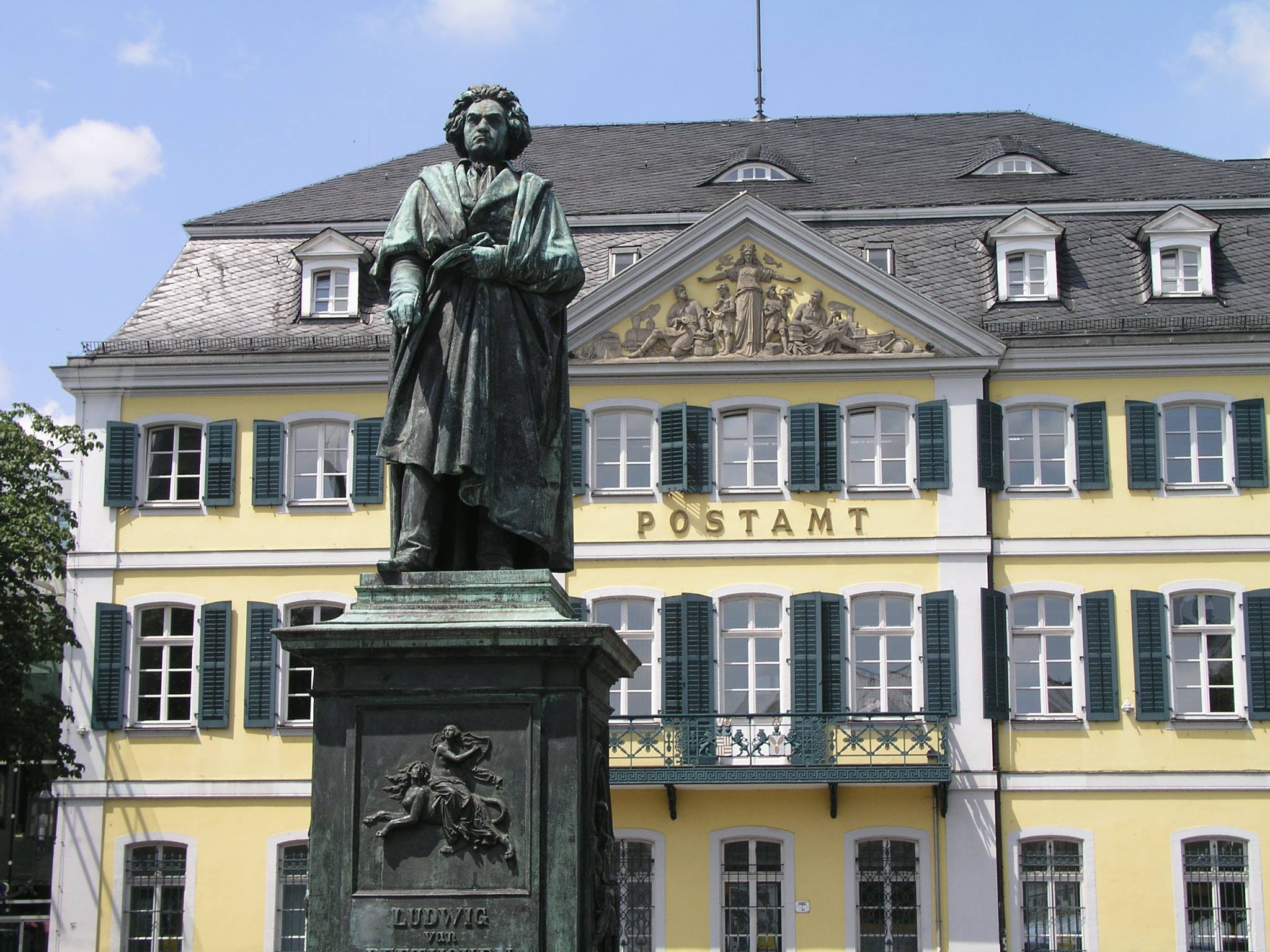
Remember when 2020 was supposed to be the big Beethoven year? Beethoven Beethoven Beethoven everywhere, the world wallowing in his music for the 250th anniversary of his birth – gorging itself to such a degree that no one could possibly stand to hear another note, until “Beethoven 300.”
So how did all that work out?
Before I cause any more tears, let’s look back to 1845 and “Beethoven 75.” The Master had been in the grave only 18 years, when a monument was unveiled in his hometown of Bonn, Germany, 175 years ago today. But it must have seemed like an eternity to the organizers.
Although the idea had been circulated since 1828, the year after Beethoven’s death, getting anyone to actually do anything about it was like herding cats. A “Bonn Association for the Beethoven Monument” was formed, but without money, the entire enterprise was largely a symbolic gesture. Luigi Cherubini promised to conduct a benefit concert in Paris, but then backed out of it. Ignaz Moscheles succeeded in organizing one in London, but, despite the inclusion on the program of Beethoven’s “Ode to Joy,” it was poorly attended.
In fact, there would have been no statue at all, if not for the efforts of Franz Liszt. When the total amount raised in France came to no more than 425 francs, Liszt donated 10,000 francs from his own pocket. Though only in his 30s at the time, Liszt had already retired from the concert stage, having amassed a considerable fortune and now ready to devote himself to other matters – conducting, teaching, and especially composing. But whenever there was a crisis or a disaster, Liszt could be counted on to emerge from seclusion to play in the largest hall he could find, and people would turn out to basically throw money. One of those concerts marked the last public appearance of Frederic Chopin, who shared the stage with Liszt in a recital of music for piano duo.
In all, Liszt went to heroic lengths – more than any other figure – to see to it that Beethoven would be immortalized in bronze. His sole condition: that the sculptor be Lorenzo Bartolini. In 1840, Bartolini had created a marble bust of Liszt, of which Liszt must have particularly fond. But the committee overruled the proposal, preferring that the commission go to a German. It was Ernst Julius Hähnel who would ultimately receive the endorsement.
As usual, Liszt took the disappointment well. A month before the unveiling, when it finally occurred to someone that there was no suitable venue to house the projected 30,000 attendees, guess who put up the money to build one? That’s right, Liszt financed what would become Beethoven Hall. The structure was erected, with contractors laboring around the clock, in just two weeks.
Of course, Liszt was equally committed to the festivities themselves. He composed a new work, the “Festival Cantata for the Inauguration of the Beethoven Monument in Bonn,” which was heard twice. He also performed Beethoven’s “Emperor” Concerto and conducted the Fifth Symphony.
He was in attendance at Bonn Cathedral when, on the eve of the monument’s unveiling, Louis Spohr conducted Beethoven’s “Missa Solemnis” and the Ninth Symphony, and the next morning, when the “Mass in C” was performed.
At the ceremony was Hector Berlioz, Giacomo Meyerbeer, Ignaz Moscheles, Jenny Lind, Pauline Viardot, and other prominent musicians; also Queen Victoria and Prince Albert, King Frederick William IV of Prussia, and Archduke Friedrich of Austria.
That afternoon, Liszt performed Beethoven, and Spohr conducted the “Coriolan Overture” and selections from “Christ on the Mount of Olives” and “Fidelio.” The day was capped with a glorious fireworks display.
On Day 3, Liszt’s “Festival Cantata” was performed. Also, Beethoven’s “Egmont Overture,” a piano concerto by Carl Maria von Weber, arias by Beethoven and Mendelssohn, and Beethoven’s song “Adeleide.”
Rounding out the festivities was a lavish banquet. Unfortunately, Lola Montez started dancing on a table and flirting with Liszt, which had the effect of generating an enormous scandal. The blame all came to roost on the festival’s greatest benefactor. 25 years later, for the Beethoven centennial celebrations in 1870, Liszt was not invited back.
What have you done for us lately?