Tag: Boston Symphony Orchestra

  • Doriot Anthony Dwyer, Pioneering Flutist, Dies at 98

    Doriot Anthony Dwyer, Pioneering Flutist, Dies at 98

    Flutist Doriot Anthony Dwyer has died. Dwyer served as principal flute of the Boston Symphony Orchestra from 1952 to 1990. She was one of the first women to win a principal chair in a major U.S. orchestra.*

    Understandably, this was a very big deal. Back in the day, Boston didn’t even have a separate dressing room for women. Early notices were all about her gender and good looks, but soon it was her playing that was receiving raves. She won over players, audiences, and critics alike.

    To mark her retirement, the orchestra commissioned for her a flute concerto from Ellen Taaffe Zwilich. Zwilich was the first female recipient of the Pulitzer Prize for Music (in 1983!).

    Prior to her tenure in Boston, she was second flute with the National Symphony Orchestra and Los Angeles Philharmonic, and served as principal flute at the Hollywood Bowl. Early in her career, she also played with Frank Sinatra and the Ballets Russes.

    Dwyer died on Saturday at the age of 98.


    • Dwyer was preceded by, at the very least, Florence Wightman (principal harp, Cleveland Orchestra, 1929-30), Alice Chalifoux (principal harp, Cleveland Orchestra, 1931-74), Edna Philips (principal harp, Philadelphia Orchestra, 1930-41 and 1942-46), and Helen Kotas (principal horn, Chicago Symphony, 1941-48).

    An interview with Doriot Anthony Dwyer, in three parts:


    Dwyer with Leonard Bernstein conducting “Prelude to the Afternoon of a Faun”

    Debussy Sonata for Flute, Viola and Harp:

    https://www.youtube.com/watch?v=9frKtO0nRn8

    Prokofiev Flute Sonata:

    Ellen Taffe Zwilich Flute Concerto:

    Charles Munch bringing Dwyer forth for a solo bow (at the very end of the video)

    https://www.youtube.com/watch?v=hrMnUUWTBd4


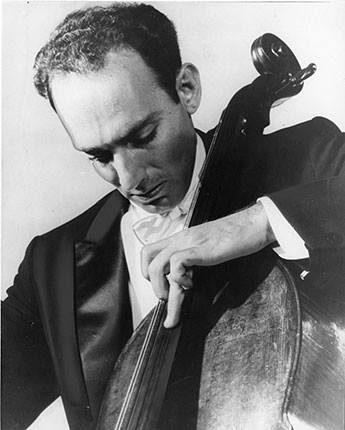
    PHOTO: Doriot Anthony Dwyer, with harpist Olivia Luetcke and cellist Winifred Winograd (courtesy of the Boston Symphony Orchestra)
  • LBJ Saved Leinsdorf A Musical Rescue

    LBJ Saved Leinsdorf A Musical Rescue

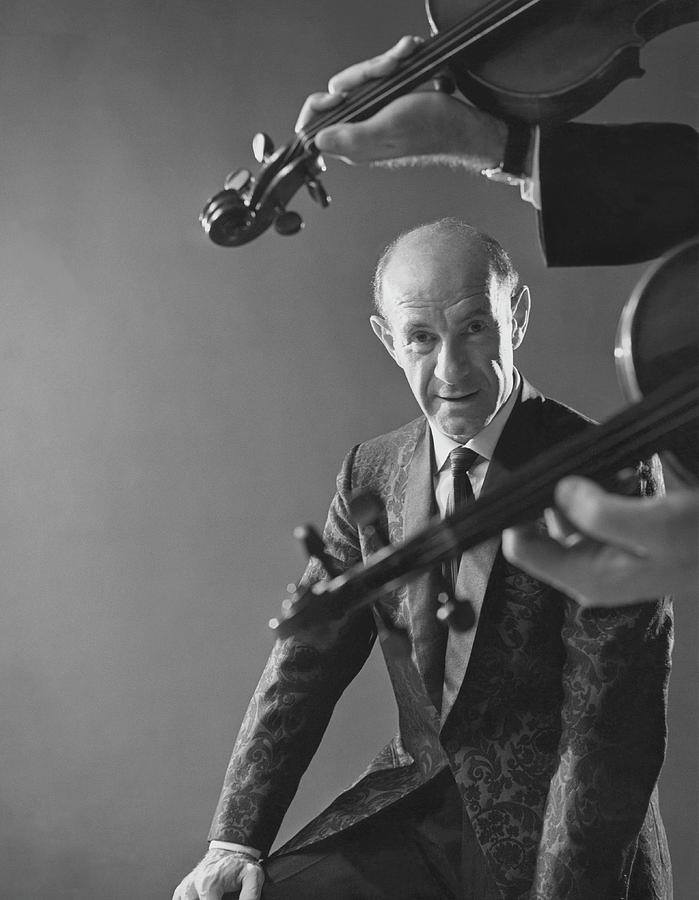
    It was recently brought to my attention that we have Lyndon Johnson to thank for Erich Leinsdorf.

    In 1938, Leinsdorf was 26 years-old and conducting at the Metropolitan Opera, when his visa expired. This was very bad timing indeed. Of course, Leinsdorf had been working hard to build a career in New York. But to really put things in perspective, the Anschluss had just taken place in March. For Leinsdorf, an Austrian Jew, to travel back to Vienna would have been the beginning of the end.

    He immediately applied for a six month extension, but grew increasingly uneasy as he received no response. Fortunately, a couple of American friends with good connections were able to hook him up with Johnson, who was then but a young congressman of 30 himself. It was Johnson’s idea to have Leinsdorf leave the country but to reenter through Cuba as an immigrant. He did everything to smooth his path. Leinsdorf followed Johnson’s instructions and before long he was back in the U.S. to declare his intention to become a citizen.

    The two men remained friendly for decades. Leinsdorf even supported Johnson’s run for the Senate. Later, however, when he disagreed with some of Johnson’s policies, he didn’t hesitate to let him know. The following was Johnson’s response to Leinsdorf’s criticisms: “Your letter makes me proud that I could have a hand in making a new citizen, who would so well use his citizenship.” Would that this story could play out that way today!

    Leinsdorf may have had the good fortune to escape Hitler, but in 1962 he had the bad luck to land one of the most prominent conducting posts in the United States – music director of the Boston Symphony Orchestra – in the wake of the great Charles Munch. Not only was Leinsdorf unprepared to handle the politics of the organization – in a ceaseless battle against musicians and administration, his outspokenness didn’t earn him many friends – he also came in for a sound drubbing from the critical establishment, which found many of his performances to be just meh.

    As someone who saw Leinsdorf conduct often in Philadelphia during his twilight years, I couldn’t disagree more. As a guest conductor, Leinsdorf brought plenty of interesting music and assembled it into satisfying programs. What’s more, unburdened by the pressures of being boss, he turned in some pretty good performances and actually seemed to enjoy himself.

    This afternoon, I’ll celebrate Leinsdorf on the anniversary of his birth with some of his better recordings, which I’ll shuffle into the mix between 4 and 7 p.m. EST, on WWFM – The Classical Network and wwfm.org.


    On November 22, 1963, Leinsdorf found himself in the unenviable position of breaking the news of President Kennedy’s assassination from the stage of Boston’s Symphony Hall and over WGBH radio. He then conducted the funeral march from Beethoven’s “Eroica” Symphony in JFK’s honor. It’s especially moving to hear the audience’s reaction in those days before cell phones. Remember also that the musicians were in the process of digesting the news themselves, as the replacement scores had only just been distributed.

  • Harold Farberman Legendary Conductor Dies

    Harold Farberman Legendary Conductor Dies

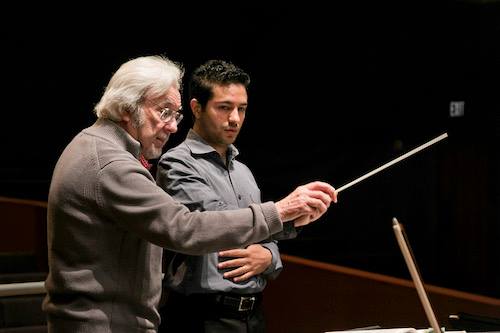
    The conductor Harold Farberman has died. From what I gather, he didn’t suffer fools lightly, but he was revered for his thorough understanding of his craft.

    When Farberman joined the Boston Symphony Orchestra as a percussionist in his early 20s, in 1951, he was the youngest player ever to become a full-time member of the organization. Later, he served as music director of the Colorado Springs Orchestra (1967-1970) and the Oakland Symphony Orchestra (1971-1979). He taught conducting at the University of Hartford’s Hartt School and at Bard Collage. He was a great champion of the music of Charles Ives and recorded the complete symphonies of Gustav Mahler and Michael Haydn.

    Obituaries will be trickling in from official news outlets, I’m sure, but for now you can search his name on Facebook and find dozens of tributes from those who studied under him and benefited from his austere tutelage.

    Among his fine recordings, none are quirkier than those of his own arrangements of the classics for percussion ensemble. The All-Star Percussion Ensemble was assembled from 10 percussionists drawn from major American orchestras, many of whom were Farberman students.

    Farberman was 89 years-old.

  • Rediscovering Loeffler’s Pagan Poem on WWFM

    Rediscovering Loeffler’s Pagan Poem on WWFM

    This afternoon on The Classical Network, you’ll have a chance to affirm your lofty love for Loeffler.

    What’s that? At best, you dimly recollect his music?

    Charles Martin Loeffler was born on this date in 1861; he died in 1935. Though he long claimed to be of Alsation birth, in actuality he was born outside Berlin. The composer turned against Germany after his father died in prison, where he had been sent for his subversive writings, when Loeffler was only 12 years-old.

    Loeffler was a fastidious artist, who cut his teeth in Berlin and Paris, and indeed he is frequently identified as French-American. He settled in Boston in 1881, where he shared the first desk with the concertmaster of the Boston Symphony Orchestra and became an important figure in the city’s musical life. A man of wide culture and refined taste, he founded the Boston Opera Company. In 1887, he left the Symphony to devote himself wholly to composition.

    I hope you’ll join me for Loeffler’s symphonic poem of 1906, titled “A Pagan Poem.” The work is inspired by the eighth Eclogue of Virgil, in which a maiden of Thessaly, abandoned by her lover, revives his ardor through the use of sorcery.

    The work was first performed by the Boston Symphony, under Karl Muck. It was later championed by Leopold Stokowski, who recorded it for EMI. The piano plays such a prominent role, the piece sounds at times as if it may be a piano concerto. We’ll hear pianist Robert Hunter, and also English hornist William Kosinski.

    You can enjoy it today, between 4 & 7:00 EST, on WWFM – The Classical Network or at wwfm.org.


    PHOTO: Loeffler (left) and Stokowski – who’s the true pagan here?

  • Jules Eskin Boston Symphony Cellist Dies at 85

    Jules Eskin Boston Symphony Cellist Dies at 85

    The beloved cellist Jules Eskin has died. Eskin was principal cellist of the Boston Symphony Orchestra for 53 years. Eskin was living history. His association with the orchestra extended back to the days of Serge Koussevitzky.

    Born in Philadelphia in 1931, Eskin was picked up by the Dallas Symphony at the age of 16, where he performed under the direction of Antal Dorati. He studied with Janos Starker in Dallas, then with Gregor Piatigorsky and Leonard Rose at the Curtis Institute of Music. In 1948, he was a fellowship student at the Tanglewood Music Center, where he performed in the TMC Orchestra under Koussevitzky. He then spent three years as principal cello of the Cleveland Orchestra under George Szell and seven years with the New York City Opera. In addition, he participated in the Marlboro Music Festival and played in the Casals Festival Orchestra in Puerto Rico. He joined the BSO as principal cello in 1964, when Erich Leinsdorf was music director.

    Eskin died yesterday at his Brookline home. The cause of death was cancer. Earlier, he had withdrawn from the Boston Symphony for a season to undergo cancer treatments in 1981. He is survived by his wife, BSO violinist Aza Raykhtsaum. The couple celebrated their 30th wedding anniversary in January. Eskin announced his retirement from the orchestra only last month. He was 85 years-old.

    We’ll honor him with some of the recordings he made with the Boston Symphony Chamber Players, of which he was a founding member, this afternoon from 4 to 7:00 EST on WWFM – The Classical Network and at wwfm.org.

Tag Cloud

Aaron Copland (92) Beethoven (95) Composer (114) Film Music (120) Film Score (143) Film Scores (255) Halloween (94) John Williams (185) KWAX (229) Leonard Bernstein (100) Marlboro Music Festival (125) Movie Music (135) Opera (198) Philadelphia Orchestra (88) Picture Perfect (174) Princeton Symphony Orchestra (106) Radio (87) Ralph Vaughan Williams (85) Ross Amico (244) Roy's Tie-Dye Sci-Fi Corner (290) The Classical Network (101) The Lost Chord (268) Vaughan Williams (103) WPRB (396) WWFM (881)

DON’T MISS A BEAT

Receive a weekly digest every Sunday at noon by signing up here


RECENT POSTS