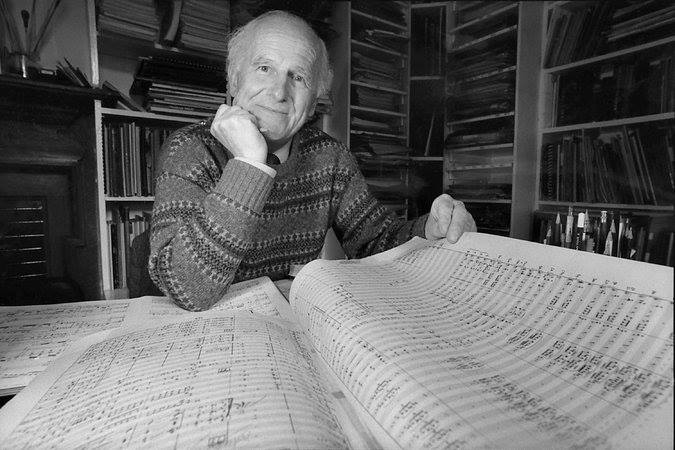
Sir David Willcocks did so much, so well, and for so long, it’s hard to believe he’s gone. Particularly renowned for his work with the Choir of King’s College, Cambridge, which he led from 1957 to 1974, he and the choir received world-wide exposure through their albums and the annual Christmas Eve broadcast of “Nine Lessons and Carols.”
Willcocks set down notable recordings of Thomas Tallis’ “Spem in Alium,” Gregorio Allegri’s “Miserere,” choral masterworks of Johann Sebastian Bach, and what many regard as the definitive interpretation of the Fauré Requiem.
His work on “Carols for Choirs,” a series of anthologies he co-edited with Reginald Jacques and John Rutter, yielded the most widely used source of carols in the British Anglican tradition, very popular among choral societies. Many of the pieces had been written, or arranged, for the annual Service of “Nine Lessons and Carols.”
In addition to his considerable accomplishments in the classical realm, Willcocks directed his London Bach Choir in the Rolling Stones song, “You Can’t Always Get What You Want.”
This Sunday night on “The Lost Chord,” we remember arguably the most esteemed British choral director of his generation, who died on September 17 at the age of 95, with performances of music composed by a couple of his countrymen.
It may seem like an awfully long stretch, to reach from Mick Jagger to the New Testament, but in the writing of “Sancta Civitas” (“The Holy City”), Ralph Vaughan Williams turned to the Book of Revelation (so perhaps it’s not so far off, after all). The oratorio, which spans just a little over 30 minutes, received its first performance in 1926. Late in life, Vaughan Williams claimed it was his favorite among his choral works. We’ll hear a classic recording with tenor Ian Partridge and baritone John Shirley-Quirk.
In the 1970s, Willcocks became director of the Royal College of Music. We’ll sample some of his work with the chamber choir there, with performances of two pieces by Gustav Holst: “Hymn to Dionysus,” composed in 1913, with its presentiments of “Jupiter, the Bringer of Jollity” from “The Planets,” and a selection from “Choral Hymns from the ‘Rig Veda,’” written between 1908 and 1912, one of numerous works to grow out of the composer’s fascination with Sanskrit literature.
I hope you’ll join me for “King David,” as we honor the legendary Sir David Willcocks, this Sunday night at 10 ET, with a repeat Wednesday evening at 6; or that you’ll listen to it later as a webcast, at wwfm.org.