Longtime followers of this page know that I tend to go a little berserk around the time of Sibelius’ birthday. In fact, for the past few years, I’ve honored “Eight Days of Sibelius,” from the start of the month to December 8 – conveniently, the actual anniversary.
Well, this year, somehow, it slipped by the wayside. I always have Sibelius’ birthday firmly in mind, but I forgot all about the “Eight Days.” Which is why you may have gotten slammed yesterday by multiple Sibelius posts, which I hope at least you found interesting or informative. There’s just so much Sibelius material to share, and I’m always setting it aside, making a mental note to save it for December. Trouble is, the memory isn’t so well-oiled as it used to be!
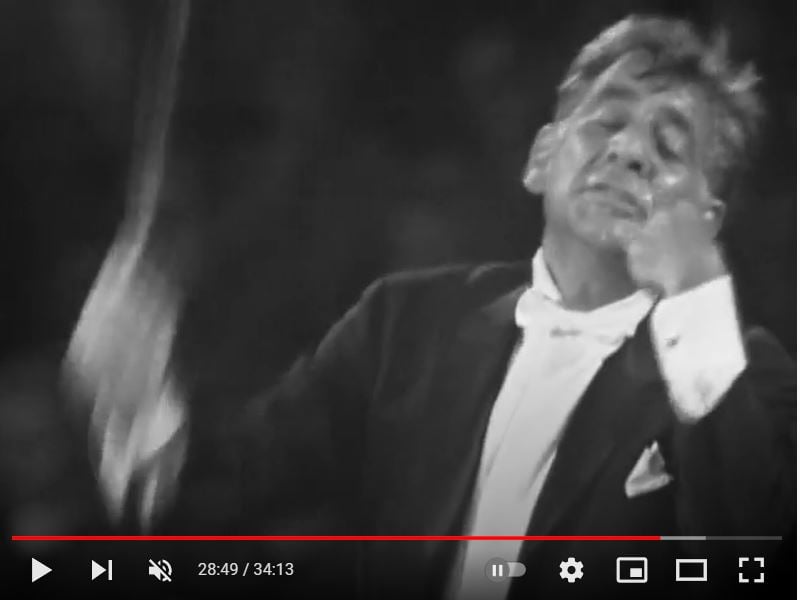
With that in mind, I hope you won’t turn up your nose at a little leftover birthday cake. I mentioned in one of my posts yesterday that Sibelius’ Fifth Symphony is a personal favorite. I haven’t always found Leonard Bernstein to be the ideal interpreter of Sibelius’ symphonies, but I still can’t pass up a live performance. I saw Bernstein conduct it at Carnegie Hall once, back in the 1980s, and it was a fabulous occasion, to be able to hear Lenny work his magic like some grizzled Kalevala wizard.
Here he is, with the London Symphony Orchestra, in 1966:
A sublime, ennobling start to any day – even if the interpretation may not always be my particular glass of vodka.
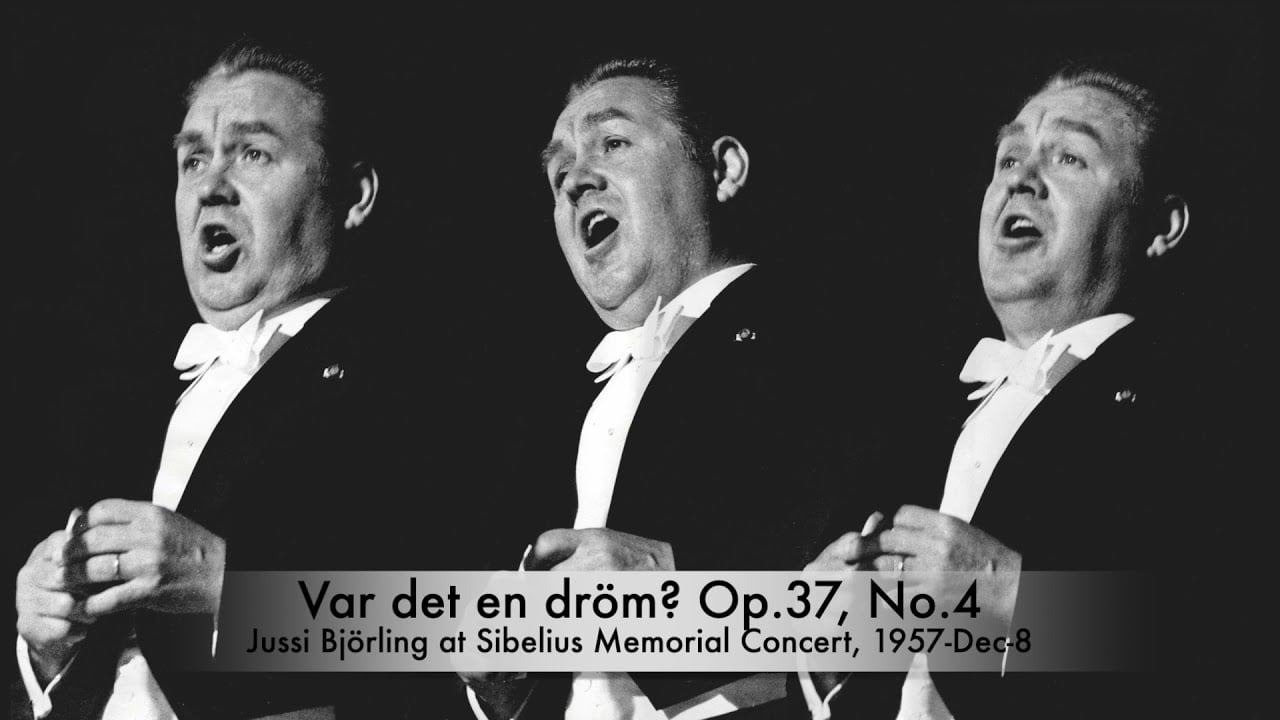
On Sibelius’ birthday, Jussi Björling sings five of the composer’s songs, as part of a memorial concert at Carnegie Hall on December 8, 1957. The composer died only weeks earlier at the age of 91.
Also on the program was Sibelius’ bleakest symphony, the Symphony No. 4, “En Saga,” and “Finlandia.” Sadly, the guest conductor of the New York Philharmonic, Martti Similä – a close friend of Sibelius, who held posts as chief conductor with the both the Helsinki and Lahti Symphony Orchestras – died not long after, on January 9. This concert was his American debut – and presumably swan song.
Sibelius had been very fond of Björling’s renditions. After a concert in Helsinki in 1951, he invited the tenor to his home, where he presented him with an inscribed photo. Sibelius wrote, “To the genius, the great singer Jussi Björling.”
And since the comments section is bound to be filled with gasps of “LEOPOLD,” we may as well get this out of the way right now. (Then read on!)
The snapping of the baton is a little bit of an in-joke, since Stokowski made it a point to lead not with a stick, but rather using his expressive, mesmerizing hands.
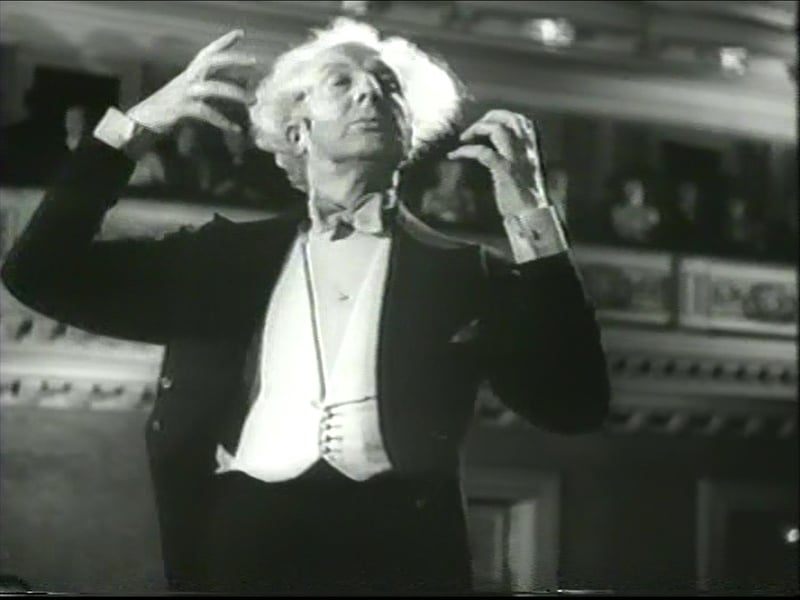
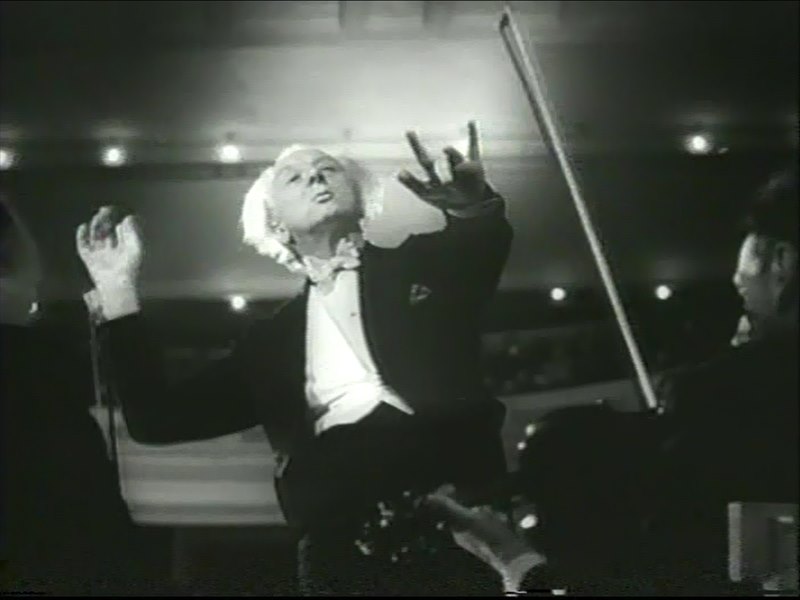
Here he is in “Carnegie Hall” (1947), real junk food for the classical music lover. Forget about the plot, which is total hokum – a brash young American pianist turns the classical music world on its ear with the debut of his corny “jazz” concerto (with Harry James, no less, playing trumpet obbligato) – the main draw is a parade of real-life classical music superstars.
The director Edgar G. Ulmer, emerged from German Expressionist cinema (he claimed to have worked on “Metropolis” and “M”), to direct atmospheric Hollywood films like “The Black Cat” and “Detour.”
The experience obviously prepared him for this showcase of Stokowski, who in the film’s best sequence conducts a movement from Tchaikovsky’s Symphony No. 5. The camera angles are striking, the lighting dramatic, and Stoky’s hair just keeps getting bigger… and bigger… and bigger.
Stokowski also shared screen time with Deanna Durbin in “One Hundred Men and a Girl” (1937). In case you’re curious, Charles Previn, credited as associate musical director, was the second-cousin of Andre Previn. Stokowski conducts the finale of the same Tchaikovsky symphony. Also, Deanna Durbin sings from “La Traviata.”
Naturally, there’s the obligatory shot of a bored husband (character actor Eugene Pallette) dozing in the audience, and a boy-next-store shouting from a balcony, just to keep it all comfortably “regular guy.”
But it goes without saying that the most enduring artifact of Hollywood’s romance with Stoky was the conductor’s work on Walt Disney’s “Fantasia” (1940), including this iconic handshake with Mickey Mouse:
Stokowski recorded the soundtrack in experimental stereo, captured by 33 microphones and three million feet of sound film, at Philadelphia’s Academy of Music in 1939. Stokowski served as the Philadelphia Orchestra’s music director from 1912 to 1938. Here he directs Bach’s “Toccata and Fugue in D minor,” from a Spanish print of the film:
Finally, Stokowski talks about his experiences in Hollywood, most specifically his work on “Fantasia,” in an interview given in the 1960s:
Notoriously, the accent is totally phony baloney. Stokowski’s grandfather was Polish, but he himself was a second-generation Londoner. But Stoky always did have a whiff of P.T. Barnum about him. He may have been a visionary, but, first and foremost, he knew how to captivate an audience.
I hope you’ll join me tonight for “The Lost Chord,” as I’ll be highlighting some of Stokowski’s early Wagner recordings with the Philadelphia Orchestra. The program, “Magic Fire,” will air at 10:00 EDT on WWFM – The Classical Network and wwfm.org.
When Alfred Brendel was at his peak as a performer, the classical music industry was still going strong. In a happy coincidence, the compact disc appeared just as he had reached maturity, and allowed him to go back and document much of his core repertoire in clean, modern recordings.
By extension, he was a regular presence on classical radio, and millions became familiar with him through his interpretations of Haydn, Mozart, Beethoven, Schubert, Schumann, Liszt, Brahms, and perhaps most interestingly, Schoenberg.
Not always credited with being the most adventurous artist, he was invariably a thoughtful one. He made the first recording of Liszt’s “Weihnachtsbaum” (“Christmas Tree”), back in 1952, and unexpectedly, his first appearance on disc was as soloist in Prokofiev’s Piano Concerto No. 5. He was the first artist to record the complete piano works of Beethoven. He went on to document the complete sonatas no less than three times.
Late in his career, he struggled against arthritis. When he retired in 2008, at the age of 78, he was at the top of his game, one of the few classical artists still guaranteed to pack halls. He appeared at Carnegie Hall no less than 81 times. Twice, he performed the complete Beethoven sonatas there.
Bespectacled, crowned with a disheveled widow’s peak, and improbably tall and lank, Brendel often looks all the world like an absent-minded professor. His interpretations have sometimes been criticized for being “cold” or “cerebral.” But the man, better-read than most, also possesses a keen sense of humor. He is a fan of Edward Gorey and Charles Addams and Gary Larson. He collects kitsch and newspaper bloopers. He has gone on record as stating that his favorite occupation is laughing.
Alongside his many thoughtful essays on musical subjects (including at least one on humor in music), he published two volumes of epigrammatic poetry, “One Finger Too Many” and “Cursing Bagels.”
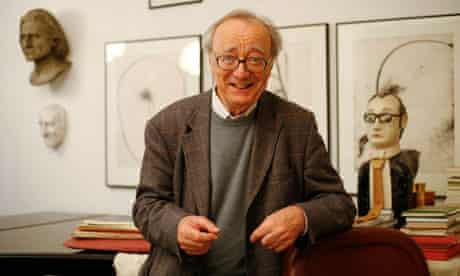
Happy birthday, Alfred Brendel, 90 years-old today.
PHOTO: Brendel, flanked by Liszt (left) and Eugene Jardin’s whimsical “Gipsbrendel”
Has anyone seen the film “Carnegie Hall?” Sure, it sports a corny plot about a young American pianist who turns the classical music world on its ear by becoming a jazz artist. Of course, the debut of his “avant garde” concerto (with Harry James as soloist) seems positively quaint from today’s perspective, as I’m sure it would have been even in 1947.
The main draw is the parade of real-life classical music superstars, including Jascha Heifetz, Gregor Piatigorsky, Arthur Rubinstein, Lily Pons, Rise Stevens, Jan Peerce, Ezio Pinza, Bruno Walter and Fritz Reiner, among others, all of whom get to perform.
The film was directed by Edgar G. Ulmer, who emerged from the German Expressionist movement (he claimed to have worked on “Metropolis” and “M”) to direct atmospheric Hollywood films like “The Black Cat” and “Detour.”
That experience obviously prepared him for this showcase of Leopold Stokowski, who in the film’s best sequence conducts a movement from Tchaikovsky’s Symphony No. 5. The camera angles are striking, the lighting dramatic, and Stoky’s hair just keeps getting bigger and bigger.
While we’re at it, here’s Stoky conducting his own transcription of music by Johann Sebastian Bach at the age of 90.
And since the comments section is bound to be filled with shouts of “LEOPOLD…”