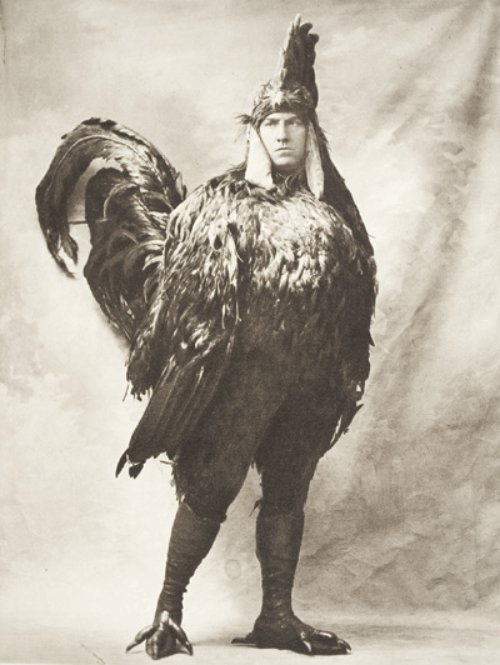
“I do not propose to write an ode to dejection, but to brag as lustily as Chanticleer in the morning, standing on his roost, if only to wake my neighbors up.” So wrote Henry David Thoreau in his preface to “Walden” (now on my bedstand, just in time for the season of consumerism run amuck).
The quote serves as a superscription for Daniel Gregory Mason’s “Chanticleer Festival Overture.” Mason was born in Brookline, MA, on this date 150 years ago. His father was Henry Mason, cofounder of the Mason & Hamlin piano company, and his grandfather was Lowell Mason, composer of some 1600 hymn tunes, including “Nearer, My God, to Thee.”
Daniel studied theory and composition at Harvard under John Knowles Paine, continuing his lessons with George Whitefield Chadwick and others. He became a writer on music and a lecturer at Columbia University. After 1907, his compositional output increased. He acquired further polish in Paris, studying with Vincent d’Indy, in 1913.
Of course, 1913 was the year that Stravinsky’s “The Rite of Spring” shook the musical world, but Mason remained resistant to its charms. Instead, he continued to create cocooned in a Romantic sensibility, and a rather conservative one.
In his way, he sought to increase respect for American music, incorporating indigenous and popular themes into a number of his works, urging native composers to stop imitating European models (though he himself evidently admired the Austro-German canon), and criticizing European conductors working in the U.S. for not including American works on their programs. On the other hand, he wasn’t overly happy with George Gershwin or Aaron Copland, nor was he thrilled by jazz or the influence of Stravinsky.
In common with many of his time, Mason held some complicated views. He publicly condemned anti-Semitism and embraced what were then described as Negro spirituals. However, he was pretty firm in his belief that American culture should be “Anglo-Saxon,” and went a little overboard in expressing his xenophobia, to the extent that he felt compelled to write an apology in the New York Times in 1933, stating that he had been misinterpreted and clarifying that he was opposed to “jingoism and Hitlerian nationalism.”
Mason was a man of contradictions, to be sure. Among his writings are 18 books on music, so there is certainly plenty to sift through. One can only imagine what he made of American music at the time of his death in 1953.
Mason’s “Chanticleer Festival Overture” dates from 1926. Gershwin’s “Rhapsody in Blue” was composed in 1924, and Copland’s jazz-inflected “Music for the Theater” appeared in 1925.
“All climates agree with brave Chanticleer. He is more indigenous even than the natives. His health is ever good, his lungs are sound, his spirits never flag.”
Mason’s own music is now virtually forgotten. But it is not without its charms. His Thoreau-derived rooster portrait is still something to crow about. A tip of the cockscomb to Daniel Gregory Mason on his sesquicentennial.
Symphony No. 3 “Lincoln,” conducted by Sir John Barbirolli
String Quartet in G minor on Negro Themes
“Variations on Yankee Doodle in the Styles of Various Composers”