Tag: Charles Ives

  • Childhood Nostalgia in Classical Music

    Childhood Nostalgia in Classical Music

    The limpid air and lambent, silvery light of late August imbue one with a sense of nostalgia swaddled in the gentle melancholy of another summer winding down. How I feel for the young ‘uns straining against the inescapable vortex of another school year.

    This Sunday night on “The Lost Chord,” we listen to music by four composers who engage in musical reminiscences of childhood.

    The American symphonist William Schuman based his “American Festival Overture” (1939) on a three-note call-to-play from his boyhood in New York City that was shouted on the syllables “Wee-Awk-Eee!”

    Haskell Small’s “Visions of Childhood” (2011) is a cycle of piano pieces in the Robert Schumann “Kinderszenen” mode, a grown artist looking back to his boyhood. The work falls into ten brief movements: “A Long Time Ago;” “Playing Rough;” “A Little Story;” “Feeling Lonely;” “School’s Out;” “Haunted House;” “Frolicking;” “Look at Me!;” “Roller Coaster;” and “Lullaby.”

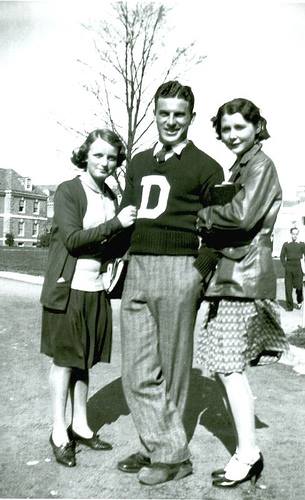
    Charles Ives may have been a radical innovator, but his subject matter frequently looked back in nostalgia to the New England of his childhood. His Violin Sonata No. 4 (1906-1915, revised in 1942) bears the subtitle, “Children’s Day at the Camp Meeting,” a programmatic work that balances hymn tunes and rowdy boyhood high jinks.

    As he entered his 70s, George Crumb embarked on a remarkably productive Indian Summer, which resulted in no less than seven volumes of “American Songbooks,” the last completed in 2011, when the composer was 82 years-old. Each volume consists of deeply personal treatments of songs Crumb recollected from growing up in West Virginia. We’ll hear selections from “American Songbook III: The River of Life” (2008). By employing his characteristic shades and cross-hatchings through an assortment of ear-tickling percussion effects, the composer provides his own commentary on the time-worn source material, lending it both unsuspected depth and an aura of timelessness.

    It’s a far cry from “Kinderszenen.” Join me for “Nostalgia Isn’t What It Used to Be” – 20th and 21st century composers look back to childhood – this Sunday night at 10:00 EDT, on WWFM – The Classical Network and wwfm.org.
  • Charles Ives Fourth of July Patriotic Music

    Charles Ives Fourth of July Patriotic Music

    Happy Fourth, everyone!

    Charles Ives’ “The Fourth of July:”

    His program note:

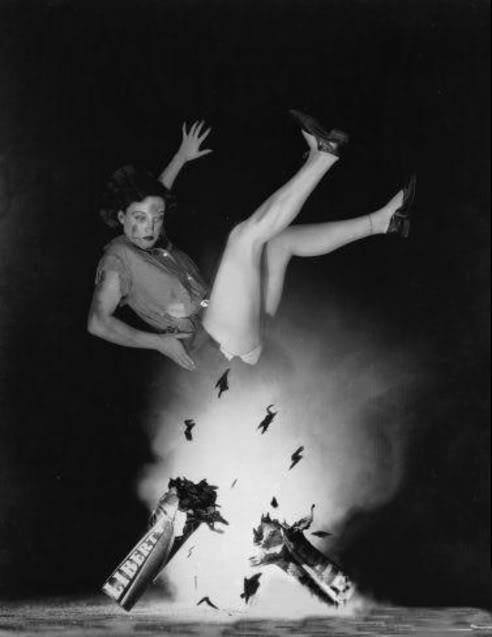
    “It’s a boy’s ‘4th—no historical orations—no patriotic grandiloquences by ‘grown-ups’—no program in his yard! But he knows what he’s celebrating—better than most of the county politicians. And he goes at it in his own way, with a patriotism nearer kin to nature than jingoism. His festivities start in quiet of the midnight before, and grow raucous with the sun. Everybody knows what it’s like—if everybody doesn’t—Cannon on the Green, Village Band on Main Street, fire crackers, shanks mixed on cornets, strings around big toes, torpedoes, Church bells, lost finger, fifes, clam-chowder, a prize-fight, drum-corps, burnt shins, parades (in and out of step), saloons all closed (more drunks than usual), baseball game (Danbury All-Stars vs Beaver Brook Boys), pistols, mobbed umpire, Red, White, and Blue runaway horse,—and the day ends with the sky-rocket over the Church-steeple, just after the annual explosion sets the Town-Hall on fire. All this is not in the music,—not now.”

    More about it:

    http://www.npr.org/templates/story/story.php?storyId=92196531

    Be careful out there!

  • Remembering Soldiers Sacrifice and Bravery

    Remembering Soldiers Sacrifice and Bravery

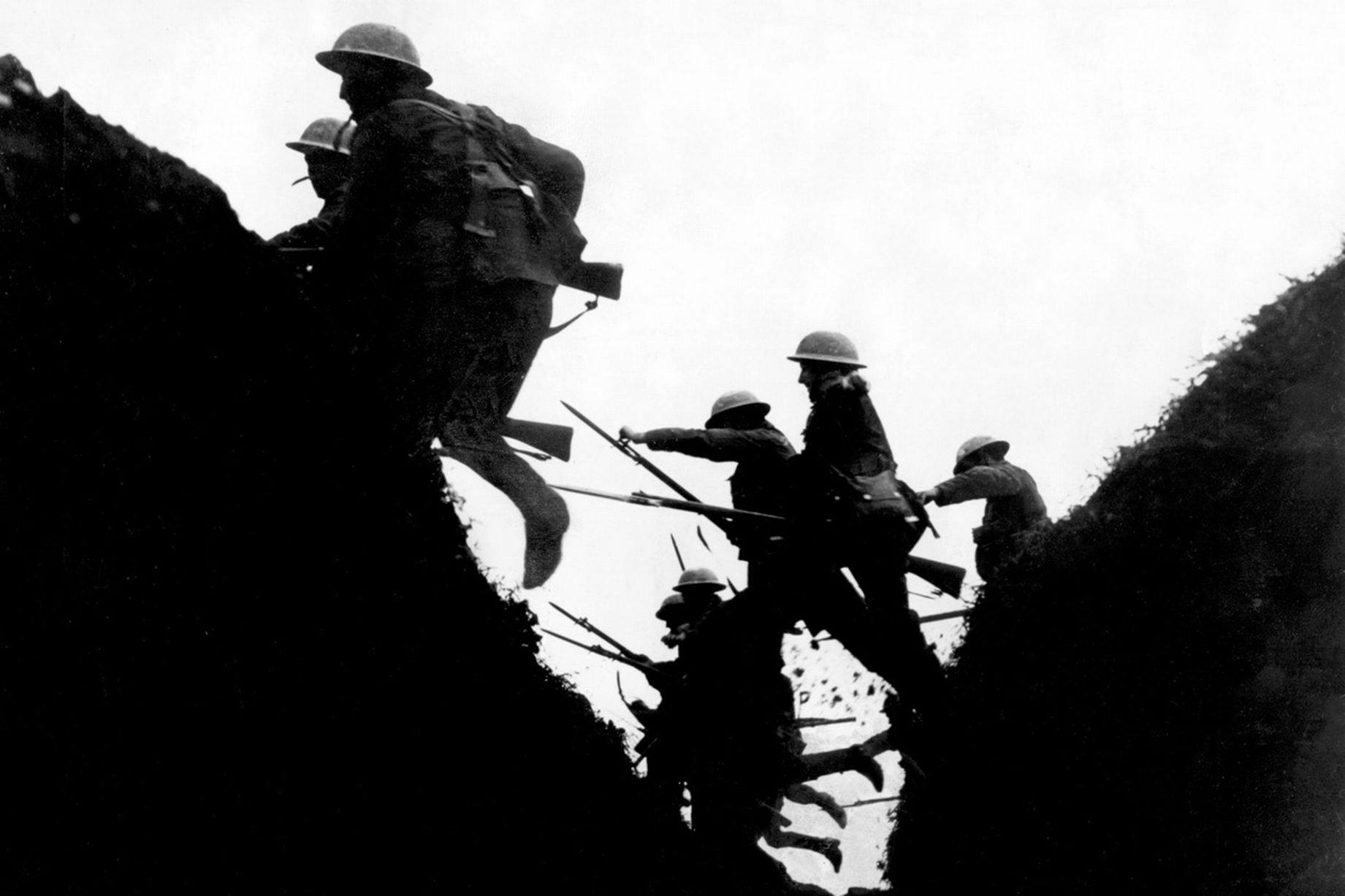
    The bravery and sacrifice of the soldier at war is unfathomable. I think especially of those souls who were called up in the days of the draft or who volunteered. What horrors were thrust upon them, and how well they acquitted themselves. I am thankful to those, like my grandfather, who did the heavy lifting so that the rest of us wouldn’t have to.


    In Flanders fields the poppies blow
    Between the crosses, row on row,
    That mark our place; and in the sky
    The larks, still bravely singing, fly
    Scarce heard amid the guns below.

    We are the Dead. Short days ago
    We lived, felt dawn, saw sunset glow,
    Loved and were loved, and now we lie
    In Flanders fields.

    Take up our quarrel with the foe:
    To you from failing hands we throw
    The torch; be yours to hold it high.
    If ye break faith with us who die
    We shall not sleep, though poppies grow
    In Flanders fields.


    “In Flanders Fields” remembered:
    http://www.greatwar.co.uk/poems/john-mccrae-in-flanders-fields.htm

    Charles Ives’ setting:

    Ives’ “Tom Sails Away”

    Ives’ “He Is There!”

    Germany’s perception of the American soldier in World War I:
    http://mentalfloss.com/article/57121/42-quotes-germans-about-american-troops-after-world-war-i

  • Ives’ Symphony No. 4: Stokowski’s 1965 Premiere

    Ives’ Symphony No. 4: Stokowski’s 1965 Premiere

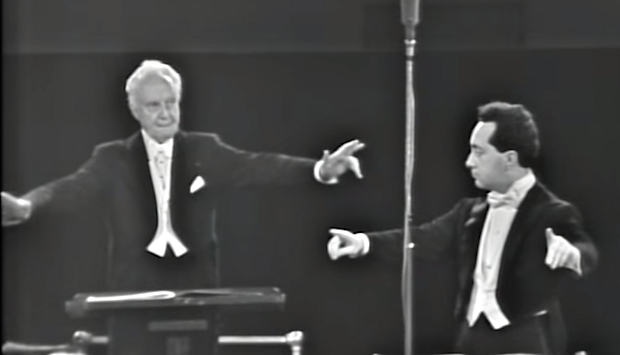
    It was on this date in 1965 that Leopold Stokowski gave the world premiere of Charles Ives’ Symphony No. 4. The performance took place at Carnegie Hall with the American Symphony Orchestra and the Schola Cantorum of New York. At the time, the work’s complex, kaleidoscopic tempos and layered, shifting meters required multiple conductors, and Stokowski enlisted the aid of David Katz and a young Jose Serebrier (pictured).

    The piece was composed between 1910 and the mid-1920s. Given the source, it’s hardly surprising that the music was decades ahead of its time. The first two movements had been performed by members of the New York Philharmonic under the direction of Eugene Goossens in 1927. This was the only occasion on which Ives would hear any of the music from the Fourth Symphony performed live by an orchestra. The composer died in 1954.

    Bernard Herrmann conducted an arrangement of the lovely third movement, the simplest and most conservative of the four (why, then, the need for an arrangement?), in 1933. The music as Ives wrote it was not heard until the complete performance in 1965.

    The composer’s biographer, Jan Swafford, describes the work as “Ives’ climactic masterpiece.”

    Stokowski recorded the symphony a few days after the premiere and led a televised studio performance, which can be seen here:

    Stokey kicks off twenty minutes of spoken introductory material (including commentary from producer John McClure) at the 4:30 mark. The symphony proper begins 25 minutes in.

    When’s the last time you saw anything like this on television?

  • Charles Ives An American Original

    Charles Ives An American Original

    Today is the birthday of Charles Ives, an American original. Ives wrote the kind of music he wanted to write, stitching hymns and fiddle tunes of his youth into a brilliant crazy quilt of the American experience.

    His father had been something of an original himself, a bandmaster during the Civil War. He taught Ives to sing in one key as he played in another. This instilled in his son, perhaps, the receptivity to recognize, when standing on a street corner during a parade, the natural dissonances and rhythmic complexities that resulted from the clash of sounds as marching bands wrapped around the block.

    He was very successful at his day job in the insurance business (some of his work in the financial field laid the groundwork for modern practices in estate planning). While this would be a claim on his time, it allowed him to pursue his idiosyncratic muse. Ives composed in the evenings, on weekends, and during holidays. For a few years, in the 1890s, he was also an organist and choirmaster at a couple of New York churches.

    He retired in 1930, which finally permitted him to devote himself wholeheartedly to music. Ironically, by then, he found he was no longer able to compose. His wife recalled a day in 1927 when he came downstairs with tears in his eyes and confessed that everything sounded wrong to him. Instead he worked at revision and publication.

    By the time his works began to gain recognition, he had already stopped writing for 20 years. At the time of his death, in 1954, he was still widely misunderstood and much of his music remained unperformed. Nevertheless, he had some important champions. He was a recipient of the Pulitzer Prize for Music in 1947, for his Symphony No. 3, “The Camp Meeting,” a work he composed in 1904. The symphony was given its belated premiere, under Lou Harrison’s direction, in 1946.

    Arnold Schoenberg regarded Ives as a paragon of artistic integrity. After Schoenberg’s death, his widow found the following among his papers: “There is a great Man living in this Country – a composer. He has solved the problem of how to preserve one’s self-esteem and to learn. He responds to negligence by contempt. He is not forced to accept praise or blame. His name is Ives.”

    Here is Ives, in all his patriotic, profane glory, singing “They Are There,” from 1943. Originally written in 1917, for the Great War, the song employs an updated text.

    Ives draws on the lesson of the wrap-around marching bands for “The Fourth of July” – and dig the climactic rocket explosion fading away into sparks!

    Finally, the work that won Ives his Pulitzer, the Symphony No. 3, “The Camp Meeting”:

    Ives’ characteristically gruff reaction: “Prizes are for boys. I’m grown up.” In private, though, he proudly hung the certificate on his wall.

    Happy birthday, Charles Ives!

Tag Cloud

Aaron Copland (93) Beethoven (95) Composer (114) Film Music (126) Film Score (143) Film Scores (255) Halloween (94) John Williams (189) KWAX (229) Leonard Bernstein (101) Marlboro Music Festival (125) Movie Music (141) Mozart (87) Opera (203) Philadelphia Orchestra (89) Picture Perfect (174) Princeton Symphony Orchestra (107) Radio (87) Ross Amico (244) Roy's Tie-Dye Sci-Fi Corner (290) The Classical Network (101) The Lost Chord (268) Vaughan Williams (103) WPRB (396) WWFM (881)

DON’T MISS A BEAT

Receive a weekly digest every Sunday at noon by signing up here


RECENT POSTS