Tag: Christmas

  • Where Have All the Oratorios Gone?

    Where Have All the Oratorios Gone?

    It’s January 6. Epiphany. The Feast of the Three Kings. The Christian feast day that marks, among other things, the Magi’s visit to the Christ Child.

    I know I’ve lamented in the past about how so many of the magnificent classical music Christmas works of the past millennium have disappeared from the airwaves. Of the larger works, it seems only Handel’s “Messiah,” Bach’s “Christmas Oratorio,” and of course Tchaikovsky’s (secular) “The Nutcracker” are guaranteed.

    Thankfully, I have an enormous record library with at least three shelves devoted exclusively to Christmas music, so I’m able to work through a lot of the forgotten and/or neglected masterworks at home and in the car. But it’s not the same as somebody else pulling and programming the music and knowing that I am part of a unified listening community.

    I feel the same way when watching a movie that is broadcast, or actually in a theater, as opposed to playing it from my own collection or streaming it. It’s wonderful to live in an age when these things are possible, but it is just not the same as knowing that I’m a part of a communal experience. (That said, I’m certainly not going to watch “It’s a Wonderful Life” on network television with a thousand commercial breaks!)

    I must give a tip of the Ebenezer Scrooge top hat to Yle Klassinen in Helsinki for airing Franz Liszt’s “Christus” complete. That station really is a marvel. Oh how I love my digital radio! Of course, I don’t speak Finnish, but I can usually make out the performers when they are announced and the playlists are posted online.

    Anyway, I had already listened to the Dorati recording on my own time. I’ve done so for many, many years. It’s enriched my Christmases ever since I first encountered it on the air, broadcast on Philadelphia’s late, lamented WFLN, back in the early 1980s. Time was, when serious classical Christmas music commenced with Advent. Yes, it was leavened with gems like Victor Hely-Hutchinson’s “Carol Symphony,” the aforementioned “Nutcracker,” and Leopold Mozart’s “A Musical Sleigh-Ride,” in the hilarious recording by the Eduard Melkus Ensemble that includes the neighing horses and barking dogs. I looked forward to hearing that every year. I snapped it up when it was reissued on compact disc and have included it in my own broadcasts for decades.

    Those works have their place, but it seems the serious, large-scale choral works are all going away. Commerce, secularism, short attention spans, ignorance, and grievance all work against the simple enjoyment of a lot of masterful music. It’s much safer to play three-minute arrangements of familiar Christmas carols. Over and over and over again.

    I grant you, three hours is a lot of radio real estate to give up to Liszt’s “Christus.” But can’t anyone even carve out an hour for Vaughan Williams’ “Hodie?” I suppose I should just shut up and be thankful that RVW’s “Fantasia on Christmas Carols” is still in rotation.

    I count myself very fortunate to have been able to share “Christus” many times over the years. I know I’ve played it complete on WXLV, WPRB, and WWFM – once I even preempted the weekly opera broadcast – and excerpted the purely orchestral movements even more frequently, working them into my morning and afternoon playlists. “The March of the Three Holy Kings” is a high point.

    I am sorry I don’t have a stretch of air-time during which to play it for you now, but the entire Dorati recording of the oratorio (one of three recordings I own, and still my preferred) is posted on YouTube.

    If you want to cut to the chase, here’s the march of the Kings.

    Think it sounds an awful lot like Wagner’s Wotan? There’s likely a reason for that. I’ve posted about it before.

    https://rossamico.com/2023/01/06/three-kings-music-mystery-wagner-liszt/

    I try to be sensitive to other people’s faiths and belief systems, and frankly I am no zealot, but when it comes to music, I am very much a fundamentalist. This is not about pushing Christianity down anyone’s throat as much as a desire to preserve and disseminate the sublime Christmas works, many of them by top-tier composers, presented, like the classic movies on TCM, complete and uncut.

    Of course, most of these recordings I’ve played over the years are from my own collection. I was very fortunate to be able to do my own programming, for hours at a time, for the better part of three decades. In such a situation, when a radio host loses his platform, countless hours of repertoire go with him. You’ll still get “Messiah,” but you probably won’t get Josef Rheinberger’s “The Star of Bethlehem” (here posted as a playlist of nine separate videos).

    Rutland Boughton’s “Bethlehem” is another Christmas work I’m crazy about. You won’t find it in many record libraries at radio stations here in the U.S. But I’ve got it, and I’ve aired it. Rather than write about it again, I’ll refer you to one of my teasers from a few years ago.

    https://rossamico.com/2017/12/21/merlin-in-bethlehem-a-christmas-music-surprise/

    If you’re a Vaughan Williams fan, I think you will find it delightful. For a long time, I was unable to share any of the audio online, due to Hyperion Records’ justifiably Draconian practice of not allowing any its recordings on YouTube. But the company is now in other hands, so here it is, finally, as a playlist – albeit with the tracks posted separately, so prepare to have to skip an occasional ad.

    On the Twelfth Day of Christmas, your resident classical music curmudgeon gives to you… three Christmas oratorios. If I splurged for a dozen, this post would be four times the length!

    Have yourself a merry “Little Christmas!”

    ——–

    IMAGE: Detail from Edward Burne-Jones’ “Adoration of the Magi”

  • These Are a Few of My Favorite Things

    These Are a Few of My Favorite Things

    I hope you’ve been enjoying a warm and meaningful holiday season. Christmas isn’t supposed to be about the loot, but it’s always welcome to receive an exciting gift. Yes, it’s the thought that counts, and with the winter winds howling, we can all use socks, sweaters, gloves, scarves, etc. But when a gift hits the bull’s-eye, it can light you up like a string of Christmas bulbs. You know, like the ones at your grandparents’ house that were so magical and emitted uncanny odors and threatened at any moment to burst into flame. Ah, the nostalgia of Christmases past!

    With the family so fragmented at this point and friends scattered willy-nilly, there is no centralized “Christmas” for me anymore. The Christmas season really is the Christmas SEASON. So the revelry and gift-gifting will continue into the New Year. Here, up to this point, are some of the winners that have appeared in my mailbox and under the tree. The bar must have been set mighty low for me to rank so highly on the “nice” list this year, since, if I haven’t exactly been naughty, I’m still not sure I’ve been exceptionally deserving of such munificence. So thanks to all you miscreants who dragged down the mean, because Santa was obviously grading on a curve!

    I learned about the Copland disc of pre-LP recordings on Mather Pfeiffenberger’s breathtakingly exhaustive Copland marathon earlier this month on WHRB. It went right on my wish list. What must it have been like to have been an artist of Copland’s caliber whose career spanned the piano roll to the digital age?

    The John Williams biography, the first in English issued by a reputable publisher (Oxford University Press), will probably be the book I’ll read to kick off the new year (as soon as I finish Jane Austen’s “Persuasion,” which I’ve been reading for her 250th anniversary, with interruptions to dip into a Christmas anthology). I read Steven C. Smith’s biographies of Bernard Herrmann and Max Steiner, so naturally his exploration of the Herrmann-Hitchcock relationship will be of interest to me. The Edward Gorey book, published for his centenary was an out-of-nowhere, post-Christmas surprise. It is quite the handsome tome – so beautiful, I am almost afraid to touch it!

    Despite my interests in music, the Faust legend, and German literature, I have never read Thomas Mann’s “Doctor Faustus.” Much has been made of the book’s allegorical significance, mirroring the collapse of German culture and morality and the rise of Nazism, but I expect it will be especially absorbing for me in light of the musical dust-up it caused with Arnold Schoenberg (who, to be clear, was vehemently anti-Nazi), as the novel’s antihero embraces the composer’s twelve-tone technique, which Mann clearly found to be harmful to German art and culture. Also, one of the concerts depicted in the book allegedly mirrors a passage in George Antheil’s autobiography, which, according to an interview I once conducted with a representative of the Composers Guild of New Jersey, Mann clearly read. Both Thomas Mann (who lectured at Princeton) and George Antheil (born in Trenton) had local connections.

    The Franco Alfano DVD has been on my Amazon wish list since 2007. Alfano is probably best known for having completed Puccini’s “Turandot.” The swagger and doomed romance of “Cyrano de Bergerac” have always very much appealed to me, but I can’t say I’m all that familiar with the opera. Perhaps I’ll watch this one, with Roberto Alagna, and the one I already own (which I’ve yet to watch), with Placido Domingo, back-to-back. I can’t think of a better way to begin a new year than with plumes and panache!

    I receive all these gifts with thanks and great humility. Don’t think for a moment that I don’t know how lucky I am. By any standard, it’s been quite a Christmas!

  • Take 2 Holiday Tea Party on “Sweetness and Light”

    Take 2 Holiday Tea Party on “Sweetness and Light”

    For whatever reason (i.e. I sent in the wrong show), my New Year’s program aired on “Sweetness and Light” a few weeks ago. Aside from having eggnog on my face, no harm done, I suppose, although I’m sure listeners were wondering why I was going all Guy Lombardo three weeks before Christmas.

    Since it’s already recorded, and because it’s the holidays, and because I’m lazy, I’m putting the kettle on to boil some more water for a festive tea party. The playlist will include Dmitri Shostakovich’s charming arrangement of “Tea for Two,” Samuel Barber’s “Souvenirs,” his musical evocation of the elegant Palm Court of the Plaza Hotel in days of yore, and Richard Strauss’ hallucinatory dancing tea leaves from the high-calorie ballet “Schlagobers,” or “Whipped Cream.”

    The show will achieve its nutty apotheosis when sugar and caffeine intersect with the hypnotic patter of the 1953 novelty song “The Little Red Monkey,” which tells of a simmering simian’s reactions to violin, euphonium, and tea.

    Your eyes will pinwheel, your brain will hum, and your heart will go pitter-pat when you join me for a bottomless cuppa on “Sweetness and Light,” this Saturday morning at 11:00 EST/8:00 PST, exclusively on KWAX Classical Oregon!

    Stream it wherever you are at the link:

    https://kwax.uoregon.edu/

  • The Sound of Silence, Christmas Eve Edition

    The Sound of Silence, Christmas Eve Edition

    Christmas Eve, already.

    On this date in 1818, the Christmas carol “Silent Night” was first sung at St. Nicholas Church in Obendorf, Austria. The words were from a poem, “Stille Nacht,” written by a young Catholic priest, Joseph Mohr, in the aftermath of the Napoleonic Wars. It’s said that Mohr was inspired in part by a walk he took, on which he was impressed by the quiet, wintry aspect of his town at peace.

    He handed the words off to the church’s choir director, Franz Xaver Gruber, who wrote the melody with a deadline looming for that evening’s mass. The carol was introduced on Christmas Eve, its creators singing it in duet, with Mohr on the guitar. (St. Nicholas Church was prone to flooding, which may have damaged the organ. Eventually, the church would be replaced by Silent Night Chapel.)

    An organ builder and repairman heard the carol and took it with him back to his own village, where it was picked up by two separate families of traveling folk singers, the Strassers and the Rainers. The Rainers performed it before the King of Prussia and Tsar Alexander I and sang it for the first time in the United States, where they introduced it at the Alexander Hamilton Monument outside Trinity Church in New York City.

    Nearly two centuries before social media, the carol went viral. You’d be hard-pressed to find anyone who doesn’t know it. It’s been recorded over 137,000 times, for the first time back in 1905.

    Even given the irresistibly Romantic story of a priest introducing the carol to his congregation on a guitar on Christmas Eve, there had been speculation over the years attributing its creation to starrier names. It was only in 1994 that the original manuscript was discovered in Mohr’s hand. Scholars now believe that two years elapsed between the actual writing of the poem in 1816 and Gruber’s last-minute contribution of the indelible melody.

    If this is true, it does nothing to take away from the carol’s magic, and the rare alchemy between poet and composer.

    ———-

    Stained glass from Silent Night Chapel, reinforcing the legend of Gruber (as opposed to Mohr) on the guitar


  • German Christmas: A Time for Fantastic Fairy Tale Operas

    German Christmas: A Time for Fantastic Fairy Tale Operas

    How many people do you know that own TWO recordings of Hans Pfitzner’s “Das Christ-Elflein” (“The Christmas Elf”)? Well, now you know ONE.

    I was riding around in the car yesterday, trying to knock out some last-minute, long-distance Christmas shopping, and after listening to Josef Rheinberger’s “The Star of the Bethlehem,” I popped in the Orfeo recording of “Das Christ-Elflein,” with Helen Donath in the title role and Kurt Eichhorn conducting. (That’s right, my car still has a CD player. In fact, it was the deciding factor in purchasing the vehicle.) If you’re curious, my other recording is a more recent one, on the CPO label, with Marlis Petersen as the Elf and Claus Peter Flor conducting.

    The plot, based on an airy-fairy play by Ilse van Stach, concerns an Elf, who’s never heard of Christmas, and a grumpy old Fir Tree, who has and doesn’t like it. (Firs get chopped down at Christmas.) Despite the Fir Tree’s warnings about the heartlessness of the human race, the inquisitive Elf ventures into the world of men. It turns out it’s a rather depressing place.

    When the Christ Child appears on Christmas Eve, the Elf wants to follow Him into heaven. But the Christ-Child has work to do: He’s to escort the soul of a dying girl. When the guileless Elf offers himself in her place, the Christ-Child accepts. The girl is restored, and the Elf returns every year at Christmas as the Christmas Elf. The opera concludes with a joyous Christmas party with the girl’s family.

    In the Eichhorn recording, Donath makes a good Elf. Her voice and characterization convey innocence and purity. The jaded and embittered Fir Tree, on the other hand, is sung by Alexander Malta, whose pleasingly resonant voice belies a gruff exterior. Bass-baritones, it happens, are thick on the ground, and Nikolaus Hillebrand sings an authoritative, even noble Knecht Ruprecht (a gift-bearing companion of St. Nicholas).

    The work itself is entertaining – it’s got some good bits, especially fun in the parts that incorporate quotations of “O Tannenbaum,” and there’s obviously also an ample amount of Christmas sentiment (okay, schmaltz) – but if I’m to be honest, it doesn’t hold a Christmas candle to the ne plus ultra of the genre, Engelbert Humperdinck’s “Hansel und Gretel.”

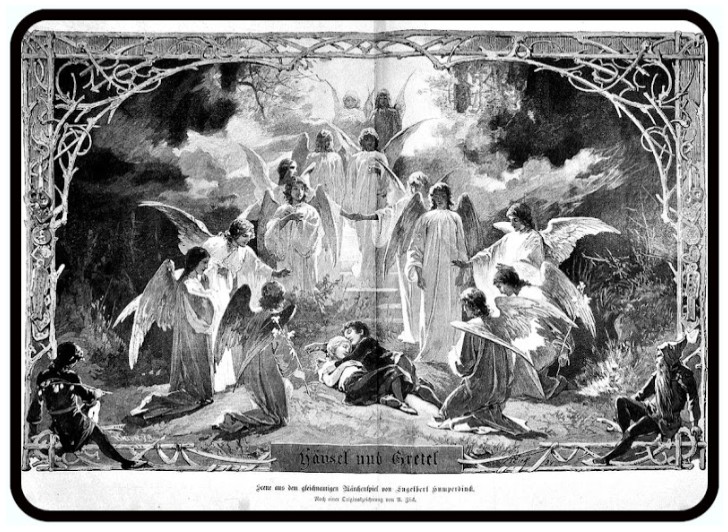
    For a time, the fairy tale opera was to Germany what the ghost story was to England, a cherished Christmas tradition. “Hansel und Gretel” was given its first performance on this date in 1893 – with Richard Strauss, no less, directing the orchestra and cueing singers from the pit of Weimar’s Hoftheater. With its folk-like simplicity, visions of sweets, and Evening Prayer (replete with angels), it’s been part of the Christmas season ever since.

    “Hansel und Gretel” had a foundational advantage in the familiar Brothers Grimm fairy tale. “Das Christ-Elflein” is a much stranger concoction, mixing sacred and secular – indeed pagan – elements into a heady Christmas punch.

    The opera, really a singspiel (an entertainment with sung parts linked by spoken passages), first appeared in 1906 and was revised in 1917. It still gets revived in German-speaking countries, but in the two recordings I own, anyway, there is the drawback of interludes delivered by a German narrator. I would have preferred had the singer’s spoken dialogue been retained.

    “Hansel and Gretel” was the first opera broadcast live on the radio from the Metropolitan Opera in 1931. Here’s a lovely, classic staging from the Met, prior to the current rage for Regietheater:

    My favorite recording of the “Dream Pantomime,” with Otto Klemperer:

    Elisabeth Schwarzkopf and Irmgard Seefried, with Josef Krips conducting, from 1947:

    “Das Christ-Elflein”


Tag Cloud

Aaron Copland (92) Beethoven (94) Composer (114) Film Music (116) Film Score (143) Film Scores (255) Halloween (94) John Williams (185) KWAX (228) Leonard Bernstein (99) Marlboro Music Festival (125) Movie Music (131) Opera (197) Philadelphia Orchestra (86) Picture Perfect (174) Princeton Symphony Orchestra (106) Radio (86) Ralph Vaughan Williams (85) Ross Amico (244) Roy's Tie-Dye Sci-Fi Corner (290) The Classical Network (101) The Lost Chord (268) Vaughan Williams (99) WPRB (396) WWFM (881)

DON’T MISS A BEAT

Receive a weekly digest every Sunday at noon by signing up here


RECENT POSTS