Tag: Christmas Traditions

  • Icelandic Yule Lads Dark Christmas Folklore

    Icelandic Yule Lads Dark Christmas Folklore

    Sheesh. Where does the time go? Only 13 days of folklore and paganism until Christmas.

    Gävle, Sweden, has already constructed its 40-foot Yule Goat. Krampus has hurled all the wicked children into hellfire. Black Peter has stirred the ire of Dutch protesters.

    But, no time to be wistful. It’s December the 12th. Here come the Yule Lads!

    These days, the Yule Lads are usually personified as a bevy of affable Santa Clauses. Except, being Icelandic, not only do they leave gifts for the nice; the naughty get rotten potatoes. That’s the sanitized version. You don’t have to dig too deeply to discover their true selves.

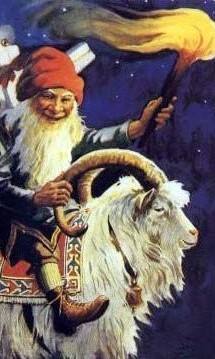
    The Lads are thirteen in number. In Icelandic lore, they are annoying pranksters at best; at worst, they are homicidal trolls who devour children. Mostly they steal from and harass Icelandic farmers.

    The Lads descend from the mountains, staggering their arrivals and departures, beginning thirteen nights before Christmas.

    Each has his own exasperating speciality, whether it be harassing sheep, stealing milk, eating crust out of pans, licking spoons, stealing leftovers, licking bowls, slamming doors, eating skyr (a kind of Icelandic yogurt), stealing sausages, peeping through windows, sniffing for bread, stealing meat with a hook, or eating candles.

    Their mother is the ogress Grýla, who descends from the mountains in search of children to boil in her cauldron. If you happen to find yourself in her gnarled claws, remember, she has to release you if you repent.

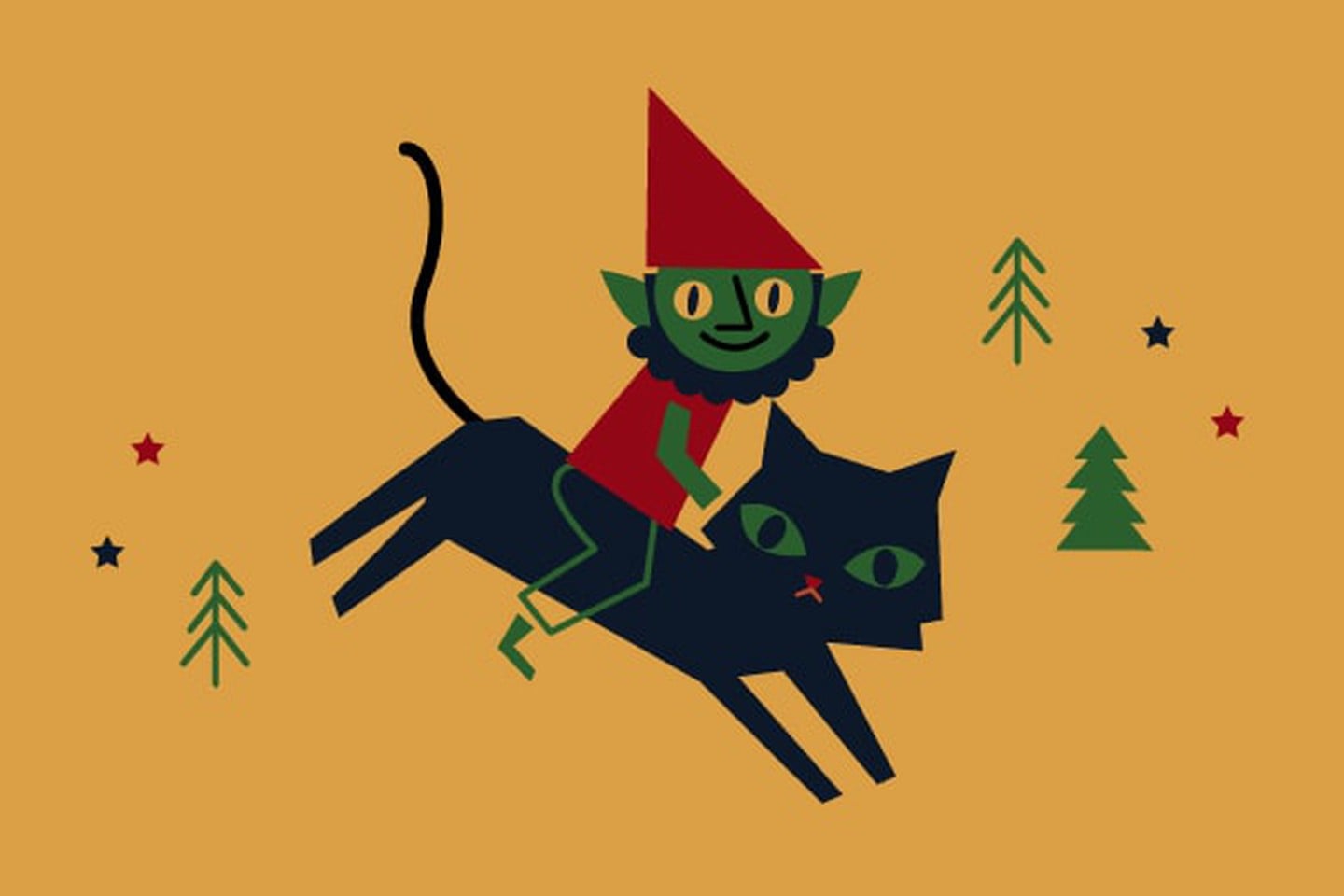
    The Yule Lads are frequently accompanied by the Yule Cat. The cat eats children who don’t receive new clothes before Christmas. This is tied in to the Icelandic work ethic. In the old days, if farm hands processed their autumn wool in a timely fashion, they were rewarded with new clothes. If not, they received nothing, leaving them fair game for the Yule Cat. Better sheer them sheep!

    In 1746, the practice of parents tormenting their children with Christmas monster stories was officially banned.

    To my knowledge, there has been no classical music written about the Yule Lads. As with Krampus, some enterprising composer could make a real killing. All you need is one Christmas hit, and then every year you can kick back and collect those sweet holiday royalties.

    Here is a selection of Yule Lad songs I found on YouTube. You can see that the bar has been set awfully low.

    https://www.youtube.com/watch?v=BJ4nSFe32ys

    How “My Darling Clementine” got over there is anyone’s guess. Maybe Leif Erikson brought it back with him.

  • Twelfth Night Christmas Traditions and Folklore

    Twelfth Night Christmas Traditions and Folklore

    Once they have sufficiently recovered from New Year’s, a lot of people take down their Christmas lights and dismantle their trees. (On the other hand, too many seem to leave them up until spring.) After all, Christmas is past, right? Wrong!

    December 5, the eve of Epiphany, is Twelfth Night – the Twelfth Day of Christmas – or is it? Well, it depends on when you start the count. Is Christmas Day the First Day, or should we begin counting the day after? The day after would make January 6, Epiphany (the Christian feast commemorating the visit of the three Magi to the Baby Jesus) the Twelfth Day, which would seem to make sense.

    But is Epiphany the Twelfth Day, or should Twelfth Night, a night of reveling to mark the last day of Christmas, really to be observed on the eve of Epiphany, just as Christmas Night, in England anyway, is actually Christmas Eve? The Christian world is divided – and that is only taking into account the West!

    Then there’s “Old Twelfth Night” (January 17), but that’s for another post.

    In any case, according to tradition, it’s perfectly fine to still have the tree and lights up, but it is bad luck to keep Christmas decorations on display beyond Epiphany. Apparently it was the Victorians who first said so, as a signal that it’s time for everyone to get back to work. The Tudors, on the other hand, kept partying right on through February 1, the eve of Candlemas (the presentation of the Christ Child at the Temple in Jerusalem).

    As for Shakespeare’s play, “Twelfth Night,” which would seem to have nothing at all to do with Christmas, it is a charming corollary of a season of merriment, masked balls, and misrule. The first performance took place on Candlemas, 1602.

    We may not be able to come to a consensus on the Twelfth Day, but we can say with certainty that the night of December 5 marks the arrival of Befana the Christmas witch. Befana is the wizened crone who bestows gifts and happiness upon the good children of Italy. If the children are bad, they get a lump of coal. (If the family is poor, they get a stick.) It’s traditional to leave a glass of wine and a tasty morsel for Befana. In return, she will sweep the floors with her broom, symbolically sweeping away the problems of the old year.

    Think about that when you worry that your tree is losing too many needles.


    PHOTO: Make way for the Holly Man!

  • Venezuelan Christmas Traditions

    Venezuelan Christmas Traditions

    As Americans, our concept of Christmas tends to be rather Northern-centric. Even to call ourselves “Americans” is a bit presumptuous, being that there are all these other folks living around the Equator and in lands south – roughly 40 percent of the population of the Eastern Hemisphere – who are also Americans, though not citizens of the United States.

    The people of Venezuela may never know what it is to enjoy a white Christmas, but they have developed their own seasonal traditions to compensate for a lack of “dashing through the snow.” On Christmas Day in the capital city of Caracas, the streets are closed to traffic, fireworks shatter the silence before dawn, and those youngsters who can sleep through anything are awakened by a tug on the toe.

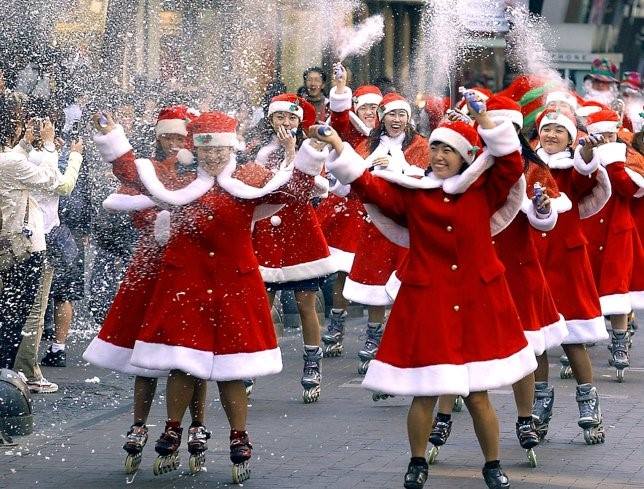
    Children go to bed on Christmas Eve with a string tied to their piggies. One end is dangled out the window to be tugged – gently, I would hope – by passersby, as a reminder that it is time to get up and strap on the skates. For in the city of Caracas, it is customary for anyone who is able-bodied to roller skate to Christmas mass. If the kids are good, they have received gifts in the night, not from Santa, but from Baby Jesus himself.

    After mass, everyone goes out and gets tostados and drinks coffee. The big meal is enjoyed on Christmas Eve (actually the wee hours of Christmas morning), following midnight mass, or Misa de Gallo. “Gallo,” if you don’t know, is Spanish for “rooster.” Nobody gets any sleep on Christmas in Venezuela. That’s one aspect of the holiday Americans in both hemispheres pretty much share in common.

  • Epiphany Traditions Drums and Decorations

    Epiphany Traditions Drums and Decorations

    I can hardly hear myself think, with twelve drummers drumming!

    While I am generally all for extending Christmas as long as possible, we have come finally to the twelfth day, the Feast of the Epiphany, and the official close of the season. This is traditionally the day to take down the Christmas tree and all the festive decorations and to let the tree spirits go about their business. Our wise forebears believed that it is bad luck to take down the decorations earlier. Taking them down later is equally unlucky, so that if you miss the date, you’re supposed to leave everything up for the rest of the year. Ignore this advice at the peril of your crops!

    I hope La Befana, the Christmas witch, was good to you.

    The Feast of the Epiphany and Celebration of La Befana

    Photos of other Epiphany celebrations, including one that involves pounding a drum while standing in frigid water:

    http://blogs.pjstar.com/eye/2015/01/06/christians-around-the-world-celebrate-epiphany/

  • Gävle Goat Lives! Sweden’s Wild Yule Tradition

    Gävle Goat Lives! Sweden’s Wild Yule Tradition

    December 9, and the Gävle Goat yet stands! Last year, Sweden’s 40-foot straw icon was set ablaze within hours of its construction. The catastrophe was timed to coincide with a security guard’s bathroom break.

    One of Northern Europe’s wackier Christmas traditions (no doubt with pagan roots), the Yule Goat may have derived from the worship of Thor. The God of Thunder’s chariot was drawn by two goats. The Christmas version is led about by Saint Nicholas, possibly as a symbol of the subjugation of evil.

    Whatever the goat’s function, it goes way back. For hundreds of years, rowdy young men in costumes would go door to door enacting plays and demanding gifts. One of these, naturally, was the ornery Yule Goat. Scandinavians sometimes refer to the practice of wassailing as “going Yule Goat.”

    In the 19th century, the Goat’s role was transformed into a giver of gifts. Though the Goat has since been replaced by a humanoid Father Christmas, in Finland he is still referred to by the name Joulupukki (you guessed it: Yule Goat).

    Nowadays, the goat is mostly seen in its incarnation as a miniature tree ornament, made of straw and bound by red ribbon. A notable exception is the Gävle Goat, which is basically that ornament, only on the grandest of scales. The Gävle Goat is constructed over a period of two days in time for Advent.

    Then begins an unsanctioned game of cat-and-mouse, with the authorities attempting to guard the Goat, while everyone else attempts to light it off. Yes, you read that correctly. If the Goat is burned to the ground before December 13 (the feast day of St. Lucia), it is rebuilt.

    Over the years, the Goat has been rammed by a Volvo, damaged by fireworks, stomped to pieces, fired upon with flaming arrows (launched by vandals dressed as Santa and gingerbread men), and torched by a hapless American who was talked into using his lighter by Swedes who convinced him it was a perfectly legal holiday tradition (it’s not). In 2010, there was even a failed plot to abduct the goat by helicopter.

    You’ll find more information and a complete history of the Goat’s destruction here:
    http://en.wikipedia.org/wiki/G%C3%A4vle_goat

    Excellent time-lapse burning of the Goat:
    http://travelbetweenthepages.com/…/12/22/yule-got-your-goat/

    Follow the Goat’s twitter feed:
    https://twitter.com/Gavlebocken?ref_src=twsrc%5Egoogle%7Ctwcamp%5Eserp%7Ctwgr%5Eauthor

    View the live webcam:
    http://www.visitgavle.se/en/gavle-goat

    To keep it musical, here’s a Christmas song by Swedish composer Hugo Alfvén:

    Anyone care to start a pool?

Tag Cloud

Aaron Copland (92) Beethoven (95) Composer (114) Film Music (120) Film Score (143) Film Scores (255) Halloween (94) John Williams (185) KWAX (229) Leonard Bernstein (100) Marlboro Music Festival (125) Movie Music (135) Opera (198) Philadelphia Orchestra (88) Picture Perfect (174) Princeton Symphony Orchestra (106) Radio (87) Ralph Vaughan Williams (85) Ross Amico (244) Roy's Tie-Dye Sci-Fi Corner (290) The Classical Network (101) The Lost Chord (268) Vaughan Williams (103) WPRB (396) WWFM (881)

DON’T MISS A BEAT

Receive a weekly digest every Sunday at noon by signing up here


RECENT POSTS