Tag: Christmas Traditions

  • Krampusnacht Creepy Christmas Traditions

    Krampusnacht Creepy Christmas Traditions

    Advent may have begun on December 3, but the season really picks up steam on December 5, the eve of St. Nicholas Day, otherwise known as Krampusnacht. Krampusnacht jumpstarts a shadow season of creepy Christmas traditions. Christmas isn’t just about buying things, you know; it’s about scaring the bejeezus out of your kids.

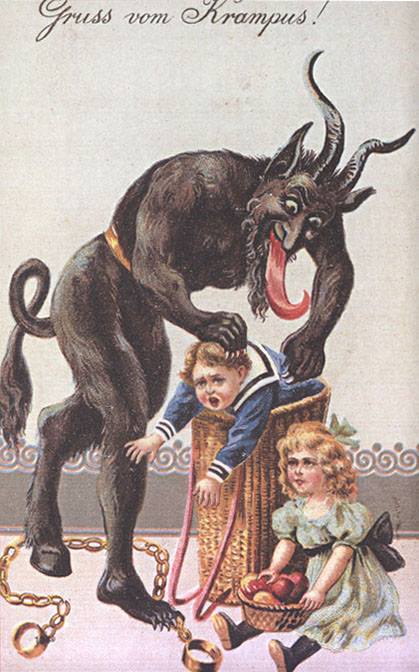
    What exactly is Krampus? Why, he’s St. Nicholas’ dark helper. Horned, hairy and horrifyingly long-tongued, Krampus emerges from his Alpine domain to dole out corporal punishment to the young and the wicked. For milder offenses, there is the sting of the switch; but for the especially ill-behaved, there are chains, a short ride in a wicker basket, and then drowning in a stream or immolation by hellfire. When a naughty child hears the dull clatter of approaching cow-bells, he knows it’s all over. He only wishes his stocking were full of coal.

    Happy holidays, everyone! Get ready for Black Pete, the Yule Lads, and the Gävle goat.

    Krampus cards were once widely circulated, not only on Christmas, but also on Valentine’s Day. I can think of no better way to catch a sweetheart.

    All hail Krampus!


    “A Krampus Carol” (incorporating a stop motion Krampus!):

    Family-friendly segment on the Krampus Renaissance in Bavaria, produced by The New York Times:

    A real, old-fashioned Krampuslauf:

    Pretty good Krampus carol (full text when you click on “show more”):

    Here comes Krampus:

    Nicholas and Krampus play “good cop/bad cop” with Tobias:

    Small child cowers behind door at 1:25:

    Academy Award-winner Christoph Waltz explains Krampus to Jimmy Fallon:

    The commercialization of Krampus:

  • Krampusnacht Creepy Christmas Traditions

    Krampusnacht Creepy Christmas Traditions

    Get ready, kids! It’s December 5. Krampusnacht. Have you been good this year?

    The eve of St. Nicholas Day kicks off a season of creepy Christmas traditions. Long-time followers of this page know I have a weakness for the whacked-out pagan lore that still surges beneath the anodyne veneer of the holidays. Christmas isn’t just about buying things. It’s about scaring the bejeezus out of your kids.

    What exactly is Krampus? He’s St. Nicholas’ dark helper. Horned, hairy and horrendously long-tongued, Krampus emerges from his Alpine domain to dole out corporal punishment to the young and the wicked. For milder offenses, there is the sting of the switch; but for the especially ill-behaved, there are chains, a short ride in a wicker basket, and then drowning in a stream or immolation by hellfire. When a naughty child hears the dull clatter of approaching cow-bells, he knows it’s all over. He only wishes his stocking were full of coal.

    Last year, Krampus became the subject of a major motion picture. It’s ironic that this ultimate expression of anti-commercialism would himself become commercialized. Then again, Krampus cards were once widely circulated, not only on Christmas, but also on Valentine’s Day. I can think of no better way to catch a sweetheart.

    Happy holidays, everyone! Get ready for Black Pete, the Yule Lads, and the Gävle goat. Wait a minute. Better strike that last one. This year’s Gävle goat, apparently, didn’t even last 24 hours. You can read the full, moving account here:

    http://www.npr.org/sections/thetwo-way/2016/11/30/503881528/swedish-revelers-get-their-goat-again-as-holiday-tradition-meets-annual-arson


    “A Krampus Carol” (incorporating a stop motion Krampus!):

    Family-friendly segment on the Krampus Renaissance in Bavaria, produced by The New York Times:

    A real, old-fashioned Krampuslauf:

    Pretty good Krampus carol (full text when you click on “show more”):

    Here comes Krampus:

    Nicholas and Krampus play “good cop/bad cop” with Tobias:

    Small child cowers behind door at 1:25:

    Academy Award-winner Christoph Waltz explains Krampus to Jimmy Fallon:

    The commercialization of Krampus:

  • Icelandic Yule Lads Naughty Folklore

    Icelandic Yule Lads Naughty Folklore

    December 12. Here come the Yule Lads!

    Long-time readers of this page know how much I love me some arcane Yuletide traditions. There’s Krampus and Knecht Ruprecht and Belsnickel and the Yule Goat. Since Krampus, sadly, looks to have jumped the shark with a move to Hollywood and a major motion picture contract, I seek consolation in the Icelandic tradition of the Yule Lads.

    Today, the Yule Lads are frequently personified as a kind of bevy of affable Santa Clauses. Except, being Icelandic, they either leave gifts (if you’ve been nice) or rotting potatoes (if you’ve been naughty). That’s the cleaned-up version. You don’t have to dig too deep to discover their true selves.

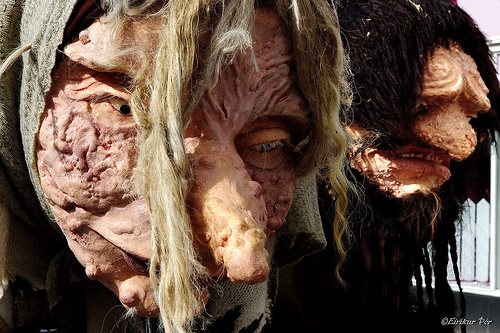
    The Lads are thirteen in number. In Icelandic lore, they are annoying pranksters at best; at worst, they are homicidal trolls who devour children. Mostly they steal from and harass Icelandic farmers.

    The Lads descend from the mountains, staggering their arrivals and departures, beginning thirteen nights before Christmas. Each has his own exasperating speciality.

    There’s the peg-legged Stekkjarstaur (Sheep-Cote Clod), who harasses sheep. He arrives on December 12 and takes his leave on Christmas Day.

    There’s Giljagaur (Gully Gawk), who lurks in gullies, biding his time to sneak into the cowshed and steal milk. He turns up on December 13 and returns to his lair on December 26.

    There’s the diminutive Stúfur (Stubby), who steals pans in order to eat the crust out of them. He trots in on December 14 and totters off on December 27.

    There’s Þvörusleikir (Spoon-Licker), who, well, licks spoons. He’s very gaunt, due to malnutrition. He shows up on December 15 and disappears, like Kafka’s hunger artist, into the straw on December 28.

    There’s Pottaskeffil (Pot-Scraper), another one who steals leftovers from pots. He comes a-calling on December 16 and returns to the hills on December 29.

    There’s Askasleikir (Bowl-Licker). Again, he licks bowls. I’d advise you to use extra soap, except once he licks the bowls, he usually steals them. He steals in on December 17 and slips out on December 30.

    There’s Hurðaskellir (Door-Slammer), who slams doors in the night. He raises a ruckus from December 18 to December 31.

    There’s Skyrgámur (Skyr-Gobbler), a Yule Lad who’s crazy for skyr, a kind of Icelandic yogurt. He sates himself from December 19 to January 1.

    There’s Bjúgnakrækir (Sausage-Snatcher), who’s crazy for the pig-products. He hides in the rafters and swipes smoked sausages. He makes his mark from December 20 to January 2.

    There’s Gluggagægir (Window-Peeper), who peeps, creepily, through windows, looking for things to steal. He cases the joint from December 21 to January 3.

    There’s Gáttaþefur (Doorway-Sniffer), who sniffs around the door jamb with his abnormally large proboscis, in search of laufabrauð, Icelandic Christmas bread. He hungers from December 22 to January 4.

    There’s Ketkrókur (Meat-Hook), who uses a hook to steal meat. He steals from December 23 to January 5.

    And finally, there’s Kertasníkir (Candle-Stealer), who pursues children so that he can eat their candles. (He likes tallow.) He’s a “light” eater from Christmas Eve, December 24, to Epiphany, January 6.

    And you thought holiday visits from your relatives drove you batty!

    Their mother is the ogress Grýla, who descends from the mountains in search of children to boil in her cauldron. If you happen to find yourself in her gnarled claws, remember, she has to release you if you repent.

    The Yule Lads are frequently accompanied by the Yule Cat, which eats children who do not receive new clothes before Christmas. This is a tradition that definitely would have kept me from pouting under the clothes rack at the department store as my poor mother tried to get me presentable for the new school year.

    Move over Krampus! Can a Yule Lads movie be far away?

  • The Second Day of Christmas Traditions

    The Second Day of Christmas Traditions

    THE SECOND DAY OF CHRISTMAS

    Now that I’m back in my own space, and since my Christmas shopping is done (well, mostly), and since I don’t have any kids, I can finally hear myself think again. I can type on my own laptop without a television set blaring or my nephew peering around the screen.

    Today is St. Stephen’s Day. Or Boxing Day. Or the Second Day of Christmas. There are twelve days to the holiday, after all – through Epiphany on January 6 – even if most of the Christmas music disappears with December 25. So don’t let the post-holiday blues overtake you. It’s not quite time for our hearts to break over Hans Christian Andersen’s Fir Tree, not quite yet. (Do not read this if you want to be happy: http://hca.gilead.org.il/fir_tree.html).

    Today is a big, big holiday all over Europe, and in Canada, and in the Antipodes, and just about anywhere that served as a European colony, except the U.S., where for some reason Madison Avenue has completely overlooked an excellent opportunity to wring a few more dollars out of Christmas. But it’s just as well. For one thing, everyone is already broke. For another, I wouldn’t want capitalism to spoil any more of the rustic traditions.

    St. Stephen’s Day is a merry antidote to the subdued piety of December 25. It is, after all, the day Good King Wenceslas looked out, determined to feed and heat the poor. In Spain, the holiday is one more excuse to consume a big meal. In Finland, it is a day of parades and sleigh-rides. In Great Britain, it used to be the custom to thrash with holly branches late risers and female servants. And you can’t tell me that still doesn’t go on in some of those manor houses.

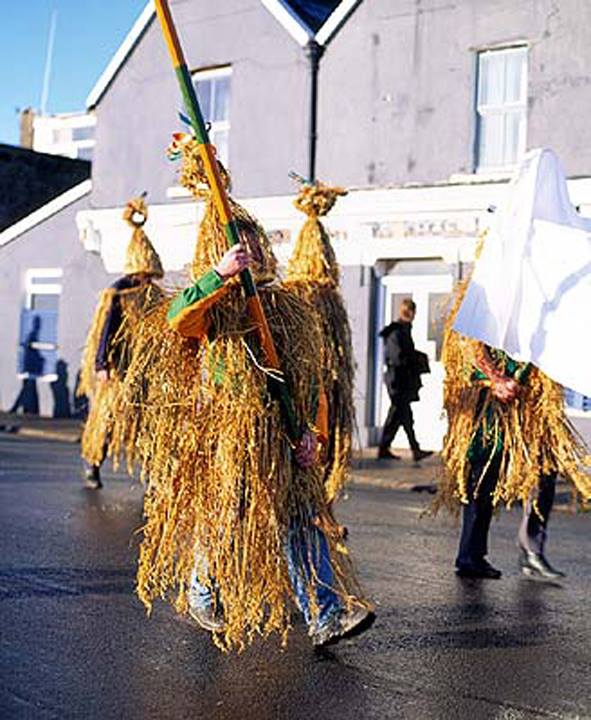
    In Ireland, St. Stephen’s Day is the Day of the Wren. It’s the day rowdy lads dress up in straw and dance around with stuffed birds (thankfully fake; they used to kill the real ones), supposedly in an allegorical homage to the birth of Christ, but also as a convenient way to extort treats (see wassailing). These wren boys or mummers show up at one’s house and sing:

    The wren, the wren, the king of all birds,
    St. Stephen’s Day was caught in the furze,
    Although he was little his honour was great,
    Jump up me lads and give us a treat.

    As I was going to Killenaule,
    I met a wren upon the wall.
    Up with me wattle and knocked him down,
    And brought him in to Carrick Town.

    Drooolin, Droolin, where’s your nest?
    ‘Tis in the bush that I love best
    In the tree, the holly tree,
    Where all the boys do follow me.

    Up with the kettle and down with the pan,
    And give us a penny to bury the wren.

    I followed the wren three miles or more,
    Three miles or more three miles or more.
    I followed the wren three miles or more,
    At six o’clock in the morning.

    I have a little box under me arm,
    Under me arm under me arm.
    I have a little box under me arm,
    A penny or tuppence would do it no harm.

    Mrs. Clancy’s a very good woman,
    a very good woman, a very good woman,
    Mrs. Clancy’s a very good woman,
    She give us a penny to bury the wren.


    Give those boys a St. Stephen’s Day pie!

    http://www.loverofcreatingflavours.co.uk/2012/11/cold-comfort-classics-2-st-stephens-day-pie/

  • Winter Solstice & Holiday Hope

    Winter Solstice & Holiday Hope

    ADVENT CALENDAR – DAY 22

    No matter what your personal creed, the real reason for the season is the Winter Solstice, the shortest day, which is why this time of year so many of the world’s cultures pull out all the stops with music, drink, evergreen, gifts and bizarre localized customs like the Yule goat (see my post of Dec. 3). It all goes back to man’s primordial desire to restore the sun and drive the cold winter away.

    So whether you set up a crèche, light candles or get liquored up and leap over bonfires, embrace life, family and community and look to the New Year with courage, optimism and appreciation. Christmas is about nothing if not hope. And love, I suppose. Remember that the next few days when you’re tempted to exchange scowls with the person who cuts you off on the way to Christmas shopping. We’re all only human. But sometimes that can be enough.

    Welcome Yule!

    One of my favorite Christmas traditions:

    One of my favorite Christmas albums (click “play all,” though you may have to be on guard to skip the occasional disruptive ad):

    https://www.youtube.com/playlist?list=PLAA2q_i2tCon6CepTgeL0n1UDUim8aueq

    This year, the original Revels runs through December 28. Search under “Revels Nationwide” at the top of the page (via the link below) to find the Revels nearest you.

    Home

    Unfortunately, the Philadelphia Revels, which used to be held in Bryn Mawr, appears to have gone belly-up. Back in the day, back in the day…

    http://articles.philly.com/1989-12-15/entertainment/26159564_1_holiday-tradition-dances-christmas

    It’s refreshing to see a Twelfth Night celebration scheduled for Boston. Contrary to what many believe (especially radio stations), Christmas does not end on December 25.

Tag Cloud

Aaron Copland (92) Beethoven (95) Composer (114) Film Music (120) Film Score (143) Film Scores (255) Halloween (94) John Williams (185) KWAX (229) Leonard Bernstein (100) Marlboro Music Festival (125) Movie Music (135) Opera (198) Philadelphia Orchestra (88) Picture Perfect (174) Princeton Symphony Orchestra (106) Radio (87) Ralph Vaughan Williams (85) Ross Amico (244) Roy's Tie-Dye Sci-Fi Corner (290) The Classical Network (101) The Lost Chord (268) Vaughan Williams (103) WPRB (396) WWFM (881)

DON’T MISS A BEAT

Receive a weekly digest every Sunday at noon by signing up here


RECENT POSTS