Tag: Clara Schumann

  • Why Is Schumann Suddenly Everywhere?

    Why Is Schumann Suddenly Everywhere?

    Is Robert Schumann having a moment?

    It seems everywhere I turn these days everyone is playing Schumann – in a way that, judging from the comparatively tepid response to his bicentennial 14 years ago, I would have never thought possible.

    Let me be clear from the start that this is not intended to be a “hit piece” on Schumann, who, by any standard, should be regarded as one of the greatest composers who ever lived. When one becomes immersed in his world, it’s not unusual for everything to go topsy-turvy. Intellectual rigor and a literary sensibility are dashed against the rocks of passion. I emerge from the brine, wringing out my clothes, exhilarated, but wondering what the hell happened. At its most personal, his music is like a siren song. But is it for every season?

    On the evidence of concert and radio programmers, it would seem so.

    Whenever I’m around my digital radio, I swear, two hours will not pass without an encounter with Schumann. Even that ne plus ultra of classical music programmers, Peter Van de Graaff, airs Schumann’s music regularly. My most recent enthusiasm is Yle Klassinen, a classical music service out of Finland. Its playlist is breathtakingly diverse, and yet, all at once, there he is again – Robert Schumann. (Even now, I am listening to Karl Goldmark. The performers: the Robert Schumann Philharmonic!)

    Is Schumann the new Brahms?

    Perhaps part of the reason we are hearing more Schumann is that we’re oversaturated with music by his star discovery. (I’m not noticing any comparable surge in the performance of music by Albert Dietrich.)

    In terms of classical radio, surely this boost is attributable in part to the form’s lamentable race to the bottom, in programming the most, and therefore shortest, selections, allowing for so much variety within a single hour, like dicing the world’s masterpieces into an overwatered gazpacho. If a work is presented complete (even classical radio hosts need to run to the bathroom), the tendency is to go “short.” Hence the insane popularity of Schumann’s Symphony No. 4, which at a half an hour or less is being aired much more frequently now than any of the Brahms’ symphonies. In their complete form, that is. Vapid radio will still drop in the third movement of Brahms 4th symphony (the one adapted and recorded by the progressive rock group Yes) from time to time.

    I’m also hearing a lot of Schumann piano music (beyond the ubiquitous “Kinderszenen”) and songs (if it’s a station that isn’t queasy about vocal music) and even substantial chamber works. I haven’t approached it scientifically, but it also seems to me that Schumann is being heard more on live concert programs.

    Is it a case of renewed curiosity, now that we’re hearing more about Clara? Is Robert riding Clara’s skirts, as she once rode his coattails? If so, I am not seeing a comparable effect with the Mendelssohns, Felix and his sister Fanny. Not that Felix Mendelssohn ever hurts for performances. It’s just that, like Schumann, everyone seems to turn up their noses and regard him as somehow “second tier.” Or perhaps as seated far to the back of the first tier.

    Of course, in the right mood, those of us of a certain disposition have no problem connecting with Schumann’s kaleidoscopic Romanticism – by turns tender and turbulent, lyrical and seething, tormented and perhaps even a little eldritch.

    There really is no one else like him – even if, of the great composers, he seems about the furthest away from Tarzan, in every respect, that I can imagine.


    Schumann of the Apes, cartoon by Pablo Helguera from 2012

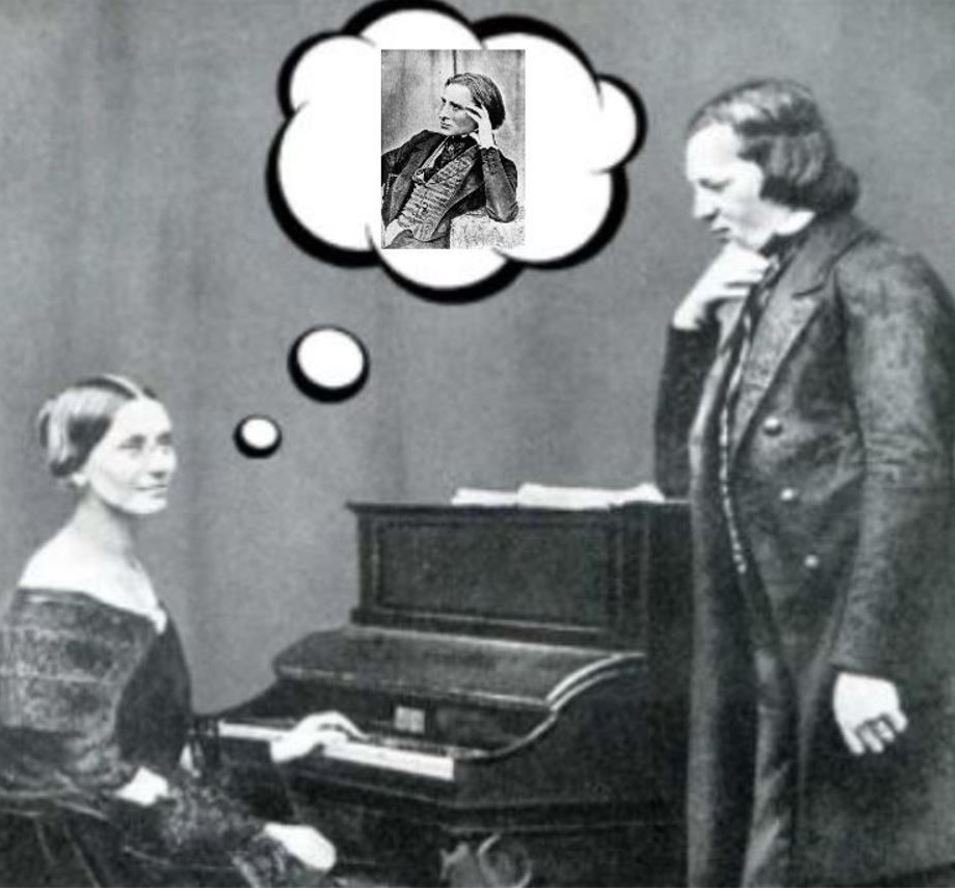
  • Schumann, Clara, & Liszt: A Musical Love Triangle

    Schumann, Clara, & Liszt: A Musical Love Triangle

    I really missed a trick this morning in not including Robert Schumann on my radio show, “Sweetness and Light.” Today is Schumann’s birthday anniversary, and my theme is June weddings. It would have been perfect had I included Franz Liszt’s arrangement of “Widmung” (“Dedication”), a song Schumann had written for his bride, Clara, as I had four or five minutes to fill at the end of the program. But perhaps it’s best that I didn’t.

    For whatever reason, Liszt really rubbed Clara the wrong way. Essentially, everything about him ran counter to what she and her husband thought music should be. But it wasn’t always the case.

    Clara first met Liszt in 1838, prior to her marriage. Clara Wieck was 19 years-old. Like everyone else, she was in awe of his superhuman technique, but it also made her feel inadequate, especially when they played piano four-hands.

    For his part, Liszt was very complimentary. In a letter to his mistress, Marie d’Agoult, he wrote, “Her compositions are truly remarkable, especially for a woman. They contain a hundred times more inventiveness and real feelings than all former and present fantasias by Thalberg.” Sigismond Thalberg was one of Liszt’s chief rivals. But this wasn’t simply “trash talk.” Liszt was consistently impressed by both Schumanns.

    In 1840, he dedicated his “Transcendental Etudes” to Clara. She continued to include his music on her concert programs until 1847. Sadly, familiarity bred contempt, and increasingly she came to find everything about him repugnant. She didn’t like that he was a showboat. She recoiled when he took liberties with the scores he played. And she was totally put off by the indelicacy with which Liszt described her husband’s Piano Quintet as “typically Leipzig.”

    Liszt, clueless, continued to make friendly overtures, championing Robert’s music. Robert, for his part, responded cordially. Liszt published a long essay in praise of the artistry of both Schumanns in 1855, but Clara remained implacable.

    As the War of the Romantics began to heat up in 1860, with heightened antagonism between the Brahmsians (including the Schumanns) and the New German School (followers of Liszt and Wagner), contact became rare.

    In 1884, Clara wrote to Liszt with the aim of copying the correspondence he maintained with her husband, who had died in 1856. Liszt responded that he hadn’t saved any of the letters. That essentially ended all interaction between them.

    45 years earlier, in 1839, Schumann completed his “Fantasie in C major,” during an imposed separation from his future wife. Clara’s father, Schumann’s piano teacher, flew into a rage when he discovered their relationship and forbade any further contact between them. (Clara had not yet reached her majority and had no say in the matter.) Following a protracted and acrimonious legal battle, the court found in favor of the young lovers, and the two married the day before Clara turned 21 – at which age she could have done as she pleased!

    Schumann wrote to Clara about the “Fantasie,” “The first movement is the most passionate I have ever composed; it is a profound lament on your account.”

    Ironically, it was Liszt who received the dedication. Liszt returned the favor by dedicating his own Piano Sonata in B minor to Schumann in 1854.

    Clara confided to her diary, “Today, Liszt sent me a Sonata dedicated to Robert and some more pieces, together with a polite note. But those pieces are so creepy! Brahms played them to me and I felt really miserable… This is only blind noise – no more healthy thoughts, everything is confused, one cannot see any clear harmonies! And, what is more, I still have to thank him now – this is really awful.”

    Of course, Robert, at 44, had already lost his grip on sanity and was by then confined to an asylum.

    With that in mind, on Robert Schumann’s birthday, enjoy his Fantasy in C major.

    Schumann vs. Wieck

    https://interlude.hk/composers-in-the-court-room-robert-schumann-versus-friedrich-wieck/?fbclid=IwZXh0bgNhZW0CMTAAAR19DNPgYutm2cGm3NxbDdD8mVZ4PwP6UsHfJu4Y0Myd1xzNhLKcm7h5QJA_aem_Aduhz14s_3TryFBTwf8hBVMPhOIrNw4rJHnmnDBS4V1pDvy04U6Medb_L_v0x2KhR4jnSgwLfnr2eLmQxQHc9mkq

    Henry Daniell, one of Hollywood’s most supercilious villains, hilariously cast as Liszt in “Song of Love” (1947), with Katharine Hepburn as Clara Schumann and Paul Henreid as Robert. As if this weren’t ridiculous enough, Robert Walker plays Brahms!

    Hepburn pantomimes selections from Schumann’s “Carnaval.” That’s Arthur Rubinstein on the soundtrack.

    Van Cliburn in concert, playing Liszt’s transcription of Schumann’s “Widmung,” written as a wedding present for Clara.

    Happy birthday, Robert Schumann!


    “Sweetness and Light” streams on KWAX Saturday mornings at 11:00 EDT/8:00 PDT.

    https://kwax.uoregon.edu/

  • Schumann’s Ghost Variations Lemonade From Madness

    Schumann’s Ghost Variations Lemonade From Madness

    When life gave him syphilis, he made lemonade. Or something like that.

    In 1854, after a twenty-year latency, Robert Schumann began to lose his grip on sanity. He complained of a persistent “A” note ringing in his ears, hallucinated that he was being hounded by devils, and hurled himself into the Rhine. He would spend his final years in an asylum, to which he committed himself at the age of 44.

    Even in the best of times, Schumann often struggled with what we now call manic-depression or bipolar disorder. His two extremes are reflected in the assumed literary doppelgangers, Florestan (the impetuous) and Eusebius (the introspective), also frequently referenced in his piano music. Evidently, there could be an undercurrent of intensity about him, even when he was at his dreamiest.

    Both before and after Schumann’s icy plunge from the bridge, he was at work on his final composition, the “Ghost Variations,” believing the theme to have been dictated to him by the spirit of Mendelssohn or Schubert. In reality, Schumann had used the theme several times before, including, only a few months earlier, in his Violin Concerto.

    Clara, his wife, wouldn’t allow the piece to be published. No doubt it held for her extremely personal, likely unpleasant associations. Still, family friend Johannes Brahms, whom Schumann had mentored and championed, would quote it in his own composition, “Variations on a Theme by Robert Schumann.”

    Brahms dedicated his tribute to Clara, who, awkwardly, also happened to be his secret (?) crush. When Schumann went into the asylum, she was pregnant with her seventh child and left to care for the family herself. She was discouraged from visiting her husband until the very end, for fear of triggering a relapse. In the meantime, Brahms was her only link, as he could enter and leave the sanatorium freely.

    The “Ghost Variations” may not be Schumann’s healthiest music, but what do you expect? It is undeniably intimate and achieves a kind of fragile beauty. You won’t encounter it very often.

    It’s also bittersweet. Kind of like a glass of lemonade.

    Happy birthday, Robert Schumann.

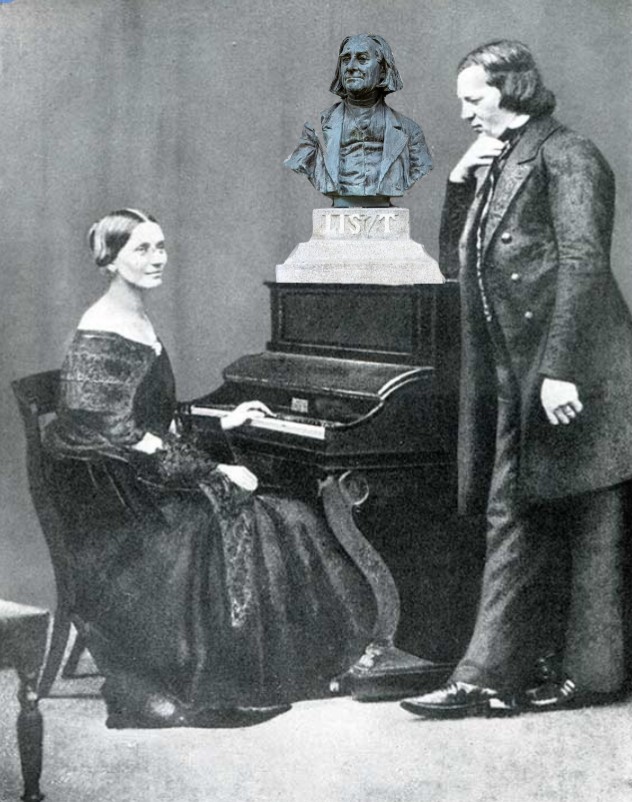
  • Clara Schumann’s Liszt Problem

    Clara Schumann’s Liszt Problem

    For whatever reason, Franz Liszt really rubbed Clara Schumann the wrong way. Essentially, everything about him ran counter to what she and her husband thought music should be. But it wasn’t always the case.

    Clara first met Liszt in 1838, prior to her marriage. Clara Wieck was 19 years-old. Like everyone else, she was in awe of his superhuman technique, but it also made her feel inadequate, especially when they played piano four-hands.

    For his part, Liszt was very complimentary. In a letter to his mistress, Marie d’Agoult, he wrote, “Her compositions are truly remarkable, especially for a woman. They contain a hundred times more inventiveness and real feelings than all former and present fantasias by Thalberg.” Sigismond Thalberg was one of Liszt’s chief rivals. But this wasn’t simply “trash talk.” Liszt was consistently impressed by both Schumanns.

    In 1840, he dedicated his “Transcendental Etudes” to Clara. She continued to include his music on her concert programs until 1847. Sadly, familiarity bred contempt, and increasingly she came to find everything about him repugnant. She didn’t like that he was a showboat. She recoiled when he took liberties with the scores he played. And she was totally put off by the indelicacy with which Liszt described her husband’s Piano Quintet as “typically Leipzig.”

    Liszt, clueless, continued to make friendly overtures, championing Robert’s music. Robert, for his part, responded cordially. Liszt published a long essay in praise of the artistry of both Schumanns in 1855, but Clara remained implacable.

    As the War of the Romantics began to heat up in 1860, with heightened antagonism between the Brahmsians (including the Schumanns) and the New German School (followers of Liszt and Wagner), contact became rare.

    In 1884, Clara wrote to Liszt with the aim of copying the correspondence he maintained with her husband, who had died in 1856. Liszt responded that he hadn’t saved any of the letters. That essentially ended all interaction between them.

    45 years earlier, in 1839, Schumann completed his “Fantasie in C major,” during an imposed separation from his future wife. Clara’s father, Schumann’s piano teacher, flew into a rage when he discovered their relationship and forbade any further contact between them. (Clara had not yet reached her majority and had no say in the matter.) Following a protracted and acrimonious legal battle, the court found in favor of the young lovers, and the two married the day before Clara turned 21 – at which age she could have done as she pleased!

    Schumann wrote to Clara about the “Fantasie,” “The first movement is the most passionate I have ever composed; it is a profound lament on your account.”

    Ironically, it was Liszt who received the dedication. Liszt returned the favor by dedicating his own Piano Sonata in B minor to Schumann in 1854.

    Clara confided to her diary, “Today, Liszt sent me a Sonata dedicated to Robert and some more pieces, together with a polite note. But those pieces are so creepy! Brahms played them to me and I felt really miserable… This is only blind noise – no more healthy thoughts, everything is confused, one cannot see any clear harmonies! And, what is more, I still have to thank him now – this is really awful.”

    Of course, Robert, at 44, had already lost his grip on sanity and was by then confined to an asylum.

    With that in mind, on Robert Schumann’s birthday, enjoy his Fantasy in C major.

    Schumann vs. Wieck

    https://interlude.hk/composers-in-the-court-room-robert-schumann-versus-friedrich-wieck/

    Henry Daniell, one of Hollywood’s stock villains, hilariously cast as Liszt in “Song of Love” (1947), with Katharine Hepburn as Clara Schumann and Paul Henreid as Robert. As if this weren’t ridiculous enough, Robert Walker plays Brahms!

    Hepburn pantomimes selections from Schumann’s “Carnaval.”

    Van Cliburn in concert, playing Liszt’s transcription of Schumann’s “Widmung,” written as a wedding present for Clara.

  • Victoria Bond Opera & Ives Recital on WWFM

    Victoria Bond Opera & Ives Recital on WWFM

    I’ve got the engine purring on the Classic Ross Amico interview machine.

    Join me this afternoon on The Classical Network for a chat with composer Victoria Bond. Bond’s new opera, “Clara,” inspired by the life of Clara Schumann, will be performed at Symphony Space in New York City, this Friday at 7 p.m. A second performance will follow in Rhinebeck, NY, on Sunday at 3.

    I’ll talk with Bond at 4:00 today. We’ll get to hear a selection from the opera, as well as music from her latest release, “Instruments of Revelation,” on the Naxos label.

    Then at 5:00, violinist Stefan Jackiw will tell us about his exciting Ives recital, with pianist Jeremy Denk, that will take place at Princeton University’s Richardson Auditorium tomorrow night at 8. The program will include not only all four violin sonatas of Charles Ives, but also demonstrations – with the help of Princeton University Glee Club – of some of the hymns, songs and marches to which the composer alludes.

    Following our conversation, we’ll get to hear Jackiw and pianist Max Levinson perform, on their album of the complete Brahms’ violin sonatas, issued on Sony Classical.

    At 6:00, it’s “Music from Marlboro,” and a salute to pianist Mieczyslaw Horszowski. We’ll hear performances of works by Johann Sebastian Bach and Ildebrando Pizzetti, captured at the legendary Marlboro Music Festival.

    Along the way, we’ll also celebrate Adolphe Sax, inventor of the saxophone, and march king John Philip Sousa on their birthdays.

    Experience music from Bach to Bond, from 4 to 7 p.m. EST, on WWFM – The Classical Network and wwfm.org.

Tag Cloud

Aaron Copland (92) Beethoven (95) Composer (114) Film Music (120) Film Score (143) Film Scores (255) Halloween (94) John Williams (185) KWAX (229) Leonard Bernstein (100) Marlboro Music Festival (125) Movie Music (135) Opera (198) Philadelphia Orchestra (88) Picture Perfect (174) Princeton Symphony Orchestra (106) Radio (87) Ralph Vaughan Williams (85) Ross Amico (244) Roy's Tie-Dye Sci-Fi Corner (290) The Classical Network (101) The Lost Chord (268) Vaughan Williams (103) WPRB (396) WWFM (881)

DON’T MISS A BEAT

Receive a weekly digest every Sunday at noon by signing up here


RECENT POSTS