Joyeux anniversaire, Claude Debussy!
Debussy, of course, is well-known for works such “La Mer,” “Prélude à l’Après-midi d’une faune,” and “Clair de lune.” But the program is, after all, “The Lost Chord,” so we’ll devote the hour this week to some less frequently encountered music.
The composer was only 21 when he was awarded the Prix de Rome in 1884, for his cantata “L’Enfant prodigue” (“The Prodigal Son”). However, it had already been his third attempt. The Prix de Rome was a very prestigious honor, a scholarship bestowed on budding French artists for 300 years, until 1968. The award, by Debussy’s time, allowed a composer subsidized residency at the Academy of France – since the days of Bonaparte housed in the Villa Medici, in Rome – where the recipient could work and study for a period of four to five years.
Unfortunately, for many of the applicants, the jury was notoriously conservative. When Ravel was turned down for the prize for a fifth time, for his now-classic String Quartet in 1905, the scandal rocked the Paris Conservatory, with charges of favoritism forcing the institution’s director to resign.
Successful applicants for the prize generally skewed to the traditional – the non-experimental. And Debussy was no exception. He actually toned it down a bit from his previous submissions, to the approbation of Gounod, Massenet and Delibes.
Of Prix de Rome winners, very few are ever performed – perhaps “Le Mort de Cleopatre” by Hector Berlioz, and “L’Enfant prodigue.” Even so, the latter is seldom recorded, and one is more likely to encounter only a brief excerpt, if anything, in concert.
The Prodigal Son, the familiar parable of Jesus, about a young wastrel who goes out into the world and squanders his fortune on extravagant delights, before returning home to his parents’ forgiving arms. In the cantata, Azael, the son, is a tenor (in this performance, sung by José Carreras); his mother, Lia, is a soprano (sung by Jessye Norman), and his father, Simeon, is a baritone (sung by Dietrich Fischer-Dieskau). The conductor is Gary Bertini.
But first, we’ll listen to some musical canapés in the form of “Six épigraphes antiques” (“Six Ancient Inscriptions”), a cycle of piano duets originally composed by Debussy as preludes to mimed recitations of poems attributed to a contemporary of Sappho, but really by the composer’s friend, Pierre Louÿs, from his collection “Les Chansons de Bilitis” (“The Songs of Bilitis”).
There’s no shortage of recordings of the original version (it’s still under-performed). However, it had been the composer’s intention to orchestrate the pieces. He never got around to it, but several others have tried, mostly notably the Swiss conductor Ernest Ansermet.
The six movements are: “To invoke Pan, god of the summer wind,” “For a nameless tomb,” “That night may be propitious,” “For the dancing girl with castanets,” “For the Egyptian Girl,” and “To thank the morning rain.”
Combined, these works represent Debussy at his most decadent and contrite. I hope you’ll join me in lauding Claude on “The Lost Chord,” now in syndication on KWAX Classical Oregon!
Joyeux anniversaire, Claude Debussy!
Debussy, of course, is well-known for works such “La Mer,” “Prélude à l’Après-midi d’une faune,” and “Clair de lune.” But the program is, after all, “The Lost Chord,” so we’ll devote the hour this week to some less frequently encountered music.
The composer was only 21 when he was awarded the Prix de Rome in 1884, for his cantata “L’Enfant prodigue” (“The Prodigal Son”). However, it had already been his third attempt. The Prix de Rome was a very prestigious honor, a scholarship bestowed on budding French artists for 300 years, until 1968. The award, by Debussy’s time, allowed a composer subsidized residency at the Academy of France – since the days of Bonaparte housed in the Villa Medici, in Rome – where the recipient could work and study for a period of four to five years.
Unfortunately, for many of the applicants, the jury was notoriously conservative. When Ravel was turned down for the prize for a fifth time, for his now-classic String Quartet in 1905, the scandal rocked the Paris Conservatory, with charges of favoritism forcing the institution’s director to resign.
Successful applicants for the prize generally skewed to the traditional – the non-experimental. And Debussy was no exception. He actually toned it down a bit from his previous submissions, to the approbation of Gounod, Massenet and Delibes.
Of Prix de Rome winners, very few are ever performed – perhaps “Le Mort de Cléopâtre” by Hector Berlioz, and “L’Enfant prodigue.” Even so, the latter is seldom recorded, and one is more likely to encounter only a brief excerpt, if anything, in concert.
The Prodigal Son, the familiar parable of Jesus, about a young wastrel who goes out into the world and squanders his fortune on extravagant delights, before returning home to his parents’ forgiving arms. In the cantata, Azael, the son, is a tenor (in this performance, sung by José Carreras); his mother, Lia, is a soprano (sung by Jessye Norman), and his father, Simeon, is a baritone (sung by Dietrich Fischer-Dieskau). The conductor is Gary Bertini.
But first, we’ll listen to some musical canapés in the form of “Six épigraphes antiques” (“Six Ancient Inscriptions”), a cycle of piano duets originally composed by Debussy as preludes to mimed recitations of poems attributed to a contemporary of Sappho, but really by the composer’s friend, Pierre Louÿs, from his collection “Les Chansons de Bilitis” (“The Songs of Bilitis”).
There’s no shortage of recordings of the original version (it’s still under-performed). However, it had been the composer’s intention to orchestrate the pieces. He never got around to it, but several others have tried, mostly notably the Swiss conductor Ernest Ansermet.
There six movements are: “To invoke Pan, god of the summer wind,” “For a nameless tomb,” “That night may be propitious,” “For the dancing girl with castanets,” “For the Egyptian Girl,” and “To thank the morning rain.”
Combined, these works represent Debussy at his most decadent and contrite. I hope you’ll join me for “Lauding Claude” on his birthday, on “The Lost Chord,” now in syndication on KWAX Classical Oregon!
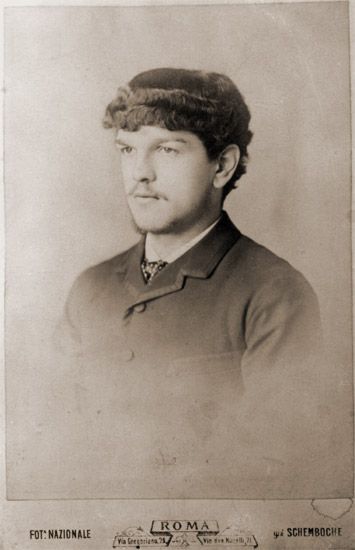
PHOTO: Debussy in Rome, which he knew he’d wind up hating, in 1885, at the age of 23
——-
Clip and save the start times for all three of my recorded shows:
PICTURE PERFECT, the movie music show – Friday at 8:00 PM EDT/5:00 PM PDT
SWEETNESS AND LIGHT, the light music program – Saturday at 11:00 AM EDT/8:00 AM PDT
THE LOST CHORD, unusual and neglected rep – Saturday at 7:00 PM EDT/4:00 PM PDT
Stream them, wherever you are, at the link!
——-
PHOTO: Debussy in Rome, which he knew he’d wind up hating, in 1885, at the age of 23
Tag: Claude Debussy
-
Lauding Claude: Debussy on “The Lost Chord”
-
Celebrating Debussy on KWAX
Catch the wave with the composer of “La Mer.” Today, to celebrate the anniversary of the birth of Claude Debussy (1862-1918), I hope you’ll consider joining me for my Saturday radio shows, “Sweetness and Light” and “The Lost Chord.”
Regarded as one of France’s greatest composers, and one of the foundational figures in 20th century music, Debussy was the most famous representative of a style known as Impressionism (although he himself loathed the term). What’s in a name?
No matter how you choose to classify it, he wrote a lot of beautiful music, and I’ve selected what I think are some of his most delightful pieces (for “Sweetness and Light”), as well some of his lesser-heard ones (for “The Lost Chord”).
On “Sweetness and Light” (11:00 EDT/8:00 PDT), we’ll enjoy orchestrations of his piano works by other hands, as well as the composer’s own arrangement of “La plus que lente” for small orchestra (including cimbalom!).
Then on “The Lost Chord” (7:00 EDT/4:00 PDT), we’ll hear “Six épigraphes antiques” (“Six Ancient Epigraphes”), orchestrated by Ernest Ansermet, and his Prix de Rome award-winning cantata “L’enfant prodigue” (“The Prodigal Son”), in a recording featuring Jessye Norman, José Carreras, and Dietrich Fischer-Dieskau.
Interested in Debussy? We’ve got you covered. Join me in lauding Claude on “Sweetness and Light” and “The Lost Chord,” on KWAX Classical Oregon!
Stream both programs, wherever you are, at the link:
https://kwax.uoregon.edu/ -

The Prodigal Sons Return
When I was in college, I was a Prokofiev nut. To the point that I would say he was probably my favorite composer. I was astonished by his melodic fecundity, and his language was just modern enough to lend a little tang.
And thanks to my love of film scores, it was comfortingly familiar, as movie composers have made frequent restorative journeys to the Russian master’s well of inspiration to lend some zing to their own compositions. Listen to “The Battle on the Ice” from “Alexander Nevsky,” the March from “The Love for Three Oranges,” and perhaps “The Death of Tybalt” from “Romeo and Juliet,” and you pretty much have yourself a film music Rosetta Stone.
During the period when I was first really getting to know this composer, beyond a childhood familiarity with “Peter and the Wolf,” I snapped up any recording of a Prokofiev piece I didn’t already own. Of course, being a student, this often involved a degree of deferred gratification.
I got around that by getting a job as a record clerk at Sam Goody’s, then (before the arrival of Tower Records) sporting the largest classical music section in Philadelphia. There, I basically signed my paycheck back over to the company, as I acquired (piecemeal) my first cycles of the symphonies of Vaughan Williams (Boult), Shostakovich (Haitink), and Prokofiev (Järvi).
After Prokofiev’s Symphony No. 1 (a.k.a. the “Classical Symphony”), No. 5 is the most popular. No. 6 also makes a great effect in concert. But I also felt an instant affinity with No. 4, which is tied up with Prokofiev’s ballet “The Prodigal Son” (choreographed by Balanchine and performed by the Ballets Russes). Prokofiev took some of the themes and episodes from the dance work and developed them into a symphony. And then he returned to it to revise it. I don’t know that it’s the strongest symphony, necessarily, but I found the music strangely compelling. And it wound up having a transformative effect on my life.
It was my whim in those days, when returning to the ancestral home (not too much a prodigal son myself, I hope) to periodically scan the radio frequencies to check if there were any classical music options I may not have known about. On one such occasion, I happened across a classical music broadcast from Allentown, PA. WMUH, based at Muhlenberg College, as a matter of fact. It was a request show, and the host put out the telephone number, so I called in and asked if I could hear Prokofiev’s Symphony No. 4.
A short while later, she came back on the air and said, “To the person who phoned in and requested the Prokofiev symphony, we don’t have it in the library, but if you want to call back, you can ask for something else.”
So I did. They didn’t have that either.
It was then that I learned that the person I was speaking with was not only the host, she was the classical director, and she said, “Look, you know more about this stuff than I do. How would you like to come in and do a show?” That’s how I fell in with the Lehigh Valley Community Broadcasters Association and came to helm my first broadcast in the summer of 1986. Little did I realize the ramifications it would have on the rest of my life.
It stuns me to consider that I have been doing radio now for 40 years. Professionally, for the past 31. I mean, I’m not that old, am I?
It helps that I got an early start. I was only 19 at the time. And it turned out I had a knack for it. Knowledge and enthusiasm can take you a long way. In my experience, they have spackled over many imperfections.
By now, I have strayed very far from my objective, which is to let you know that the New York Repertory Orchestra will be performing Prokofiev’s Symphony No. 4 this weekend. I’m not sure which version. Does it matter? It’s hardly ever done.
At some point I figured out that the Prokofiev works that communicated most directly were from a certain period of his artistic development. The earlier stuff could be a little more acerbic. Not just for the purposes of tang.
You see, Prokofiev was bit of prodigal son himself, an enfant terrible who drank deeply of the decadent West, before returning to Soviet Russia and all that would entail.
So the program, cleverly conceived by the music director David Leibowitz, works on multiple levels.
You see, you get not only Prokofiev’s “Prodigal Son” symphony, but also, by way of introduction, Claude Debussy’s early Prix de Rome winner, “L’enfant prodigue” (“The Prodigal Son”). When’s the last time you heard THAT?
Debussy originally scored the work for soprano, baritone, tenor, and piano. It was his friend, André Caplet, who provided the orchestration. (Caplet also orchestrated Debussy’s “Clair de lune” and “Children’s Corner,” among others.)
This Saturday at 8:00, both prodigals will be revived in performance by the New York Repertory Orchestra, conducted by Leibowitz, at the Church of St. Mary the Virgin, 145 West 46th Street, between 6th & 7th Avenues. Soloists in the Debussy will include soprano Sarah Cambridge, baritone Kyle Oliver, and tenor Kyle van Schoonhoven.
If you’re not enticed at the prospect, probably nothing will sway you, not even the fact that ADMISSION IS FREE (with a recommended donation of $15).
Seriously? What are you waiting for?
Of course, I’ve got a conflict this weekend (again)… But I vow, one of these days, New York Repertory Orchestra, I am coming for you!
For more information, visit https://www.nyro.org/
Clip of the orchestra rehearsing Prokofiev’s Symphony No. 4
https://www.facebook.com/reel/830354070051178——
PHOTO: Prodigal Prokofiev
-

Ernest Fanelli’s Lost Mummy Masterpiece
By the time his music was performed publicly, it had been 18 years since the composer had stopped writing.
Ernest Fanelli is one of those poor, unsung prophets of music history who wrote works brimming with colorful ideas, expressed well ahead of their time. He was underappreciated, unnoticed, or fell short of his overall potential, yet later masters capitalized, either wittingly or unwittingly, on his remarkable innovations. Others undoubtedly lifted his discoveries to greater heights, but that doesn’t change the fact that Fanelli got there first.
This week on “The Lost Chord,” with Halloween only days away, we rediscover this forgotten composer and exhume his seminal masterpiece, “The Romance of the Mummy.”
It’s fairly obvious that Fanelli’s unpublished manuscript fueled the imagination of Claude Debussy, who in turn not only influenced the course of French music, but also changed the way artists and audiences thought about music heading into 20th century. That’s not to say that Fanelli was of the same caliber as Debussy. But like Hans Rott, whose lone symphony clearly influenced Mahler, he is an essential footnote in the history of a new kind of music.
Episodes from “The Romance of the Mummy” anticipate not only Debussy and Ravel, but also Paul Dukas and Florent Schmitt, Holst, Sibelius, Respighi, Richard Strauss and even Stravinsky, a figure Fanelli would not have known. Not all of these composers were familiar with Fanelli’s work – in many cases, it’s simply a matter of music history finally catching up – but Debussy most probably was. When Fanelli’s “Mummy” was finally given its first public hearing, Debussy did his best to distance himself from the composer. He was even known to have done an about-face if he happened to walk into a café and saw Fanelli sitting at the piano.
Fanelli lived from 1860 to 1917. A French composer of Italian descent, he studied at the Paris Conservatory for a stint – allegedly under Charles-Valentin Alkan (although it’s unlikely, since Alkan had already quit the Conservatory by the time he entered). Later, he returned to study under Léo Delibes. Fanelli was unable to complete either course, due to lack of funds. In the meantime, he eked out a career as a percussionist.
He was seeking employment as a copyist in 1912, when he showed Gabriel Pierné an example of his handwriting from one of his unpublished manuscripts, written some 30 years earlier. Pierné was so taken by the actual music that he arranged for the “Mummy’s” belated premiere.
“The Romance of the Mummy,” based on a novel by Théophile Gautier, tells the tale of an English archaeologist, who exhumes and falls in love with – well, a mummy. Papyrus rolls in her mausoleum reveal her back-story and fate. She is Tahoser, who falls in love of Poeri, a handsome Hebrew. The Pharaoh (unnamed, though it would have been Ramses II) desires Tahoser for himself. However, the lovely young woman falls ill when she finds Poeri is in love with Rachel. She is healed by the prophet Moses, who initiates her into the cult of Jehovah. Pharaoh becomes an enemy of the Jewish people and abducts Tahoser. When he dies in the Red Sea, in circumstances described in the Book of Exodus, Tahoser is crowned Queen of Egypt. Hence, her presence in the pharaoh’s tomb.
The first set of tableaux is titled “Thebes,” and is made up of the subsections “Before Tehoser’s Palace,” “On the Nile,” and “Triumphal Return of the Pharaoh.”
It was the conductor Adriano who discovered a second set of tableaux in the music library of Radio France, titled “Festivities in the Pharaoh’s Palace.” The three subsections of the second set are called “In a Room in the Palace – The Naked Jugglers,” “Grotesque Dance of the Egyptian Jesters,” and “Triumphant Hymns – Orgy.” The music received its first performance only in 2002 for this release, issued on the Marco Polo label.
Is it love or infatuation? Peer behind the bandages of music history on “Mummy Dearest,” on “The Lost Chord,” now in syndication on KWAX, the radio station of the University of Oregon!
Remember, KWAX is on the West Coast, so there’s a three-hour difference for the Trenton-Princeton area. Here are the respective air-times of my recorded shows (with East Coast conversions in parentheses):
PICTURE PERFECT, the movie music show – Friday on KWAX at 5:00 PACIFIC TIME (8:00 PM EDT)
THE LOST CHORD, unusual and neglected rep – Saturday on KWAX at 4:00 PACIFIC TIME (7:00 PM EDT)
Stream them here!
-

Happy Birthday Debussy Celebrating the Faun
Happy birthday, Claude Debussy!
A good afternoon to fawn over the Faun…
Tag Cloud
Aaron Copland (94) Beethoven (95) Composer (114) Film Music (150) Film Score (143) Film Scores (255) Halloween (102) John Williams (198) KWAX (233) Leonard Bernstein (105) Marlboro Music Festival (125) Movie Music (165) Mozart (91) Opera (215) Philadelphia Orchestra (90) Picture Perfect (174) Princeton Symphony Orchestra (110) Radio (90) Ross Amico (244) Roy's Tie-Dye Sci-Fi Corner (290) The Classical Network (101) The Lost Chord (269) Vaughan Williams (107) WPRB (397) WWFM (881)