So how soon is too soon to unleash the pent-up forces of Christmas? It’s less than two weeks away. I’ve got enough in my library, probably, to program the entire month, without repeating – and yet I’ve felt sheepish about already letting slip the fairly secular “Tuttifäntchen” by Paul Hindemith and Constant Lambert’s “Les Patineurs” (“The Skaters”) after Meyerbeer.
Where do I start? How much do I play? These are but some of the decisions that weigh on the conscience of the classical music programmer. In the full knowledge that I can’t please everyone, I will rouse my slumbering inner elf and gradually crank up the volume of egg nog and mistletoe.
It won’t be all glitter and ho ho ho. There may be a few more cantatas and oratorios than some would like. Then again, how many brass arrangements of “The Twelve Days of Christmas” can one take?
Wish me luck. We’ll also have music by Swedish composer Kurt Atterberg on the anniversary of his birth, this afternoon from 4 to 7 EST, on WWFM – The Classical Network and at wwfm.org.
Serge Diaghilev, impresario of the Ballets Russes, commissioned some of the most enduring ballet scores of the 20th century, from composers such as Claude Debussy (“Jeux”), Maurice Ravel (“Daphnis and Chloe”), Manuel de Falla (“The Three-Cornered Hat”) and especially Igor Stravinsky (“The Firebird,” “Petrushka” and “The Rite of Spring”).
Less well known is the fact that he approached two Englishmen to write music for his famed and influential company.
This Sunday night on “The Lost Chord,” we’ll be listening to works by Constant Lambert and Lord Berners – both figures so diverse in their interests, and possessing such outsized personalities, that it isn’t really possible to do either justice in the time allotted.
Lambert was a brilliant polymath. In addition to his considerable talents as a composer, he was a conductor, arranger, and writer, as well as the lover of Margot Fonteyn. Alas, alcoholism and workaholism conspired with undiagnosed diabetes to hasten his demise at the age of 45.
His ballet, “Romeo and Juliet,” presented as a play-within-a-play, turns Shakespeare’s tragedy of star-crossed lovers on its head, with the leads falling hard in a backstage romance with happier results. Lambert would go on to greater things, but the ballet is undeniably an impressive piece of work for a 20 year-old.
Similarly, Lord Berners’ interests lay all over the place, but his was a much more relaxed character. Unfailingly productive as a composer, a painter and a writer, he never lost sight of the fact that his life would be his magnum opus. And Berners lived well.
Furthermore, his fortune ensured that he would never be taken to task for any of his whimsical behavior. This included having a 140-foot folly tower constructed on his estate (partly to annoy the neighbors) and inviting a horse to his indoor tea parties.
Berners wrote novels, painted portraits (always certain to include a moustache, whether the sitter had one or not), and composed a respectable amount of music, especially for the ballet.
For the Ballets Russes, he wrote “The Triumph of Neptune,” which became a great favorite of Sir Thomas Beecham. Sacheverell Sitwell provided the scenario, which concerns a sailor who is shipwrecked en route to Fairyland, and George Balanchine supplied the choreography.
I hope you’ll join me for “England à la Russe,” tonight at 10 ET, with a repeat Wednesday evening at 6, or that you’ll listen to it later as a webcast at http://www.wwfm.org.
PHOTO: Berners, no doubt contemplating the placement of a moustache
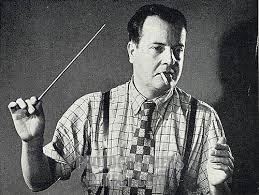
Today is the birthday of Constant Lambert, a composer perhaps too gifted, and certainly too much in love with women and drink.
Lambert was the enormously talented conductor of the Vic-Wells ballet. Like Leonard Bernstein, he believed, with justification, that his conducting duties diluted his achievements as a composer.
Nevertheless, he managed to craft some very interesting works. He was the first English composer to be commissioned by the Ballet Russes, for which he wrote “Romeo and Juliet” (1928). Perhaps more memorable is his ballet “Horoscope” (1938), based on astrological themes. The work propelled to fame the dancer Margot Fonteyn, with whom Lambert enjoyed a long, on-again, off-again affair.
His choral work, “Summer’s Last Will and Testament” (1932-35), after the Elizabethan poet Thomas Nashe, is a grim, remarkable achievement, a fatalistic meditation on plague, disease and death.
He may have been down on symphonic jazz (he assessed “Rhapsody in Blue” as neither good jazz, nor good Liszt) and neoclassicism, yet both color his Concerto for Piano and Nine Instruments (1931).
His most enduring success is “The Rio Grande” (1928), a work for vocal and piano soloists, chorus and orchestra. The text was by his friend, Sacheverell Sitwell. Lambert achieved fame, in part, as one of the speakers of Sacheverell’s sister Edith’s nonsense poems, set to music by William Walton as “Façade.”
His book, “Music Ho!,” is a quirky, entertainingly subjective piece of music criticism, in which he praises Sibelius, Liszt, Chabrier, Duke Ellington and the Marx Brothers, while taking swipes at the superficiality of “time travelers” like Francis Poulenc (who embrace all styles without achieving any depth), the neoclassicism of Stravinsky (who misapprehends the classical style), and the Russian nationalists and English pastoralists (whose music is reduced to incessant repetition of folk tunes).
You don’t have to agree with Lambert’s opinions to be delighted by his wit or stimulated by his observations.
Michael Kownacky will be presenting two hours of Lambert’s music this evening, on his program, “A Little Night Music,” which begins at 10 ET. You can hear it at http://www.wwfm.org.
Happy birthday, Constant Lambert!
Lambert conducts three numbers from his ballet “Horoscope”:
PHOTO: Lambert flaunting his fashion sense and philosophy for healthy living