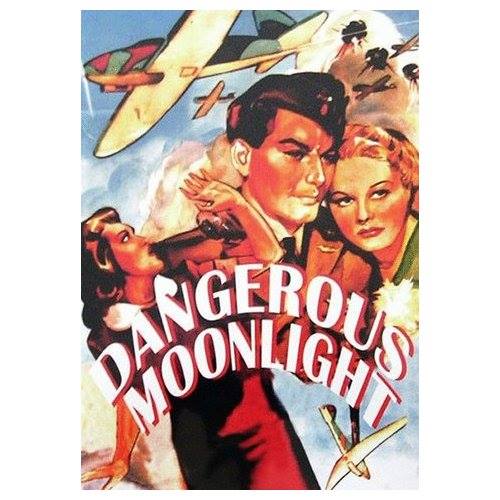
Yesterday, Richard Addinsell’s birthday, I wrote about the “Warsaw Concerto,” which was introduced in the English film “Dangerous Moonlight” (released in the U.S. as “Suicide Squadron”). The mini Rachmaninoff-style concerto went on to sell millions. I want to live in a world where a piano concerto can attain Platinum status!
As I mentioned, the work’s success sparked an unlikely rage for cinematic concerti. There followed the “Cornish Rhapsody” by Hubert Bath, from the film “Love Story” (1944), the “Dream of Olwen” by Charles Williams, from “While I Live” (1947), and most successfully, the “Spellbound Concerto,” from the Alfred Hitchcock classic (1945), actually arranged into a concerto after the fact, by Miklós Rózsa.
Other Hollywood productions, such as “The Enchanted Cottage” (1945), with music by Roy Webb, flirted with the concept, with blind pianist Herbert Marshall’s “tone poem” played throughout the film, but whether or not there was ever a commercial recording, I don’t know.
David Lean’s “Brief Encounter” (1945) went whole hog and simply used Rachmaninoff’s Piano Concerto No. 2, which is interesting since Addinsell’s orchestrator, Roy Douglas, claimed the reason for creating the “Warsaw Concerto” in the first place was because either the Rachmaninoff’s use was forbidden by the copyright holders or that it was simply too expensive.
“Dangerous Moonlight” tells the tale of a Polish pianist and composer who becomes a fighter pilot during World War II. He is discovered by an American reporter while practicing one of his compositions in a bombed-out building, and their love story commences. The title refers not only to the romantic influence of the moon, but also the more palpable threat of nighttime bombing raids.
By the way, Douglas who whipped Addinsell’s sketches into the concerto’s final form, worked for years as an assistant to Ralph Vaughan Williams and Sir William Walton. He is still listed as a vice president of the Ralph Vaughan Williams Society. Probably best known for his ballet “Les Sylphides,” he was born on December 12, 1907 – which means, as of last month, he is 107 years old!
Here’s Miklós Rózsa’s “Spellbound Concerto,” in its superior version for two pianos and orchestra, with ondes Martenot (in lieu of theremin), arranged by the composer to twice its former length:
PHOTO: The dangerous moonlight pales beside the hazard of secondhand smoke