Joyeux anniversaire, Claude Debussy!
Debussy, of course, is well-known for works such “La Mer,” “Prélude à l’Après-midi d’une faune,” and “Clair de lune.” But the program is, after all, “The Lost Chord,” so we’ll devote the hour this week to some less frequently encountered music.
The composer was only 21 when he was awarded the Prix de Rome in 1884, for his cantata “L’Enfant prodigue” (“The Prodigal Son”). However, it had already been his third attempt. The Prix de Rome was a very prestigious honor, a scholarship bestowed on budding French artists for 300 years, until 1968. The award, by Debussy’s time, allowed a composer subsidized residency at the Academy of France – since the days of Bonaparte housed in the Villa Medici, in Rome – where the recipient could work and study for a period of four to five years.
Unfortunately, for many of the applicants, the jury was notoriously conservative. When Ravel was turned down for the prize for a fifth time, for his now-classic String Quartet in 1905, the scandal rocked the Paris Conservatory, with charges of favoritism forcing the institution’s director to resign.
Successful applicants for the prize generally skewed to the traditional – the non-experimental. And Debussy was no exception. He actually toned it down a bit from his previous submissions, to the approbation of Gounod, Massenet and Delibes.
Of Prix de Rome winners, very few are ever performed – perhaps “Le Mort de Cleopatre” by Hector Berlioz, and “L’Enfant prodigue.” Even so, the latter is seldom recorded, and one is more likely to encounter only a brief excerpt, if anything, in concert.
The Prodigal Son, the familiar parable of Jesus, about a young wastrel who goes out into the world and squanders his fortune on extravagant delights, before returning home to his parents’ forgiving arms. In the cantata, Azael, the son, is a tenor (in this performance, sung by José Carreras); his mother, Lia, is a soprano (sung by Jessye Norman), and his father, Simeon, is a baritone (sung by Dietrich Fischer-Dieskau). The conductor is Gary Bertini.
But first, we’ll listen to some musical canapés in the form of “Six épigraphes antiques” (“Six Ancient Inscriptions”), a cycle of piano duets originally composed by Debussy as preludes to mimed recitations of poems attributed to a contemporary of Sappho, but really by the composer’s friend, Pierre Louÿs, from his collection “Les Chansons de Bilitis” (“The Songs of Bilitis”).
There’s no shortage of recordings of the original version (it’s still under-performed). However, it had been the composer’s intention to orchestrate the pieces. He never got around to it, but several others have tried, mostly notably the Swiss conductor Ernest Ansermet.
The six movements are: “To invoke Pan, god of the summer wind,” “For a nameless tomb,” “That night may be propitious,” “For the dancing girl with castanets,” “For the Egyptian Girl,” and “To thank the morning rain.”
Combined, these works represent Debussy at his most decadent and contrite. I hope you’ll join me in lauding Claude on “The Lost Chord,” now in syndication on KWAX Classical Oregon!
Joyeux anniversaire, Claude Debussy!
Debussy, of course, is well-known for works such “La Mer,” “Prélude à l’Après-midi d’une faune,” and “Clair de lune.” But the program is, after all, “The Lost Chord,” so we’ll devote the hour this week to some less frequently encountered music.
The composer was only 21 when he was awarded the Prix de Rome in 1884, for his cantata “L’Enfant prodigue” (“The Prodigal Son”). However, it had already been his third attempt. The Prix de Rome was a very prestigious honor, a scholarship bestowed on budding French artists for 300 years, until 1968. The award, by Debussy’s time, allowed a composer subsidized residency at the Academy of France – since the days of Bonaparte housed in the Villa Medici, in Rome – where the recipient could work and study for a period of four to five years.
Unfortunately, for many of the applicants, the jury was notoriously conservative. When Ravel was turned down for the prize for a fifth time, for his now-classic String Quartet in 1905, the scandal rocked the Paris Conservatory, with charges of favoritism forcing the institution’s director to resign.
Successful applicants for the prize generally skewed to the traditional – the non-experimental. And Debussy was no exception. He actually toned it down a bit from his previous submissions, to the approbation of Gounod, Massenet and Delibes.
Of Prix de Rome winners, very few are ever performed – perhaps “Le Mort de Cléopâtre” by Hector Berlioz, and “L’Enfant prodigue.” Even so, the latter is seldom recorded, and one is more likely to encounter only a brief excerpt, if anything, in concert.
The Prodigal Son, the familiar parable of Jesus, about a young wastrel who goes out into the world and squanders his fortune on extravagant delights, before returning home to his parents’ forgiving arms. In the cantata, Azael, the son, is a tenor (in this performance, sung by José Carreras); his mother, Lia, is a soprano (sung by Jessye Norman), and his father, Simeon, is a baritone (sung by Dietrich Fischer-Dieskau). The conductor is Gary Bertini.
But first, we’ll listen to some musical canapés in the form of “Six épigraphes antiques” (“Six Ancient Inscriptions”), a cycle of piano duets originally composed by Debussy as preludes to mimed recitations of poems attributed to a contemporary of Sappho, but really by the composer’s friend, Pierre Louÿs, from his collection “Les Chansons de Bilitis” (“The Songs of Bilitis”).
There’s no shortage of recordings of the original version (it’s still under-performed). However, it had been the composer’s intention to orchestrate the pieces. He never got around to it, but several others have tried, mostly notably the Swiss conductor Ernest Ansermet.
There six movements are: “To invoke Pan, god of the summer wind,” “For a nameless tomb,” “That night may be propitious,” “For the dancing girl with castanets,” “For the Egyptian Girl,” and “To thank the morning rain.”
Combined, these works represent Debussy at his most decadent and contrite. I hope you’ll join me for “Lauding Claude” on his birthday, on “The Lost Chord,” now in syndication on KWAX Classical Oregon!
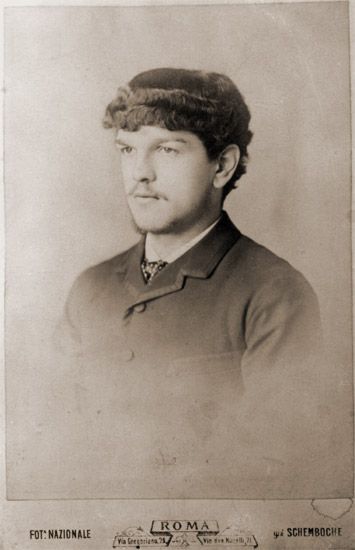
PHOTO: Debussy in Rome, which he knew he’d wind up hating, in 1885, at the age of 23
——-
Clip and save the start times for all three of my recorded shows:
PICTURE PERFECT, the movie music show – Friday at 8:00 PM EDT/5:00 PM PDT
SWEETNESS AND LIGHT, the light music program – Saturday at 11:00 AM EDT/8:00 AM PDT
THE LOST CHORD, unusual and neglected rep – Saturday at 7:00 PM EDT/4:00 PM PDT
Stream them, wherever you are, at the link!
——-
PHOTO: Debussy in Rome, which he knew he’d wind up hating, in 1885, at the age of 23
Tag: Dietrich Fischer-Dieskau
-
Lauding Claude: Debussy on “The Lost Chord”
-
Goethe’s Birthday: Schumann’s Faust & More
You want something you won’t generally hear on the radio? How about Robert Schumann’s “Scenes from Goethe’s ‘Faust’” – all blessed two hours of it, complete with vocal soloists and chorus. I’ve got a fine performance of it, all ready to go, with Dietrich Fischer-Dieskau as Faust, Elisabeth Harwood as Gretchen, and John Shirley-Quirk as Mephistopheles. The conductor? Benjamin Britten.
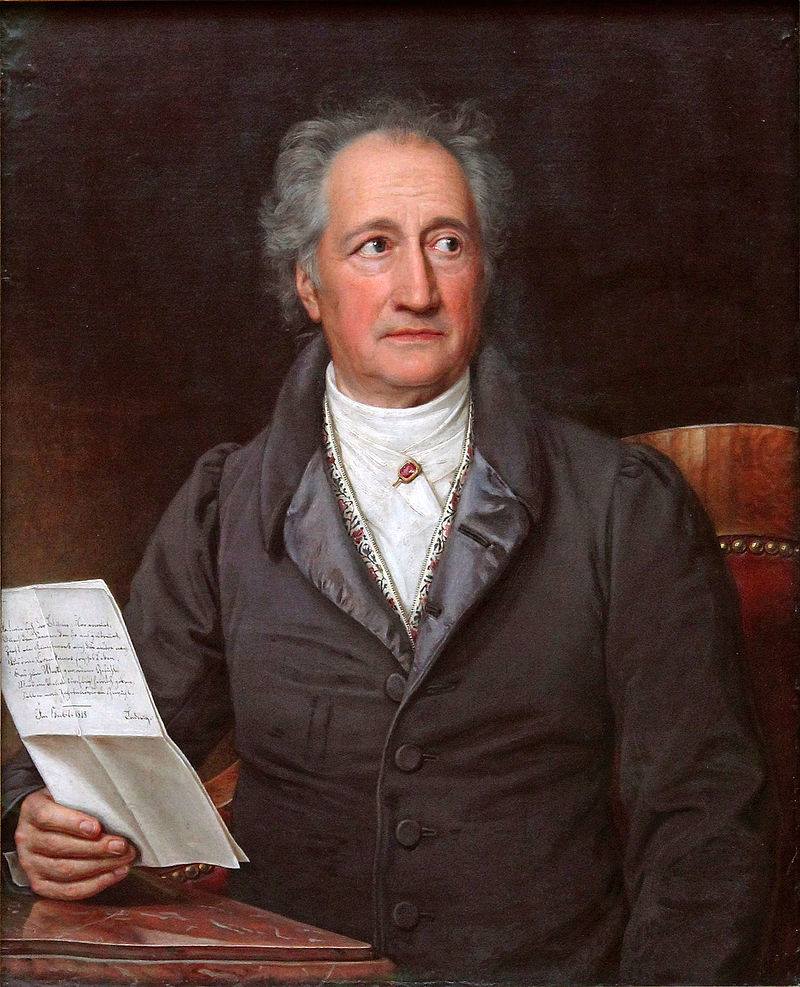
It may very well be the highlight of this morning’s show, which will be devoted to works inspired by Germany’s literary giant, Johann Wolfgang von Goethe (1749-1832), on his birthday anniversary.
Here’s the thing: in order to play what I want to play, I’ll have to start Schumann’s “Faust” at 7 a.m. So brew yourself some strong coffee and leave a message for the boss that you’ve got an emergency dental appointment and you’ll be in a little late.
There will also be symphonic poems by Liszt (“Tasso, Lament and Triumph”) and Paul Dukas (“The Sorcerer’s Apprentice,” in a vintage recording with Leopold Stokowski and the Philadelphia Orchestra), plenty of music based on melodies from Gounod’s “Faust,” Beethoven’s “Calm Sea and Prosperous Voyage,” some opera arias, and lieder, lieder, lieder, from Franz Schubert to Hugo Wolf.
All you have to do is sign this parchment with your blood.
I hope you’ll join me this morning, from 6 to 11 ET, as we celebrate Goethe, on WPRB 103.3 FM or at wprb.com. Get your fill of the quill, on Classic Ross Amico.*
*Apparently Goethe actually preferred the pencil:
http://takingnotenow.blogspot.com/2013/08/goethe-and-quill-and-pencil.html
Tag Cloud
Aaron Copland (94) Beethoven (95) Composer (114) Film Music (150) Film Score (143) Film Scores (255) Halloween (102) John Williams (198) KWAX (233) Leonard Bernstein (105) Marlboro Music Festival (125) Movie Music (165) Mozart (91) Opera (215) Philadelphia Orchestra (90) Picture Perfect (174) Princeton Symphony Orchestra (110) Radio (90) Ross Amico (244) Roy's Tie-Dye Sci-Fi Corner (290) The Classical Network (101) The Lost Chord (269) Vaughan Williams (107) WPRB (397) WWFM (881)