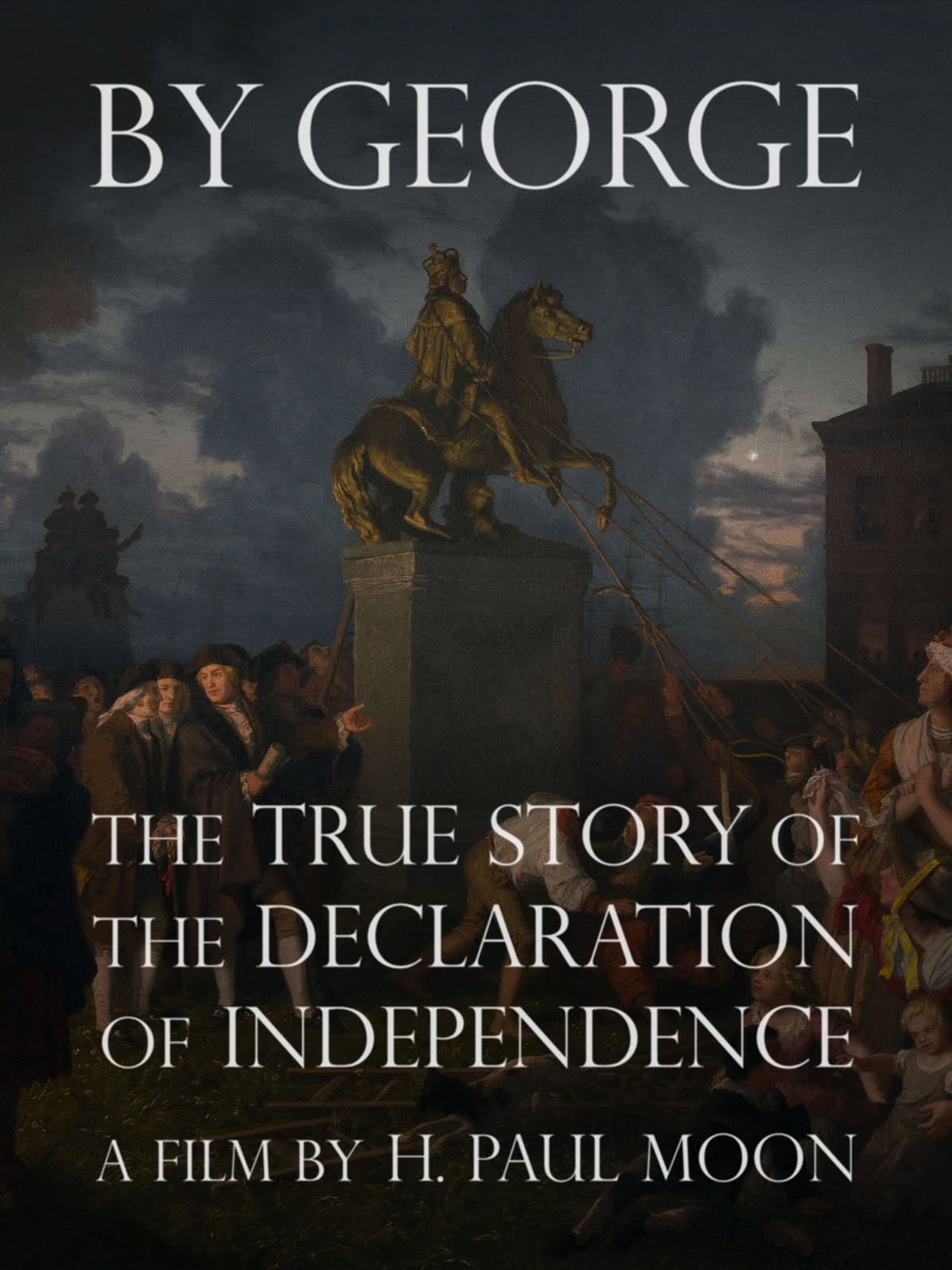
If you’re in DC or NYC, you’re in prime position to catch “By George: It All Comes Down,” a new film by H. Paul Moon for America’s Semiquincentennial.
On July 9, 1776, following the first public reading of the Declaration of Independence, New Yorkers toppled a statue of King George III that stood in Bowling Green. Among other things, the statue was melted down into musket balls to defend the American cause.
You can learn more about this one-hour documentary and the context of its New York premiere (on July 9, 2026, 250 years to the day later), a special outdoor screening just about a stone’s throw from the former location of the actual statue, by following the link. If you’re interested, you’ll also be able to reserve a free ticket.
nyc.july9th.com
In the meantime, the film is showing in a special four-screen immersive version at Dupont Underground (beneath Dupont Circle), in Washington, DC. Hourly showings take place every hour on the hour, weekends through July 5.
You can learn more about that here:
dc.july9th.com
I know Paul has worked long and hard on this project. I’ve already reserved my spot at the Battery. I hope you will join me in supporting it!
Yet more information, with stills from the film, here:
https://zenviolence.com/bygeorge
Tag: Documentary
-
By George! A New Documentary by H. Paul Moon
-
Spring Into Documentary Music from England’s Green and Pleasant Land
This week on “Picture Perfect,” with the arrival of spring, we travel to “England’s green and pleasant land” for an hour of documentary music. The playlist will include scores by some of the country’s most respected composers.
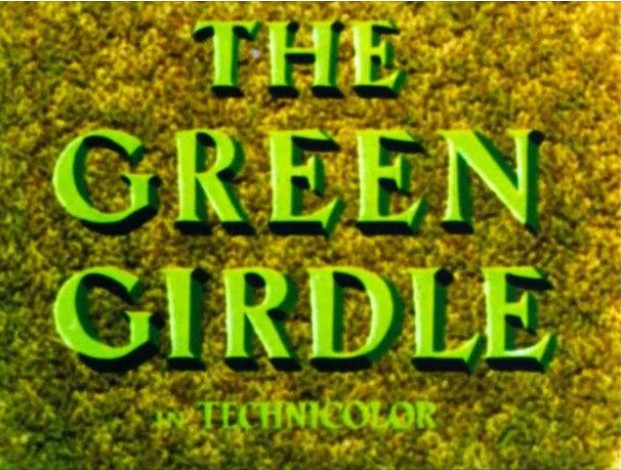
We’ll hear selections by Ralph Vaughan Williams, from “The People’s Land” (1941), Benjamin Britten, from “The King’s Stamp” (1935), William Alwyn, from “The Green Girdle” (1941), and Master of the Queen’s Music, Sir Arthur Bliss, from “The Royal Palaces of Britain” (1966). All four films are patriotic utterances on distinctly English themes.
Historically, in the United States, writing music for the movies has often been regarded as “hack work,” but overseas it has been accepted as just another aspect of what it means to be a working artist. There is no disgrace in a composer earning a living, and some of the nation’s greatest musicians – including those in the employ of the Royal Family – have contributed finely-crafted scores to its body of cinema.
You may not have seen any of these shorts, but the music sure is beautiful. I hope you’ll join me for music from English documentaries, on “The Lost Chord,” now in syndication on KWAX Classical Oregon!
——–
Clip and save the start times for all three of my recorded shows:
PICTURE PERFECT, the movie music show – Friday at 8:00 PM EDT/5:00 PM PDT
SWEETNESS AND LIGHT, the light music program – Saturday at 11:00 AM EDT/8:00 AM PDT
THE LOST CHORD, unusual and neglected rep – Saturday at 7:00 PM EDT/4:00 PM PDT
Stream them, wherever you are, at the link!
https://kwax.uoregon.edu
——–
In the meantime, if you’re having a slow day, why not get a taste of the films themselves?
“The People’s Land,” score by Vaughan Williams:
https://film.britishcouncil.org/resources/film-archive/the-peoples-land
“The King’s Stamp,” score by Benjamin Britten:
https://www.dailymotion.com/video/x21r04k
“The Green Girdle,” score by William Alwyn:
https://www.youtube.com/watch?v=YOlnnshTsvQ -
Jane Goodall Good for All
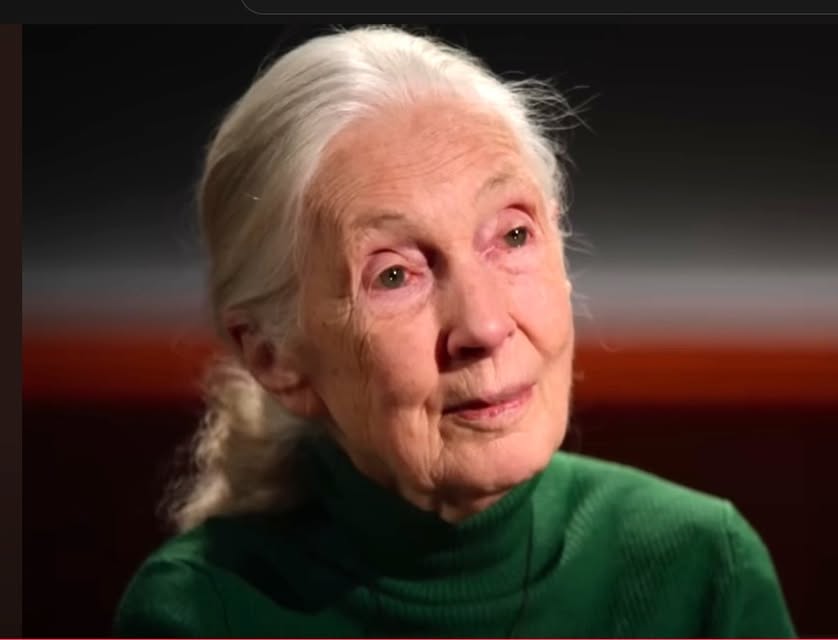
If you have Netflix and you haven’t watched this yet, you should. It’s 55 minutes very well spent. The interview was recorded with the specific intention to offer it for streaming after Jane Goodall’s death.
There are few surprises – she was a genuinely good person, and a wise one – but she’s magnetic in her serenity and honesty and insight. In particular, her true last words, after the interviewer gets up and leaves the room at the end and she’s left alone with the remotely-operated cameras, are important for everyone to hear. I don’t care what political axe you may have to grind, if any. If you aren’t touched by her humanity, I am sorry for you.
I’ve refrained from saying anything about her death, because it’s outside the arts and not really in my wheelhouse – but it is, really, since her mission was always a holistic one and what happens to any of us affects all of us, human or animal.
Don’t react to anything you may have read in the press or on social media about what she says in the interview. There’s too much tendency in the modern world to have kneejerk reactions to soundbites. Real life isn’t tabloid news, and Jane encourages us to really listen to one another. I hope you will watch and listen and really take it all in.
There’s no questioning that hers was a life well-lived. I hope her vision of what the Hereafter may hold for her spirit has come to pass. If anyone has earned it, she has.
Just a clip from “Famous Last Words: Dr. Jane Goodall”:
On Netflix here:
-
Filming Leonard Rose A Cello Legend’s Story
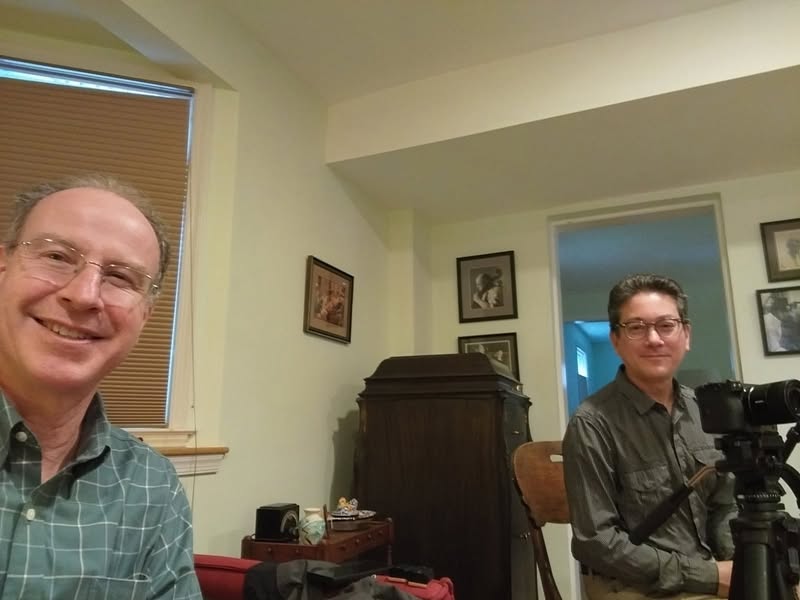
Here are a few photos of our most recent day of filming for an ongoing project, a documentary about the great American cellist Leonard Rose.
Rose was the first American-born and trained cellist to achieve a world-class solo career. He played in the NBC Symphony Orchestra under Arturo Toscanini, and as principal cellist in the Cleveland Orchestra and New York Philharmonic under Artur Rodzinski, before making the courageous decision to support himself as a star soloist. Unusually, he also developed into as a marvelous chamber musician, performing and recording with such artists as Isaac Stern, Eugene Istomin, and Glenn Gould. For most of his career he was also a perceptive teacher whose influence is still felt today. (Yo-Yo Ma was a pupil.)
I was in the DC area on Tuesday and Wednesday for our latest interview. This was an important one, as our subject was none other than Arthur Rose, the cellist’s son. Art was full of helpful information about, and insights into, Rose’s personality, his family life, and his personal dealings with his associates.
Art still works in radio after half a century as an engineer. This room is adorned with a Victrola, a vintage radio, and a harpsichord of Art’s own construction. In an adjacent room is a clavichord he also built. The walls are hung with inscribed photos of a number of Rose associates, including Pablo Casals, Jascha Heifetz, and Dimitri Mitropoulos.
Art also allowed us access to unpublished photos, a manuscript of a Rose memoir, with handwritten corrections, that the cellist was at work on at the time of his death, and rare audio recordings such as the world premiere performance of Alan Shulman’s Cello Concerto, which Rose never recorded commercially. All very exciting.
That’s H. Paul Moon behind the camera. Paul and I met when I interviewed him on the radio prior to the PBS broadcast of his award-winning documentary “Samuel Barber: Absolute Beauty.” I conduct all my interviews for the current project off-camera, with the intention of having the subjects tell Rose’s story themselves, through the magic of attentive editing.
We have a few more interviews before we wrap, at least one of them with a classical music legend. Paul has many projects going simultaneously, but we are getting there.
-

Leonard Rose Documentary NYC Interviews
I was in New York on Thursday for another round of interviews for a documentary being shot by filmmaker H. Paul Moon about the great American cellist Leonard Rose.
Here are some fun photos from the shoot, which took place at Bowery Poetry in the East Village. In various permutations, you’ll find Paul, musicologist Eric Wen (in one shot seen in the chair I usually occupy, asking questions from off-camera), cellist and Rose pupil Sara Sant’Ambrogio of the Eroica Trio, and violist Eric Shumsky, son of the legendary violinist Oscar Shumsky, who was Rose’s close associate and good friend.
There were lots of juicy stories about Toscanini, Glenn Gould, and Isaac Stern, among others, and some anecdotes about Yo-Yo Ma gone wild. I’m guessing not all of these will make it into the movie! This is an ongoing project that will continue to span many months, with more interviews in New York, Philadelphia, and D.C., and perhaps further afield.
All the interview subjects on Thursday were great, of course, but the highlight of the day, for me, surely was the realization that Wen, who is on the faculty of the Curtis Institute of Music, was a regular patron of my Philadelphia book store, back in the 1990s! He just couldn’t get over it. In particular, he treasures a Samuel Johnson facsimile he found there, and he says he and his wife still talk about the shop, despite the fact that it closed in that location all the way back in 2000. (That’s us together in another photo, taken, he says, to share with her.) As you can imagine, it made me feel really good that someone still remembers and values the space and the inventory I curated.
It turns out we have much else in common, including a shared adoration of Erich Wolfgang Korngold!
It was a real pleasure to meet everyone.
Tag Cloud
Aaron Copland (93) Beethoven (95) Composer (114) Film Music (144) Film Score (143) Film Scores (255) Halloween (94) John Williams (195) KWAX (229) Leonard Bernstein (104) Marlboro Music Festival (125) Movie Music (159) Mozart (90) Opera (212) Philadelphia Orchestra (89) Picture Perfect (174) Princeton Symphony Orchestra (109) Radio (88) Ross Amico (244) Roy's Tie-Dye Sci-Fi Corner (290) The Classical Network (101) The Lost Chord (269) Vaughan Williams (105) WPRB (397) WWFM (881)