Halloween is my favorite holiday. The weather, the movies, the music, the costumes, the treats, the decorations (except for those horrible inflatable ones), and once upon a time, the mischief. Also, the nostalgia. Seldom are the memories and sensations of childhood nearer than at this time of year.
I’ve always been a great enthusiast of classic ghost stories. Every year, I try to cram October with as much Halloween reading as possible. I’m not a fast reader, and I mostly read in bed, which means the best I can hope for is to get through a chapter or two a night, and that with drooping eyes. But I really try to cover a lot of unhallowed ground at Halloween.
In my library I have an extensive collection of supernatural fiction. I mostly gravitate toward the older stuff, from the Victorian period through the golden age of the pulps. This year, I finally took down my copy of “The Golem” (1907-14) by Gustav Meyrink. I thought it would make for an appropriate crossover with the Jewish High Holy Days (which concluded this year on October 5th). At 190 pages, I thought I could knock it out in a week.
Unfortunately, it is not a good book to read when tired, and it turned out to be a bit of a slog. Also, I don’t think if I were Jewish, I would be particularly flattered by the depictions of the inhabitants of the Prague Ghetto. Which is interesting, because Meyrink’s mother was Jewish, technically making him Jewish. But as the story unfolds, there is a little more shading to the characters.
In Jewish folklore, the Golem is an anthropomorphic being, fashioned out clay, that’s endowed with life. Depending on the tale, the Golem can be a helper, even a protector, or it can run amok, killing its creator or rampaging through the ghetto. The concept is said to have been, in part, an inspiration for “Frankenstein.”
Certainly, it was the impetus for a trilogy of silent movies by Paul Wegener. I was familiar with stills from Wegener’s vision from my boyhood fascination with classic horror films. I didn’t actually get to see one of them until I was in my 20s. Wegener’s dusty Golem, with its medieval pageboy “haircut,” remains indelible.
Unfortunately, Meyrink’s Golem is not the Golem of folklore. Rather, it serves as a murky symbol and at times doppelganger of the book’s protagonist. The tale is Kafkaesque (the two writers were contemporaries, though Meyrink was about 15 years Kafka’s senior), but I couldn’t help but think how much better it would have been had it been written by Kafka himself – or at least Arthur Machen. The overall impression is like “The Trial” meets “The Great God Pan.”
I really wanted to like the book more than I did. But frankly, I found myself pushing to get to the end of certain chapters, and it took me two weeks to finish, bleeding into time that could have spent reading another ghost story. I’m especially sorry that this wound up being my assessment, since from everything I’ve read about him, the author seems like he was a really fascinating eccentric. Among other things, there was a scandal when it was revealed he was using spiritualism to guide his actions as a banker. He and Machen were both members of the Hermetic Order of the Golden Dawn. He also translated the complete novels of Charles Dickens into German. If only “The Golem” were as interesting as its author.
Some may beg to disagree. I concede it is possible that I might have had a very different experience had I read it at a time of day when I could stay awake. H.P. Lovecraft called it “the most magnificent weird thing I’ve come across in aeons!”
My copy sits on a shelf of Dover editions. You remember Dover, right? It was a publishing house devoted to inexpensive reprints of mostly hard-to-get, often out-of-print material. The covers are all monochromatic and employ designs, usually illustrations, from early editions of the texts. Public domain is key. I hasten to add, the paper is of good quality, and copies I picked up from 40 years ago still look brand new.
“The Golem” is on the same shelf with cherished Dover editions of works by J. Sheridan LeFanu. LeFanu was a writer of Victorian ghost stories. One of the best, in fact. I read a lot of his stuff in my teens and 20s, when I was a nut for the Victorian novel. In fact, I wrote a paper on “Uncle Silas” at a time when this would have been viewed as radical. (Genre fiction was still looked upon with suspicion in academic circles back then.) It was a time before the internet, when one would have to pound the pavement and eagerly scour the inventory of bookstores in distant towns in the hopes of turning up something unusual.
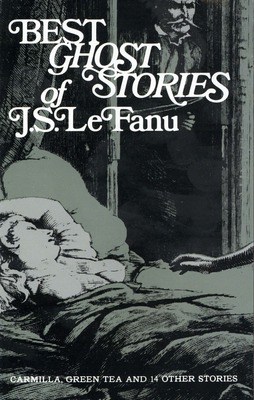
The volume I took down this year is titled, simply, “Best Ghost Stories of J.S. LeFanu.” The book incudes all the best-known stories from “In a Glass Darkly,” collected from the papers of fictional occult detective Dr. Hesselius, a prototype for Bram Stoker’s Van Helsing.
Primarily, I was interested in revisiting “Carmilla” (1872), the most compelling vampire story – more like a novella – before Stoker’s “Dracula.” About 25 years before. “Carmilla,” the tale, still oozes with atmosphere, even as ultimately Carmilla, the character, drips with blood. The story is as fascinating for its subtexts, as the quintessential lesbian vampire story, as it is for its supernatural elements. A very compelling story, with strong female characters (monsters, of course) in a world of ineffectual patriarchs. I enjoyed rereading this quite a bit, and it went by very quickly.
Nearly as much did another ghost story in the collection, which I recalled, titled “Green Tea” (also 1872), a cautionary tale of the supernatural perils of too much caffeine. How could I not love this?
Right now, I’m in the middle of another Dover edition, of J. Meade Falkner’s “The Lost Stradivarius” (1895). For a time, Falkner was best known for his novel “Moonfleet,” which was made into a film with Stewart Granger (produced by John Houseman and directed by Fritz Lang). “The Lost Stradivarius” attracted me not only for its ghostly aspects, but for its obvious musical elements. I’m only a quarter of the way into it, but so far I’m enjoying the gloomy setting, mostly in a moonlit, oak-paneled room at Oxford, in which two students conjure a phantom through the performance of an obscure Baroque violin sonata. I just read the chapter in which the title instrument makes its appearance, wrapped in a cloth and covered in cobwebs, so we’ll see where it goes from here.
The Dover edition is a slender volume of some 100 pages, so I am confident I will have it finished in enough time to take up Robert Burns’ “Tam O’Shanter” for Halloween. I just wrote about “Tam” in a post on October 21st, to coincide with Malcolm Arnold’s birthday (he composed a concert overture after the poem), so if you’re interested to learn more, you can scroll down my page. This is not a Dover edition, for once, but rather a nice, slender hardbound edition from Anro Communications. The text is presented in both Burns’ Lowland Scots and an English translation by May Kramer-Muirhead, and the amusing illustrations are by Chris Riker.
With its climactic wild ride, “Tam” resembles a kind of a Scottish “The Legend of Sleepy Hollow.” But the tale is in the telling, and Burns’ wry yarn about a drunken rogue scared sober by his misadventures involving a witches’ sabbath and a bagpipe-playing devil is a Halloween classic.
For me, it will be the last gasp for the ghost story until January, probably, as next month will be be occupied with my Thanksgiving reading and December will be taken up with Christmas. Alas, the winter is not long enough for all the gloomy books I would like to read.