In the wake of Isaias, it was as if someone had upset a giant chess board. Only, trees were the bishops and rooks that toppled across power lines and plunged Princeton into darkness. A very close knight was spent, then, pawn at my beard, as I was reduced, basically, to sleeping in a window. Checkmate!
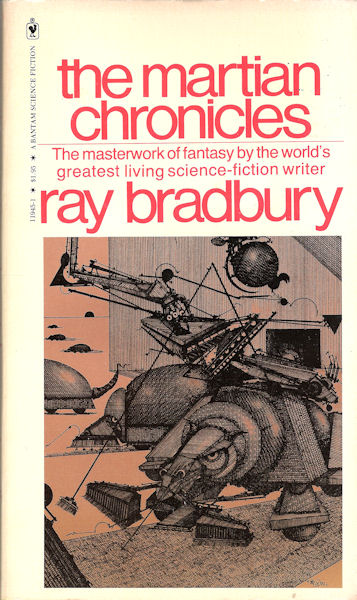
Since I do not own a smart phone, it resulted in an enforced fasting from the internet, driving me to the nearest book I could find, which happened to be Ray Bradbury’s “The Martian Chronicles,” an old, pleasantly pulp-scented paperback I’ve owned since the late 1970s. That also happens to be the last time I opened it. I finished my second reading by flashlight on Tuesday night.
Bradbury’s virtuosic and comprehensive exploration of themes surrounding Martian colonization, and all that that might imply, traces the parallel fates of Martians and mankind. Hovering somewhere between novel and short story collection (the author cites Sherwood Anderson’s “Winesburg, Ohio” as a principal influence), the book is wonderfully strange, weirdly poetic, at times humorous, frequently ironic, unusually disturbing, and often startlingly dark. And in terms of human nature, unfortunately it all rings true.
Bradbury, who lived from 1920 to 2012, would probably shake his head, but not be at all surprised by today’s world, with its twisting of facts, distortion and denial, “fake news,” censorship, historical revisionism, ignorance, fear, and lack of respect. The earth continues on its mad course, becoming more and more “science fiction” every day. Bradbury lived through the perils of Fascism, Communism with a capital C, the Cold War, and the Red Scare. Did he see today coming? Or, in his heart of hearts, did he believe in our better natures, despite our mad, self-destructive impulses? Did he intend “The Martian Chronicles” as speculative fiction, the literary exorcising of nightmares, a kind of thought-provoking what if? Or as an inevitability, given who we are?
“The Martian Chronicles” itself has been subject to censorship, with one chapter, in particular, “Way in the Middle of the Air,” omitted from the 2001 Doubleday and 2006 William Morrow/Harper Collins reprints, even though the story serves as a critique of the racism now evidently misattributed to the author. How stupid are we? How afraid? How fragile our civilization, so quick to outrage we are? In a world of sound bites, surfaces, and bold absolutes, there is little room for nuance, contemplation, and reasoned discussion. The world of “Fahrenheit 451,” sadly, chillingly, is not so far-fetched.
One of the most satisfying stories in the book must be “Usher II,” in which an Edgar Allan Poe admirer exacts gruesome revenge on those “Moral Climate Monitors” who, in their righteous zealotry, make it their lives’ missions to censor and destroy. Here’s a selection:
“Does the name Usher mean nothing to you?”
“Nothing.”
“Well, what about this name: Edgar Allan Poe?”
Mr. Bigelow shook his head.
“Of course.” Stendahl snorted delicately, a combination of dismay and contempt. “How could I expect you to know blessed Mr. Poe? He died a long while ago, before Lincoln. All of his books were burned in the Great Fire. That’s thirty years ago – 1975.”
“Ah,” said Mr. Bigelow wisely. “One of those!”
“Yes, one of those, Bigelow. He and Lovecraft and Hawthorne and Ambrose Bierce and all the tales of terror and fantasy and horror and, for that matter, tales of the future were burned. Heartlessly. They passed a law. Oh, it started very small. In 1950 and ‘60 it was a grain of sand. They began by controlling books of cartoons and then detective books and, of course, films, one way or another, one group or another, political bias, religions prejudice, union pressures; there was always a minority afraid of something, and a great majority afraid of the dark, afraid of the future, afraid of the past, afraid of the present, afraid of themselves and shadows of themselves.”
“I see.”
“Afraid of the word ‘politics’ (which eventually became a synonym for Communism among the more reactionary elements, so I hear, and it was worth your life to use the word!), and with a screw tightened here, a bolt fastened there, a push, a pull, a yank, art and literature were soon like a great twine of taffy strung about, being twisted in braids and tied in knots and thrown in all directions, until there was no more resiliency and no more savor to it. Then the film cameras chopped short and the theaters turned dark. and the print presses trickled down from a great Niagara of reading matter to a mere innocuous dripping of ‘pure’ material. Oh, the word ‘escape’ was radical, too, I tell you!”
“Was it’?”
“It was! Every man, they said, must face reality. Must face the Here and Now! Everything that was not so must go. All the beautiful literary lies and flights of fancy must be shot in mid-air. So they lined them up against a library wall one Sunday morning thirty years ago, in 1975; they lined them up, St. Nicholas and the Headless Horseman and Snow White and Rumpelstiltskin and Mother Goose – oh, what a wailing! – and shot them down, and burned the paper castles and the fairy frogs and old kings and the people who lived happily ever after (for of course it was a fact that nobody lived happily ever after!), and Once Upon a Time became No More! And they spread the ashes of the Phantom Rickshaw with the rubble of the Land of Oz; they filleted the bones of Glinda the Good and Ozma and shattered Polychrome in a spectroscope and served Jack Pumpkinhead with meringue at the Biologists’ Ball! The Beanstalk died in a bramble of red tape! Sleeping Beauty awoke at the kiss of a scientist and expired at the fatal puncture of his syringe. And they made Alice drink something from a bottle which reduced her to a size where she could no longer cry ‘Curiouser and curiouser,’ and they gave the Looking Glass one hammer blow to smash it and every Red King and Oyster away!”
He clenched his fists. Lord, how immediate it was! His face was red and he was gasping for breath.
As for Mr. Bigelow, he was astounded at this long explosion. He blinked and at last said, “Sorry. Don’t know what you’re talking about. Just names to me. From what I hear, the Burning was a good thing.”
“Get out!” screamed Stendahl. “You’ve done your job, now let me alone, you idiot!”
Beginning with the 1997 edition, the chronology of the narrative, which spans 1999 to 2026, was advanced 31 years. That annoys me almost as much as the excised chapter. It’s not as if science fiction as a genre is not rife with day-after-tomorrow speculation. The fact that Bradbury’s “future,” as he envisioned it, is already upon us does not change the truths expressed. Whether it’s 1950 (the date of the book’s publication), 1978 (when I likely first read it), or 2020, man is man – now, in “correct” circles, perhaps too generously labeled “humanity.”
We pursue our visions of utopia in ignorance or denial. And history repeats. Every day I wake up and wonder, am I the one living on Mars?