Tag: Eastman School of Music

  • Phillips, Hanson, and American Music

    Phillips, Hanson, and American Music

    I began yesterday by cracking the back of my skull on the bathroom floor, and then I had to drag my carcass to the polls, so I hope you will forgive me for taking the day off. I just react poorly to vaccines. And before anyone suggests it’s because I had tiny submarines injected into me, “Fantastic Voyage”-style, I hasten to add I know very few people who suffer anything worse than a sore arm. I’m just lucky to be blessed with an overachieving immune system, I guess. Either that, or I’m a bigger threat than I thought, a threat that can only be eliminated by tiny Donald Pleasence.

    Be that as it may, I hate to miss a day posting. It’s purely egotism, I know, since in the scheme of things, it doesn’t make any damn difference, but it does make me feel out of sorts. It’s part of my morning routine, like filling the birdfeeders and drinking a cup of coffee.

    This lengthy preamble has nothing to do with Burrill Phillips, who was born on this date in 1907. Phillips was a product of the Eastman School, and later taught there. His best-known music is “Selections from McGuffey’s Reader,” which takes its name from the old schoolhouse primers. Its three movements – “The One-Horse Shay,” “John Alden and Priscilla,” and “Midnight Ride of Paul Revere” – are inspired by writings of Oliver Wendell Holmes and Henry Wadsworth Longfellow, and possibly the Revere painting by Grant Wood. Can’t get much more consciously “American” than that.

    Phillips confided to his diary in 1933, “I don’t think anyone had written such ‘American-sounding’ music before. On the first night, the students said it was corny. And it was. But I didn’t care, because it was a huge success.” It still is.

    Later, Phillips evolved from that early, populist style to embrace more experimental techniques. I confess I don’t know any of his later work, but I try to play “Selections from McGuffey’s Reader” every year around Thanksgiving.

    Fortuitously, this also gives me the opportunity to tip the top of my skull to Howard Hanson, whose birthday (October 28, 1896) I passed over in the run-up to Halloween. For some 40 years, Hanson was director of the Eastman School. In that capacity, and as conductor of the Eastman-Rochester Orchestra, he did a world of good for American music. Hanson would be awarded the Pulitzer Prize for Music in 1944 for his Symphony No. 4, “Requiem,” dedicated to the memory of his father. But his best-known piece is unquestionably his Symphony No. 2, “Romantic,” still mined by Hollywood composers.

    Both Phillips and Hanson were Nebraska natives. (Phillips was from Omaha, and Hanson hailed from Wahoo). My heart is in the Heartland, even as the back of my head is on the bathroom floor.


    “Selections from McGuffey’s Reader” (posted separately as a YouTube playlist, so you may have to skip ads in between movements)

    Burrill Phillips’ Piano Concerto

    Howard Hanson’s “Romantic” Symphony

    History of McGuffey’s Reader


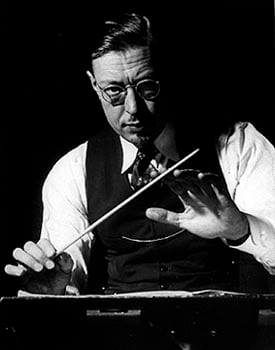
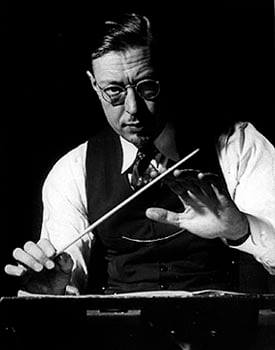
    Go Eastman, young men: Burrill Phillips (left, with music typewriter) and Howard Hanson
  • Howard Hanson Romantic Composer in Hollywood

    Howard Hanson Romantic Composer in Hollywood

    Howard Hanson, you incurable Romantic, you.

    For 40 years, you were director of the Eastman School of Music. You were the recipient of the Pulitzer Prize in 1944, for your Symphony No. 4, “Requiem,” dedicated to the memory of your father.

    You championed innumerable American composers, as conductor of the Eastman-Rochester Orchestra, an ensemble you founded. The lucky ones made it onto your now highly-collectible recordings for the Mercury label.

    Undoubtedly, your best-known music is the Symphony No. 2, “Romantic,” composed in 1930. The trademark “Hanson sound” is one of heart-on-the-sleeve lyricism, with wistful melodies arrayed in lambent orchestration.

    The Symphony No. 2 has been a great favorite in Hollywood, at least since the 1970s. How else would you have turned up in the end credits of “Alien” (1979), or been evoked in the bicycle chase and finale of “E.T.” (1982), or, most recently, been cribbed for “The Boss Baby” (2017)?

    Romantic Hanson in “Alien”:

    Hans Zimmer borrows for “The Boss Baby”:

    John Williams’ most glorious music, for the last 15 minutes of “E.T.,” would not have been the same without your influence.

    As it’s heard in the original:

    “E.T.” is a brilliant score, but clearly Williams was a fan of your “Romantic Symphony.”

    Happy birthday, Howard Hanson!


    Romantic Symphony (complete)

    Piano Concerto

    “Elegy in Memory of Serge Koussevitzky”

    Koussevitzky conducts Hanson’s Symphony No. 3

    “Pastorale” for Oboe, Harp and Strings

    Hanson conducts Henry Cowell’s Symphony No. 4, a recording that never made it to compact disc

    https://www.youtube.com/watch?v=hOz9aAMFXI8

  • Howard Hanson’s Bold Island Inspiration

    Howard Hanson’s Bold Island Inspiration

    For many, the prospect of having to work through vacation can be a real drag; but for the creative artist, getting away can be a welcome opportunity to really get things done.

    This Sunday night on “The Lost Chord,” we’ll hear three pieces associated with Bold Island, Maine, the summer home of Howard Hanson.

    For 40 years, Hanson was director of the Eastman School of Music. In that capacity he nurtured and championed innumerable American composers, giving literally thousands of premieres at the helm of the Eastman-Rochester Orchestra, an ensemble he founded. The lucky ones made it onto Hanson’s records on the Mercury label.

    Hanson, of course, was himself a composer. He was awarded the Pulitzer Prize for Music in 1944, for his Symphony No. 4 “Requiem,” written in memory of his father. But his best-known music, undoubtedly, is his Symphony No. 2 “Romantic,” composed in 1930.

    The famous “Hanson sound” is one of heart-on-the-sleeve romanticism, characterized by glowingly nostalgic melodies, though he also had his severe side. After all, he was born in Wahoo, Nebraska, to Swedish parents, and a certain Nordic austerity can be detected, especially in his later works.

    His Symphony No. 6, of 1967, is more tightly argued than his earlier, more famous symphonies. Its six brief movements are built on a recurring motif. At times, it can sound a bit like Sibelius, though Hanson very much remains his own man. Hanson being Hanson, he doesn’t really skimp on the lyricism, but he doesn’t exactly indulge it to the same extent he does in the earlier works. Still, predictably, the symphony was derided as old-fashioned by the genuinely austere musical establishment of the day.

    The Bold Island connection is through Hanson’s “Summer Seascape No. 2,” written a few years earlier, and clearly the blueprint for the symphony. In fact, the opening of the symphony is identical.

    Hanson’s first “Summer Seascape” forms the centerpiece of his “Bold Island Suite,” a separate work composed in 1961. The suite also contains movements with the descriptive titles “Birds of the Sea” and “God in Nature.”

    The North Atlantic inspires some august music, on “August Hanson,” this Sunday night at 10:00 EDT, on WWFM – The Classical Network and wwfm.org.


    PHOTO: Not-very-austere Puffins off the coast of Maine

  • Howard Hanson Romantic Composer Remembered

    Howard Hanson Romantic Composer Remembered

    Howard Hanson, you incurable Romantic, you. I wish I really had time to write about you today, on this, your birthday – but I don’t.

    For four decades, you were the director of the Eastman School of Music; you were the recipient of a Pulitzer Prize in 1944 for your Symphony No. 4; and you were the champion of hundreds of American composers as conductor of the Eastman-Rochester Orchestra. Your Symphony No. 2, subtitled “Romantic,” is still one of the most frequently encountered of all American symphonies.

    We’ll enjoy some of your recordings today, and save you a little cake, between 4 and 7 p.m. EDT, on WWFM – The Classical Network and wwfm.org.

  • Howard Hanson’s Bold Island Inspiration

    Howard Hanson’s Bold Island Inspiration

    For many people, the prospect of having to work through vacation could be a real drag; but for the creative artist, getting away can provide an opportunity to really get things done.

    This Sunday night on “The Lost Chord,” we’ll hear three pieces associated with Bold Island, Maine, the summer home of Howard Hanson.

    For 40 years, Hanson was the director of the Eastman School of Music. In that capacity he nurtured and championed innumerable American composers, giving literally thousands of premieres at the helm of the Eastman-Rochester Orchestra, an ensemble he founded. The lucky ones found their way onto records issued on the Mercury label.

    Hanson, of course, was himself a composer. He was awarded the Pulitzer Prize for Music in 1944, for his Symphony No. 4 “Requiem,” written in memory of his father. But his best known music, undoubtedly, is his Symphony No. 2 “Romantic,” composed in 1930.

    The famous “Hanson sound” is one of heart-on-the-sleeve romanticism, characterized by glowingly nostalgic melodies, though he also had his severe side. After all, he was born in Wahoo, Nebraska, to Swedish immigrants, and a certain Nordic austerity can be detected, especially in his later works.

    His Symphony No. 6, of 1967, is more tightly argued than his earlier, more famous symphonies, structured in six brief movements, built on a recurring motif. At times, it can sound a bit like Sibelius, though Hanson very much remains his own man. Hanson being Hanson, he doesn’t really skimp on the lyricism, but he doesn’t exactly indulge it to the same extent he does in the earlier works. Still, predictably, the symphony was derided as old-fashioned by the genuinely austere musical establishment of the day.

    The Bold Island connection is through Hanson’s “Summer Seascape No. 2,” written a few years earlier, and clearly the blueprint for the symphony. In fact, the opening of the symphony is identical.

    The first “Summer Seascape” was the centerpiece of the “Bold Island Suite,” a separate work composed in 1961. The suite also contains movements with the descriptive titles “Birds of the Sea” and “God in Nature.”

    The North Atlantic inspires some august music, on “August Hanson,” this Sunday night at 10:00 EDT, on WWFM – The Classical Network and wwfm.org.


    PHOTO: Not-very-austere Puffins off the coast of Maine

Tag Cloud

Aaron Copland (92) Beethoven (95) Composer (114) Film Music (119) Film Score (143) Film Scores (255) Halloween (94) John Williams (185) KWAX (229) Leonard Bernstein (99) Marlboro Music Festival (125) Movie Music (134) Opera (198) Philadelphia Orchestra (86) Picture Perfect (174) Princeton Symphony Orchestra (106) Radio (87) Ralph Vaughan Williams (85) Ross Amico (244) Roy's Tie-Dye Sci-Fi Corner (290) The Classical Network (101) The Lost Chord (268) Vaughan Williams (102) WPRB (396) WWFM (881)

DON’T MISS A BEAT

Receive a weekly digest every Sunday at noon by signing up here


RECENT POSTS