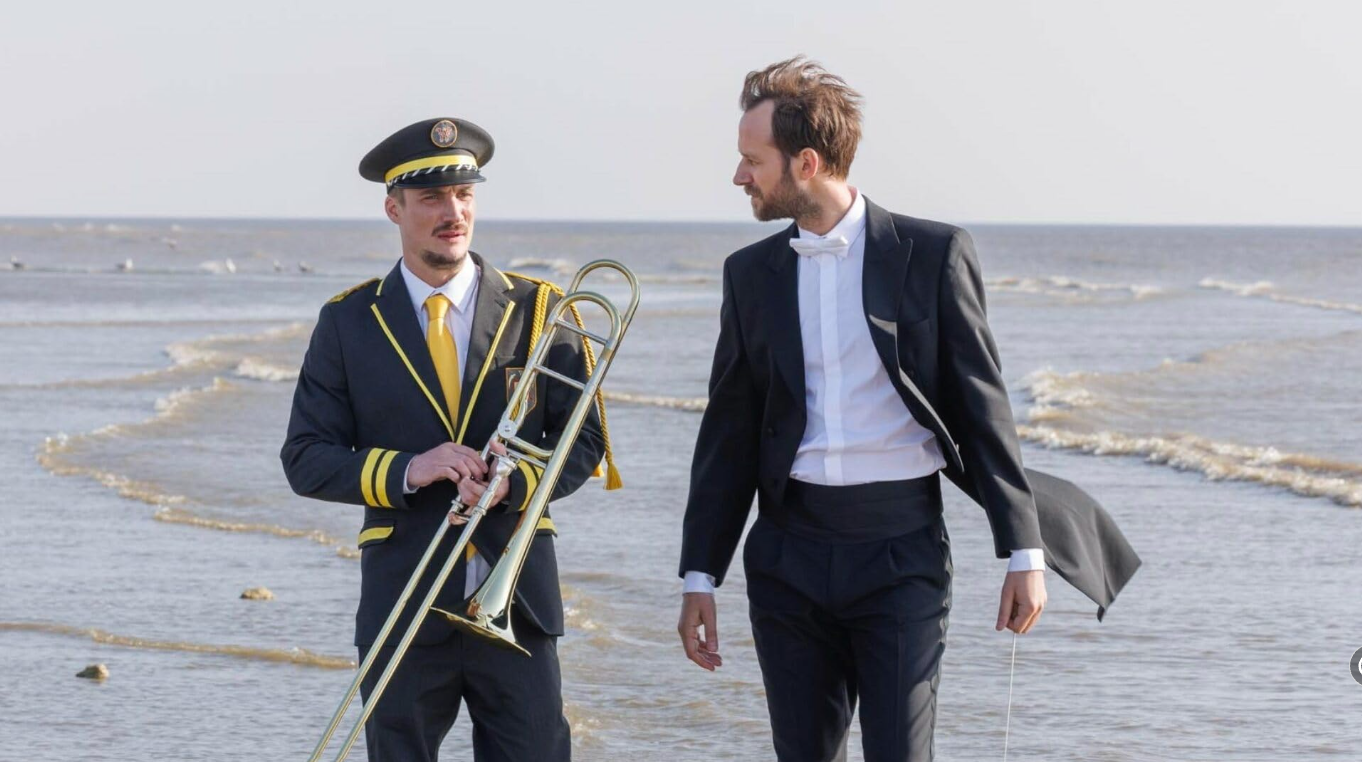
What a delightful surprise this was! My ideal condition for seeing a movie is knowing next to nothing about it, and I walked into this one cold. It’s a French film, released here in the U.S. as “The Marching Band,” which I know is not a direct translation of the original title, “En Fanfare.” There’s not a lot to spoil in the basic premise, but I will be as vague about it as possible in stating that it is about two brothers, adopted into separate families at birth, who are brought together in adulthood only to discover a surprising connection through music.
If this were made in England, I could see it becoming a quirky art house hit along the lines of “Brassed Off,” with which it shares certain elements in common. But it is French, after all, so the whimsy is a little more restrained, and the drama a little more vérité (by which I mean, literally, truthful, as opposed to anything related specifically to the style of cinema).
I walked in anticipating the focus would be on the brothers’ relationship and wholly expected the musical elements to be subservient to the drama. So often movies about classical music just don’t get the “music” and the process of creating and performing music right. I have to say, in this case, it mostly did. And there was enough Beethoven, Mozart, Mahler, Debussy, and Ravel to keep me happy.
I didn’t know who any of the actors are, but the lead, Benjamin Lavernhe, who plays an internationally recognized conductor of symphony orchestras, is very good. I looked him up, and he is predominately a stage actor, associated with classical theater (his screen credit explicitly links him to the Comédie-Française), from Euripides through Racine, Shakespeare, and Molière, to Chekhov. The most recent playwright on his resume in Bertolt Brecht. For all that, he turns in a remarkably naturalistic and easygoing charismatic performance.
Classical music people will be relieved to know that, for once, this is a movie in which an actor conducting doesn’t look like he just took a few lessons. Lavernhe is comfortable with a baton, and his bearing and technique transcend pantomime to be wholly convincing.
The other brother is played by Pierre Lottin, who has the less showy, and perhaps more difficult role, since so much of it is internalized. His character hasn’t enjoyed the same advantages as Lavernhe’s, nor does he share his constructive attitude. He’s tamping down a lifetime of hurt and disappointment, and the struggle, the suppressed emotion, can be read in his eyes. Despite himself, he finds himself opening up to his long-lost brother. But his wounds are too close to the surface, and he keeps retreating back into his shell. Interestingly, Lottin is best known in France for a series of successful comedies (the “Les Tuche” series), but here he gives a good dramatic performance.
Remarkably, the director and screenwriter, Emmanuel Courcol, is not a musician, nor did he have any formal musical training, but his family instilled in him a lifelong passion for classical music. He certainly has the right instincts in terms of finding good coaches and the right actors to commit to the training.
Lavernhe is a far more convincing conductor, and character, than Cate Blanchett’s Lydia Tár. And he comes across as a real person, as opposed to an egotistical, condescending sociopath (though unquestionably problematic conductors do exist!). It’s nice to see a music director portrayed as something other than a “Seinfeld” maestro caricature for a change.
The only part that screamed “movie” for me was the ending, which at first I found a touch contrived, though it undeniably packs an emotional punch, to the extent that it teeters on the brink of sentiment. But after I left the theater, I thought about it for a while, and I realized, though in the moment it may have been a lot to swallow and certainly seemed a little more heart-on-the-sleeve than the rest of the film, it was still within the realm of plausibility. But it is something more along the lines of what you might expect from one of those British charmers like “Brassed Off,” “The Full Monty,” “Calendar Girls,” or “Kinky Boots.” Don’t go into it expecting that kind of movie. It’s not. Unless perhaps filtered through a Gallic sensibility.
At least it lands more convincingly than Richard Dreyfuss’ painful “American Symphony” that mars “Mr. Holland’s Opus.” “The Marching Band” doesn’t tidy everything up with its spoonful of sugar, but it delivers enough of an uplift to send you out of the theater feeling you had just experienced something worthwhile.
No guns. No superheroes. No CGI. No Hans Zimmer. Just a good, solid, human movie, that will also have you thinking about the old question of nature versus nurture, as music will out!
Tag: Emmanuel Courcol
-
For Classical Music People, “The Marching Band” Gets It Mostly Right
Tag Cloud
Aaron Copland (94) Beethoven (95) Composer (114) Film Music (150) Film Score (143) Film Scores (255) Halloween (102) John Williams (198) KWAX (233) Leonard Bernstein (105) Marlboro Music Festival (125) Movie Music (165) Mozart (91) Opera (215) Philadelphia Orchestra (90) Picture Perfect (174) Princeton Symphony Orchestra (110) Radio (90) Ross Amico (244) Roy's Tie-Dye Sci-Fi Corner (290) The Classical Network (101) The Lost Chord (269) Vaughan Williams (107) WPRB (397) WWFM (881)