Tag: English Composers

  • Ballets Russes’ Lost English Composers

    Ballets Russes’ Lost English Composers

    Serge Diaghilev, impresario of the Ballets Russes, commissioned some of the most enduring ballet scores of the 20th century, from such composers as Claude Debussy (“Jeux”), Maurice Ravel (“Daphnis and Chloe”), Manuel de Falla (“The Three-Cornered Hat”), and Igor Stravinsky (“The Firebird,” “Petrushka” and “The Rite of Spring”).

    Less well known is the fact that two Englishmen were also approached.

    This Sunday night on “The Lost Chord,” we’ll listen to works by Constant Lambert and Lord Berners – both men so diverse in their interests, and possessing such outsized personalities, it isn’t really possible to do justice to either in the time allotted.

    Lambert was a brilliant polymath. In addition to his considerable talents as a composer, he was a conductor, arranger, and writer, as well as the lover of Margot Fonteyn. Alas, alcoholism and workaholism conspired with undiagnosed diabetes to hasten his demise at the age of 45.

    His ballet, “Romeo and Juliet,” presented as a play-within-a-play, turns Shakespeare’s tragedy of star-crossed lovers on its head, with the leads falling hard in a backstage romance with happier results. Lambert would go on to greater things, but the ballet is undeniably an impressive piece of work for a 20 year-old.

    Similarly, Lord Berners’ interests lay all over the place, but his was a much more relaxed character. Unfailingly productive as a composer, a painter, and a writer, nonetheless he never lost sight of the fact that life would be his magnum opus. And Berners lived well.

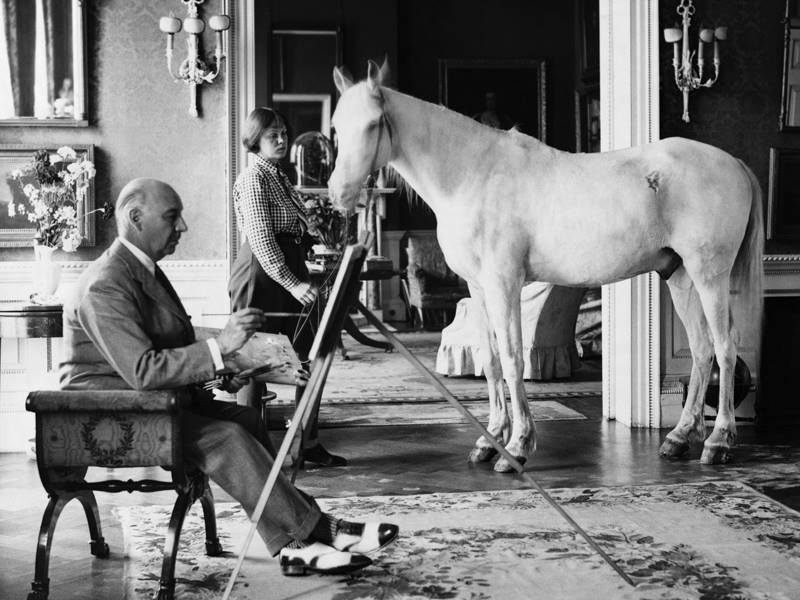
    Furthermore, his fortune ensured that he would never be taken to task for any of his whimsical behavior. This included having a 140-foot folly tower constructed on his estate (partly to annoy the neighbors) and keeping a horse and a giraffe to invite to his indoor and outdoor tea parties.

    Berners wrote novels, painted portraits (always sure to include a moustache, whether the sitter had one or not), and composed a respectable amount of music, especially for the ballet.

    For the Ballets Russes, he wrote “The Triumph of Neptune,” which became a great favorite of Sir Thomas Beecham. Sacheverell Sitwell provided the scenario, which concerns a sailor who is shipwrecked en route to Fairyland, and George Balanchine supplied the choreography.

    That’s a heady mix of hornpipes and pas de deux. I hope you’ll join me for “England à la Russe,” this Sunday night at 10:00 EDT, on WWFM – The Classical Network and wwfm.org.


    PHOTO: Berners, no doubt contemplating the placement of a moustache
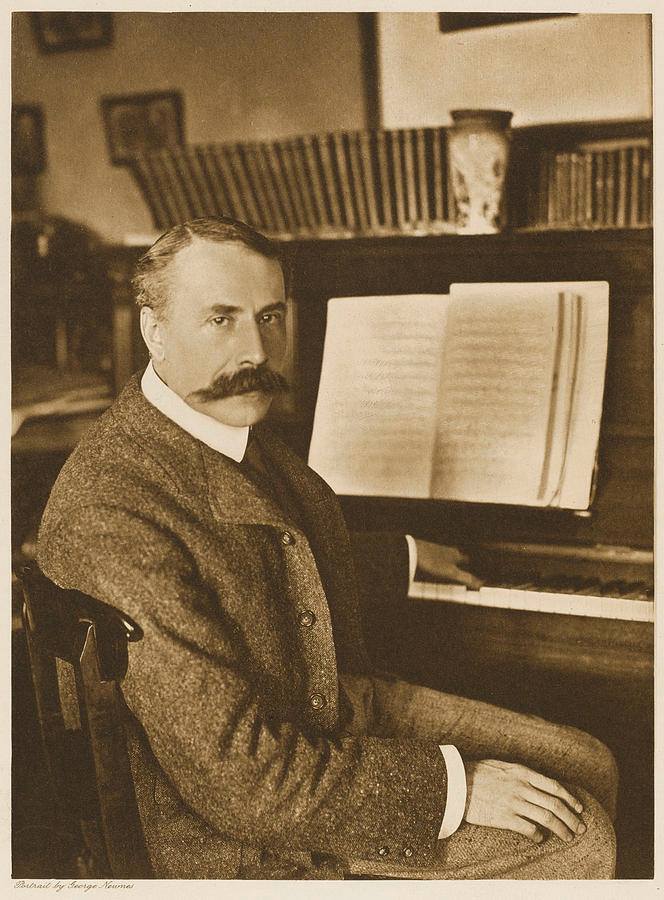
  • Elgar & Vaughan Williams Quintets Marlboro

    Elgar & Vaughan Williams Quintets Marlboro

    English music is more than simply ham, lamb, and strawberry jam. On the next “Music from Marlboro,” we’ll highlight one of the most deeply personal utterances of perhaps Albion’s most respected composer.

    In the spring of 1918, Sir Edward Elgar underwent an operation in London to have an infected tonsil removed. At the time, this was considered a dangerous operation for a 61 year-old man. When the composer regained consciousness, the first thing he did was ask for a piece of paper, and he jotted down the opening theme of what was to become his last major work, the Cello Concerto in E minor.

    The Elgars retired to Brinkwells, a thatched cottage that was their summer home near Fittleworth, in Sussex, so that they could have time to relax and recover from their ailments. Even in this idyllic setting, with its trees and farmland, the guns could be heard at night rumbling across the Channel. The First World War had a profound effect on Elgar, as it did on everyone, but most especially those of the older generation, who had regarded the Boer War as a yardstick against which the cost and loss of armed conflict had been measured.

    Nevertheless, by August, Elgar was composing again. In quick succession came the Violin Sonata in E minor, the Piano Quintet in A minor, and the String Quartet in E minor. All three works were given their first performances one hundred years ago, in May of 1919, at which point Elgar launched into the Cello Concerto, which was to be his final masterpiece.

    Elgar labored with great intensity, rising at 4 or 5:00 every morning. His music from this period is spare and almost confessional in nature, colored by nostalgia, introspection, and a kind of sad beauty.

    But when it came time to play through the quintet, the composer was surrounded by some of his closest confidantes, and he couldn’t have been happier. These included W.H. Reed, with whom he had worked on the Violin Concerto; Albert Sammons, who would make the concerto’s first complete recording, and Felix Salmond, who would assist him on the Cello Concerto.

    We’ll hear a performance of Elgar’s Piano Quintet from the 2002 Marlboro Music Festival, featuring pianist Jeremy Denk, violinists Erin Keefe and Bradley Creswick, violist Teng Li, and cellist Joel Noyes.

    That will be prefaced by another quintet, from 1912, by Ralph Vaughan Williams. Vaughan Williams’ “Phantasy Quintet” was one of a number of works commissioned from England’s great composers by Walter Wilson Cobbett, a businessman and amateur musician whose dual passions were chamber music and music of the Elizabethan era. (“Phantasy” was Cobbett’s preferred spelling.)

    Vaughan Williams’ quintet is full of Tudor inflections and stamped by the composer’s tell-tale love of folk music. RVW doubles his violas, and the instrument is heard to great effect throughout the piece. We’ll enjoy it in a 1975 performance from Marlboro, featuring violinists James Buswell and Sachiko Nakajima, violists Philipp Naegele and Caroline Levine, and cellist Anne Martindale.

    I hope you’ll join me for the quintessence of English quintets – and one fantastic phantasy – on the next “Music from Marlboro,” this Wednesday evening at 6:00 EDT, on WWFM – The Classical Network and wwfm.org.

    Marlboro School of Music and Festival: Official Page

  • Ralph Vaughan Williams: A Birthday Salute

    Ralph Vaughan Williams: A Birthday Salute

    Though he was affectionately known as “Uncle Ralph,” there was more to the man and his music than is suggested by his unpressed, avuncular persona. Ralph Vaughan Williams, more than anyone, elevated the music of the English countryside to high art. He reexamined the past, as he pushed to the future; he peered inward, even as he expressed the universal. Traditionalist and revolutionary, romantic and modernist – his was a remarkable career, and his body of work was more diverse than many realize from the countless performances of “The Lark Ascending” and the “Fantasia on a Theme by Thomas Tallis” for which he is best known.

    This Thursday morning on WPRB, we’ll attempt to convey the full genius of Ralph Vaughan Williams, with an assortment of his recordings from all across the spectrum. We’ll hear his bleakest symphony (conducted by Boult in 1954), as well as his most hopeful (conducted by Barbirolli in 1944). We’ll hear an orchestral fantasy from one of his least-known operas, and the final act of another, which became the basis for one of his most beloved works. We’ll hear rare gems issued by major labels, such as EMI and London/Decca, in their glory days, as well as hard-working independents that specialize in English music, such as Dutton Vocalion Records and Albion Records, the record label of the Ralph Vaughan Williams Society. We’ll hear a recording made by David Munrow, unheard since its release on LP in 1977. We’ll hear works inspired by Spenser and Shakespeare and Aristophanes. Sir David Willcocks will conduct one of RVW’s substantial choral works, and the composer himself with lead a rollicking performance of one of his most hilarious overtures.

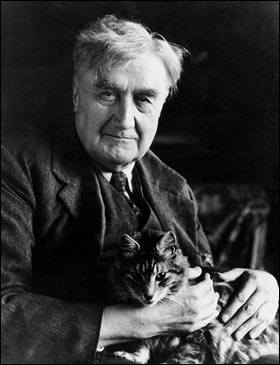
    These are some of the attractions you can expect, as we salute Ralph Vaughan Williams on his birthday. I hope you’ll join me this Thursday morning from 6 to 11 EDT on WPRB 103.3 FM and wprb.com. We’ll do our best to keep the cat hairs out of the cake, on Classic Ross Amico.


    PHOTO: Vaughan Williams engaged in a shedding contest with his friend, Foxy

  • The Frankfurt Group: English Music Pioneers

    The Frankfurt Group: English Music Pioneers

    The Frankfurt Group, sometimes called the Frankfurt Gang, met at the Hoch Conservatory in Frankfurt-am-Main in the 1890s. The group included Balfour Gardiner, Roger Quilter, Norman O’Neill, Cyril Scott, and the youngest of the bunch, the piano prodigy Percy Grainger.

    Later, though never officially part of the group, other figures became closely associated, including Frederic Delius, Sir Thomas Beecham, and the composer Frederic Austin.

    The Hoch Conservatory of the day had the reputation of being one of the very finest in Europe. Clara Schumann had been on the faculty there until 1892 – within a few years of the Frankfurt Group’s arrival. In fact, at least one of them, Cyril Scott had already been there.

    Scott arrived at the school early, at the age of 12, and then later returned for a second stint. Balfour Gardiner was also there twice, taking a break to attend Oxford. Grainger was 13 at the time he was admitted. He was to remain at the Hoch Conservatory for four-and-a-half years.

    What united this brilliant array of young talent in a foreign land? Well, there was shared language and culture, of course, but also a determination to break away from the dominant, Teutonic musical thinking of the time, and especially the place, to create a fresh English art.

    I hope you’ll join me for “Hochschule Musical,” sampling works by members of the Frankfurt Group, this Sunday night at 10:00 EST on “The Lost Chord,” on WWFM – The Classical Network and at wwfm.org.


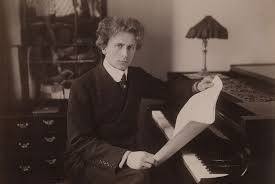
    PHOTOS: Former classmates (clockwise from top) Percy Grainger, Cyril Scott, and Roger Quilter

  • Lloyd & Vaughan Williams Symphonies on WPRB

    Lloyd & Vaughan Williams Symphonies on WPRB

    Right now on WPRB, we’re listening to the Symphony No. 4 by the underrated English composer George Lloyd, a work which grew out his experiences serving in the Royal Marines during WWII.

    Lloyd’s vessel was struck by a torpedo while he was manning the transmitting station deep within the ship’s hold. He nearly drowned, as many of his shipmates and close comrades actually did, in fuel oil. Though he survived the ordeal, he suffered from shell shock and could not speak for nearly a year.

    As he recovered, he began to compose again, hoping to exorcise his demons. The result was his Symphony No. 4, subtitled the “Arctic,” a surprisingly optimistic work, considering its genesis. But, as the composer points out, he also experienced much beauty during his service in the North Sea, including a memorable trip up the Norwegian coast.

    Of the infectious marches that characterize the work’s final movement, the composer remarked wryly, “… perhaps I was trying to end the symphony by reaffirming the old convention that when the funeral is over the band plays quick, cheerful tunes to go home.”

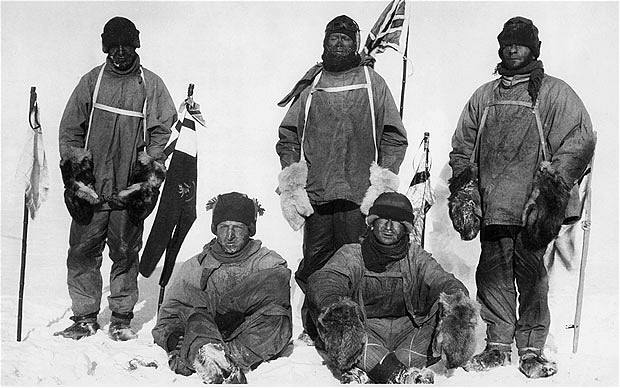
    Coming up in the 9:00 hour, we’ll have another English symphony, suggestive of the opposite pole, the Symphony No. 7 by Ralph Vaughan Williams, subtitled “Sinfonia Antarctica.” Vaughan Williams’ opus grew out of his film score for the Ealing Studios adventure “Scott of the Antarctic,” which starred John Mills as doomed explorer Robert Falcon Scott.

    Vaughan Williams’ symphony captures a sense of foreboding in the face of punishing elements and the desolation of the Antarctic landscape. Along the way, he evokes chill winds, crashing ice slides, and the play of penguins and whales.

    Sir Adrian Boult recorded the work twice. The earlier recording featured spoken prefaces by Sir John Gielgud, who reads from English poets and Scott’s diary. The performance itself is quite good, though expectedly not as vivid as the later, stereo remake. So as to share the best of both worlds this morning, I will interpolate the Gielgud readings into the stereo performance.

    Stick around, and you’ll also get to hear music inspired by the aurora borealis, by Uuno Klami and Geirr Tveitt. We’ll go to any lengths to keep cool, until 11 EDT on WPRB 103.3 FM and at wprb.com.

Tag Cloud

Aaron Copland (92) Beethoven (95) Composer (114) Film Music (120) Film Score (143) Film Scores (255) Halloween (94) John Williams (185) KWAX (229) Leonard Bernstein (100) Marlboro Music Festival (125) Movie Music (135) Opera (198) Philadelphia Orchestra (88) Picture Perfect (174) Princeton Symphony Orchestra (106) Radio (87) Ralph Vaughan Williams (85) Ross Amico (244) Roy's Tie-Dye Sci-Fi Corner (290) The Classical Network (101) The Lost Chord (268) Vaughan Williams (103) WPRB (396) WWFM (881)

DON’T MISS A BEAT

Receive a weekly digest every Sunday at noon by signing up here


RECENT POSTS