Tag: Enigma Variations

  • Elgar’s Enigmatic Violin Concerto

    Elgar’s Enigmatic Violin Concerto

    In 1905, the celebrated violinist Fritz Kreisler remarked to the press, “If you want to know whom I consider to be the greatest living composer, I say without hesitation Elgar… I say this to please no one; it is my own conviction… I place him on an equal footing with my idols, Beethoven and Brahms. He is of the same aristocratic family. His invention, his orchestration, his harmony, his grandeur, it is wonderful. And it is all pure, unaffected music. I wish Elgar would write something for the violin.”

    Two years later, Elgar complied, beginning work on a concerto at Kreisler’s request. (In 1909, the piece was formally commissioned by the Royal Philharmonic Society.) The completed work was given its first public performance in 1910 and received immediate, widespread acclaim. Kreisler himself was not disappointed. He declared it “the greatest violin concerto since Beethoven’s.”

    Heartbreakingly, plans for Kreisler and Elgar to record the work fell through. The first recording of the piece, using the acoustic process and an abridgement of the score, was in 1916, with Marie Hall the soloist and Elgar on the podium. Later, Hall would advise Ralph Vaughan Williams on the violin part of “The Lark Ascending,” which she would introduce in both versions (first for violin and piano, and then for violin orchestra).

    The first COMPLETE recording, made using the electrical process, which allowed for greatly improved dynamic range and realism, was set down in 1929 by Albert Sammons with Sir Henry Wood conducting.

    It was record producer Fred Gaisberg’s desire to preserve the concerto with Elgar conducting in better sound, with Kreisler reprising his interpretation, but when Kreisler proved to be elusive, he turned instead to the teenaged Yehudi Menuhin. In the event, Menuhin rose to the challenge and their recording of the concerto has remained in the catalogue since it was first issued in 1932.

    The Violin Concerto is not the work of a composer whose legacy was soon to be reduced to, and sadly dismissed as, one of pomp and empire, a relic of the Edwardian era. Rather, it is a confessional work of great tenderness and intimacy.

    There have been many theories as to whom the composer might have had in mind in prefacing his score with the Spanish superscription, “Aqui está encerrada el alma de…..” (“Herein is enshrined the soul of…..”). By Elgar’s own admission, the unusual ellipsis of five dots is meant to signify one of his acquaintances. Does it hint at his close friend and confidante Alice Stuart Wortley, married daughter of the painter John Everett Millais? “Windflower” was the affectionate name Elgar bestowed upon her, and he professed that the concerto is full of “windflower themes.”

    Or could it be Helen Weaver, a violinist to whom Elgar was briefly engaged, before they were divided by economic and religious objections on the part of her family? When Helen contracted tuberculosis, she departed for New Zealand, and Elgar never saw her again. (It is believed that Weaver is the subject of the penultimate variation, there identified with three asterisks, in Elgar’s “Enigma Variations.” The music quotes Mendelssohn’s “Calm Sea and Prosperous Voyage,” with a side-drum played in a manner perhaps suggestive of a steamer’s engine.)

    Or, as Elgar scholar Jerrold Northrop Moore suggested, are there actually multiple souls enshrined (Wortley and Weaver in the first movement; Elgar’s wife, Alice, and his mother in the second; and violinist W.H. “Billy” Reed, with whom he worked closely on the concerto, and the composer’s friend and publisher Augustus Jaeger, subject of the “Enigma’s” famous “Nimrod” variation, in the third)?

    Elgar, in his ceremonial music and portraits, may have projected an air of self-confidence and respectability, but beneath the veneer of that push-broom mustache and starched collar was an artist of great sensitivity, fundamental melancholy, and jealously guarded privacy.

    Raised Roman Catholic in a predominately Protestant country, he rose from lowly origins (his father worked in music sales, his mother was the daughter of a farm worker, and he was largely self-taught as a composer) to become the most celebrated musician in the land as Master of the King’s Music.

    It’s interesting that late in life Elgar affected to care more about attending the races than promoting his own music. Perhaps he would be amused to find himself characterized as a dark horse. On paper, he was the ultimate outsider. It’s hardly surprising that emotional and intellectual enigmas would underpin his greatest masterworks.

    Happy birthday, Sir Edward Elgar.


    Yehudi Menuhin and Elgar in 1932

    Tasmin Little and Andrew Davis at the Proms in 2011

  • Vaughan Williams & Elgar Lansdale Concert

    Vaughan Williams & Elgar Lansdale Concert

    Two of my favorite pieces of music by English composers (which is to say, two of my favorite pieces of music, period) will be performed tonight by the Southeastern Pennsylvania Symphony Orchestra: Ralph Vaughan Williams’ Symphony No. 5 and Edward Elgar’s “Enigma Variations.” The concert will take place at 7:30 p.m. at Calvary Baptist Church, minutes from downtown Lansdale, PA. Tickets at spsorchestra.org

  • Is Elgar Still Relevant? A Reappraisal

    Is Elgar Still Relevant? A Reappraisal

    Is there a more out-of-fashion composer than Sir Edward Elgar?

    For many, Elgar is inseparable from “Pomp and Circumstance.” His ceremonial music conjures visions of Imperial England (and, of course, stateside graduation ceremonies), though anyone with a sensitive ear will detect the melancholy underpinnings of the artist.

    Elgar was a soulful composer, whose faith, love of country, love of wife, and love of animals enriched his existence and informed his music. That said, not all was peaches and cream. Of humble origins in a class-conscious society (his fiancée was disinherited for accepting his proposal), a Catholic in an overwhelmingly Protestant nation, and an autodidact who rose to England’s highest musical office (he served as Master of the King’s music for ten years), he was seldom wholly comfortable in his own skin. Haunted by feelings of inadequacy, this perpetual outsider yet managed to become his country’s most celebrated composer.

    He was also a grand procrastinator, often getting lost in his experiments as an amateur chemist and shirking his responsibilities in favor of slipping off to the races.

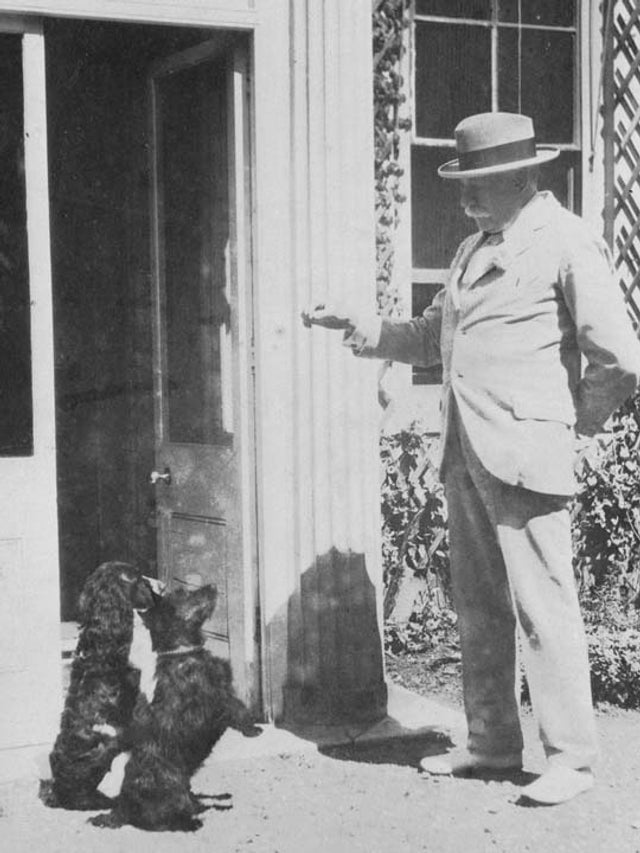
    Though he loved his wife devotedly (he wrote little of note after her death in 1920), he was deprived while she lived of the pleasure of the company of dogs, which he adored. A close friend’s bulldog, Dan, became an honorary pet, and as we know from Elgar’s letters and marginalia in his manuscripts, the spirit of Dan infuses a surprising number of his works. (Most famously, an episode in which Dan tumbled into the Thames is immortalized as one of the “Enigma Variations.”)

    After the death of his wife, Elgar was able to openly indulge his passion for dogs, even setting places for them at his table. One of these was a cairn terrier named Mina, who was the inspiration for a charming miniature, his very last work:

    Hilarious video of the “Enigma” variation inspired by Dan falling into the Thames – here associated with ants, bees, and birds!

    Elgar home movies, including footage of Mina and his spaniel Marco

    One of my favorite pieces of all time, the “Enigma Variations.” The “Nimrod” variation (beginning around the 11:19 mark) turned up in the movie “Dunkirk” a few years ago, so maybe Elgar isn’t as out-of-fashion as I think.

    Jacqueline Du Pré performing Elgar’s masterful Cello Concerto, written in the wake of World War I

    Elgar, colorized, conducting his greatest hit. “Land of Hope and Glory,” of course, is the trio section of his Pomp and Circumstance March No. 1. A happy coincidence that he was born during graduation season!

    https://www.youtube.com/watch?v=n3KLDKg9IVA

    Happy Birthday, Sir Edward Elgar!

  • Renaissance Riddles and Musical Games on WWFM

    Renaissance Riddles and Musical Games on WWFM

    Looking for a little diversion?

    On today’s Noontime Concert on The Classical Network, the ensemble Pomerium will present “Musical Games, Puzzles, and Riddles of the Renaissance: A Century of Musical Ingenuity, 1410-1510.” The program was designed to complement an exhibit of Renaissance playing cards mounted at The Met Cloisters in early 2016.

    Pomerium was founded in New York by Alexander Blachly in 1972. The group has fostered the careers of such outstanding early music performers as Julianne Baird, Drew Minter, and members of Anonymous 4.

    This concert was presented at St. Bartholomew’s Church, 50th Street and Park Avenue, in Midtown Manhattan, where free concerts are held every Thursday at 1:15 p.m.

    Its broadcast is made possible in part by Gotham Early Music Scene, or GEMS. GEMS is a non-profit corporation that supports and promotes artists and organizations in New York City devoted to early music – music of the Middle Ages, Renaissance, Baroque, and early Classical periods. For more information and GEMS’ events calendar, look online at gemsny.org.

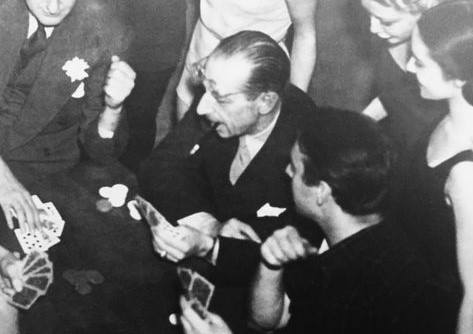
    Following the Pomerium concert, we’ll continue with an afternoon of musical diversions and cryptograms, shuffling works about games (Stravinsky’s “Jeu de Cartes” – “A Card Game”) with some actual musical puzzles and codes (Elgar’s “Enigma Variations”). Among these will be “32 Cryptograms for Derek Jarman,” a nod to Philadelphia composer Robert Moran, on his birthday.

    Here’s hoping you’re game for an afternoon of great music, from 12 to 4 p.m. EST, on WWFM – The Classical Network and wwfm.org.


    PHOTO: Stravinsky the card sharp

  • Elgar’s Enigma Decoding New Year’s Blues

    Elgar’s Enigma Decoding New Year’s Blues

    THE SEVENTH DAY OF CHRISTMAS

    New Year’s Eve, my nemesis. The most depressing day of the year.

    Fortunately, I’ll be working tonight, so I’m hoping I’ll be able to ignore all the hollow attempts at merriment. But it hasn’t happened so far, that I can remember. Once, I even flew through the night to Europe, hoping to confound the natural passage of time. But it’s always midnight somewhere, and the flight attendants vexed me with a champagne toast.

    At any rate, I hope whatever you are doing, you have a better attitude, and that you are all safe and genuinely happy with your New Year’s lot.

    Don’t get me wrong, I’m pretty happy with my life. It’s just New Year’s I hate!

    To coat the bitter pill, I’d like to talk for a minute about Sir Edward Elgar. For over a hundred years, musicologists have puzzled over the hidden theme Elgar claims to have left off of his “Enigma Variations” – which, come to think of it, is a great New Year’s Eve piece, since it celebrates friendship as an antidote to what the composer claimed was his sense of loneliness as an artist.

    “Through and over the whole set, another and larger theme ‘goes,’ but is not played,” Elgar wrote.

    Since then, theories as to the theme’s identity have ranged from “Rule, Britannia” to the “Dies Irae” to “Pop Goes the Weasel.” Here’s an interesting article from 1991 that posits the elusive theme may have been taken from Mozart’s “Prague” Symphony.

    http://www.nytimes.com/1991/11/07/arts/new-answer-to-a-riddle-wrapped-in-elgar-s-enigma-variations.html

    In this clip, someone actually uses the opening of the “Enigma” to harmonize “Auld Lang Syne.”

    What do you think?

    Ernest Tomlinson takes this theory about as far as it can go, suggesting that “Auld Lang Syne” underlies not only Elgar’s magnum opus, but also most of the world’s great masterpieces. He puts his money where his mouth is, with tongue planted firmly in cheek, by sending up no less than 152 familiar melodies in his “’Auld Lang Syne’ Variations.’”

    Happy New Year, everyone.

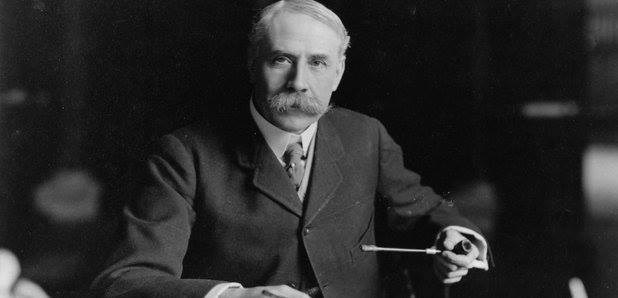
    PHOTO: Sir Edward takes a pipe for Auld Lang Syne

Tag Cloud

Aaron Copland (92) Beethoven (95) Composer (114) Film Music (120) Film Score (143) Film Scores (255) Halloween (94) John Williams (185) KWAX (229) Leonard Bernstein (100) Marlboro Music Festival (125) Movie Music (135) Opera (198) Philadelphia Orchestra (88) Picture Perfect (174) Princeton Symphony Orchestra (106) Radio (87) Ralph Vaughan Williams (85) Ross Amico (244) Roy's Tie-Dye Sci-Fi Corner (290) The Classical Network (101) The Lost Chord (268) Vaughan Williams (103) WPRB (396) WWFM (881)

DON’T MISS A BEAT

Receive a weekly digest every Sunday at noon by signing up here


RECENT POSTS