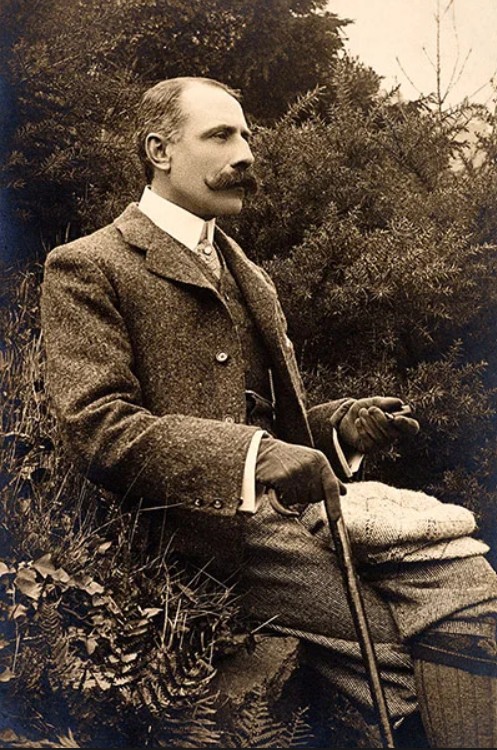
In 1905, the celebrated violinist Fritz Kreisler remarked to the press, “If you want to know whom I consider to be the greatest living composer, I say without hesitation Elgar… I say this to please no one; it is my own conviction… I place him on an equal footing with my idols, Beethoven and Brahms. He is of the same aristocratic family. His invention, his orchestration, his harmony, his grandeur, it is wonderful. And it is all pure, unaffected music. I wish Elgar would write something for the violin.”
Two years later, Elgar complied, beginning work on a concerto at Kreisler’s request. (In 1909, the piece was formally commissioned by the Royal Philharmonic Society.) The completed work was given its first public performance in 1910 and received immediate, widespread acclaim. Kreisler himself was not disappointed. He declared it “the greatest violin concerto since Beethoven’s.”
Heartbreakingly, plans for Kreisler and Elgar to record the work fell through. The first recording of the piece, using the acoustic process and an abridgement of the score, was in 1916, with Marie Hall the soloist and Elgar on the podium. Later, Hall would advise Ralph Vaughan Williams on the violin part of “The Lark Ascending,” which she would introduce in both versions (first for violin and piano, and then for violin orchestra).
The first COMPLETE recording, made using the electrical process, which allowed for greatly improved dynamic range and realism, was set down in 1929 by Albert Sammons with Sir Henry Wood conducting.
It was record producer Fred Gaisberg’s desire to preserve the concerto with Elgar conducting in better sound, with Kreisler reprising his interpretation, but when Kreisler proved to be elusive, he turned instead to the teenaged Yehudi Menuhin. In the event, Menuhin rose to the challenge and their recording of the concerto has remained in the catalogue since it was first issued in 1932.
The Violin Concerto is not the work of a composer whose legacy was soon to be reduced to, and sadly dismissed as, one of pomp and empire, a relic of the Edwardian era. Rather, it is a confessional work of great tenderness and intimacy.
There have been many theories as to whom the composer might have had in mind in prefacing his score with the Spanish superscription, “Aqui está encerrada el alma de…..” (“Herein is enshrined the soul of…..”). By Elgar’s own admission, the unusual ellipsis of five dots is meant to signify one of his acquaintances. Does it hint at his close friend and confidante Alice Stuart Wortley, married daughter of the painter John Everett Millais? “Windflower” was the affectionate name Elgar bestowed upon her, and he professed that the concerto is full of “windflower themes.”
Or could it be Helen Weaver, a violinist to whom Elgar was briefly engaged, before they were divided by economic and religious objections on the part of her family? When Helen contracted tuberculosis, she departed for New Zealand, and Elgar never saw her again. (It is believed that Weaver is the subject of the penultimate variation, there identified with three asterisks, in Elgar’s “Enigma Variations.” The music quotes Mendelssohn’s “Calm Sea and Prosperous Voyage,” with a side-drum played in a manner perhaps suggestive of a steamer’s engine.)
Or, as Elgar scholar Jerrold Northrop Moore suggested, are there actually multiple souls enshrined (Wortley and Weaver in the first movement; Elgar’s wife, Alice, and his mother in the second; and violinist W.H. “Billy” Reed, with whom he worked closely on the concerto, and the composer’s friend and publisher Augustus Jaeger, subject of the “Enigma’s” famous “Nimrod” variation, in the third)?
Elgar, in his ceremonial music and portraits, may have projected an air of self-confidence and respectability, but beneath the veneer of that push-broom mustache and starched collar was an artist of great sensitivity, fundamental melancholy, and jealously guarded privacy.
Raised Roman Catholic in a predominately Protestant country, he rose from lowly origins (his father worked in music sales, his mother was the daughter of a farm worker, and he was largely self-taught as a composer) to become the most celebrated musician in the land as Master of the King’s Music.
It’s interesting that late in life Elgar affected to care more about attending the races than promoting his own music. Perhaps he would be amused to find himself characterized as a dark horse. On paper, he was the ultimate outsider. It’s hardly surprising that emotional and intellectual enigmas would underpin his greatest masterworks.
Happy birthday, Sir Edward Elgar.
Yehudi Menuhin and Elgar in 1932
Tasmin Little and Andrew Davis at the Proms in 2011
Leave a Reply