Tag: Edward Elgar

  • Elgar’s Enigmatic Violin Concerto

    Elgar’s Enigmatic Violin Concerto

    In 1905, the celebrated violinist Fritz Kreisler remarked to the press, “If you want to know whom I consider to be the greatest living composer, I say without hesitation Elgar… I say this to please no one; it is my own conviction… I place him on an equal footing with my idols, Beethoven and Brahms. He is of the same aristocratic family. His invention, his orchestration, his harmony, his grandeur, it is wonderful. And it is all pure, unaffected music. I wish Elgar would write something for the violin.”

    Two years later, Elgar complied, beginning work on a concerto at Kreisler’s request. (In 1909, the piece was formally commissioned by the Royal Philharmonic Society.) The completed work was given its first public performance in 1910 and received immediate, widespread acclaim. Kreisler himself was not disappointed. He declared it “the greatest violin concerto since Beethoven’s.”

    Heartbreakingly, plans for Kreisler and Elgar to record the work fell through. The first recording of the piece, using the acoustic process and an abridgement of the score, was in 1916, with Marie Hall the soloist and Elgar on the podium. Later, Hall would advise Ralph Vaughan Williams on the violin part of “The Lark Ascending,” which she would introduce in both versions (first for violin and piano, and then for violin orchestra).

    The first COMPLETE recording, made using the electrical process, which allowed for greatly improved dynamic range and realism, was set down in 1929 by Albert Sammons with Sir Henry Wood conducting.

    It was record producer Fred Gaisberg’s desire to preserve the concerto with Elgar conducting in better sound, with Kreisler reprising his interpretation, but when Kreisler proved to be elusive, he turned instead to the teenaged Yehudi Menuhin. In the event, Menuhin rose to the challenge and their recording of the concerto has remained in the catalogue since it was first issued in 1932.

    The Violin Concerto is not the work of a composer whose legacy was soon to be reduced to, and sadly dismissed as, one of pomp and empire, a relic of the Edwardian era. Rather, it is a confessional work of great tenderness and intimacy.

    There have been many theories as to whom the composer might have had in mind in prefacing his score with the Spanish superscription, “Aqui está encerrada el alma de…..” (“Herein is enshrined the soul of…..”). By Elgar’s own admission, the unusual ellipsis of five dots is meant to signify one of his acquaintances. Does it hint at his close friend and confidante Alice Stuart Wortley, married daughter of the painter John Everett Millais? “Windflower” was the affectionate name Elgar bestowed upon her, and he professed that the concerto is full of “windflower themes.”

    Or could it be Helen Weaver, a violinist to whom Elgar was briefly engaged, before they were divided by economic and religious objections on the part of her family? When Helen contracted tuberculosis, she departed for New Zealand, and Elgar never saw her again. (It is believed that Weaver is the subject of the penultimate variation, there identified with three asterisks, in Elgar’s “Enigma Variations.” The music quotes Mendelssohn’s “Calm Sea and Prosperous Voyage,” with a side-drum played in a manner perhaps suggestive of a steamer’s engine.)

    Or, as Elgar scholar Jerrold Northrop Moore suggested, are there actually multiple souls enshrined (Wortley and Weaver in the first movement; Elgar’s wife, Alice, and his mother in the second; and violinist W.H. “Billy” Reed, with whom he worked closely on the concerto, and the composer’s friend and publisher Augustus Jaeger, subject of the “Enigma’s” famous “Nimrod” variation, in the third)?

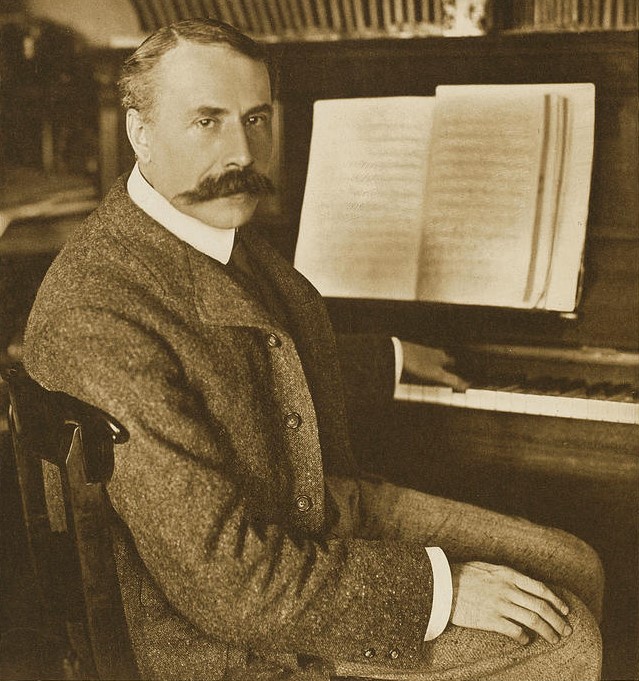
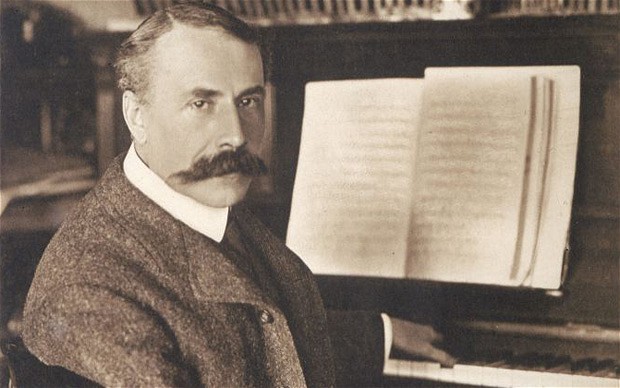
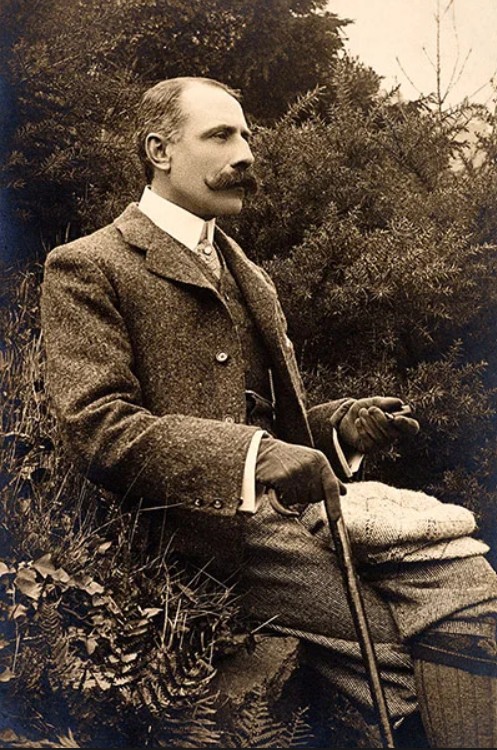
    Elgar, in his ceremonial music and portraits, may have projected an air of self-confidence and respectability, but beneath the veneer of that push-broom mustache and starched collar was an artist of great sensitivity, fundamental melancholy, and jealously guarded privacy.

    Raised Roman Catholic in a predominately Protestant country, he rose from lowly origins (his father worked in music sales, his mother was the daughter of a farm worker, and he was largely self-taught as a composer) to become the most celebrated musician in the land as Master of the King’s Music.

    It’s interesting that late in life Elgar affected to care more about attending the races than promoting his own music. Perhaps he would be amused to find himself characterized as a dark horse. On paper, he was the ultimate outsider. It’s hardly surprising that emotional and intellectual enigmas would underpin his greatest masterworks.

    Happy birthday, Sir Edward Elgar.


    Yehudi Menuhin and Elgar in 1932

    Tasmin Little and Andrew Davis at the Proms in 2011

  • Elgar’s Pomp and Circumstance: Beyond Graduation

    Elgar’s Pomp and Circumstance: Beyond Graduation

    It’s only appropriate that the composer of “Pomp and Circumstance” would be born at the height of graduation season.

    Of course, commencement was the furthest thing from Sir Edward Elgar’s mind when he came to compose his most famous march. His “Pomp and Circumstance” marches are military marches, full of splendor and pageantry, conceived well before Elgar and everyone he knew were plunged into suffering as a result of the widespread loss and devastation wrought by World War I. The first four marches mostly sparkle with the sheen, naivete, and romance of soldiers on parade.

    He wrote five “Pomp and Circumstance” marches in all, and you know what? They’re all terrific. They should be played as a set more often, as the character, mood, and tempi of the marches vary. In fact, taken as whole, they should be regarded with the same level of respect as Dvořák’s “Slavonic Dances.”

    Really, though, they weren’t conceived that way. The first four marches were published between 1901 and 1907, when Elgar was in his 40s. The fifth was published in 1930, when he was in his 70s. A belated addendum, then, yet it rounds off the collection so beautifully! It does have a sense of valediction about it.

    It is the “Pomp and Circumstance March No. 1” that has been drummed into the consciousness of all Americans as the graduation march. Given its first performance in Liverpool in 1901, it was fated to take its place as a staple of commencement ceremonies all across the U.S. after it was played as the processional at Yale University in 1905, in the presence of the composer, who was presented with an honorary doctorate.

    In England, the trio section, the part everyone here processes to, is also recognized as “Land of Hope and Glory.” Elgar repurposed the tune for use in his “Coronation Ode” for King Edward VII. With the text further modified, it then took its place as a fixture at the Last Night of the Proms. It’s played at sporting events and anywhere a hit of patriotism is required. It is an undeniably stirring tune.

    Unfortunately, it’s ubiquity has also led to Elgar being inextricably tied up with the idea of “empire” and “imperialism,” which is deeply unfortunate, as Elgar was a man and an artist of great sensitivity, who as a Roman Catholic and the son of a tradesman, often felt out of step with the character and actions of the English establishment. He gained a large following for his patriotic works, but his wider output is full of music that is marked by intimacy, frequently confessional in nature, and often quite soulful.

    A sixth “Pomp and Circumstance” march was completed posthumously, using the composer’s sketches, by Anthony Payne. I always regard such exercises as curiosities, and I am happy to hear them, but they are by no means “canon.” That said, Payne, a composer himself, did a marvelous job assembling an Elgar Third Symphony, again using sketches and fragments as a springboard. (The proper title of the work is “Edward Elgar: the sketches for Symphony No. 3 elaborated by Anthony Payne.”) It’s not Elgar, but personally I find it to be a quite beautiful and successful piece. As long as listeners are aware that it is not, by any stretch of the imagination, Elgar’s vision.

    The set of five marches is very satisfying as it stands, but I’m also including Payne’s elaboration of Elgar’s sketches for a sixth at the bottom of this post. It’s an inspired touch to allude to the first march to round off the set, but I’m still not convinced it’s anything more than a clever stunt. It shouldn’t be included in the established set.

    This would also be a good time to acknowledge the passing of Jerrold Northrop Moore, the academic who devoted his life to archiving and advancing Elgar’s legacy. I always had a soft spot for this guy, because (1) he was an American, born in Paterson, NJ – and the U.S., as a matter of course, often seems to regard even the greatest English composers with a degree of skepticism – and (2) although he had academic credentials, clearly he was also an enthusiast. Some would say even eccentrically so. His passion for Elgar transcended the years of his professional life spent sifting through the dusty stacks of research libraries.

    Yes, Moore collected, annotated, and published the composer’s correspondence. A biography, “Edward Elgar: A Creative Life,” is especially highly-regarded.

    He also wrote extensively about the gramophone and early sound recordings, collected and edited the letters of conductor Sir Adrian Boult, and put together a charming volume of photographs of Ralph Vaughan Williams.

    But he also owned a set of Elgar’s china, cultivated plants from the composer’s garden, and named his Pekinese Sir Edward.

    In common with the American popularity of the “Pomp and Circumstance March No. 1,” Moore enjoyed a strong connection to Yale. Following his graduation from there (no doubt marching to Elgar) and a stint teaching at the University of Rochester, he returned to New Haven to become Yale’s curator of historical sound recordings from 1961 to 1970. After that, he was off to England, where he lived for the rest of his life.

    His is a name that anyone who loves Elgar has encountered again and again over the years, through his books, program notes, and reviews. By all appearances, his life was a long and fulfilling one. Jerrold Northrop Moore died on May 18 at the age of 90. I owe you a debt of gratitude, sir!

    And you too, Sir Edward (the composer, not the Pekinese). Happy birthday!


    “Pomp and Circumstance” Marches 1-5 can be heard as a set at the start of this classic recording by Sir John Barbirolli

    “Pomp and Circumstance March No. 6,” realized by Anthony Payne

    “Land of Hope and Glory,” from the “Coronation Ode”

    At the Proms, with the late Sir Andrew Davis

    Footage of Elgar conducting it


    PHOTOS: Sir Edward (colorized), looking distinguished, and his champion at 90

  • Dreamy Gerontius

    Dreamy Gerontius

    If you’re within driving distance of Princeton and aren’t holding tickets to tonight’s performance of George Antheil’s “Ballet Mécanique” in Trenton (by the New Jersey Capital Philharmonic Orchestra), you owe it to yourself to do everything in your power to try to catch the second performance of Edward Elgar’s “The Dream of Gerontius” by the Princeton University Orchestra and Princeton University Glee Club.

    I happen to be extremely fond of Elgar, and this is always deemed to be one of his best pieces (with the “Enigma Variations,” it’s the work that really solidified his reputation as the foremost English composer of his generation); but if I’m to be honest, I’ve always found it to be kind of meh. Beyond the Demons Chorus, there really isn’t any of that Elgarian swagger (it’s the flip side of “Enigma”), and the whole bears a heavy Wagnerian stamp. But last night it was so beautiful, and came across so much better than on recordings. It’s one of those pieces that simply has to be experienced live. Do it!

    The soloists were all wonderful, with tenor Anthony Dean Griffey, the Met’s “Peter Grimes,” as Gerontius, countertenor Aryeh Nussbaum Cohen, a Princeton alumnus, as the Angel (unusually, as the part is usually taken by a mezzo-soprano), and bass-baritone Andrew Foster Williams, singing from balcony and platform (extending stage left to accommodate organist Eric Plutz and double basses), as the Priest and Angel of Agony.

    I have no idea how Michael Pratt maintains the quality of his orchestra. First of all, the musicians are mostly dilettantes, pursuing degrees in other fields, like astrophysics, bioengineering, computer science, linguistics, sociology, philosophy, and anything else in no way related to music. Second, a substantial portion of the personnel must turn over every year as students graduate. I’ve heard the orchestra a number of times before (Mahler 3, “Ein Heldenleben,” “Daphnis and Chloe”), and they’ve always been very good, if perhaps interpretatively safe, but last night they excelled. I can’t believe anyone could have done it any better.

    Princeton University Glee Club, supplying the three choirs, was transcendent. They sang with spirit and celestial joy. Their director, Gabriel Crouch, formerly a member of the King’s Singers and founder of Gallicantus, stepped up his game to conduct the massed forces of orchestra and singers. A very, very fine job he did. The concert was shamefully under-attended, with many empty seats, but those in the audience cheered like a full house.

    Take it from someone who owns at least four recordings of the piece (conducted by Boult, Britten, Hickox, and Sargent): those recordings may offer some superior musicianship and insights, but none of them outstrip the “Gerontius” I experienced last night. The young musicians were strikingly committed – I caught a few of them even smiling – in this astonishingly somber, bold piece of programming for such an overly sensitive, culturally retrogressive age.

    “Gerontius” is standard repertoire in the U.K. but not bound to pack houses in the U.S. Its somber nature encourages introspection and contemplation. The subject matter is no less than a speculative journey into the afterlife.

    That this solemn, 90-minute work by a dead white male who was always photographed in heavy tweeds and a stuffy push-broom mustache, and who has become further weighted with the post-colonial baggage of “Empire” (he wrote a lot of ceremonial music and those “Pomp and Circumstance” marches), that this musical monument steeped in profound religious feeling, would so engage these young performers of varied backgrounds and ethnicities is a powerful rebuttal to the reductive 21st century impulse to damn anything that doesn’t perfectly blend with our own thoughts, experiences, or systems of belief. Watching those who poured their souls into it last night, and realizing they will have a role in shaping the future, gave me a rare glimmer of hope.

    “The Dream of Gerontius” is a human masterpiece. Open your heart and see it.

    https://music.princeton.edu/event/the-walter-l-nollner-memorial-concert-dream-of-gerontius/2024-04-20/

  • Central Jersey Concert Weekend Antheil Elgar

    Central Jersey Concert Weekend Antheil Elgar

    Quite a concert weekend for Classic Ross Amico – perhaps for you too, if you live in Central Jersey – and we won’t even have to drive to New York or Philadelphia!

    Yesterday, I posted about George Antheil’s cacophonous masterpiece of the Machine Age, “Ballet Mécanique,” which will be performed in Trenton, with members of the New Jersey Capital Philharmonic Orchestra, Plenty Pepper Steel Band, and Trenton Circus Squad. The concert – nay, event – will be held at Trenton Machine Shop on Saturday at 7:30 p.m.

    For tickets, visit

    https://www.capitalphilharmonic.org/

    You’ll find more information in my article in this week’s U.S. 1:

    https://www.communitynews.org/princetoninfo/artsandentertainment/george-antheil-and-a-marriage-of-music-industry/article_28e86b32-fbfb-11ee-ad9e-5f434e9d5447.html?fbclid=IwZXh0bgNhZW0CMTAAAR2sUhzhgk5O1R2mJUyDfgykK9m_h6m4s96NCQqp-8TLnvoXrfbdTdAVuuk_aem_AdMeH761OjYf6QKs7z3oFquKM2prwQNFcqz_3Xr1NduAwJ3_p-lQcXAUYaksC8qHVCEONIwPPSOIzYA4woG4kana

    As if the Capital Phil’s industrial vaudeville weren’t enough, the Princeton University Glee Club will also join the Princeton University Orchestra for two performances of Edward Elgar’s monumental “The Dream of Gerontius.” Alongside the “Enigma Variations,” this is the work that cemented Elgar as the foremost English composer of his generation. It’s not something you will encounter live on this side of the pond every day. Dream along with two performances, at Princeton University’s Richardson Auditorium in Alexander Hall, Friday & Saturday at 7:30 p.m.

    A link to info for the Friday concert (Saturday is identical):

    https://music.princeton.edu/event/the-walter-l-nollner-memorial-concert-dream-of-gerontius/2024-04-19/

    Tickets for either night available here:

    https://music.princeton.edu/events/

    Look for me on Sunday, and you’ll find me swinging my legs on a cloud, half-deaf and wearing a beatific smile.


    PHOTOS: Eddie and George, ready to raise the roof in Central Jersey

  • Elgar’s Third Symphony A Lost Chord Rediscovered

    Elgar’s Third Symphony A Lost Chord Rediscovered

    This Sunday night on “The Lost Chord,” we mark the passing of an era in English history with music that had its origin in the twilight of another.

    Sir Edward Elgar produced no major works following the death of his wife in 1920. It was his friend and champion, George Bernard Shaw, who, in an attempt to keep one of England’s greatest composers from withering on the vine, persuaded the BBC to commission from Elgar a Third Symphony.

    Elgar, who died in 1934, worked at the piece during the last year of his life, jotting down his ideas – some merely a few bars in length; others, pages in full score. As his health deteriorated, he realized he would never be able to complete the work, and he made contradictory remarks concerning his intentions over the fate of the sketches.

    Another of his friends, the violinist W.H. Reed, passed many hours playing through what existed of the piece, with the composer at the piano. After Elgar’s death, Reed published 40 pages’ worth of sketches into a memoir, which kept the work at the periphery of the public consciousness.

    Several attempts were made over the decades to make something more of the sketches, but musicians and musicologists have always been stopped short by the Elgar estate.

    The composer Anthony Payne became interested in the fragments in 1972. For many years, he worked at a realization of the symphony, again meeting resistance from Elgar’s heirs, until it became apparent that, due to the publication of the sketches in Reed’s book, the material would soon fall into the public domain. The family opted to capitalize on what control it had left and finally authorized Payne’s efforts.

    Payne’s realization was given its premiere in 1998 and granted broad exposure through performances by major orchestras, particularly in England and the United States (including the Philadelphia Orchestra), and the piece has been recorded at least four times.

    The formal title is “Edward Elgar: The Sketches for Symphony No. 3 Elaborated by Anthony Payne,” or the “Elgar/Payne Symphony No. 3,” for short. It’s an uncanny piece of work, and you’ll have a chance to hear it tonight.

    It’s hard to believe, but the lives of Elgar and the long-lived Elizabeth actually did overlap. In 1930, the composer was commissioned to write a “Nursery Suite” for then-Princess Elizabeth and her sister Margaret. And what do you know, Payne actually quotes from one of the suite’s movements, “The Waggon Passes,” to conclude what would have been Elgar’s valedictory symphony. There are also quotations from the composer’s incidental music to Laurence Binyon’s dramatic account of “King Arthur.”

    Lots of history packed into this piece, then, which serves as a musical farewell – from our perspective, in more ways than one.

    I hope you’ll join me for “No Payne, No Gain,” this Sunday night at 10:00 EDT, on WWFM – The Classical Network and wwfm.org.

Tag Cloud

Aaron Copland (92) Beethoven (95) Composer (114) Film Music (120) Film Score (143) Film Scores (255) Halloween (94) John Williams (185) KWAX (229) Leonard Bernstein (100) Marlboro Music Festival (125) Movie Music (135) Opera (198) Philadelphia Orchestra (88) Picture Perfect (174) Princeton Symphony Orchestra (106) Radio (87) Ralph Vaughan Williams (85) Ross Amico (244) Roy's Tie-Dye Sci-Fi Corner (290) The Classical Network (101) The Lost Chord (268) Vaughan Williams (103) WPRB (396) WWFM (881)

DON’T MISS A BEAT

Receive a weekly digest every Sunday at noon by signing up here


RECENT POSTS