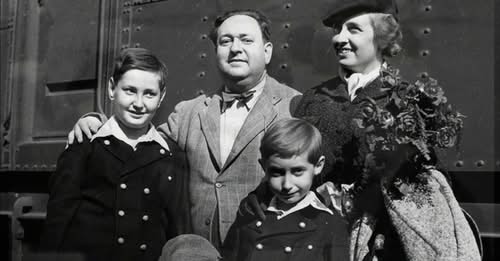
Today is the birthday of one of my favorite composers, Erich Wolfgang Korngold (1897-1957), in my heart since childhood, thanks to viewings of “The Adventures of Robin Hood. But guess what? I love his concert music and his operas too! Here’s a joyous discovery for a spring afternoon: Korngold at the piano, playing his own themes from opera and the movies, at the home of Ray Heindorf, who worked very closely with the composer as an orchestrator on a number of his classic film scores. By 1951, Korngold had already left Warner Brothers. He would work on only one more film, the Richard Wagner biopic “Magic Fire,” released by Republic Pictures in 1955. Hear Korngold sing (if you can distinguish him from Heindorf) and actually speak, especially during the final minutes, accompanied by some fascinating home movies.
Tag: Erich Wolfgang Korngold
-

Movie Music & Literary Lives on Picture Perfect
Words on the printed page captivate us so completely that it’s natural to assume that the lives of writers must be rich, full of incident, and very dramatic indeed. Surely that is sometimes the case. Who among us could keep up with a Byron or a Pushkin or a Poe?
Yet, with even the most outlandish writers, Hollywood for some reason often feels the need to fabricate. How else to explain “Devotion” (1943), Warner Brothers’ salute to the Brontës? Then again, the temptation must be strong to characterize the sisters who penned “Jane Eyre” and “Wuthering Heights” as tortured Romantics.
Ida Lupino plays Emily, the creator of Cathy and Heathcliff, and Olivia de Havilland, Charlotte, who conceived Jane and Rochester. Nancy Coleman is their sister Anne, who wrote “The Tenant of Wildfell Hall,” and Arthur Kennedy, their dissolute brother Branwell. The film also features Sidney Greenstreet as William Makepeace Thackeray, Paul Henreid as an Irish priest, and – well, you get the idea. The casting, at times, strains credulity.
However, the music by Erich Wolfgang Korngold is up to the composer’s usual high standard. Korngold himself became so enamored of one of its themes that he recycled it for use in the first movement of his Violin Concerto. This week on “Picture Perfect,” we’ll have chance to sample some of it.
We’ll also hear selections from movies about Iris Murdoch (“Iris,” with music by James Horner), the Bard of Avon (“Shakespeare in Love,” with an Academy Award-winning score by Stephen Warbeck), and Samuel Clemens (“The Adventures of Mark Twain,” by Max Steiner).
Writers are such characters, especially when they’re depicted on the big screen. Everything’s writ large, on “Picture Perfect,” music for the movies, now in syndication on KWAX, the radio station of the University of Oregon!
Clip and save the start times for all three of my recorded shows:
PICTURE PERFECT, the movie music show – Friday at 8:00 PM EST/5:00 PM PST
SWEETNESS AND LIGHT, the light music program – ALL NEW! – Saturday at 11:00 AM EST/8:00 AM PST
THE LOST CHORD, unusual and neglected rep – Saturday at 7:00 PM EST/4:00 PM PST
Stream them, wherever you are, at the link!
-

Ives Bellamann Kings Row A Lost Chord
In putting together a special edition of “The Lost Chord” for the 150th anniversary of the birth of Charles Ives, I learn that the first performances of Ives’ “Concord Sonata,” following the work’s publication in 1920, were organized by Henry Bellamann.
Bellamann, later chairman of the examination board at Juilliard (1924-26) and dean of the Curtis Institute of Music in Philadelphia (1931-32), wrote the bestselling novel “Kings Row.” The book was published in 1940 and adapted into a film by Warner Bros. in 1942.
I’ve always loved “Kings Row,” the movie, even though it is rather bizarre and over-the-top. Okay, I admit it: I love it BECAUSE of those things. It’s actually a very grim story, anticipating the work of David Lynch, in some respects, as it gradually reveals the dark underbelly of life in a small Midwestern town. A sign on the outskirts advertises it as “a good town… a good clean town… a good town to live in… and a decent place to raise your children.” Of course it’s none of those things. But for as dark as the movie gets, it somehow never loses its sense of optimism. Bellamann’s book, on the other hand, is unrelentingly melancholy and bleak-as-hell. I have to say, it’s a massive downer. Even so, readers adored it. So much so, that Bellamann was spurred to write a sequel (which I have not read), “Parris Mitchell of Kings Row.”
As you can imagine, the notoriety of “Kings Row” caused quite a stir in Bellamann’s hometown of Fulton, Missouri, and not necessarily because of its success. Rather, a few too many people and institutions recognized themselves in the extremely unflattering narrative. Allegedly the book was banned from the town library, and Bellamann was the target of at least one indignant editorial in the local newspaper.
“Kings Row” is one of the most subversive films of Hollywood’s golden age. How it managed to get around the Hays Code is anybody’s guess, but I’m putting my money on the music by Erich Wolfgang Korngold, which breathes uplift and hope into what could have been two hours and seven minutes of sustained misery.
Also, the ending was changed, such an obvious overcompensation, with the climax an almost ludicrous eruption of joy. It’s a neat trick, as somehow, in the film, not only is the wicked in human nature balanced by the good, but the whole is infused with an undercurrent of nostalgia for a passing world. It’s kind of like how people choose to remember “It’s a Wonderful Life,” even though you have to go through hell before you get to heaven.
Amusingly, from the title, Korngold thought he was being assigned yet another historical adventure (he was Warners’ composer of choice for the Errol Flynn swashbucklers), which is why the theme is so wildly exuberant. By 1942, Korngold could do pomp and braggadocio in his sleep. When he learned of his misunderstanding, he just kept at it. And what a happy accident! The film is so much better – and so much more bearable – than it otherwise would have been. After all, how much madness, suicide, amputation, and incest can one take, especially in the 1940s? It really is quite the sleight of hand.
FUN FACT: When John Williams came to write the main title for “Star Wars,” “Kings Row” was one of his principal inspirations.
It was decades earlier that Bellamann reached out to Ives, in preparation for his lectures on the “Concord Sonata.” Bellamann toured the work across the American South, from New Orleans to Spartanburg, South Carolina, providing spoken introductions to each of the four movements, the music itself performed by pianist Lenore Purcell.
Bellamann would go on to write important articles about Ives, based on his extensive correspondence with the composer. He was the first to report on the influence of Ives’ musically progressive father, George, who was as much ahead of his time as Charles would be, and the composer’s perceptions of his hidebound teacher, Horatio Parker. Bellamann also provided program notes for some early Ives’ performances.
A graduate of Westminster College in Fulton (no relation to the Princeton institution), Bellamann also studied piano at the University of Denver. He then taught music at several girls’ schools in the South, while in the summers, he traveled to Europe to continue his studies with Charles-Marie Widor and Isador Philipp. Bellamann would hold several prominent administrative and teaching positions in the U.S. In addition to his work at Juilliard and Curtis, he was also a professor of music at Vassar College.
Since I won’t be talking about him on my Ives show, I figured I’d mention him here. The “Concord Sonata” will be heard in a most unusual form on “Concord and Discord,” an all-new episode of “The Lost Chord,” this Saturday, the eve of Ives’ sesquicentenary, at 4:00 EDT/7:00 PDT, exclusively on KWAX, the radio station of the University of Oregon.
Stream it wherever you are at the link:
CLOCKWISE FROM LEFT: Ives; Bellamann; and 680 pages of pure misery
-

Music in Movies Fellini Corigliano Korngold
This week on “Picture Perfect,” get ready for an exercise in postmodern self-reflexivity, as we enjoy music from movies about music and musicians.
Federico Fellini’s “Orchestra Rehearsal” (1978) is a mock-documentary that presents the symphony orchestra as a metaphor for the human condition. Full of political overtones, the film explores the joys, sorrows, frustrations and triumphs of the musicians, who struggle with the concepts of individual liberty, tyranny and the collective good. The project would mark the final collaboration between Fellini and Nino Rota. The two artists first came together in 1952 on Fellini’s “The White Sheik.” They would go on to create such classics as “La Strada,” “Nights of Cabiria,” “La dolce vita” and “8 ½.”
We’ll also hear music from the Canadian art house hit “The Red Violin” (1998). The film traces the history of the fictional title instrument from its creation in 17th century Cremona to the present day. The violin passes through the hands of a child prodigy, into those of a romantic virtuoso in the Paganini mold; then to China during the Cultural Revolution; and finally to a Canadian auction house. John Corigliano wrote the Academy Award-winning music, which is performed on the soundtrack by violinist Joshua Bell.
Finally, we’ll turn to a classical music film noir from Hollywood’s Golden Age. “Deception” (1946) tells the tale of a dangerous love triangle between Bette Davis, Paul Henreid and Claude Rains. Much of the plot hinges on the premiere of a new cello concerto by a celebrated – though fictional – composer, played by Rains, who puts a fragile cellist, his rival in love, played by Henreid, through the psychological wringer. The music, which serves as both underscore and crux of the story, is by Erich Wolfgang Korngold. The composer subsequently published the on-screen concerto as his Op. 37.
All aboard the musical ouroboros! Join me for music from movies about music and musicians, on “Picture Perfect,” now in syndication on KWAX, the radio station of the University of Oregon!
Clip and save the start times for all three of my recorded shows:
PICTURE PERFECT, the movie music show – Friday at 8:00 PM EDT/5:00 PM PDT
SWEETNESS AND LIGHT, the light music program – ALL NEW! – Saturday at 11:00 AM EDT/8:00 AM PDT
THE LOST CHORD, unusual and neglected rep – Saturday at 7:00 PM EDT/4:00 PM PDT
Stream them, wherever you are, at the link!
The overheated trailer for “Deception”
PHOTO: Henreid wore a special jacket to accommodate the arms of two professional cellists who stood behind him as he emoted. On the film’s soundtrack the concerto was performed by Eleanor Aller Slatkin, mother of Leonard Slatkin.
-

Korngold The Genius Behind John Williams’ Sound
Before John Williams, there was Erich Wolfgang Korngold.
Korngold’s music for “The Adventures of Robin Hood” (1938) was every bit as influential to me, in terms of introducing me to the wonders of orchestral music, as the score to “Star Wars.” Clearly, it also impacted John Williams, as the music for his biggest blockbusters adheres to the Korngold template of leitmotifs, lush orchestration, and swashbuckling action cues.
Williams has cited Korngold’s main title music for “Kings Row,” in particular, as one of his inspirations for “Star Wars.” The bold, opulent, classic Hollywood imprint is obvious. Listeners coming cold to “Kings Row” detect the influence immediately. Which is interesting. It’s there in the orchestration, of course, and in the bold fanfares, but it isn’t so blatant as some of the other, more brazen allusions that occur throughout Williams’ score, which I’m sure I’m not alone in contending is a post-modern masterpiece. It’s only little minds that scream theft. Good artists copy; great artists steal! (I believe Stravinsky stole that from Picasso.)
In case you are unfamiliar with his backstory, years before he came to Hollywood, Korngold was a child prodigy, the toast of Vienna. Gustav Mahler declared him a genius, and Richard Strauss claimed he was terrified by the amount of talent exhibited by one so young. His works were championed by the most esteemed musicians of the day. He was especially highly-regarded for his operas, with “Die tote Stadt” (“The Dead City”), given a double premiere in Hamburg and Cologne, the high-water mark of his success.
Korngold first came to Hollywood to assist Viennese theatrical impresario Max Reinhardt in bringing “A Midsummer Night’s Dream” to the big screen for Warner Bros. This is the version with James Cagney, Olivia de Havilland, and Mickey Rooney (as Puck). So impressed was Warner with the score, freely adapted from the music of Mendelssohn, that they didn’t want to let this world-class composer go. He was a particularly nice fit for the pageantry and swagger of the Errol Flynn classics.
Fortunately, Korngold was at work on “Robin Hood” when the Nazis marched into Austria. He and his family found refuge in the company of many other notable European exiles on the paradisal West Coast of the United States. But the luster soon dulled. Korngold vowed to compose no concert music while Hitler remained in power. After the war, he produced a Violin Concerto, which was savaged by one critic as “more corn than gold,” and a heart-breaking Symphony in F-sharp, which exudes longing for a lost world. Both assimilated themes from his film scores.
He never lived to see his reputation rebound. However, since the 1970s, the popularity of his film music and critical esteem for his concert music have been on an upward trajectory.
I’ve always loved “Kings Row,” even though the film is something of a curate’s egg. It’s actually a very grim story, anticipating the work of David Lynch, in some respects, as it gradually reveals the dark underbelly of small-town life in the Midwest. But it’s nowhere near as dark as the source material, a bleak-as-hell novel by Henry Bellamann.
“Kings Row,” the book, is a massive downer. Somehow, it also became a runaway bestseller.
Interestingly, Bellamann also had a musical background. Following his graduation from Westminster College (unrelated to the Princeton institution) in his hometown of Fulton, Missouri, he studied piano at the University of Denver. He went on to teach music at several girls’ schools in the South, while in the summers, he continued his studies in Europe with Charles-Marie Widor and Isador Philipp. Bellamann would hold several prominent administrative and teaching positions in the U.S., including director of the Juilliard Musical Foundation, dean of the Curtis Institute of Music, and professor of music at Vassar College.
As you can imagine, the book caused quite a stir in Fulton, but not because of its success. Rather, a few too many people and institutions recognized themselves in the extremely unflattering narrative! Allegedly the book was banned from the town library, and Bellamann was the target of at least one indignant editorial in the local newspaper.
“Kings Row” is one of the most subversive films of Hollywood’s golden age. How it managed to get around the Hays Code is anybody’s guess, but I’m putting my money on Korngold’s score, which breathes uplift and hope into what could have been an unrelentingly bleak story (as it is in the novel). Also, the ending was changed, such an obvious overcompensation, with the climax an almost ludicrous eruption of joy. It’s a neat trick, as somehow, in the film, not only is the wicked in human nature balanced by the good, but the whole is infused with an undercurrent of nostalgia for a passing world. It’s kind of like how people choose to remember “It’s a Wonderful Life,” even though you have to go through hell before you get to heaven.
Amusingly, from the title, Korngold thought he was being assigned yet another historical adventure, which is why the theme is so wildly over the top. By 1942, Korngold could do pomp and braggadocio in his sleep. When he learned of his mistake, he just kept it. And what a happy accident! The film is so much better – and so much more bearable – than it would have been without it. After all, how much madness, suicide, amputation, and incest can one take, especially in the 1940s? It really is quite the sleight of hand. Now I want to watch it again!
To this day, I waver as to whether Korngold or Williams is my favorite film composer. There are others I may revere more than either of them, but these two give me the most pleasure.
May I obey all your commands with equal pleasure, Sire! Happy birthday, Erich Wolfgang Korngold!
“Kings Row”
John Williams talks Korngold with Leonard Slatkin
Good nine-minute primer on E.W.K.
Violin Concerto
Music as good as spring itself: the Sinfonietta, composed at 15
Marietta’s Lied from “Die tote Stadt”
“The Sea Hawk”
What say you to that, Baron of Loxley?
Tag Cloud
Aaron Copland (92) Beethoven (94) Composer (114) Film Music (116) Film Score (143) Film Scores (255) Halloween (94) John Williams (185) KWAX (228) Leonard Bernstein (99) Marlboro Music Festival (125) Movie Music (131) Opera (197) Philadelphia Orchestra (86) Picture Perfect (174) Princeton Symphony Orchestra (106) Radio (86) Ralph Vaughan Williams (85) Ross Amico (244) Roy's Tie-Dye Sci-Fi Corner (290) The Classical Network (101) The Lost Chord (268) Vaughan Williams (99) WPRB (396) WWFM (881)