This week on “The Lost Chord,” on the eve of International Women’s Day, the focus will be on outstanding works by two extraordinary female composers, from comparatively early in their respective careers.
Unfortunately, in the case of Vitězslava Kápralová (1915-1940), it was not to be a long one. One of the great hopes of Czech music, Kápralová undoubtedly would be much better known had she not died of tuberculosis at the age of 25. As it stands, her reputation is only beginning to emerge from the shadow of her teacher and lover, Bohuslav Martinů
Kápralová’s String Quartet was written while she was yet a student at the Prague Conservatory, where her teachers included Vitězslav Novák and Václav Talich. (She studied with Martinů later in Paris.) The work was completed in 1936, when Kápralová was about 21 years-old.
More about Kápralová here, in this article written to mark her centenary in 2015:
https://www.telegraph.co.uk/culture/music/classicalmusic/11365848/The-tragedy-of-Europes-great-forgotten-female-composer.html?fbclid=IwAR26f65euwM_lesL-fSWvTids3argkS6dbtmz5P3ruuP9cCYKUsn1F-IXC4
Ethel Smyth (later DAME Ethel Smyth, 1858-1944) was one of the most vocal advocates of the women’s suffrage movement in England. She overcame early opposition to a career in music on the part of her father to receive the praise of George Bernard Shaw, who called her Mass “magnificent.”
However, her works were often better-appreciated abroad. Her operas, in particular, were embraced in Germany. One of them, “Der Wald,” was the only opera by a woman composer mounted by New York’s Metropolitan opera for over a century!
Smyth served time in prison for putting out the windows of politicians who opposed a woman’s right to vote. She also wrote for the cause “The March of the Women.” When Sir Thomas Beecham went to visit her in jail, he witnessed her conducting through the bars of her window with a toothbrush as her associates gathered for exercise in the courtyard.
Smyth’s “Serenade in D” – a symphony in all but name – was her first orchestral score, composed in 1890, when she was about 32 years-old. In my opinion, it’s better than just about anything composed by her contemporary, Sir Hubert Parry, and much more compelling than the symphonies of Sir Charles Villiers Stanford.
More about Smyth here, in this piece put together in connection with a revival of her opera, “The Wreckers”:
https://www.npr.org/sections/deceptivecadence/2015/07/23/410033088/one-feisty-victorian-womans-opera-revived?fbclid=IwAR0XG4Np46RjSJWuUIYwENZ9zFIdkoQYGL7vncYT7i5qFK5_sREFzI56gKw
I hope you’ll join me for music by these two extraordinary women. That’s “A Woman’s Place is in the Concert Hall” on “The Lost Chord,” now in syndication on KWAX Classical Oregon!
——–
Clip and save the start times for all three of my recorded shows:
PICTURE PERFECT, the movie music show – Friday at 8:00 PM EST/5:00 PM PST
SWEETNESS AND LIGHT, the light music program – Saturday at 11:00 AM EST/8:00 AM PST
THE LOST CHORD, unusual and neglected rep – Saturday at 7:00 PM EST/4:00 PM PST
Stream them, wherever you are, at the link!
https://kwax.uoregon.edu
Tag: Ethel Smyth
-

A Woman’s Place Is in the Concert Hall on “The Lost Chord”
-
Brahms & Tchaikovsky A Classical Bromance
Ever since I learned some years ago that Johannes Brahms (1833-1897) and Pyotr Ilych Tchaikovsky (1840-1893) – who share a birthday on May 7 – actually met on several occasions, and that Tchaikovsky’s initial suspicion of, and contempt for, his colleague and rival softened into a genuine admiration for the man (if not his music), I haven’t been able to resist revisiting the story of this classical music true bromance.
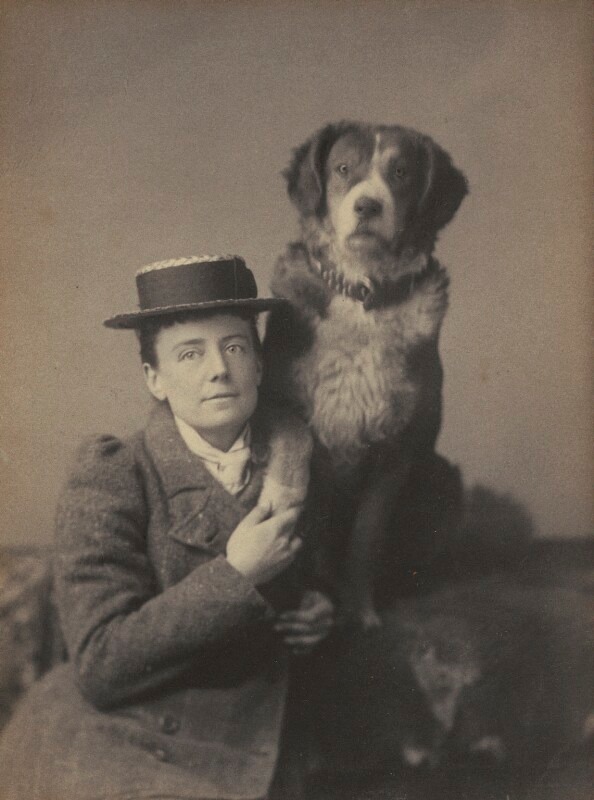
This year, I’ll put a different spin on it by sharing the observations of English composer Ethel Smyth (1858-1944) and the antics of her exuberant dog Marco. Smyth, whose steely determination to become a composer, in a day when it was the sort of thing that women simply didn’t do, wore down the opposition of her father – a major general in the Royal Artillery! – and enrolled at the Leipzig Conservatory in 1877.
When the conservatory didn’t measure up to her expectations, she acquired further polish through private studies with Heinrich von Herzogenberg (and fell in love with his wife). Her adventures in Germany brought her into contact with Dvořák, Grieg, Clara Schumann, and Herzogenberg’s friend, Johannes Brahms.
It was at a private performance of Brahms’ Piano Quintet, with the composer in attendance, that Smyth’s St. Bernard mix, Marco, burst through a door, toppling the cellist’s music stand, which, much to everyone’s relief, the notoriously prickly Brahms found hilarious.
Smyth also became friendly with Tchaikovsky, another visitor. Her first-hand accounts of her interactions and correspondence with both composers make for enjoyable reading. According to her, Tchaikovsky was “secretly terrified” of Marco, but whenever he wrote, he never failed to ask after him.
Brahms also kept in touch. It’s said that he carried a photo of Smyth with him until the time of his death.
In his diary, Tchaikovsky had characterized Brahms as a “scoundrel” and “a giftless bastard.” He was elated to find him, in reality, to be full of warmth and good humor. His preemptive hatred likely had more to do with the over-the-top and widely-broadcast veneration of establishment figures, such as Eduard Hanslick and Hans von Bülow, who hailed Brahms as the rightful heir of Beethoven.
“I’ve been on the booze with Brahms,” Tchaikovsky wrote after their first meeting. “He is tremendously nice – not at all proud as I’d expected but remarkably straightforward and entirely without arrogance. He has a very cheerful disposition, and I must say that the hours I spent in his company have left me with nothing but pleasant memories.”
I always find it oddly endearing that Brahms and Tchaikovsky were able to look past their personal aversions to one another’s music to actually grow to appreciate their individual qualities as people. There’s a lesson to be learned from that, I think. You can read more about it – and Marco! – at the links below to the website Tchaikovsky Research.
Happy birthday, boys. I’m glad it all worked out in the end.
Smyth, Marco, Brahms, and Tchaikovsky
https://en.tchaikovsky-research.net/pages/Ethel_Smyth
Tchaikovsky and Brahms (and Grieg)
https://en.tchaikovsky-research.net/pages/Johannes_Brahms
Brahms, Piano Trio No. 3 in C minor, Op. 101 (disliked by Tchaikovsky)
Tchaikovsky, Symphony No. 5 in E minor (disliked by Brahms)
Smyth, Serenade in D, her first orchestral work (written with the encouragement of Tchaikovsky)
-
Kapralova & Smyth: Forgotten Female Composers
This week on “The Lost Chord,” the focus will be on outstanding works by two extraordinary female composers, from comparatively early in their respective careers.
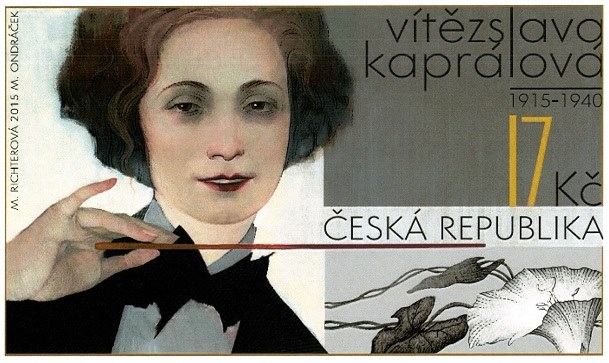
Unfortunately, in the case of Vitězslava Kápralová (1915-1940), it was not to be a long one. One of the great hopes of Czech music, Kápralová undoubtedly would be much better known had she not died of tuberculosis at the age of 25. As it stands, her reputation is only beginning to emerge from the shadow of her teacher and lover, Bohuslav Martinu.
Kápralová’s String Quartet was written while she was yet a student at the Prague Conservatory, where her teachers included Vitězslav Novák and Václav Talich. (She studied with Martinu later in Paris.) The work was completed in 1936, when Kápralová was about 21 years-old.
More about Kápralová here, in this article written to mark her centenary in 2015:
Ethel Smyth (later DAME Ethel Smyth, 1858-1944) was one of the most vocal advocates of the women’s suffrage movement in England. She overcame early opposition to a career in music on the part of her father to receive the praise of George Bernard Shaw, who called her Mass “magnificent.”
However, her works were often better-appreciated abroad. Her operas, in particular, were embraced in Germany. One of them, “Der Wald,” was the only opera by a woman composer mounted by New York’s Metropolitan opera for over a century!
Smyth served time in prison for putting out the windows of politicians who opposed a woman’s right to vote. She also wrote for the cause “The March of the Women.” When Sir Thomas Beecham went to visit her in jail, he witnessed her conducting through the bars of her window with a toothbrush as her associates gathered for exercise in the courtyard.
Smyth’s “Serenade in D” – a symphony in all but name – was her first orchestral score, composed in 1890, when she was about 32 years-old. In my opinion, it’s better than just about anything composed by her contemporary, Sir Hubert Parry, and much more compelling than the symphonies of Sir Charles Villiers Stanford.
More about Smyth here, in this piece put together in connection with a revival of her opera, “The Wreckers,” by the great Leon Botstein:
I hope you’ll join me for music by these two extraordinary women. That’s “A Woman’s Place is in the Concert Hall” on “The Lost Chord,” now in syndication on KWAX, the radio station of the University of Oregon!
Remember, KWAX is on the West Coast, so there’s a three-hour difference for those of you listening in the East. Here are the respective air-times for all three of my recorded shows (with East Coast conversions in parentheses):
PICTURE PERFECT, the movie music show – Friday on KWAX at 5:00 PM PACIFIC TIME (8:00 PM EST)
SWEETNESS AND LIGHT, the light music program – ALL NEW! – Saturday on KWAX at 8:00 AM PACIFIC TIME (11:00 AM EST)
THE LOST CHORD, unusual and neglected rep – Saturday on KWAX at 4:00 PM PACIFIC TIME (7:00 PM EST)
Stream all three, at the times indicated, by following the link!
Vitězslava Kápralová honored on a postage stamp; Ethel Smyth taken into custody
-
Ethel Smyth: Beyond Labels, Rediscovering Her Music
I’ve written about Dame Ethel here before. I always liked her music and was a champion of her stuff before it was cool. I’ve said it before and I’ll say it again: I find her Serenade in D, a symphony in all but name, more rewarding than anything written in the form by either of her near-contemporaries, Parry or Stanford. What’s even more remarkable is the range of her development, that the same composer who wrote the Serenade in 1890 (when she was already 32), a big-hearted, Brahmsian creation full of great tunes, arrived at her last, meditative symphony, “The Prison,” as much an oratorio or cantata for vocal soloists and orchestra, in the ruminative manner of Mahler, in 1930.
This is not a bad article, even if the slant makes her out to be more of a battle-axe than she really was. Yes, she was determined (as she had to be), and yes, she busted out some windows, but in between she was just trying to live a happy, fulfilling life like the rest of us. Unquestionably Smyth had lesbian inclinations (most of her lovers were women), but there’s no way in hell she would have described herself as “defiantly queer.” One of the things I find so annoying these days is how everyone, whether specialist or person on the street, seems hellbent on interpreting the past through the lens of the present. Hence, we get the front-loaded insinuation about Smyth’s allegedly bigoted views, as an English citizen whose consciousness was formed during the height of the Victorian era. I just read her memoirs a month or two ago, and trust me, she was not a repugnant, malicious person in any respect.
Ironically, this preoccupation with snap judgments and pigeonholing is the very thing that limited Smyth during her career as a “lady composer.” It’s as misguided as the now seemingly ensconced practice of updating with lurid productions operas composed generations ago, in an attempt to make them seem more “relevant” to the present. If the music and the story and the overall effect truly are timeless, is it really necessary to make everything look like a New Jersey rest stop? If you wonder what I’m ranting about, see the stills from the recent Glyndebourne production of Smyth’s “The Wreckers” at the link (by clicking on the BBC photo below).
I’m grateful that Dame Ethel is getting so much attention now after decades of comparative neglect. I suppose there is a pendulum effect in any revolution, and there is usually a period of overcompensation before things start to swing back, but I long for the day that artists of all backgrounds are finally accepted for their inherent worth, without having to over-politicize everything. I love Smyth for the beauty of her music, not because she was “defiantly queer” or “problematically bigoted.” Hopefully in a few decades, none of this will mean anything. We’ll have learned from history and evolved, and finally we can get back to experiencing the music.
Serenade in D
“The Prison”
“The Wreckers Overture” (conducted by Smyth)
-
Ethel Smyth’s Memoirs and Musical Legacy
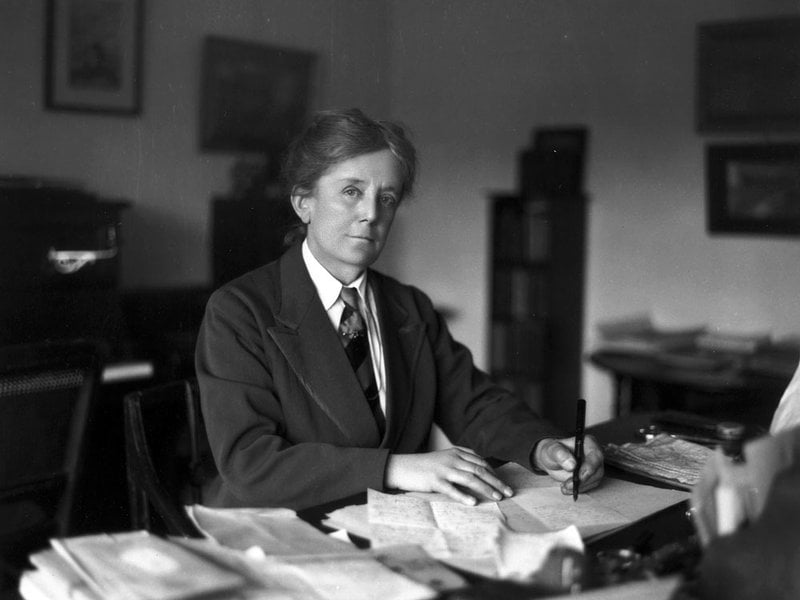
Well, I finally finished reading Dame Ethel Smyth’s memoirs a few days ago. In fact, I wrote this the following morning, but am only just getting around to smoothing it out.
While I wouldn’t modify my assessment that, for a published work, Smyth takes up an awful lot of space bringing in way too many names of people we never get to know, so that it becomes a chore for the reader to try to keep most of them straight – as I indicated, the memoirs have been distilled from multiple volumes, so the effect might have been exacerbated in part by the book’s editors (who try to make up for it with the inclusion of a glossary of “biographical notes”) – I did indeed find the concluding sections especially poignant.
Smyth struggled her entire life to get her music heard, and in my opinion, she did an amazing job for the era, and with so much stacked against her. Her foremost impediment, of course, was that she was a woman, which automatically restricted her acceptance in a male-dominated profession. I mean, women didn’t even have the right to vote. (At a point, she would become passionately involved with the women’s suffrage movement.)
She also enjoyed actually having a life. So while by no means unproductive, she made time whenever she could to engage in sport and walk with her dogs and plant her garden and bicycle and visit with friends. For these reasons, among others, she preferred to live outside the musical center of London, which she found both physically and psychologically restrictive. She couldn’t bear the thought of prolonged city life. She adored her pets, and her account of her relationship with her last sheepdog, Pan the Fourth, will move anyone who has ever loved an animal.
Of course, she also had other distractions. She virtually walked away from composition for two years to devote herself to the cause of women’s suffrage in England (for which she served time in prison for knocking out windows with stones). And personality-wise, she was always very forthright and wouldn’t take no for an answer. I would argue, for the era, it helped her more than it hurt her, but she felt it alienated some who might have helped her. Certainly it did not put off Thomas Beecham or Henry Wood or Bruno Walter or any number of other important musical figures who championed her music along the way.
Unquestionably, she was a celebrity. If her contemporaries heard comparatively little of her music, they knew of her character and exploits. Furthermore, she wrote prolifically, issuing ten autobiographical volumes (from which the one-volume “Memoirs” was extracted). She received a laudatory entry in the 1908 edition of “Grove’s Dictionary of Music and Musicians,” for her 50th year. In 1922, she became the first female composer to be honored with a damehood. And in 1934, at 75, a festival was organized of her music, which again was conducted by Beecham. Unfortunately, by then, she was stone deaf.
She pursued opera in a country without a strong operatic tradition, and therefore spent too much time in foreign lands, especially Germany, chasing down and creating opportunities. Her opera “Der Wald” was heard at New York’s Metropolitan Opera before it was ever heard in England. She had two of her operas all set to go in reputable opera houses in Germany, when Archduke Ferdinand was assassinated in Sarajevo, precipitating World War I. This was very bad luck indeed. But as Smyth observes, “Life has taught me one thing: when people fail to get over (or round) obstacles, it is never wholly the fault of other people.”
In fact, she is as clear-eyed about any personal shortcomings as she is the external factors that weighed against her. She is reflective and articulate, as any memoirist must be. There is an eerily prescient passage in which she speculates as to whether or not her music will ever be revived in future years.
“… [I]t amuses me to think that someday after my death, when all traces of my sex have been reduced to ashes at the Woking Crematorium (so handy!) someone will very likely take me up as a stunt – no extravagant assumption, seeing what subjects attain Stunt Rank these days! Then, together with the assembling of my musical remains, this Annex will be available, and the Stunt Raiser, lifting his eyebrows, can either burst out laughing (“O, come! You can’t put that across in England!”) or he can have those pages made into a fan and therewith fan the flame of the Stunt. And thus, someday, I may make friends, musically, with those I cannot get at in my lifetime.”
Keep in mind, this was an era when neglected scores were not digitized or maintained, but left to molder, if not in archives or libraries, then at home in drawers or on high shelves. She also muses wistfully that reviews that appeared in the foreign press were all but inaccessible to those of influence in her native land.
But she remained philosophical, and always grateful. The chapter “A Life Summed Up” conveys it best. “Blessed with friends, with health, spared the most wearing, the most disheartening form of the inevitable struggle for existence, what has or has not been achieved the days have been gloriously spent in the open. And if, digging from morn till eve, one has not unearthed exactly what one expected, all the while the treasure was being found.”
Smyth died on May 8, 1944, at the age of 86. What would she think now that so much of her music has been recorded, I wonder? All these years later, I am moved to think that she would never know. I am not one to promote music merely for political reasons, or to suit current trends in fashion. Smyth was a composer of merit, who felt acutely that she had something genuine to say. Her assessment was backed up by enough notable musicians of her time. Certainly, she was impeded by professional politics and social norms and current events and severe illness and just plain bad luck.
But even with all that stacked against her, she managed to make her mark. Ethel Smyth was a force to be reckoned with. And now, in the present day, the stage is set for a fairer assessment of her worth.
Tag Cloud
Aaron Copland (93) Beethoven (95) Composer (114) Film Music (144) Film Score (143) Film Scores (255) Halloween (94) John Williams (195) KWAX (229) Leonard Bernstein (104) Marlboro Music Festival (125) Movie Music (159) Mozart (90) Opera (212) Philadelphia Orchestra (89) Picture Perfect (174) Princeton Symphony Orchestra (109) Radio (88) Ross Amico (244) Roy's Tie-Dye Sci-Fi Corner (290) The Classical Network (101) The Lost Chord (269) Vaughan Williams (105) WPRB (397) WWFM (881)