Tag: Ethel Smyth

  • Dame Ethel Smyth A Spirited Birthday

    Dame Ethel Smyth A Spirited Birthday

    Today is the birthday of Dame Ethel Smyth.

    By coincidence, I am getting close to the end of Smyth’s memoirs (abridged from nine volumes). While I don’t find her the most compelling writer, she does offer some fun glimpses of Brahms, Tchaikovsky, Grieg, Mahler, Arthur Nikisch, and Sir Thomas Beecham, among others. Also, she was a great lover of dogs.

    However, too often the narrative, such that it is, devolves into a blur of name-dropping. Fine for a diary; not so much for a reader. After a while, I just gave up trying to keep everyone straight. It’s all the same anyway. Whether or not this “shortcoming” was exacerbated by editorial decisions, I don’t know.

    That’s not to say the book is not worthwhile. Smyth’s personality definitely comes through. She was indefatigable, I’ll say that for her, and spirited. Often almost giddy. This is a person who would never take no for a definitive answer, but kept looking for new solutions, and when she couldn’t find any, she picked herself up, and peddled her music elsewhere.

    Though she regrets that her pieces hardly ever get programmed, it seems she managed to have her operas and orchestral works played all over Germany and, to a slightly lesser extent, England. Her opera “Der Wald” was picked up by New York’s Metropolitan Opera (though she deemed the performances less-than-satisfactory). Gabriel Fauré even helped to organize a concert of her chamber music in Paris.

    What is striking is how impromptu the concert programming seemed to be back then. In Leipzig (at the Gewandhaus, no less), in Weimar, Berlin, and Prague, it seems like one could get an opera picked up fairly quickly, on a whim, almost. Of course, the commitment could just as rapidly fall through.

    While history, and, to some extent, even her contemporaries, may have undervalued her, I’d say, all in all, she did pretty well – if having to wait 30 years for some of her works to be revived is tolerable. Happily, she never seemed to let it get her down, and she was always writing new things. Now her music is being performed again.

    I wrote more about her, only just last month. If you’re interested, you can read it here, with plenty of links to her music:

    Happy birthday, Dame Ethel!

  • Ethel Smyth: Suffragette Composer

    Ethel Smyth: Suffragette Composer

    It’s International Women’s Day. The global holiday, established to celebrate the cultural, political, and socioeconomic achievements of women, has its roots in the universal female suffrage movement.

    Perhaps the composer most frequently associated with the movement was Dame Ethel Smyth (1858-1944). I am reminded of Sir Thomas Beecham’s recollection of Smyth, already in her 50s, conducting an impromptu chorus of women, gathered in a prison courtyard for exercise, by waving her toothbrush between the bars of her cell.

    Smyth was incarcerated for two months for smashing out the windows of politicians who opposed the female vote. Her “March of the Women” became the anthem of the women’s suffrage movement in England.

    But Smyth was more than just a political firebrand. Unusual for a woman of the time, she was also a composer of some renown. Her opera, “Der Wald” (“The Forest”), would be the only work by a female composer produced at New York’s Metropolitan Opera for over a century. That was in 1903.

    Anticipating the assertion that well-behaved women seldom make history, Smyth was driven to act up from the start. And who could blame her?

    She managed to outmaneuver her father, a major general in the Royal Artillery. When he objected to her pursuit of a career in music, she took the initiative to study privately. An all-out war of wills ensued. Ethel’s stomach proved stronger than her dad’s. In the end, he allowed her to attend the Leipzig Conservatory.

    When the conservatory didn’t measure up to Smyth’s expectations, she sought out Heinrich von Herzogenberg for further polish. Her travels also brought her into contact with Dvořák, Grieg, Tchaikovsky, Clara Schumann, and Herzogenberg’s friend, Johannes Brahms.

    It was at a private performance of Brahms’ Piano Quintet, with the composer in attendance, that Smyth’s St. Bernard mix, Marco, burst through a door, toppling the cellist’s music stand, which, much to everyone’s relief, the notoriously prickly Brahms found hilarious. Later, when Tchaikovsky wrote to Smyth, he never failed to ask after Marco.

    Her first piece to be played in public was her String Quintet in E major (1884).

    Her first orchestral work, the Serenade in D (1889) – written with the encouragement of Tchaikovsky – is better than just about anything composed by Sir Hubert Parry (whose music I happen to enjoy) and much more compelling than the symphonies of Sir Charles Villiers Stanford. Smyth’s serenade is a symphony in all but name, with some pretty good tunes.

    Even so, it was only in 1893, after her Mass in D was favorably received by George Bernard Shaw – he declared the Mass “magnificent” – that her father finally warmed to her chosen career.

    While she met with considerable success in her lifetime, as a woman, she was still often marginalized and had to push for almost everything. In her mid-50s, she began to lose her hearing. Undeterred, she commenced a second career as a writer, producing ten books. She was made a Dame Commander of the Order of the British Empire in 1922.

    The next time a music director is looking for an alternative to Elgar (himself not exactly overplayed in this U.S.), he or she could do worse than to consider Ethel Smyth. The overture to “The Wreckers” (1906) would make for a dynamic curtain-raiser.

    Beecham considered “The Wreckers” to be Smyth’s masterpiece. In 2015, the opera was presented at Bard College, in a series of performances under the direction of Leon Botstein. Botstein led a concert performance of the piece at Carnegie Hall in 2007. Happily, the Bard production was filmed.

    Smyth herself conducts the overture here, in a 1930 recording.

    Finally, here’s “March of the Women” (1910), sung with more polish than it would have been in a prison courtyard.


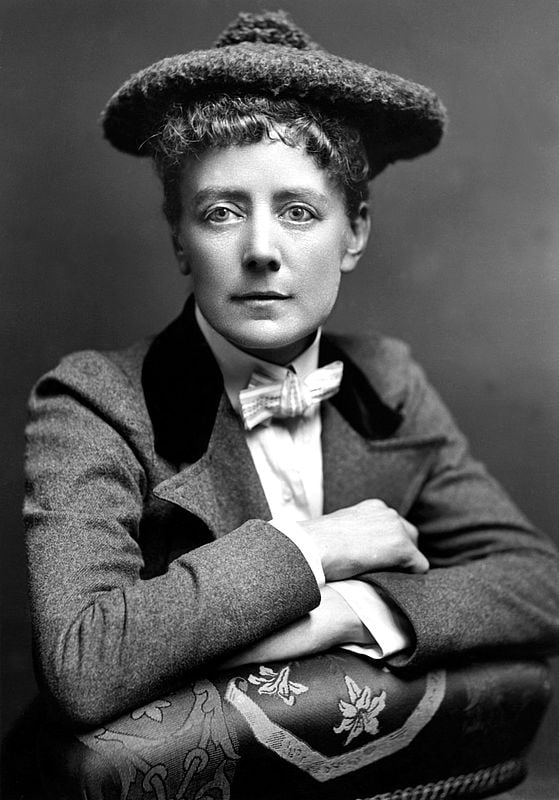
    PHOTO: Smyth rocks the boat

  • Ethel Smyth: Rebel Composer and Suffragette

    Ethel Smyth: Rebel Composer and Suffragette

    When I think of Dame Ethel Smyth (1858-1944), the first thing that springs to mind is Sir Thomas Beecham’s recollection of her leading an impromptu chorus of women, gathered in a prison courtyard for exercise, by conducting with her toothbrush between the bars of her cell.

    Smyth was incarcerated for two months for smashing out the windows of politicians who opposed the female vote. Her “March of the Women” became the anthem of the women’s suffrage movement in England.

    The other thing I think about is how Smyth’s opera, “Der Wald” (“The Forest”), was the only work by a female composer produced at New York’s Metropolitan Opera for over a century. That was in 1903.

    Anticipating the assertion that well-behaved women seldom make history, Smyth was driven to act up from the start. And who could blame her?

    She managed to outmaneuver her father, a major general in the Royal Artillery. When he objected to her pursuit of a career in music, she studied privately. This culminated in an all-out battle, in the course of which Ethel’s will proved steelier than her dad’s. The result was that she was that she was able to attend the Leipzig Conservatory.

    When the conservatory didn’t measure up to her expectations, she sought out Heinrich von Herzogenberg for further polish. Her travels also brought her into contact with Dvořák, Grieg, Tchaikovsky, Clara Schumann, and Herzogenberg’s friend, Johannes Brahms.

    It was at a private performance of Brahms’ Piano Quintet, with the composer in attendance, that Smyth’s St. Bernard mix, Marco, burst through a door, toppling the cellist’s music stand, which, much to everyone’s relief, the notoriously prickly Brahms found hilarious. Later, when Tchaikovsky wrote to Smyth, he never failed to ask after Marco.

    Her first piece to be played in public was her String Quintet in E major (1884).

    Her first orchestral work, the Serenade in D (1889) – written with the encouragement of Tchaikovsky – is better than just about anything composed by Sir Hubert Parry (whose music I happen to enjoy) and much more compelling than the symphonies of Sir Charles Villiers Stanford. Smyth’s serenade is a symphony in all but name, with some pretty good tunes.

    Even so, it was only in 1893, after her Mass in D was favorably received by George Bernard Shaw that her father’s objection to her chosen career began to thaw. (Shaw had declared the Mass “magnificent.”)

    While she met with considerable success in her lifetime, as a woman, she was still often marginalized and had to push for almost everything. In her mid-50s, she began to lose her hearing. Undeterred, she commenced a second career as a writer, producing ten books. She was made a Dame Commander of the Order of the British Empire in 1922 .

    The next time a music director is looking for an alternative to Elgar (himself not exactly overplayed in this U.S.), he or she could do worse than to consider Ethel Smyth. The overture to her opera “The Wreckers” (1906) would make for a dynamic curtain-raiser.

    “The Wreckers” was presented at Bard College, in a series of performances, under the direction of Leon Botstein, in 2015. Botstein led a concert performance of the piece at Carnegie Hall in 2007. Happily, the Bard production was filmed.

    https://www.youtube.com/watch?v=Y6jvyTaDqkc

    Smyth herself conducts the overture.

    Happy birthday, Dame Ethel Smyth!


    “March of the Women” (1910), sung here with more polish than it would have been in a prison courtyard.

    PHOTO: Smyth rocks the boat

  • Kápralová and Smyth: Forgotten Female Composers

    Kápralová and Smyth: Forgotten Female Composers

    This Sunday night on “The Lost Chord,” the focus will be on outstanding works by two extraordinary female composers.

    Vitězslava Kápralová (1915-1940) was one of the great hopes of Czech music, a figure who undoubtedly would be much better known had she not died of tuberculosis at the age of 25. As it stands, her reputation is only beginning to emerge from the shadow of her teacher and lover, Bohuslav Martinu.

    Kápralová’s String Quartet was written while she was yet a student at the Prague Conservatory, where her teachers included Vitězslav Novák and Václav Talich. (She studied with Martinu later in Paris.) The work was completed in 1936, when Kápralová was about 21 years-old.

    More about Kápralová here, in this article written to mark her centenary in 2015:

    https://www.telegraph.co.uk/culture/music/classicalmusic/11365848/The-tragedy-of-Europes-great-forgotten-female-composer.html?fbclid=IwAR1EgKzOjglhAKe-58wHwivhYjI1LtTCPzgr0efhV0xuf0898oeeZYbJHU0

    Ethel Smyth (later DAME Ethel Smyth, 1858-1944) was one of the most vocal advocates of the women’s suffrage movement in England. She overcame early opposition to a career in music on the part of her father to receive the praise of George Bernard Shaw, who called her Mass “magnificent.”

    However, her works were often better-appreciated abroad. Her operas, in particular, were embraced in Germany. One of them, “Der Wald,” was the only opera by a woman composer mounted by New York’s Metropolitan opera for over a century!

    Smyth served time in prison for putting out the windows of politicians who opposed a woman’s right to vote. She also wrote for the cause “The March of the Women.” When Sir Thomas Beecham went to visit her in jail, he witnessed her conducting through the bars of her window with a toothbrush as her associates gathered for exercise in the courtyard.

    Smyth’s “Serenade in D” – a symphony in all but name – was her first orchestral score, composed in 1890, when she was about 32 years-old. In my opinion, it’s better than just about anything composed by her contemporary, Sir Hubert Parry, and much more compelling than the symphonies of Sir Charles Villiers Stanford.

    More about Smyth here, in this piece put together in connection with a revival of her opera, “The Wreckers,” by the great Leon Botstein:

    https://www.npr.org/sections/deceptivecadence/2015/07/23/410033088/one-feisty-victorian-womans-opera-revived?fbclid=IwAR2GIlgZ3p6rwkh8dFa-2H7X27tQPRRKFK_TLnuxWI67kayucG8tuXkOj5I

    I hope you’ll join me for music by these two extraordinary women – “A Woman’s Place is in the Concert Hall” – this Sunday night at 10:00 EDT, on WWFM – The Classical Network and wwfm.org.


    Vitězslava Kápralová honored on a postage stamp; Ethel Smyth taken into custody

  • Stream Ethel Smyth’s “The Wreckers” Online

    Stream Ethel Smyth’s “The Wreckers” Online

    Bard College is now streaming its 2015 production of Dame Ethel Smyth’s “The Wreckers.”

    This English seaside opera predates Benjamin Britten’s “Peter Grimes” by decades, a tale of doomed love set against the backdrop of plundering land pirates, who lure unsuspecting ships onto the rocks of coastal Cornwall. The “pirates,” in this instance, are common villagers who justify their misdeeds as righteous Methodists. (Alas, some things never change.)

    “The Wreckers,” Smyth’s third opera, is a product of the so-called English musical renaissance, a flowering that took place around the turn of last century, after an alleged dearth of native talent that reached back centuries – tradition holds, since the death of Henry Purcell – a charge that really was without basis. In 1904, Germany had only just derided England as “Das Land ohne Musik” (“The Land without Music”). Ironic, then, that “The Wreckers” would be given its first performance there, in Leipzig, in German translation, in 1906.

    Why the timidity, England? Smyth’s second opera, “Der Wald,” which also received its premiere in Germany, had made it as far as New York City’s Metropolitan Opera in 1903. It would be the only opera by a woman composer presented by the Met for over a century! Why no performances at home? Eventually, “The Wreckers” would receive its English premiere in 1909, under the direction of Sir Thomas Beecham.

    Smyth was not only a formidable talent, she was a formidable personality. Few were the men who could stand up to this tweed-wearing, cigar-smoking suffragette. After Smyth was arrested for putting out the windows of politicians who opposed a woman’s right to vote, Beecham visited her in prison, only to find her leading her sisters-in-arms in an anthem she composed, “March of the Women,” which she conducted through the bars of her cell with a toothbrush.

    Beecham would conduct “The Wreckers” again in 1934 to celebrate Smyth’s 75th birthday. Sadly, by then she was unable to enjoy it, as by that time she was stone deaf.

    Leon Botstein led the first U.S. performance of the opera, with the American Symphony Orchestra, in New York City, as recently as 2007! These forces brought “The Wreckers” to Bard College, of which Botstein is president, and where he is co-director each summer of the Bard Music Festival.

    This year’s festival, which was to have been devoted to another remarkable woman, Nadia Boulanger, has been postponed to the summer of 2021.

    For now, enjoy Dame Ethel Smyth’s “The Wreckers”:

    https://fishercenter.bard.edu/events/ups-the-wreckers/?utm_source=wordfly&utm_medium=email&utm_campaign=2020-06-24-UPS-Wreckers&utm_content=version_A#the-wreckers

    A talk about the opera, with Leon Botstein:

    https://fishercenter.bard.edu/events/ups-the-wreckers/?utm_source=wordfly&utm_medium=email&utm_campaign=2020-06-24-UPS-Wreckers&utm_content=version_A#opera-talk

Tag Cloud

Aaron Copland (92) Beethoven (95) Composer (114) Film Music (120) Film Score (143) Film Scores (255) Halloween (94) John Williams (185) KWAX (229) Leonard Bernstein (100) Marlboro Music Festival (125) Movie Music (135) Opera (198) Philadelphia Orchestra (88) Picture Perfect (174) Princeton Symphony Orchestra (106) Radio (87) Ralph Vaughan Williams (85) Ross Amico (244) Roy's Tie-Dye Sci-Fi Corner (290) The Classical Network (101) The Lost Chord (268) Vaughan Williams (103) WPRB (396) WWFM (881)

DON’T MISS A BEAT

Receive a weekly digest every Sunday at noon by signing up here


RECENT POSTS