Tag: Fantasy Film

  • Herrmann’s Fantasy Film Scores for Halloween

    Herrmann’s Fantasy Film Scores for Halloween

    Hallowe’en is fast approaching. This week on “Picture Perfect,” it’s high time we get the pumpkin rolling, with an hour of fantasy film scores of Bernard Herrmann.

    Just about everyone has some awareness of Herrmann’s fruitful run with Alfred Hitchcock, a collaborative relationship which yielded scores to “Vertigo,” “North by Northwest” and “Psycho,” among others. Concurrently, Herrmann worked with producer Charles H. Schneer to create a series of classic films on fantastic subjects, featuring special effects by stop-motion maestro Ray Harryhausen. We’ll be listening to selections from two of these.

    Jules Vernes’ novel, “Mysterious Island,” was a sequel of sorts to “20,000 Leagues under the Sea.“ During the American Civil War, a ragtag band of Union soldiers escape from a Confederate prison by hot air balloon. A storm sweeps them off to the titular island, where they encounter pirates, a castaway, and an orangutan. Indeed Captain Nemo turns up late in the narrative, though no giant creatures, as in the film (made in 1961). Herrmann has a field day characterizing an enormous crab, bee, and especially bird, for which he employs a fugue!

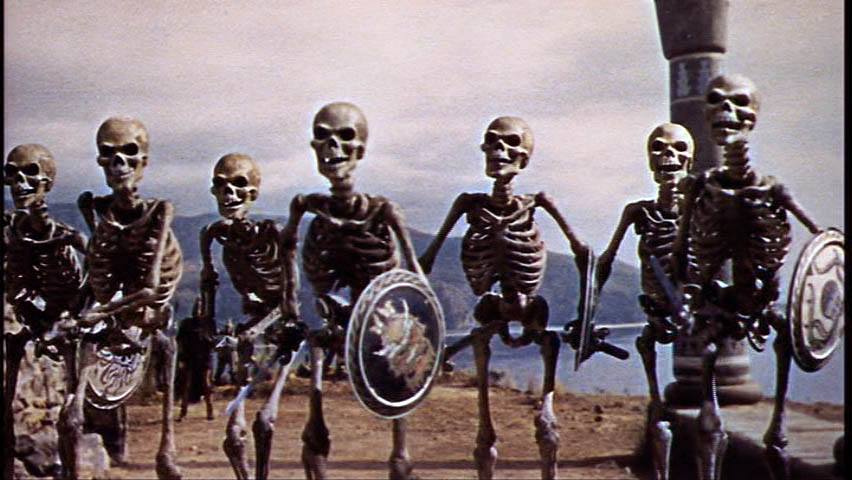
    Harryhausen’s skeleton fight from Schneer’s “Jason and the Argonauts” (1963) stands as one of the all-time classic fantasy sequences, a dream marriage of visuals and music. Herrmann, who always provided his own orchestrations, was well known for putting together unique combinations of instruments, the better to illustrate the special character of a given film. In the case of “Jason,” he went in the opposite direction from what he had taken with “Psycho,” stripping away the strings and concentrating instead on winds, brass and percussion.

    On a somewhat gentler note, Herrmann scored the beautiful spectral romance, “The Ghost and Mrs. Muir” (1947), with Gene Tierney as a young widow who moves with her daughter to a seaside village, where she encounters the ghost of salty Captain Gregg (played by Rex Harrison). Of course, their banter leads to a hopeless attraction developing between them. Herrmann was a master at creating musical evocations of yearning, and his score for “The Ghost and Mrs. Muir” is full of romantic longing.

    Criminally, for a composer whose career spanned over four decades, from “Citizen Kane” to “Taxi Driver,” Herrmann received only a single Oscar, for “The Devil and Daniel Webster” (released in 1941 as “All That Money Can Buy”). Walter Huston makes a meal of his role as Mr. Scratch in Stephen Vincent Benét’s recasting of the Faust legend, transferred to the New England countryside. Director William Dieterle, who had his roots in German Expressionism, creates some truly eerie visuals, and Herrmann’s score barn-dances deftly back and forth between dread and whimsy.

    Join me for fantasy film scores of Bernard Herrmann this week on “Picture Perfect,” music for the movies, now in syndication on KWAX, the radio station of the University of Oregon!


    Clip and save the start times for all three of my recorded shows:

    PICTURE PERFECT, the movie music show – Friday at 8:00 PM EDT/5:00 PM PDT

    SWEETNESS AND LIGHT, the light music program – Saturday at 11:00 AM EDT/8:00 AM PDT

    THE LOST CHORD, unusual and neglected rep – Saturday at 7:00 PM EDT/4:00 PM PDT

    Stream them, wherever you are, at the link!

    https://kwax.uoregon.edu/

  • Clash of the Titans Harryhausen’s Swan Song

    Clash of the Titans Harryhausen’s Swan Song

    When “Clash of the Titans” opened on June 12, 1981, it was opposite “Raiders of the Lost Ark.” Needless to say, on Friday night I was riding with Indiana Jones; but on Saturday, you can bet I was cozying up with Medusa.

    This week on Roy’s Tie-Dye Sci-Fi Corner, we’ll dust off our Edith Hamilton to search vainly for Calibos and Bubo, on a quest to rescue Andromeda from… the Kraken?

    Okay, so maybe it’s not scrupulously faithful to the classical myths. Who cares? It’s Ray Harryhausen!

    “Clash of the Titans” would be the swan song of this special effects maestro. With classics like “Jason and the Argonauts,” “The Seventh Voyage of Sinbad,” and “Mighty Joe Young” adorning his buckler, Harryhausen had long since secured his place in the pantheon.

    But when “Titans” opened, critics were divided: Gene & Roger loved it, but many were shockingly condescending, dismissing the film – some of them even the effects – as turgid and old-fashioned. In the wake of “Star Wars,” the all-knowing arbiters were now too-cool-for-school.

    Nevermind the fact that George Lucas’ Industrial Light and Magic repeatedly tipped its hat to Harryhausen. Only the year before, in fact, in the “Star Wars” sequel “The Empire Strikes Back,” ILM served up a gloriously-retro Tauntaun and some hilariously-improbable Imperial Walkers. Where would Empire or Rebellion be without Harryhausen?

    Even so, it is hard to deny that Harryhausen’s Dynamation process did start to seem a tad quaint alongside ILM’s “go motion” effects, especially when, only two weeks later, on June 26, 1981, ILM would challenge Harryhausen on his own turf with the fire-breathing antagonist of “Dragonslayer.” The wondrous creation that was Vermithrax Pejorative looked forward to “Jurassic Park” in 1993. So realistic was he, it’s conceivable he would have made Harryhausen himself blanch.

    But realism was never the point of Harryhausen’s fantastic visions, and I feel sorry for anyone who can’t see what’s so special about his special effects. By what law should fantasy be photorealistic? Are not our dreams filled with the otherworldly and the uncanny? Must they conform to the logic of our waking hours?

    Whatever the case, evidently by 1981, the time for this sort of magical storytelling had passed. Harryhausen and his longtime producer Charles Schneer had been hoping to mount a “Titans” follow-up, to be titled “Force of the Trojans,” but they couldn’t secure the funding. So it was that one of special effects’ most imaginative masters was driven to retirement at the age of 61.

    That retirement would be a long one – Harryhausen died in 2013 at the age of 92 – but it was not inactive. He began his own foundation to promote stop motion animation, oversaw the restoration and completion of some of his earlier projects, and in general was lauded and paid tribute to by generations of younger filmmakers. He also turned up in a few cameos.

    With “Clash of the Titans,” nobody can say he didn’t swing for the fences. For one thing, the cast was the starriest of any movie of his career, with supporting roles played by stage and screen legends Laurence Olivier, Claire Bloom, Maggie Smith, Ursula Andress, Siân Phillips, Flora Robson, and Burgess Meredith. Harry Hamlin, soon to attain fame with the success of TV’s “L.A. Law,” played Perseus. Did Hamlin possess the dash of Kerwyn Matthews? Ask your local cyclops.

    More to the point, will Roy and I clash over “Clash of the Titans? Winged horses couldn’t keep us away! We’ll RELEASE THE KRAKEN in the comments section, when we livestream on Facebook, YouTube, etc., this Friday evening at 7:30 EDT!

    https://www.facebook.com/roystiedyescificorner

  • Herrmann’s Halloween Fantasy Film Scores

    Herrmann’s Halloween Fantasy Film Scores

    Hallowe’en is fast approaching. This week on “Picture Perfect,” it’s high time we get the pumpkin rolling, with an hour of fantasy film scores of Bernard Herrmann.

    Just about everyone has some awareness of Herrmann’s fruitful run with Alfred Hitchcock, a collaborative relationship which yielded scores to “Vertigo,” “North by Northwest” and “Psycho,” among others. Concurrently, Herrmann worked with producer Charles H. Schneer to create a series of classic films on fantastic subjects, featuring special effects by stop-motion maestro Ray Harryhausen. We’ll be listening to selections from two of these.

    Jules Vernes’ novel, “Mysterious Island,” was a sequel of sorts to “20,000 Leagues under the Sea. “ During the American Civil War, a ragtag band of Union soldiers escape from a Confederate prison by hot air balloon. A storm sweeps them off to the titular island, where they encounter pirates, a castaway and an orangutan. Indeed Captain Nemo turns up late in the narrative, though no giant creatures, as in the film (made in 1961). Herrmann has a field day characterizing an enormous crab, bee and especially bird, for which he employs a fugue!

    Harryhausen’s skeleton fight from Schneer’s “Jason and the Argonauts” (1963) stands as one of the all-time classic fantasy sequences, a dream marriage of visuals and music. Herrmann, who always provided his own orchestrations, was well known for putting together unique combinations of instruments the better to illustrate the special character of a given film. In the case of “Jason,” he went in the opposite direction he had taken with “Psycho,” stripping away the strings and concentrating instead on winds, brass and percussion.

    On a somewhat gentler note, Herrmann scored the beautiful spectral romance, “The Ghost and Mrs. Muir” (1947), with Gene Tierney as a young widow who moves with her daughter to a seaside village, where she encounters the ghost of salty Captain Craigg (played by Rex Harrison). Of course, their banter leads to a hopeless attraction developing between them. Herrmann was a master at creating musical evocations of yearning, and his score for “The Ghost and Mrs. Muir” is full of romantic longing.

    Criminally, for a composer whose career spanned over four decades, from “Citizen Kane” to “Taxi Driver,” Herrmann received only a single Oscar, for “The Devil and Daniel Webster” (released in 1941 as “All That Money Can Buy”). Walter Huston makes a meal of his role as Mr. Scratch in Stephen Vincent Benet’s recasting of the Faust legend, transferred to the New England countryside. Director Wlliam Dieterle, who had his roots in German Expressionism, creates some truly eerie visuals, and Herrmann’s score barn-dances deftly back and forth between dread and whimsy.

    Join me for fantasy film scores of Bernard Herrmann this week on “Picture Perfect,” music for the movies, this Friday evening at 6; or catch it later as a webcast at http://www.wwfm.org.

Tag Cloud

Aaron Copland (92) Beethoven (94) Composer (114) Film Music (116) Film Score (143) Film Scores (255) Halloween (94) John Williams (185) KWAX (228) Leonard Bernstein (99) Marlboro Music Festival (125) Movie Music (131) Opera (197) Philadelphia Orchestra (86) Picture Perfect (174) Princeton Symphony Orchestra (106) Radio (86) Ralph Vaughan Williams (85) Ross Amico (244) Roy's Tie-Dye Sci-Fi Corner (290) The Classical Network (101) The Lost Chord (268) Vaughan Williams (99) WPRB (396) WWFM (881)

DON’T MISS A BEAT

Receive a weekly digest every Sunday at noon by signing up here


RECENT POSTS