I am starting to get just a little bit tired of hearing that if Felix Mendelssohn had never lived, music history would not have turned out any differently. He’s second-rate, he’s sentimental, he’s an academician, blah blah blah. When are these pompous idiots going to open their ears and acknowledge the fact that he was only one of the most influential composers of the 19th century? Especially in Germany, England and America, did any serious musician escape his sway?
Mendelssohn was essentially adopted as England’s national composer. Figures from William Sterndale Bennett through Sir Arthur Sullivan gleefully played in his shadow. In fact, Mendelssohn was the hottest composer in England since Handel. Such a stranglehold did Handel and Mendelssohn have on English concertgoers’ affections that, in Germany, England was mocked as “Das Land ohne Musik” – The Land without Music. The best English composers were all German.
But if the Germans were to be at all honest with themselves, they would have realized that all the best German composers were also followers of Mendelssohn. What about Wagner, you say, surely one of the most progressive composers who ever lived? There’s plenty of Mendelssohn in early Wagner. Ditto for Richard Strauss. As for the “second rank,” the more conservative school, just about everyone emulated Mendelssohn.
Of himself, of course, Mendelssohn was one of the most astonishing of musical prodigies. He composed two of the most enduring masterpieces in the repertoire, the overture to a “Midsummer Night’s Dream” and the Octet for Strings, at 16 and 17 respectively. In terms of maturity and polish, these were certainly on a par with anything written by the teenaged Mozart.
Yes, Mendelssohn was a traditionalist. He structured his music on foundations laid in the past. Even so, he cautiously ventured into the mists of Romanticism. Occasionally, he even subverted expectations, in works like his famous Violin Concerto. Furthermore, he was respectful, if not kind, to everyone, even those of whose music he disapproved.
As a conductor, there’s no question he was one of the most influential musicians in Europe, if not the world. For twelve years, he led the Leipzig Gewandhaus Orchestra, an ensemble full of players who went on to distinction in their own right. He was admired for the precision of his performances. He was also the one who essentially drew up the blueprint for modern orchestras in developing a musical “canon.” He gave important premieres of music by his contemporaries, while also reviving works of Bach, Mozart, and Beethoven.
In particular, he is credited with resuscitating the reputation of Johann Sebastian Bach, not only through his resurrection of the “St. Matthew Passion,” but in overseeing an edition of Bach’s organ works, along with an edition of Handel’s oratorios, both of which were published in England.
So music history would have been quite different if not for Mendelssohn, thank you very much. He may not have been the most seismic of innovators, but there’s something to be said for being a master of one’s craft.
Mendelssohn died in Leipzig, after a series of strokes, at the age of 38. Did he live up to his potential? Who among us is really qualified to judge? How much is one man expected to accomplish, anyway?
No radio station in the world is going to devote a full day to Mendelssohn’s music. Since the death of Victoria, I don’t think Mendelssohn has ever really been fashionable, except perhaps at weddings. But who doesn’t love the overture to “A Midsummer Night’s Dream,” the Octet for Strings, the “Hebrides Overture,” the “Italian” Symphony, or the Violin Concerto in E minor?
Morton Feldman once said, “The people you think are radicals might really be conservative. The people who you think are conservative might really be radical.”
I don’t know that I would ever go so far as to label Mendelssohn a radical, but he most certainly did change the world, and those of us who love music would have been a lot poorer without him.
Happy birthday, Felix Mendelssohn!
———
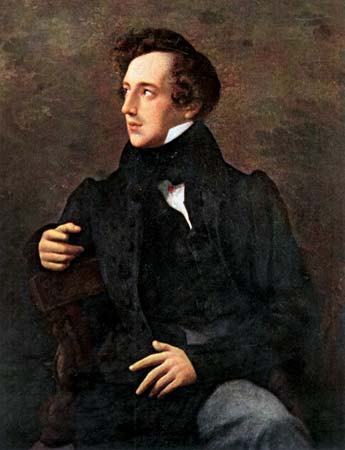
IMAGE: Another view of Mendelssohn
Tag: Felix Mendelssohn
-
Salterello Vivace to the Philadelphia Orchestra for John Williams’ Tuba Concerto
It’s rare to encounter a soloist standing before an orchestra with an instrument as cumbersome in appearance as the tuba; but that is the precisely what happened this weekend, when principal tubist Carol Jantsch took the stage of Marian Anderson Hall at the Kimmel Center of the Performing Arts to join the Philadelphia Orchestra for three performances of John Williams’ Tuba Concerto. And so as not to keep you in suspense, Friday afternoon’s concert, which I took in from the center of Row C in the Orchestra Tier (on the ground floor toward the back of the hall, but out from under the balcony) was superior in every way.
The tuba is an outlandish instrument that comes with a lot of baggage, from polka and marching bands to Tubby the Tuba and Jabba the Hutt. It looks heavy, and it can sound heavy. But the instrument is actually nimbler than one might think, especially in the hands of John Williams and his soloist. The composer, who professed to play the tuba “a little,” describes it as “agile” and compares it to “a huge cornet.” It certainly is lither than any outsider would ever expect.
I don’t know the specifications of Jantsch’s instrument, but a concert tuba can weigh from ten to twenty pounds. There is no chin-rest, strap, or pin to rest it on. You hold the thing and you play it, in this case for 18 minutes. It’s not only an impressive display of dexterity but also stamina. Furthermore, in the grand 19th century tradition, Jantsch lent her own embellishments to the work’s first movement cadenza, working in sly references to Williams’ “Imperial March” and “Jurassic Park.” Not interpolations I would want on a recording, necessarily (it was not Williams’ plan to include these in the concerto), but fun in the moment.
Cumulatively, Jantsch stunned with lung power, breath control, color, and finger work. I sensed many in the audience had no idea what to expect, but they sat in rapt, riveted silence throughout. The music and performance made an electrifying impact, as well they should have.
As if that weren’t enough, Jantsch demonstrated she had plenty in reserve, when, after being called back a couple of times to acknowledge the hoots and applause, she strolled over to join musicians at a keyboard and drum kit stage left, for a cover of “Beastly” by the American funk/soul band Vulfpec, which if anything was more rigorous and virtuosic than the concerto!
She was not gasping afterwards and she never broke a sweat. Unbelievable musician, on the unlikeliest of instruments. But that’s how one gets to be a principal player in the Philadelphia Orchestra.
Williams’ concerto is one of his most immediately accessible and an ideal bridge for fans of his film music. Moreover, the work itself is of very high quality, expertly orchestrated, with the tuba playing with or against various sections or solo players, like a kind of aural kaleidoscope, yet never obscured. The concerto shows off a player’s command of lithe finger work and leather lungs. And it never flags for 18 minutes. (Its three movements are played attacca).
Ralph Vaughan Williams’ is the Tuba Concerto most classical music people are likely to know, but for as much as I love RVW, this one, frankly, surpasses it. Perhaps a less contentious statement would be that if you want to make the short list of most effective tuba concertos, you’ve got a leg-up if your name happens to include “Williams.”
Conductor Dalia Stasevska was midway through her final series of concerts on a multi-week visit to Philadelphia, and quite a visit it’s been. Only days ago, she led the orchestra in a one-off performance of Dvořák’s Cello Concerto – with Yo-Yo Ma, no less. I was not present for that concert, but I was there last Friday for the program of John Adams’ “Short Ride in a Fast Machine,” Samuel Barber’s Violin Concerto (with Augustin Hadelich), and Gustav Mahler’s Symphony No. 4 (with soprano Joélle Harvey). That concert was up to the Philadelphia Orchestra’s usual fine standards, but I did not find it exceptional. (A couple of other online reviewers were more impressed, though I’m not sure on what day they attended.) For this one, however, Stasevska pitched a perfect game.
The program opened with the Symphony No. 2 by Julius Eastman, a talented and sensitive musician, who attended Philadelphia’s Curtis Institute of Music (Mieczyslaw Horszowski was among his teachers) before pursuing experimental music in Buffalo at the invitation of Lukas Foss. There he worked alongside leading avant-gardists Morton Feldman and Pauline Oliveros. But as a Black man and a homosexual, he faced a lot of impediments, both professional and personal. And he didn’t always address them in the healthiest ways. Among other things, he struggled with substance abuse. For a time, he was homeless. The titles of several of his works include slurs that, if anything, stir even greater outrage now than they did then, so that even to name them would be to risk virulent backlash and an almost-certain ban from Facebook. He was angry and he wanted to shock audiences awake. He had his share of angst, and who can blame him?
Many of his works include experimental touches. His output embraces the disparate influences of aleatory, minimalism, jazz, and popular music (even disco!). None of these are reflected in his symphony.
The Symphony No. 2 was the product of a dying love affair. The composer wrote it at white heat and handed it off to the man he loved. It is a painful, confessional work, introverted and bleak, but also heartfelt and absorbing. It does not outstay its welcome. Most importantly, it reflects the composer’s humanity, which is one of the highest services of music. It doesn’t matter who you are, or what color you are, or who you love, if you have the tools to express yourself articulately in music you can put yourself out there and connect with receptive listeners of all backgrounds. Eastman, at least in this work, does so very well. It’s probable he didn’t actually intend it for public performance. But as a spontaneous outpouring of grief, vulnerability, and tenderness, it is raw and communicative.
Stasevska has been an advocate for the work, and before the performance, she addressed the audience, articulately, informatively, and persuasively, about Eastman and his music. The manuscript of the symphony was rediscovered in a trunk of its dedicatee, the composer’s former lover. It was not in any sense complete, but rather more of a sketch, in 2018 filled-out into a performance edition by Luciano Chessa. How much is Eastman and how much is Chessa, I do not know. A detail that had me raise my eyebrows was an indication in the program that the duration of the piece in performance could be anywhere from 12 to 24 minutes. Not having seen score, I can only guess at the reasons.
I can say that, in Stasevska’s performance, it did not outstay its welcome. I did not check the time at her downbeat, but a recording she made of the work clocks in at around 14 minutes. The music is scored to emphasize lower instruments, employing three bass clarinets, three contrabass clarinets, three bassoons, three contrabassoons, three trombones, and three tubas. A melody suggestive of romantic loss and resultant grief opens onto a desolate soundscape. Instruments drone, but the orchestration is varied and full of interest. The strings wander, but with intensity of purpose, and the orchestra roils. In the original score, Stasevska says, Eastman marked one of the passages “Like Wagner.” Was Eastman recalling “Tristan und Isolde”? Or searching for catharsis in tragedy and grandeur? Whatever his intent, the work is as poignant as it is sonically expansive.
Eastman died in 1990 at the age of 49. His cause of death was given as cardiac arrest, possibly due to complications from HIV/AIDS. It’s said that he was on the verge of starvation. The concert’s programming, perhaps unwittingly, led me to reflect on Eastman’s struggle in comparison with the success of John Williams, his near-contemporary, wildly successful and still active, even as he is about to turn 94.
After a knock-out first half – for many in the hall, I’m sure, full of worthwhile surprises – I felt a bit going into the second half of the concert like a baseball fan entering the ninth inning of a no-hitter. Will the magic hold, or will the charm be broken? I’m not sure if it made me more concerned that the music was Felix Mendelssohn’s beloved “Italian” Symphony, which every classical music enthusiast knows so intimately. A mediocre performance, it would not go unnoticed.
But I needn’t have worried. Musicians of a major orchestra can likely play this one in their sleep. And hey, come on, this is THE PHILADELPHIA ORCHESTRA. Needless to say, the musicians played it like it was in their blood. With Stasevska at the helm, the first movement was chipper, at a pace that was on the edge, but didn’t push too hard. (All too often, interpreters mistake rushing somehow for being more upbeat and exciting. It is not always!) It might be Italy, but at the time Mendelssohn visited the Maserati hadn’t been invented yet. It was a pleasure to see the conductor smiling as she oversaw an orchestra playing with such vigor and precision.
The second movement is said to have been inspired by a religious procession the composer witnessed in Naples, but I have never heard anyone take it at a convincingly solemn pace. Thank God for that! I’m not sure Mendelssohn even intended it to be played so. Mendelssohn is the master of flow, and his pilgrims and holy men had just enough espresso to keep it moving at a walking pace, no lollygagging.
“Flowing” even better describes the third movement’s pleasing zephyrs and bird songs. The horn interludes always put me in mind of Mendelssohn’s music for “A Midsummer Night’s Dream.” If I were to characterize the symphony from the perspective of this movement alone, I would have no hesitation in calling it his “Pastoral” Symphony.
Except then comes the manic saltarello of the fourth movement, which propels the music relentlessly to the double-bar. By this point, the musicians were playing almost as if they were in a trance, the concentration was so intense. The music glided, fleet, nimble, and cleanly. It was some fancy footwork!
Even before the audience erupted into applause, I found myself marveling anew at what an underrated master Mendelssohn was. He deserves so much better than the enduring slight of a child prodigy who allegedly never fulfilled his promise. Any composer would be elated to have Mendelssohn’s success rate. There aren’t a lot who have so many works in the active repertoire. Will his name pack a house like Mozart’s? That’s not my concern. His best music always speaks to me, and I for one welcome the enchantment of his Romantic creations, which are full of atmosphere and feeling, sometimes touched with gentle melancholy but always without angst.
I am self-aware enough to recognize that any number of internal and external factors can influence my perceptions of a given performance – traffic, weather, the parking garage, an ill-timed email, my blood sugar level, how I slept, whatever else is going on in my life. The list is a lengthy one. I am a delicate instrument! But when the stars align, I have a pretty good ear, or at any rate an experienced one, and if I can keep my brain and my stomach silent, I can give a fair assessment of what I heard.
With that in mind, this concert had a lot stacked against it, as it was only on Friday morning that a glance at the calendar reminded me that I had a 2 p.m. performance. And I still had to get the last of my radio shows in for the weekend! This I produced in near-record time. (I wish I had had more.) Still, it was nearly 12:30 by the time I was able to shave and shower, including a hair wash, probably TMI. Then I had to refresh the bird feeders and hit the road.
Since there was no time for anything else, it meant the old coffee and banana lunch, consumed behind the wheel on I-95. Thankfully, and unusually, the highway was blissfully clear of stopped traffic. I don’t know how I did it, but I managed to make the leap from Princeton to Philadelphia and was seated in the hall well before the start of the concert. Furthermore, I was able to stay focused and attentive throughout. An MLK Weekend miracle!
Even with all that, nothing could dampen my appreciation of this truly fine event. Bravi to Carol Jantsch, Dalia Stasevska, Julius Eastman, John Williams, Felix Mendelssohn, and the Philadelphia Orchestra!
——–
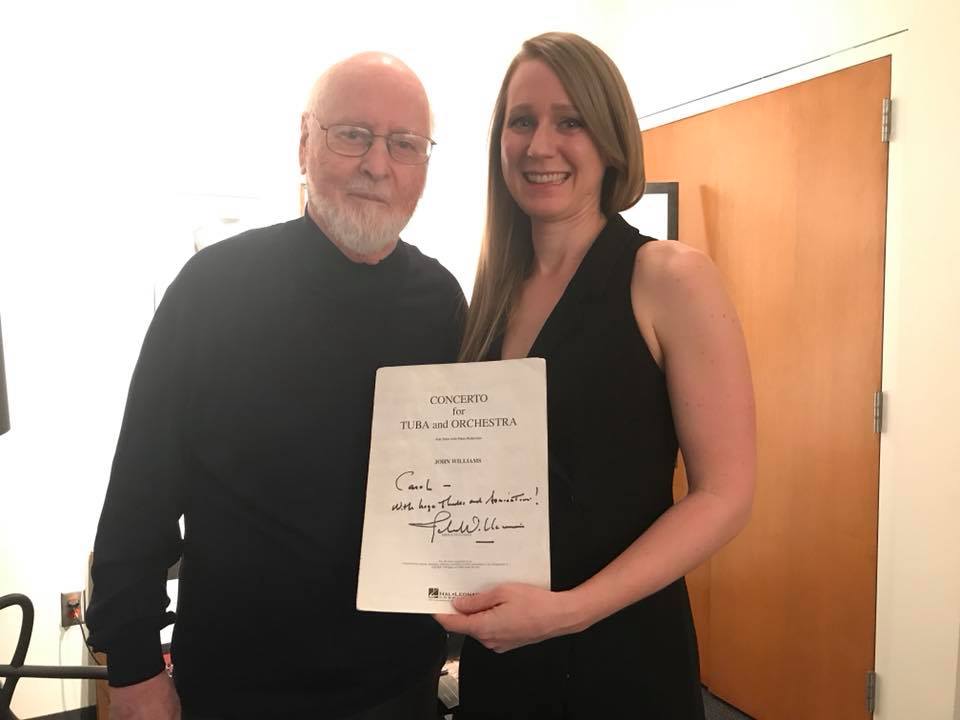
Photo from Carol Jantsch’s Facebook page, taken after a 2018 performance of Williams’ Tuba Concerto, with the composer in attendance -

Beardsley’s Mendelssohn Grotesque Genius
A caricature of Felix Mendelssohn from 1896 by Aubrey Beardsley. Beardsley was a leading figure in the Aesthetic Movement of fin-de-siècle England that also included Oscar Wilde and James McNeill Whistler.
Traveling to Paris, Beardsley encountered the poster art of Henri Toulouse-Lautrec and a rage for Japanese prints. He managed to assimilate these influences, in addition to Pre-Raphaelite models, especially Edward Burne-Jones, in the development of his own distinctive style and contributed significantly to the development of Art Nouveau.
His frequent choice of decadent, grotesque, and salacious subject matter was a cause of continuous controversy, until his early death of tuberculosis at the age of 25.
Salome, I get… but Mendelssohn???
-

Mendelssohn’s Spring Song & More
How many times have you heard Felix Mendelssohn’s “Spring Song” parodied, in cartoons or otherwise?
Yesterday, Punxsutawney Phil prognosticated an early spring, and today is Mendelssohn’s birthday (born on this date in 1809), so conditions are ripe to give it another listen. You’ll have your chance this morning on “Sweetness and Light.”
A selection of Mendelssohn’s “Songs without Words” (of which “Spring Song” is the most famous) will be offered, played by pianist Daniel Barenboim, as will one of the composer’s delightful string symphonies, written at the tender age of 12.
I will always associate “War March of the Priests” with the organ arrangement played by Vincent Price under the opening credits of “The Abominable Dr. Phibes.” We’ll hear it performed by Arthur Fielder and the Boston Pops. Also featured will be music from “A Midsummer Night’s Dream,” freely adapted for a 1935 film (starring James Cagney, Olivia de Havilland, and Mickey Rooney) by Erich Wolfgang Korngold.
Finally, we’ll enjoy two takes on the “Wedding March,” one in a paraphrase by Franz Liszt, given the Vladimir Horowitz treatment, and the other in a zany performance by Lara St. John’s polka band, Polkastra, that would have made Spike Jones proud.
I hope you’ll join me for an hour of felicitous Mendelssohn on “Sweetness and Light.” It will put a spring in your step and a song in your heart, when you tune in this morning at 11:00 EST/8:00 PST. Hear it exclusively on KWAX, the radio station of the University of Oregon!
Stream it, wherever you are, at the link:
While you’re waiting, here’s “Spring Song” (1931) by future Disney animator Cy Young. Back when cartoons were cartoons!
Happy birthday, Felix Mendelssohn!
-

Mendelssohn: Underrated Genius and Musical Revolutionary
I am starting to get just a little bit tired of hearing that if Felix Mendelssohn had never lived, music history would not have turned out any differently. He’s second-rate, he’s sentimental, he’s an academician, blah blah blah. When are these pompous idiots going to open their ears and acknowledge the fact that he was only one of the most influential composers of the 19th century? Especially in Germany, England and America, did any serious musician escape his sway?
Mendelssohn was essentially adopted as England’s national composer. Figures from William Sterndale Bennett through Sir Arthur Sullivan gleefully played in his shadow. In fact, Mendelssohn was the hottest composer in England since Handel. Such a stranglehold did Handel and Mendelssohn have on English concertgoers’ affections that, in Germany, England was mocked as “Das Land ohne Musik” – The Land without Music. The best English composers were all German.
But if the Germans were to be at all honest with themselves, they would have realized that all the best German composers were also followers of Mendelssohn. What about Wagner, you say, surely one of the most progressive composers who ever lived? There’s plenty of Mendelssohn in early Wagner. Ditto for Richard Strauss. As for the “second rank,” the more conservative school, just about everyone emulated Mendelssohn.
Of himself, of course, Mendelssohn was one of the most astonishing of musical prodigies. He composed two of the most enduring masterpieces in the repertoire, the overture to a “Midsummer Night’s Dream” and the Octet for Strings, at 16 and 17 respectively. In terms of maturity and polish, these were certainly on a par with anything written by the teenaged Mozart.
Yes, Mendelssohn was a traditionalist. He structured his music on foundations laid in the past. Even so, he cautiously ventured into the mists of Romanticism. Occasionally, he even subverted expectations, in works like his famous Violin Concerto. Furthermore, he was respectful, if not kind, to everyone, even those of whose music he disapproved.
As a conductor, there’s no question he was one of the most influential musicians in Europe, if not the world. For twelve years, he led the Leipzig Gewandhaus Orchestra, an ensemble full of players who went on to distinction in their own right. He was admired for the precision of his performances. He was also the one who essentially drew up the blueprint for modern orchestras in developing a musical “canon.” He gave important premieres of music by his contemporaries, while also reviving works of Bach, Mozart, and Beethoven.
In particular, he is credited with resuscitating the reputation of Johann Sebastian Bach, not only through his resurrection of the “St. Matthew Passion,” but in overseeing an edition of Bach’s organ works, along with an edition of Handel’s oratorios, both of which were published in England.
So music history would have been quite different if not for Mendelssohn, thank you very much. He may not have been the most seismic of innovators, but there’s something to be said for being a master of one’s craft.
Mendelssohn died in Leipzig, after a series of strokes, at the age of 38. Did he live up to his potential? Who among us is really qualified to judge? How much is one man expected to accomplish, anyway?
No radio station in the world is going to devote a full day to Mendelssohn’s music. Since the death of Victoria, I don’t think Mendelssohn has ever really been fashionable, except perhaps at weddings. But who doesn’t love the overture to “A Midsummer Night’s Dream,” the Octet for Strings, the “Hebrides Overture,” the “Italian” Symphony, or the Violin Concerto in E minor?
Morton Feldman once said, “The people you think are radicals might really be conservative. The people who you think are conservative might really be radical.”
I don’t know that I would ever go so far as to label Mendelssohn a radical, but he most certainly did change the world, and those of us who love music would have been a lot poorer without him.
Happy birthday, Felix Mendelssohn!
IMAGE: Another view of Mendelssohn
Tag Cloud
Aaron Copland (92) Beethoven (94) Composer (114) Conductor (84) Film Music (106) Film Score (143) Film Scores (255) Halloween (94) John Williams (179) KWAX (227) Leonard Bernstein (98) Marlboro Music Festival (125) Movie Music (121) Mozart (84) Opera (194) Picture Perfect (174) Princeton Symphony Orchestra (102) Radio (86) Ross Amico (244) Roy's Tie-Dye Sci-Fi Corner (290) The Classical Network (101) The Lost Chord (268) Vaughan Williams (97) WPRB (396) WWFM (881)