Tag: Film Composer

  • Victor Young The Immortal Composer

    Victor Young The Immortal Composer

    He may have died in 1956, but his music is forever Young. Victor Young was born in Chicago on this date in 1900.

    The composer of “Stella by Starlight” and “When I Fall in Love” was classically trained and thoroughly drilled: a violinist from the age of 6, he studied at the Warsaw Imperial Conservatory and found employment (following further training on the piano at the Paris Conservatory) while still a teen in the Warsaw Philharmonic Orchestra.

    His talent was admired by Czar Nicholas II, but his ability to capitalize on the connection was sharply curtailed as Russia boiled over into revolution, and Young barely escaped with his life. He fled to Warsaw and then Paris, and he didn’t stop running until he reached the United States.

    Here, he acted as a conductor and arranger of popular music. He was responsible for transforming Hoagy Carmichael’s “Stardust,” which had previously been played as an up-tempo dance number, into a romantic ballad, which secured its status as a mega-hit. “Stardust” went on to become one of the most-recorded songs of all time.

    In the mid-‘30s, Young made the move to film, where his gift for melody served him well. Over the course of the next two decades, he received 22 Academy Award nominations. Twice, he was nominated four times within a single year. Young holds the record for the most nominations prior to a win.

    Unfortunately, the honor of Oscar gold would be bestowed posthumously. His score for “Around the World in 80 Days” was recognized in 1957. Young died of a cerebral hemorrhage in November of 1956.

    In 20 years, he managed to compose 300 scores, among them those for “Reap the Wild Wind,” “The Glass Key,” “The Palm Beach Story,” “For Whom the Bell Tolls,” “The Uninvited,” “State of the Union,” “A Connecticut Yankee in King Arthur’s Court,” “Sands of Iwo Jima,” “Samson and Delilah,” “Rio Grande,” “The Greatest Show on Earth,” “Scaramouche,” “The Quiet Man,” “Shane,” “Three Coins in a Fountain” and “Johnny Guitar.”

    In 1960, he received a star on the Hollywood Walk of Fame. In 1970, he was inducted into the Songwriters Hall of Fame.

    Happy birthday, Victor Young. What he might have accomplished had he lived to be old!


    Nat King Cole singing “When I Fall in Love”

    A suite from “Scaramouche” (1952)

    “The Quiet Man” (1952)

    “Around the World in 80 Days” (1956):

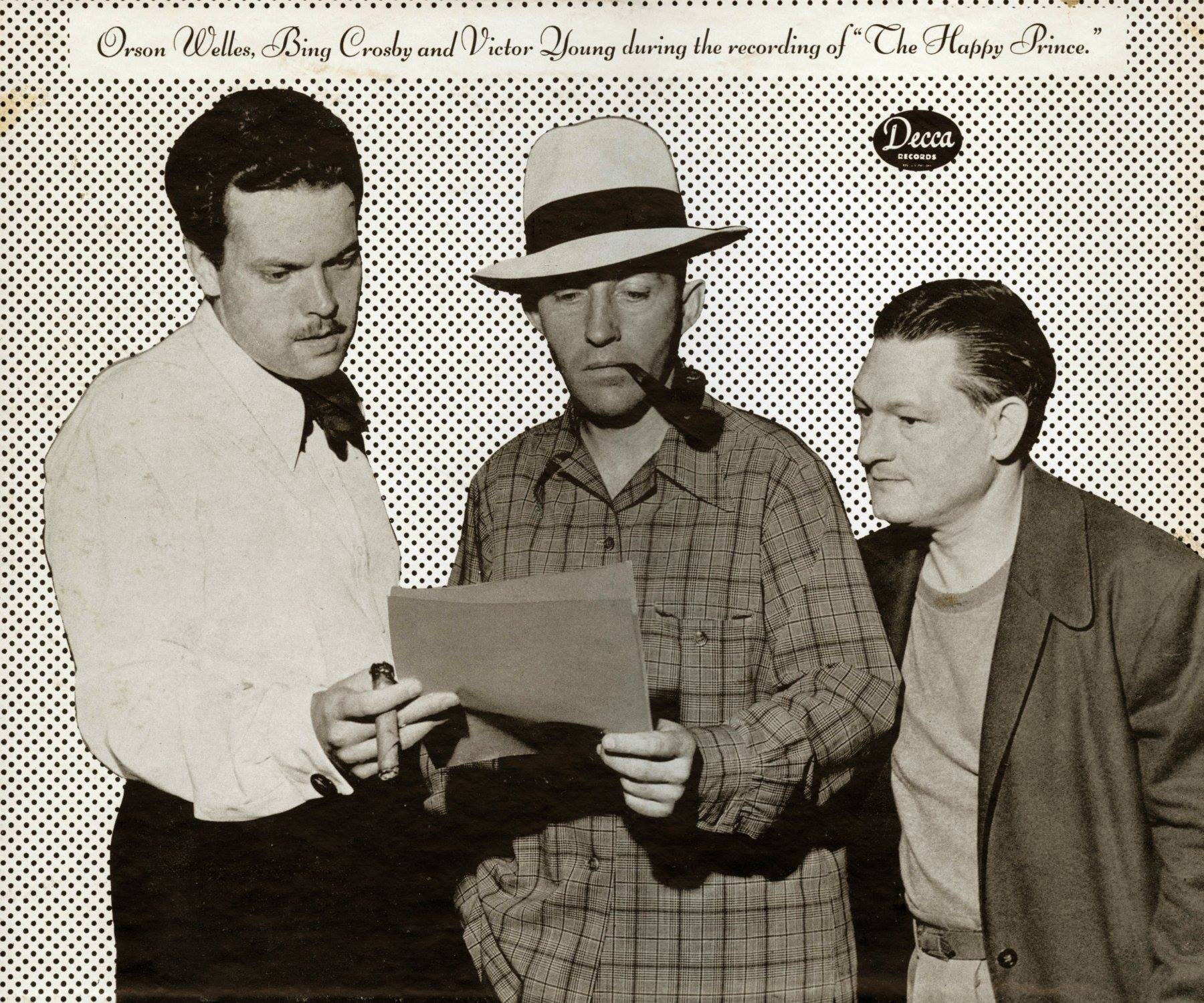
    PHOTO: Orson, Bing and Young
  • David Raksin Laura’s Composer Remembered

    David Raksin Laura’s Composer Remembered

    There are a number of interesting birthday anniversaries today, including those of Jean-Baptiste Lully, William Schuman and Louis Armstrong (who believed he was born on July 4).

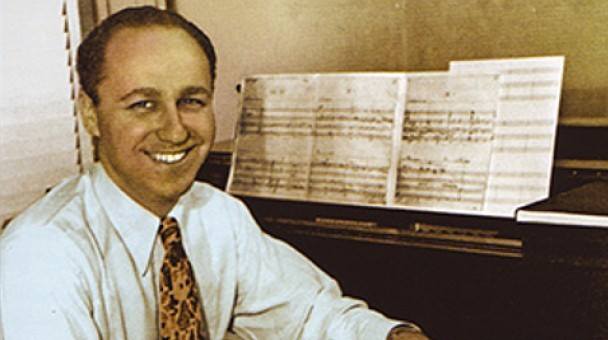
    However, I’m going to focus on David Raksin, the Philadelphia-born film composer, who attained immortality with his music for “Laura” (1944), which, with the addition of lyrics by Johnny Mercer, went on to become a popular standard. In fact, it’s said that in Raksin’s lifetime “Laura” was recorded more than any other song, save Hoagy Carmichael’s “Stardust.”

    Raksin worked on over 100 films and 300 television shows. One of the earliest was Charlie Chaplin’s “Modern Times” (1936). While Chaplin was an amateur violinist who “composed” all of his own scores, it was people like Raksin who really did the heavy lifting, filling out the harmony and the orchestration and so forth. Their work together led to some friction, with the demanding Chaplin firing Raksin at least once, but the two wound up fast friends, full of mutual respect.

    Despite decades of fine work, Raksin never attained the status of composers like Max Steiner or Erich Wolfgang Korngold. However, film historians and classic movie fans owe Raksin much, since he lived long enough (he was 92 when he died in 2004) and possessed a sharp enough memory that he was able to recount many, many interesting anecdotes about colleagues who had since passed on into legend.

    Some thumbnails are posted on the website of the American Composers Orchestra, so that it’s possible to enjoy a few of Raksin’s recollections of Steiner, Korngold, Bernard Herrmann and the rest. You can find them by clicking here:

    http://www.americancomposers.org/raksin_intro.htm

    Happy birthday, David Raksin!


    Raksin conducts “Laura”:

  • John Williams Night on TCM

    John Williams Night on TCM

    The always masterful programmers over at Turner Classic Movies: TCM are devoting prime time tonight to the artistry of John Williams. Williams, of course, is the world’s most famous (and most successful) film composer, having written music for “Jaws,” “Star Wars,” “Close Encounters of the Third Kind,” “Superman,” “Raiders of the Lost Ark,” “E.T. The Extra-Terrestrial,” “Jurassic Park,” “Schindler’s List,” the first three “Harry Potter” films, and well, I’m sure you could name a half dozen others.

    His longest collaboration has been with director Steven Spielberg, with 26 features (most recently, “Lincoln”) and counting. TCM will be kicking off what should be an exceedingly interesting evening for Williams aficionados with Spielberg’s theatrical debut, the undershown “The Sugarland Express” (1974), at 8 p.m. ET. Goldie Hawn and William Atherton play a Texas couple – Atherton an escaped convict – who lead the police on a wild chase as they attempt to prevent the adoption of their son. Along the way, they become unlikely folk heroes. That’s harmonica legend Toots Thielemans on the soundtrack.

    That’s followed at 10 p.m. with a rebroadcast of “AFI Master Class – The Art of Collaboration: Spielberg-Williams,” in which the two screen titans discuss their 40 year association before an audience of aspiring filmmakers at the AFI Conservatory.

    Then at 11 p.m. comes the rare opportunity to see “The Man Who Loved Cat Dancing” (1973), with Burt Reynolds as the head of a band of train-robbers in the old west, again on the run, forced by circumstance to ride with the wife (Sarah Miles) of the Wells Fargo agent who pursues them. The music (actually replacing a rejected score by Michel Legrand) melds a pop-tinged main title with the Williams sound we all know and love.

    Experience John Williams before “Jaws” (1975) and “Star Wars” (1977) made him a household name, tonight on TCM.

    Music from “The Sugarland Express”:

    And from “The Man Who Loved Cat Dancing”:

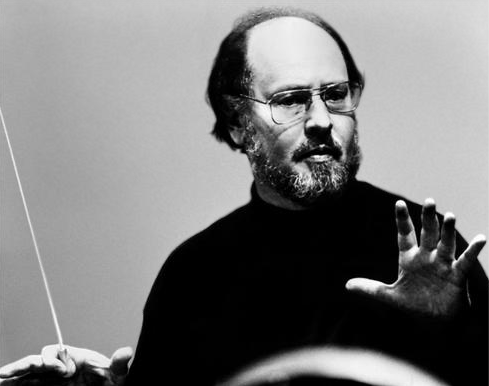
    PHOTO: Williams in the ‘70s

Tag Cloud

Aaron Copland (92) Beethoven (95) Composer (114) Film Music (120) Film Score (143) Film Scores (255) Halloween (94) John Williams (185) KWAX (229) Leonard Bernstein (100) Marlboro Music Festival (125) Movie Music (135) Opera (198) Philadelphia Orchestra (88) Picture Perfect (174) Princeton Symphony Orchestra (106) Radio (87) Ralph Vaughan Williams (85) Ross Amico (244) Roy's Tie-Dye Sci-Fi Corner (290) The Classical Network (101) The Lost Chord (268) Vaughan Williams (103) WPRB (396) WWFM (881)

DON’T MISS A BEAT

Receive a weekly digest every Sunday at noon by signing up here


RECENT POSTS