Tag: Film Composer

  • Max Steiner: Hollywood’s Epic Composer

    Max Steiner: Hollywood’s Epic Composer

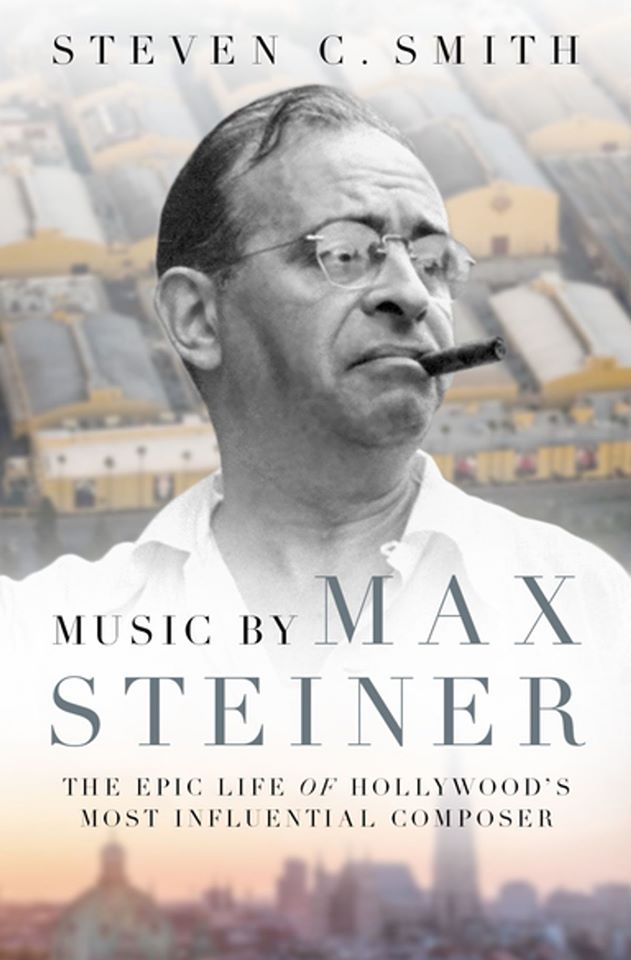
    It’s an unfortunate coincidence that I happened to finish this book on the anniversary of Olivia de Havilland’s death. De Havilland was one of the dozens of subjects interviewed or researched for this authoritative biography of Max Steiner, unbelievably the first full-length treatment of one of the movies’ most celebrated composers.

    Steiner might be said to have had one foot in Vienna and one on the Great White Way. His grandfather, for whom he was named, was a formative influence on the development of Viennese operetta, and his father, also very much involved with the theater, built an entertainment city within the city, which included among its wonders the Riesenrad, the giant Ferris wheel used so memorably in “The Third Man.” In the New World, Steiner worked as music director for the Gershwins, Jerome Kern, and others. But it was in Hollywood, at the dawn of talking pictures, that he was to make his greatest mark.

    Steiner pioneered the concept of the Wagnerian-Straussian underscore, in films such as “Bird of Paradise,” “King Kong,” and “She,” an approach that would set the industry standard for decades. Indeed, many of Steiner’s technical, if not musical, innovations are still employed in the process of adding music to film.

    You’d think that, for being such a powerful and lucrative asset to RKO, Warner Brothers, and David O. Selznick (for whom he scored “Gone with the Wind”), Steiner would have been better appreciated, even seen as indispensable – and to an extent he was, whenever a prestige picture needed a little added luster, or a middling one some emergency TLC.

    Sadly, the studio system began to crumble sooner than one might think. Already in the late ‘40s, contracts were not being renewed, and Steiner, in common with many of the legendary actors and directors he had worked with, all at once found himself a free agent. This meant that he had to scramble for much of his later work.

    Also, despite being well paid – or well enough, by the day’s standards – he had all sorts of drains on his income. An appreciation for the good life, several alimonies, the support of his parents, unchecked generosity, and a profligate child left him scrambling. In fact, he was nearly always saddled with enormous debt and literally working around the clock to meet impossible deadlines. This continued until a late-in-life miracle, the theme to “A Summer Place” becoming an unexpectedly popular hit, brought him financial security.

    But life is strife, and Steiner still had his share of personal miseries. He struggled with failing eyesight for his entire adulthood (he scored at least one of his films while legally blind, though thankfully cataract surgery brought him back to the point where he could at least see), and a rocky relationship with his son led the kind of heartbreak that is every parent’s nightmare.

    Music remained a refuge. Steiner was a man who clearly took joy in the act of composing, and he was a master at solving the puzzle of how to match just the right kind of music to a particular kind of film. His home life could be volatile, the hours were certainly terrible, but he kept up a playful, almost child-like disposition. His scores are peppered with outrageous puns and side-notes to his orchestrators, many of them of an astonishingly bawdy nature.

    While some of his music may seem a little old fashioned today, at times mawkish and even a little cartoon-like (“Mickey Mousing,” or matching music too closely to an onscreen action, was one of Steiner’s weaknesses), he was undeniably a force to be reckoned with. Personally, I still find his idiom highly attractive. There would be no “Star Wars” or “The Lord of the Rings” without Max Steiner.

    Steven C. Smith’s “Music by Max Steiner: The Epic Life of Hollywood’s Most Influential Composer” is published by Oxford University Press. The study is generously annotated, with a bibliography, for those of a scholarly bent, but also compellingly written, so as to satisfy the more casual reader. If you’re at all curious about the art of film scoring, or simply a classic movie buff – Steiner knew everyone from Johann Strauss II to Frank Sinatra – this book is for you.

    Smith is also the author of “A Heart at Fire’s Center: The Life and Music of Bernard Herrmann” (1991). Let’s hope it’s not another 30 years before he tackles Franz Waxman, Alfred Newman, or someone equally worthy!

    Oxford Academic (Oxford University Press)

  • Ennio Morricone Death A Loss for Film Lovers

    Ennio Morricone Death A Loss for Film Lovers

    A sad day for anyone who loves the movies. Ennio Morricone is dead.

    The composer of over 500 film and television scores, he was likely the most prolific film composer of all time.

    Although he has always been very popular in America, and around the world, with tributes pouring in over the decades from both pop and classical artists, acknowledgment from the Hollywood establishment came only fairly recently. He received a star on Hollywood’s Walk of Fame in 2016, the same year he won his only competitive Academy Award, for his score to Quentin Tarantino’s “The Hateful Eight.” By then, he was 87 years-old. (He was nominated five other times, the first in 1979.) Earlier, he received an honorary Oscar, for lifetime achievement, in 2007.

    Of course, Morricone never needed Hollywood to confirm his greatness. He churned out score after score from his home in Rome, and always supplied his own orchestrations – by no means standard practice in the film industry. The sheer volume of his output ensured that he left his mark on nearly every genre, but none more indelibly than the western. His collaborations in the form with director Sergio Leone – especially “A Fistful of Dollars,” “For a Few Dollars More,” “The Good, the Bad and the Ugly,” and “Once Upon a Time in the West” – made him internationally famous.

    His music for “The Mission,” “The Untouchables,” and “Cinema Paradiso” also remains popular. His melodies are much appropriated by figure skaters, television commercials, and by the movies themselves. His music has been quoted or reused in over 150 films, in which he has had absolutely no involvement. Even in instances in which the movies were absolutely atrocious, Morricone could be counted on to draw on his unfailing professionalism, infusing the ridiculous with dramatic tension and often heartbreaking lyricism.

    No word on whether or not he was able to follow through on his commitment to write music for the 2026 Olympic Games in Milano Cortina.

    Morricone was 91 years-old. One of the last of the legends is gone.


    “The Good, the Bad and the Ugly”

    “The Mission”

    https://www.youtube.com/watch?v=L41oGXgVmZg

    Morricone conducts “Cinema Paradiso”

  • Franz Waxman’s Hilarious New Year’s Party Piece

    Franz Waxman’s Hilarious New Year’s Party Piece

    Franz Waxman, of course, was one of the great film composers. His music can be heard in “The Bride of Frankenstein,” “Rebecca,” “The Philadelphia Story,” “Sunset Boulevard,” “A Place in the Sun,” “Rear Window,” “Peyton Place,” “The Spirit of St. Louis,” and dozens of others.

    It was customary that Waxman and his family would get together with their neighbors, the Jascha Heifetzes, to welcome the new year with an evening of chamber music. Other guests on these occasions would include violist William Primrose and cellist Gregor Piatigorsky.

    Mainstream classical fare would dominate the festivities until the countdown to midnight. With the turn of the year, the musical selections would become a bit more frivolous.

    Waxman composed his “Auld Lang Syne Variations” in 1947, for one such gathering. This party piece sends up the traditional New Year’s anthem in the styles of several well-known composers.

    Feel free to play along and test your musical knowledge. You’ll find further clues in the work’s subtitles, listed below the video. One can only imagine Heifetz stepping out in “Chaconne a Son Gout.”

    Happy New Year!

  • Victor Young Forever The Composer Remembered

    Victor Young Forever The Composer Remembered

    He may have died in 1956, but his music is forever Young. Victor Young was born in Chicago on this date in 1900.

    The composer of “Stella by Starlight” and “When I Fall in Love” was classically trained and thoroughly drilled: a violinist from the age of 6, he studied at the Warsaw Imperial Conservatory and found employment (following further training on the piano at the Paris Conservatory) while still a teen in the Warsaw Philharmonic Orchestra.

    His talent was admired by Czar Nicholas II, but his ability to capitalize on the connection was sharply curtailed as Russia boiled over into revolution, and Young barely escaped with his life. He fled to Warsaw and then Paris, and he didn’t stop running until he reached the United States.

    Here, he acted as a conductor and arranger of popular music. He was responsible for transforming Hoagy Carmichael’s “Stardust,” which had previously been played as an up-tempo dance number, into a romantic ballad, which secured its status as a mega-hit. “Stardust” went on to become one of the most-recorded songs of all time.

    In the mid-‘30s, Young made the move to film, where his gift for melody served him well. Over the course of the next two decades, he received 22 Academy Award nominations. Twice, he was nominated four times within a single year. Young holds the record for the most nominations prior to a win.

    Unfortunately, the honor of Oscar gold would be bestowed posthumously. His score for “Around the World in 80 Days” was recognized in 1957. Young died of a cerebral hemorrhage in November of 1956.

    In 20 years, he managed to compose 300 scores, among them those for “Reap the Wild Wind,” “The Glass Key,” “The Palm Beach Story,” “For Whom the Bell Tolls,” “The Uninvited,” “State of the Union,” “A Connecticut Yankee in King Arthur’s Court,” “Sands of Iwo Jima,” “Samson and Delilah,” “Rio Grande,” “The Greatest Show on Earth,” “Scaramouche,” “The Quiet Man,” “Shane,” “Three Coins in a Fountain” and “Johnny Guitar.”

    In 1960, he received a star on the Hollywood Walk of Fame. In 1970, he was inducted into the Songwriters Hall of Fame.

    Happy birthday, Victor Young. What you might have accomplished had you lived to be old!


    Nat King Cole singing “When I Fall in Love”

    “Scaramouche” (1952)

    “The Quiet Man” (1952)
    https://www.youtube.com/watch…

    “Around the World in 80 Days” (1956):


    PHOTO: Orson, Bing and Young

  • Elmer Bernstein a Hollywood Legend

    Elmer Bernstein a Hollywood Legend

    Over the course of an enviable career that spanned some 50 years, Elmer Bernstein composed music for dozens of movies, many of them still much-beloved, including “The Ten Commandments” (1956), “The Magnificent Seven” (1960), “To Kill a Mockingbird” (1962), and “The Great Escape” (1963).

    In addition, he was one of the first film composers to incorporate jazz elements into his work for dramatic purposes, in movies like “The Man with the Golden Arm” (1955), “Sweet Smell of Success” (1957), and “Walk on the Wild Side” (1962).

    Coming out of the Swinging Sixties, when the industry clearly favored a more “popular” sound over purely orchestral scores (until John Williams changed everything), Bernstein kept right on working. Thanks to a generation of younger filmmakers who had grown up on his classics, he never lacked for opportunities. Suddenly he found himself much in demand as a comedy composer, providing the underscores for “Animal House” (1978), “The Blues Brothers” (1980), “Airplane!” (1980), “Stripes” (1981), and “Ghostbusters” (1984).

    For Martin Scorsese, he composed music for “The Age of Innocence” (1993), “Bringing Out the Dead” (1999), and “The Gangs of New York” (2002), though his score for the latter was ultimately rejected. He also adapted Bernard Herrmann’s music for Scorsese’s remake of “Cape Fear” (1991).

    Oh yeah, along the way, he also composed the iconic National Geographic theme – clearly by the same man who wrote “The Magnificent Seven.”

    In all, Bernstein was nominated for 14 Academy Awards, but claimed the Oscar only once, fairly early on, for his work on “Thoroughly Modern Millie” (1967), of all things. His final nomination was for his very last score, for “Far from Heaven” (2002). Elmer Bernstein died on August 18, 2004 at the age of 82.

    No relation to Leonard Bernstein (or “Bern-STINE”), Elmer pronounced his name “Bern-STEEN.” The two were sometimes further differentiated as “East Coast Bernstein” and “West Coast Bernstein.”

    In the year 2000, Elmer Bernstein composed a guitar concerto and expressed regret that he hadn’t contributed more to the concert hall. At least it was good one. David Hurwitz of classicstoday.com describes it as “incontestably the finest piece ever composed for this combination” (i.e. guitar and orchestra), going so far as to hold it up to Joaquin Rodrigo’s “Concierto de Aranjuez.” I don’t know if I’d take it that far, but it is pretty damn good.

    https://www.youtube.com/watch?v=eOxXLDdWZF8&list=PLjRpv3cr2epHnVUvbZhp8v0de0pXaOjkY

    Happy birthday, Elmer Bernstein. You are very much missed!

Tag Cloud

Aaron Copland (92) Beethoven (95) Composer (114) Film Music (120) Film Score (143) Film Scores (255) Halloween (94) John Williams (185) KWAX (229) Leonard Bernstein (100) Marlboro Music Festival (125) Movie Music (135) Opera (198) Philadelphia Orchestra (88) Picture Perfect (174) Princeton Symphony Orchestra (106) Radio (87) Ralph Vaughan Williams (85) Ross Amico (244) Roy's Tie-Dye Sci-Fi Corner (290) The Classical Network (101) The Lost Chord (268) Vaughan Williams (103) WPRB (396) WWFM (881)

DON’T MISS A BEAT

Receive a weekly digest every Sunday at noon by signing up here


RECENT POSTS