Tag: Film Composer

  • Laurie Johnson Avengers Composer Dies at 96

    Laurie Johnson Avengers Composer Dies at 96

    The composer and bandleader Laurie Johnson has died at a venerable age.

    Among other things, Johnson was the composer of super-cool TV music for shows such as “Jason King,” “The Professionals,” and of course “The Avengers” – by which I mean the elegant and often surreal spy-fi series, starring Patrick Macnee and Diana Rigg. You won’t find the incredible Hulk shooting very many corks out of champagne bottles.

    Johnson was already composing and arranging for the Ted Heath Band by his late teens. At 21, he was recording with his own band for EMI. He spent four years in the Coldstream Guards. In the 1950s, he became well-established as a composer and arranger for many of the major big bands.

    His music for the stage included collaborations with Lionel Bart (of “Oliver!” fame), Peter Cooke (of “Beyond the Fringe”), and Harry Secombe (of “The Goon Show”).

    Later, he cofounded Mark 1 Productions, the television company responsible for “The Avengers” and “The Professionals,” and became co-owner of Gainsborough Pictures.

    Among his feature film scores were those for Stanley Kubrick’s “Dr. Strangelove” and the Hammer cult classic “Captain Kronos – Vampire Hunter.”

    Arbiters of “serious music” are too often dismissive of the kind of skill it takes for an artist of Johnson’s ilk to succeed. It requires versatility, speed, polish, and instant memorability. What’s more, those putting up the money want it on the cheap. You won’t find many Stravinskys or Schoenbergs in the field (although, Lord knows, both tried to break in).

    Johnson was tutored at the Royal College of Music by Herbert Howells and Ralph Vaughan Williams.

    In addition to conducting albums of his own works, he recorded film scores of Dimitri Tiomkin and “North by Northwest” by Bernard Herrmann. He also wrote an autobiography, “Noises in the Head.”

    He directed, toured, and recorded with his own big bands well into old age. I own a number of their recordings. I’m thinking I might resurrect one of his more ambitious works, the “Symphony (Synthesis),” this weekend on my radio show, “The Lost Chord.”

    In 1971, a critic for Gramophone magazine described the symphony as a masterpiece: “This is perhaps the first truly successful combination of the Jazz and European music traditions,” he wrote.

    Johnson died on Tuesday at the age of 96. R.I.P.

  • David Raksin Hollywood’s Golden Age Composer

    David Raksin Hollywood’s Golden Age Composer

    Thanks to his unusual longevity and abundant wit, film composer David Raksin was, for years, the mouthpiece of a faded era, the man to whom historians and journalists would turn when seeking a well-turned quote or anecdote about his long-past contemporaries of the Golden Age of Hollywood.

    Raksin was born in Philadelphia on this date in 1912. This week on “Picture Perfect,” we’ll celebrate the occasion by revisiting some of his music written for the silver screen.

    Raksin received his early musical training from his father, who played in concert bands and theater orchestras, and was also a member of the Philadelphia Orchestra. The younger Raksin formed his own dance band, taught himself orchestration, and put himself through the University of Pennsylvania by playing gigs. After graduation, he went to New York, where he played and sang with a number of ensembles and worked as an arranger.

    It was pianist Oscar Levant who brought him to the attention of his friend, George Gershwin. Gershwin was so impressed with Raksin’s arrangement of “I Got Rhythm,” that it wasn’t long before the boy from Philadelphia was orchestrating for musical theater and receiving invitations to Hollywood.

    While Raksin would go on to compose all sorts of music, for the stage and concert hall, he is best recognized as a composer for film. He wrote over 100 film scores in all, and 300 scores for television. He was twice nominated for an Academy Award – for “Forever Amber,” in 1947, and “Separate Tables” in 1958.

    Raksin’s haunting theme for the noir classic “Laura” (1944), after lyrics were added by Johnny Mercer, became a sensation. It’s said that during the composer’s lifetime it was the second most-recorded song in history, behind only Hoagy Carmichael’s “Stardust.”

    Raksin’s first Hollywood job, believe it or not, was working for Charlie Chaplin. Chaplin hired Raksin to assist him on the score for his last silent film, and one of the most famous, “Modern Times” (1936). “Modern Times” had actually been conceived as a sound picture (it would have been Chaplin’s first), but he soon realized that his “Little Tramp” would lose his universal appeal, should the character be allowed to talk. So he reverted to his usual silent format, though punctuated by evocative sound effects and one notable gibberish song.

    Chaplin exercised close control over every aspect of his productions, right down to more-or-less composing the music. He had experience as a violinist and cellist, who had practiced sometimes four to six hours a day. He had good musical instincts and a certain melodic fecundity, which, with the help of his orchestrators, he would use to underscore his feature films.

    Raksin later revealed it was he who had essentially scored “Modern Times,” with Chaplin whistling tunes and asking him to make them fit the action.

    Such close and exacting supervision could be a challenge for Chaplin’s collaborators. Raksin was actually fired once, after only a week and a half, though quickly rehired. When the music director, Alfred Newman, stormed out of one of the recording sessions, Raksin refused to take up the baton in his stead, which led to further acrimony. The rift was eventually mended, and decades later Raksin would recollect his work on “Modern Times” as some of the happiest days of his life.

    The recording we’ll hear was conducted by none other than Carl Davis, who on occasion served a similar function, as when he collaborated with Paul McCartney on his “Liverpool Oratorio.” Davis, a prolific film composer himself, died yesterday at the age of 86.

    As was the case with “Laura,” the love theme from “Modern Times” was later outfitted with lyrics, and became a popular standard as “Smile,” attracting countless vocal artists, including Nat King Cole. Again, what cohesion there is to the film score is largely thanks to Raksin.

    Although Raksin had taught himself a great deal, he did receive instruction from Harl McDonald at the University of Pennsylvania, Isadore Freed in New York, and later Arnold Schoenberg in Los Angeles.

    At times he found himself frustrated when dealing with the musical ignorance of Hollywood producers. He was fond of relating a story about having finally found one that was musically literate. The producer claimed he didn’t want anything “Hollywood” for his film, but rather “something different, really powerful – like ‘Wozzeck.’”

    Raksin, elated, invited the producer to dinner at his home. As the two were conversing over drinks, the producer remarked suddenly, “What’s that crap you’re playing?” “That crap,” Raksin responded, “is ‘Wozzeck.’”

    For “The Man with a Cloak” (1951), a story influenced by elements drawn from the life and stories of Edgar Allan Poe, Raksin slyly worked twelve-tone elements into his score – one of the first instances of a composer having done so for a Hollywood film. A few years later, Leonard Rosenman would take modernistic techniques to a whole other level. Raksin employs the language of the Second Viennese School in scenes featuring the Poe character, who in the film goes by the name of his fictional creation, Dupin. The character is given a leitmotif consisting of a tone row made up of the notes E-D-G-A and D-flat (which could be read as “Re”), effectively revealing the identity of Dupin as Edgar, right in the music. For all that, the score retains its accessibility and manages to wed the language of Schoenberg to the necessities of Hollywood storytelling.

    The film, based on a novel of John Dickson Carr, had quite a cast: Joseph Cotten, Barbara Stanwyck, Louis Calhern, Leslie Caron, and even Jim Backus.

    We’ll conclude the hour with one of Raksin’s greatest scores, that for “The Bad and the Beautiful” (1952), Vincent Minelli’s extraordinarily cynical view of Hollywood. Kirk Douglas plays a character Raksin must have known well: a ruthless producer who uses and abuses everyone around him. The film, which also stars Lana Turner, Walter Pigeon, and Dick Powell, won a whole slew of Oscars, including one for Gloria Graham as Best Supporting Actress.

    Raksin died in 2004, at the age of 92. His music was beautiful, but never bad. I hope you’ll take an hour to sample some of it with me on Raksin’s birthday, on “Picture Perfect,” music for the movies, now in syndication on KWAX, the radio station of the University of Oregon!


    Keep in mind, KWAX is on the West Coast, so there’s a three-hour difference for the Trenton-Princeton area. Here are the respective air-times of my recorded shows (with East Coast conversions in parentheses):

    PICTURE PERFECT, the movie music show – Friday on KWAX at 5:00 PACIFIC TIME (8:00 PM EDT)

    THE LOST CHORD, unusual and neglected rep – Saturday on KWAX at 4:00 PACIFIC TIME (7:00 PM EDT)

    Stream them here!

    https://kwax.uoregon.edu/

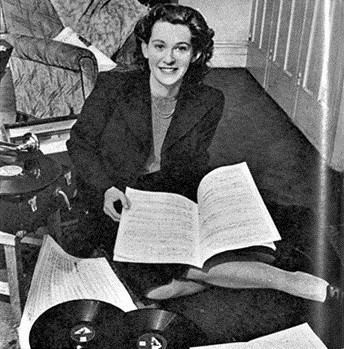
  • Doreen Carwithen Rediscovered?

    Doreen Carwithen Rediscovered?

    On the centenary of her birth, is Doreen Carwithen finally ready for her close-up?

    Carwithen has been lauded as the first female film composer. She was certainly the first to study in the Royal Academy of Music’s film program, instituted by J. Arthur Rank in 1946. Could she have been the first woman in the world to have made film music a career? In all, she composed scores for some 30 films, many of them shorts and documentaries, but six of them were features.

    Alas, her concert works, while well-received, were not embraced with particular enthusiasm by either programmers or publishers.

    Carwithen entered the Royal Academy as a cellist, who could also play violin and piano, in 1941. There, she enrolled in William Alwyn’s harmony class. Before long, he was also teaching her composition. Their mutual attraction was instantaneous, sparking a 30-year romance that culminated in their marriage in 1975.

    Unfortunately, at the time of their meeting, Alwyn happened already to be married. The affair proved deleterious to everyone – Carwithen, Alwyn, and Alwyn’s wife – with stress, depression, and physical health issues all around.

    When they finally did marry (after Alwyn’s doctor gave him a talking to, pointing out that he was killing everyone by not living honestly), Carwithen preferred to be recognized by her middle name. She had always disliked Doreen. Thereafter, she went by Mary.

    In 1961, as her career never really seemed to get off the ground, Carwithen began acting as Alwyn’s secretary and amanuensis. Increasingly, she shifted her focus to supporting and promoting his music at the expense of her own. After all, he was by that time a symphonist of stature, while she wasn’t gaining any traction.

    Following Alwyn’s death in 1985, she devoted herself purely to the preservation of his legacy. When she herself died in 2003, she left sketches for a string quartet (which would have been her third), a symphony, and a cello concerto. One can only imagine that, as a creative artist, Carwithen withered on the vine.

    Now it seems her time has come. Her overture, “Bishop Rock,” was performed at this year’s BBC Proms (alongside Grace Williams’ “Sea Sketches” and Ralph Vaughan Williams’ “A Sea Symphony”). On a separate concert, her Second String Quartet was also played. Another scheduled overture, “ODTAA (One Damn Thing After Another)” was not heard, as the Last Night of the Proms was cancelled because of the Queen’s death.

    I expect, with the increased interest in music by composers marginalized because of race or gender, that we’ll be seeing more recordings and concerts featuring Carwithen’s works.

    Here’s an interesting write-up that contains a lot of information about the composer, beyond that usually drawn from her Wikipedia page:

    History

    I’ve also been looking for an excuse to post this video of her Piano Sonatina for the last few weeks.

    “ODTAA (One Damn Thing After Another),” introduced by Sir Adrian Boult and the London Philharmonic in 1947

    Concerto for Piano and Strings, first performed at the Proms in 1952

    “Bishop Rock”

    String Quartet No. 1

    “Suffolk Suite” (1964)

    Carwithen wrote the score for the documentary “Elizabeth is Queen” (1953) at white heat. The film was released in theaters three days after Elizabeth’s coronation. The music under the opening credits is arranged from Walton’s “Crown Imperial.” Keep in mind, this is only reel one!

    https://www.britishpathe.com/video/elizabeth-is-queen-reel-1-1

    Carwithen and Alwyn were the focus of my film music show, “Picture Perfect,” this past Saturday on WWFM – The Classical Network. You can listen to the webcast by following the link below.

    https://www.wwfm.org/show/picture-perfect-with-ross-amico/2022-11-10/picture-perfect-november-12-william-alwyn-doreen-carwithen

    Happy birthday, Doreen Carwithen.

  • Doreen Carwithen Unsung Film Composer

    Doreen Carwithen Unsung Film Composer

    This week on “Picture Perfect,” we’ll shine a light on the shamefully underutilized talent of Doreen Carwithen.

    In 1941, Carwithen studied harmony and composition with William Alwyn at London’s Royal College of Music. For both, it was love at first sight. Their fateful pairing led to a decades-long romance that culminated in their marriage, finally, in 1975.

    The reason for the delay was, unfortunately, at the time of their meeting, Alwyn happened already to be married. The double-life caused tremendous stress. Alwyn, in particular, descended into alcoholism and suffered a nervous breakdown. Finally, his doctor urged him that, if he was going to live at all, he should get on with it already and live honestly.

    In the concert hall, Alwyn – a contemporary of William Walton and Michael Tippett – enjoyed comparative success as a symphonist. Carwithen, too, got off to a promising start. Her overture “ODTAA (One Damn Thing After Another)” was conducted by Adrian Boult at Covent Garden in 1947. She also wrote two award-winning string quartets. But the cinema promised more lucrative employment. Carwithen was the first selected by J. Arthur Rank to enter the college’s new film music program.

    Combined, during their heyday, in the 1940s and ‘50s, Alwyn and Carwithen wrote the music for over 100 films. Alwyn, in particular, scored such high-profile projects as “The Crimson Pirate,” “A Night to Remember,” and “The Swiss Family Robinson.” Carwithen, although groomed for the very purpose, was not given the same opportunities. In all, she scored only six dramatic features. The rest were documentaries and shorts.

    Neither were her concert works, though well-received, met with the same enthusiasm or eagerness by either programmers or publishers. In 1961, she became Alwyn’s secretary and amanuensis, and following his death in 1985, devoted herself to the preservation of his legacy.

    After her own death, in 2003, discovered among her papers were sketches for an unfinished string quartet (her third), a symphony, and a cello concerto. One can only imagine that, as an artist, her potential remained unfulfilled.

    In anticipation of the centenary of Carwithen’s birth (on November 15, 1921), we’ll do our best to level the playing field, dividing the hour between Alwyn and Carwithen, 50/50, this week, on “Picture Perfect,” music for the movies, this Saturday evening at 6:00 EST, on WWFM – The Classical Network and wwfm.org.

    Watch this space: I’ll be writing more about Carwithen and her efforts for the concert hall this Tuesday!


    If you enjoy either of my weekly shows (or both!), or any of the other music you hear on The Classical Network, please consider making a contribution today. We’re celebrating our 40th anniversary on the air and online. If you’re in a position to do so, why not make a donation right now at wwfm.org. Thank you in advance for your generosity and for your continued support of WWFM The Classical Network!

    https://wwwfm.secureallegiance.com/wwfm/WebModule/Donate.aspx?P=DEFAULT&PAGETYPE=PLG&CHECK=vOU2bz5JCWmgCDbf53nm9ezWDeZ%2beA1M

Tag Cloud

Aaron Copland (92) Beethoven (95) Composer (114) Film Music (120) Film Score (143) Film Scores (255) Halloween (94) John Williams (185) KWAX (229) Leonard Bernstein (100) Marlboro Music Festival (125) Movie Music (135) Opera (198) Philadelphia Orchestra (88) Picture Perfect (174) Princeton Symphony Orchestra (106) Radio (87) Ralph Vaughan Williams (85) Ross Amico (244) Roy's Tie-Dye Sci-Fi Corner (290) The Classical Network (101) The Lost Chord (268) Vaughan Williams (103) WPRB (396) WWFM (881)

DON’T MISS A BEAT

Receive a weekly digest every Sunday at noon by signing up here


RECENT POSTS