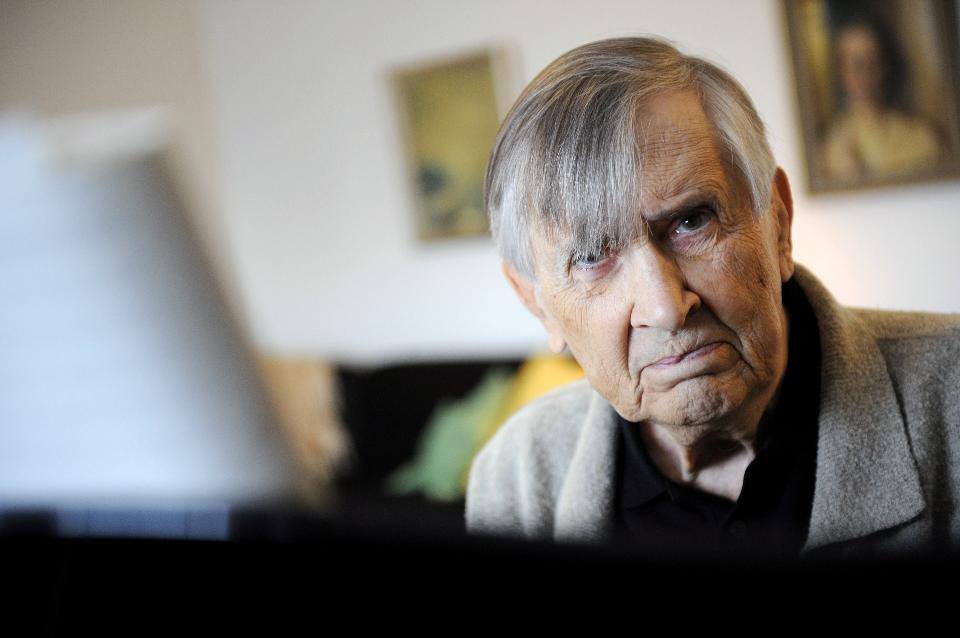
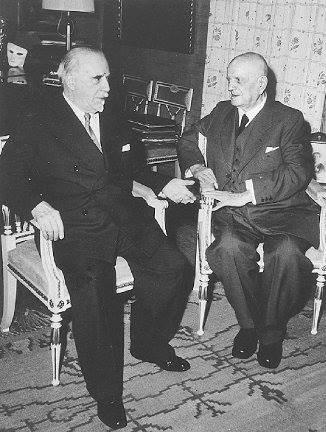
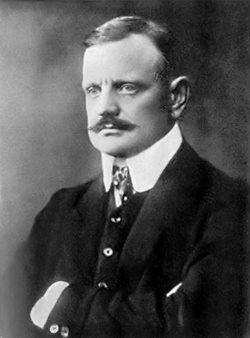
The great Finnish composer Einojuhani Rautavaara died on July 27 at the age of 87. It’s been a hectic couple of weeks, but tomorrow morning on WPRB, I’ll finally give the master his due, with FIVE BLESSED HOURS devoted to his music.
Rautavaara, widely regarded as one of the world’s great composers, the grand old man of Finnish music, and the spiritual heir of Jean Sibelius, composed eight symphonies, nine operas, 14 concertos, and dozens of other orchestral and vocal compositions.
How much Rautavaara is too much Rautavaara? We’re soon to find out. Scoff at the excessive heat warning with five hours of music from Finland (including Rautavaara’s “Cantus Arcticus”), tomorrow morning from 6 to 11 EDT, on WPRB 103.3 FM and at wprb.com. We’re cool to the Finnish, on Classic Ross Amico.
For the last 30 years of his life, Sibelius was gripped by what became known as “The Silence from Järvenpää.” Järvenpää is the Finnish market town outside which the composer made his home, which he called Ainola (after his wife, Aino, who in turn was named for a character in the Kalevala, the Finnish national epic).
After the completion of the 7th Symphony and the tone poem “Tapiola” in the mid-1920s, Sibelius created no more major works, though he grappled with the composition of an 8th symphony, which he eventually destroyed. He spent his later years being lionized by visiting conductors and listening to performances of his music over the radio.
Until then, however, he wrote prolifically, and this morning on WPRB, we’ll have another chance to sample from his unique output, with major works like the symphonies, of course (we have yet to hear Symphonies No. 2, 6 and 7), but we’ll also listen to some of the tone poems, miniatures, and reams of incidental music he composed for the Swedish Theater in Helsinki.
Our guests this morning will be Melissa Malvar and Fernando Malvar-Ruiz of The American Boychoir, who will be dropping by at around 7:30 to tell us a little bit about the group’s upcoming Christmas concert, “Home for the Holidays,” a Princeton tradition, which will take place at Richardson Auditorium on December 20 at 4 p.m.
Otherwise, it’s wall-to-wall Sibelius, as we wrap up loose ends from the sesquicentennial celebrations of his birth, on December 8, 1865. Join me from 6 to 11 ET, on WPRB 103.3 FM or at wprb.com. We’ll rail against The Silence, on Classic Ross Amico.
We continue our celebration of the 150th anniversary of the birth of Jean Sibelius (which occurred on December 8, 1865). Right now, we’re in the middle of an hour of his final masterworks, including incidental music from “The Tempest,” the tone poem “Tapiola,” and the Symphony No. 7.
Then at 10:00 we’ll ricochet back to one of his early successes, “Four Legends from the Kalevala,” in a fantastic recording with Eugene Ormandy and the Philadelphia Orchestra.
It’s all-Sibelius until 11 ET, on WPRB 103.3 FM and at wprb.com.
At last the day is upon us – the 150th anniversary of the birth of Jean Sibelius. Sibelius, of course, was Finland’s most revered artist and, though arguably underestimated for much it, one of the most influential composers of the 20th century.
With his 50th birthday imminent in 1915, the Finnish government commissioned from him a 5th symphony. The work was given its premiere one hundred years ago today, with the composer conducting the Helsinki Philharmonic Orchestra – though the original version was quite different, in many respects, from the masterpiece that has entered the standard repertoire. In a remarkable feat of objectivity, Sibelius revised the symphony twice, in 1916 and then again in 1919.
One of the work’s major innovations (showing the influence of Liszt, whom Sibelius greatly admired) involved the elimination of the break between the first two movements of the original, four-movement structure. The demarcations are blurred so that the first movement slips inexorably into the scherzo, and the listener is swept along, as if caught in a powerful current or precipitated into an avalanche, to thrilling effect.
This transition is always a challenge for conductors, since the changeover should appear entirely organic. Sibelius would further experiment with the telescoping of movements and the subversion of classical expectations in his 7th Symphony.
Perhaps the most striking revision is in how the final movement builds to a climax of impressive grandeur, a sublime apotheosis of the ennobling “swan theme,” only to come up against a series of powerful, monolithic chords, each isolated from the other by a moment of silence. The first five suspend the effect, before coming down with an indisputable sense of finality on the sixth. This is music of the gods.
On this day, one hundred years ago, the Finnish government declared Sibelius’ birthday a national holiday. You would do yourself a favor if you put in a call to your boss to tell him or her that you’ll be staying home today so that you can enjoy Sibelius’ Symphony No. 5.
More Sibelius this Thursday morning, from 6 to 11 ET, when I continue with the second half of my sesquicentennial salute on WPRB 103.3 FM and at wprb.com.
It’s all-Sibelius this morning, as we anticipate the 150th anniversary of his birth on December 8. December 8 also marks the 100th anniversary of the first performance of his Symphony No. 5, commissioned by the Finnish government to celebrate Sibelius’ 50th birthday, which was declared a national holiday.
The Sibelius 5th is among the noblest music in the entire literature. It is about nature, it is about something larger than ourselves. It is elemental, like a symphony built on tectonic plates. The opening “sunrise” in the horns gives way to awe and terror in the precipitous scherzo. The tension in the finale, following the noble “swan theme,” is like massive blocks of granite grating against one another as the mists disperse and great shafts of light ride in on the brass and a powerful truth is revealed. It is music of optimism and strength.
Join me in the 10:00 hour for the Symphony No. 5 of Sibelius. We celebrate the great Finnish master until 11 ET on WPRB 103.3 FM and at wprb.com.