Very few get rich in the arts. But every once in a while, you can score a nice pay day.
On this date in 1928, Swedish composer Kurt Atterberg entered his Symphony No. 6 into a contest held by the Columbia Record Company in honor of the 100th anniversary of the death of Franz Schubert. For his effort, he was awarded the first prize of $10,000. (Not bad for 1928!) The work became known as Atterberg’s “Dollar Symphony.” It remains the composer’s most-recorded piece, starting all the way back with Sir Thomas Beecham and a recorded broadcast with Arturo Toscanini.
Though Atterberg was the winner of the international competition, divisional winners (by “zone”) included the now-forgotten English composer John St. Anthony Johnson, for his work “Pax Vobiscum,” and the equally-forgotten American, Charles Haubiel, for a piece called “Karma.”
Franz Schmidt was recognized in Austria, for his Symphony No. 3. Havergal Brian won second prize in England, for the first three movements of his “Gothic Symphony.”
For a time at least, Atterberg’s “Dollar Symphony” was one of the darlings of Classical 24, a streaming service out of Minnesota used by classical music radio stations around the country to save on the cost of maintaining local announcers. However, characteristically, C24 only ever plays a single movement.
Whether it’s 1928 or 2022, money makes the world go ‘round. Ka-ching!
Atterberg, Symphony No. 6 – the whole thing – on YouTube
How great a debt do we record collectors owe to Neeme Järvi?
Järvi must be one of the most prolific recorded conductors of all time. He certainly stands out in his choice of repertoire, thanks in no small part to enterprising and supportive independent labels like Chandos and BIS (the latter for which he recorded the complete works of Jean Sibelius, more or less).
Of course, Järvi also recorded for Deutsche Grammophon, but by then he was able to use his influence to gently nudge this most mainstream of classical music record labels closer to the fringes of the repertoire.
From Järvi, you could always expect first-rate performances of music relegated to the lower drawers. It was from him that I learned all the Prokofiev symphonies, when all anyone else wanted to record was 1 & 5. It was his performances that convinced me that Glazunov was actually a fairly decent composer. He’s the only conductor to persuade me that Joachim Raff’s Fifth Symphony can be a compelling work. He also managed a thrilling and idiomatic recording of Duke Ellington’s “Harlem.”
Frankly, there are too many composers who have benefited from Järvi’s advocacy to list them all here. Among those who are now much better-know internationally, thanks to him, are Arvo Pärt, Wilhelm Stenhammar, Niels Wilhelm Gade, and Eduard Tubin.
Järvi excels in music of the Romantic era and the 20th century, and appears to be able to assimilate scores fairly quickly. And the more opulent, the better. His set of orchestral music from the operas of Rimsky-Korsakov is another highlight. His Strauss tone poems mesmerize. His recording of Prokofiev’s “Alexander Nevsky” is a knockout.
How about his Beethoven? Who cares? Järvi is one of the rare talents in his field who managed to buck the tradition of having to prove his metal against the core Austro-Germanic repertoire. Frankly, I’m much more interested to hear his Halvorsen.
A native of Tallin, Estonia (he emigrated to the United States in 1980 and has been an American citizen since 1985), Järvi trained under the Soviet system. His teachers included Yevgeny Mravinsky and Nikolai Rabinovich.
He went on to helm such orchestras as the Estonian National Symphony Orchestra (1963-79), the Gothenburg Symphony Orchestra (1982-2004), the Royal Scottish National Orchestra (1984-88), the Detroit Symphony Orchestra (1990-2005), the New Jersey Symphony (2005-2009), the Resident Orchestra of the Hague (2005-12), and the Orchestre de la Suisse Romande (2012-15).
As a performer, he’s a real throwback. Aside from his superb recordings, he also frequently excels in concert. On a good night, when he catches fire, his performances are marked by a romantic spontaneity and passion. The results can be thrilling. No other conductor, at least since the days when Dennis Russell Davies was a presence, would have been able to sway the Philadelphia Orchestra to perform Hans Rott’s Symphony in E – on the second half of the program, no less.
Of course, the orchestra loved him for having stepped up to conduct Tchaikovsky on a joint concert with the New York Philharmonic during an orchestra strike in 1996. The program was prepared in one rehearsal. Jarvi donated his services for the concert and received no fee – an unpopular move with management, but one that made him a hero to musicians.
All his children have entered the family business. His sons, Paavo and Kristjan, are also conductors, and his daughter, Maarika, is a flutist. According to the most recent information, he resides with his wife in New York City.
While personally I never met him, he did respond to my request to sign some CDs of Estonian music to be used as “thank you” gifts during a radio membership drive for “The Lost Chord,” and into the bargain he also sent me a recording of Artur Kapp’s oratorio “Job,” with a very nice letter.
Is it possible everything he’s recorded can be considered “great music?” Of course not. But is it interesting and historically significant? You bet! It would be a very boring world indeed, and a less enlightening one, if all we ever heard was Mozart’s “Jupiter” Symphony.
Järvi is 85 today. Happy birthday, Maestro, and many, many more!
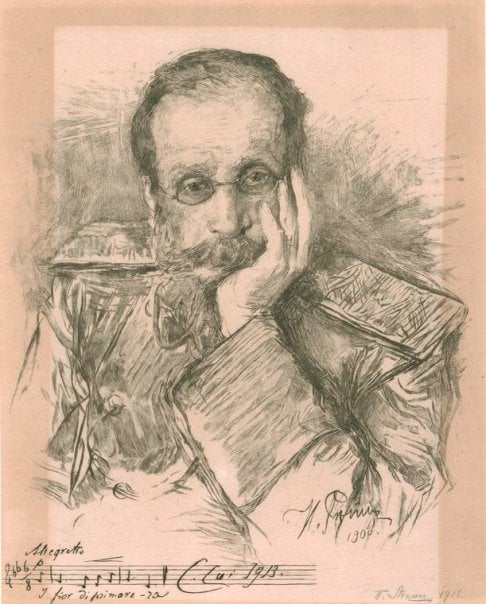
It’s January 18. Get queasy on Cui, for his birthday!
Among the followers of Mily Balakirev that collectively came to be known as “The Mighty Handful,” or “The Five,” unquestionably the least well-known is César Cui (1835-1918). Nikolai Rimsky-Korsakov, Modest Mussorgsky, and Alexander Borodin all went on to attain a kind of immortality in Russian music, each having left his indelible mark.
Cui wrote 15 operas, believe it or not – one of them, “William Ratcliff,” earning the highest praise from Franz Liszt – but today, he is remembered, if at all, as a miniaturist, or perhaps as a composer of art song, and at that, the least Russian-sounding of the five.
He shared in common with the others the fact that for him music was an avocation. He paid his bills as a military engineer. Beyond that, however, he was a bit of an outsider – born in Vilnius (now in Lithuania) to a father who had been a general in Napoleon’s army, who stayed and married a local. In addition to Russian, Cui grew up speaking French, Polish and Lithuanian. Perhaps this broader cultural perspective led to a more cosmopolitan approach to music.
As a critic, he was prolific, and he could be blistering in his sarcasm. Perhaps most notorious was his reception of Rachmaninoff’s First Symphony:
“If there were a conservatory in Hell, and if one of its talented students were to compose a program symphony based on the story of the Ten Plagues of Egypt, and if he were to compose a symphony like Mr. Rachmaninoff’s, then he would have fulfilled his task brilliantly and would delight the inhabitants of Hell. To us this music leaves an evil impression with its broken rhythms, obscurity and vagueness of form, meaningless repetition of the same short tricks, the nasal sound of the orchestra, the strained crash of the brass, and above all its sickly perverse harmonization and quasi-melodic outlines, the complete absence of simplicity and naturalness, the complete absence of themes.”
His assessment plunged Rachmaninoff into a two-year depression, during which he was unable to compose until lifted out of his funk by hypnotic therapy. Of course, today everyone knows Rachmaninoff’s music (if not his First Symphony). How many, I wonder, know Cui’s?
2 Morceaux for cello and orchestra, Op. 36
3 Morceaux for piano duo, Op. 69 (with Yakov Flier and Emil Gilels)
Orchestral Suite No. 3, Op. 43, “In modo populari”
Mischa Elman plays “Orientale”
“A Feast in Time of Plague” (which has gotten a lot of play, suddenly, since 2020)
Rachmaninoff, Symphony No. 1 (which Cui compared to the 12 plagues of Egypt)
I have so much music at this point, there’s probably no way I’ll ever be able to listen to all of it. Certainly, there are records and CDs I own that I will never hear again. But it is gratifying to have such an extensive library. It marks me as something of a dinosaur, I know, in this age of digital downloads and streaming.
And I am at a point of life now that it vexes me to wonder who will be around to appreciate it all when I am gone. Even if I were to bequeath it to some institution or other, I envision everything being scanned into a computer and the physical media winding up in a thrift shop or a landfill. My own fault, I suppose, for not cultivating any heirs. I guess I’ll just have to have it all bundled up and carted off with me to my pyramid.
Meditations on the impermanence of things aside, one of the delights of having such a vast collection is stumbling across music I didn’t even know I owned. As a patron of Princeton Record Exchange, I frequently walk out of the store with shopping bags full of CDs marked down to a dollar or two, and being involved with radio and the press for so long, I receive promos in the mail all the time. Is it any wonder I have only the vaguest idea of what I own?
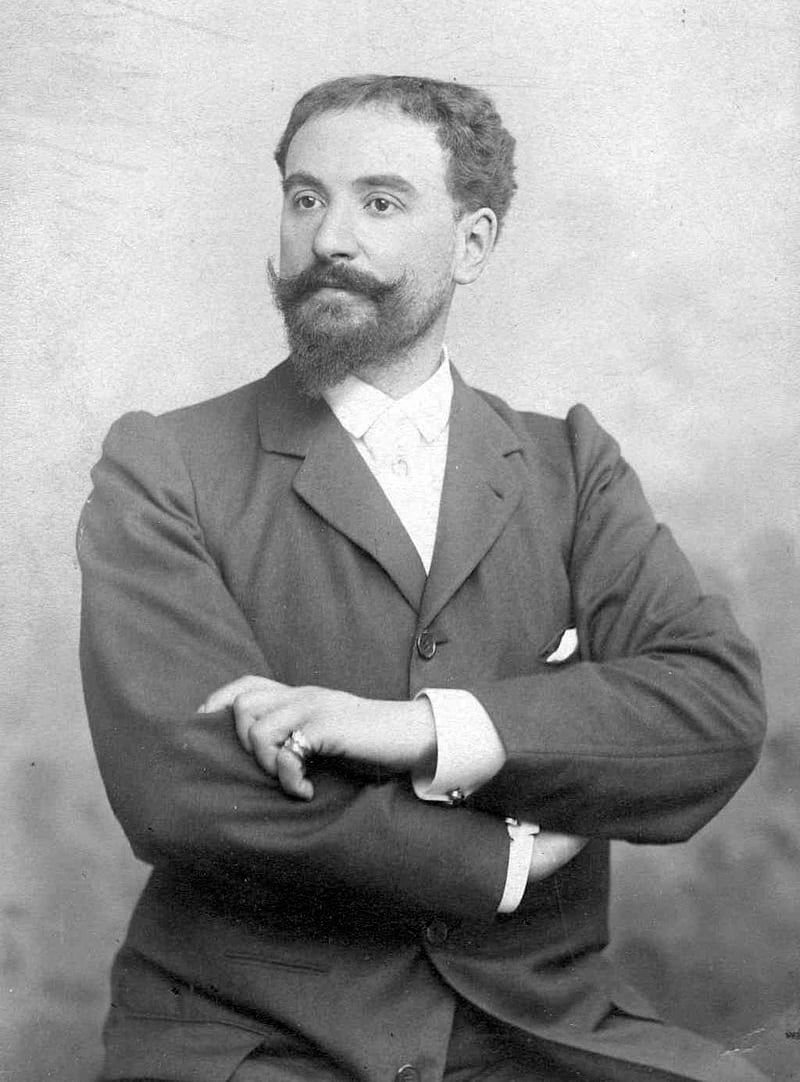
At some point during the pandemic, I was eyeballing the shelves and happened across a Naxos album of works by Luigi Mancinelli (1848-1921). I didn’t know the first thing about the composer. In fact, I had never even heard his name.
Mancinelli was a cellist and composer, but in his lifetime, apparently, he received most of his recognition as a conductor. He held principal conducting posts at home (that is to say, in Italy) and abroad, scoring great success at both the Royal Opera House, Covent Garden, and New York’s Metropolitan Opera. He also held appointments in Madrid, Rio de Janeiro, and Buenos Aires. He inaugurated the Teatro Colón with a performance of Verdi’s “Aida” in 1908.
Arrigo Boito called him the ideal interpreter of “Mefistofele,” and he was highly regarded as a Wagner conductor, even receiving the endorsement of the composer himself. Mancinelli introduced Verdi’s “Falstaff” at both Covent Garden and the Met. He also conducted the first Met performances of “The Magic Flute,” “Don Giovanni,” and “La bohème.”
Mancinelli composed several operas himself. Sadly, none of his works, operatic or otherwise, have entered the repertoire. I find it surprising that one of the criticisms leveled against him in the “Grove Dictionary of Music and Musicians” is an inability to craft memorable melodies, since one of the things that struck me immediately, based on the works on this CD (issued in 2013), is Mancinelli’s distinctly Italianate flair for long-limbed, singable tunes.
“Scene veneziane” (1889), in particular, is a winner, a piece I would program happily on any radio air shift. It would make an absolutely charming addition to any mid-morning, or perhaps even dinner hour. Mancinelli’s mastery of the orchestra is colorful and felicitous. The opening sounds like something out of Respighi’s “Three Botticelli Pictures,” though predating that other work by nearly 40 years!
But don’t take my word for it. Give a listen for yourself.