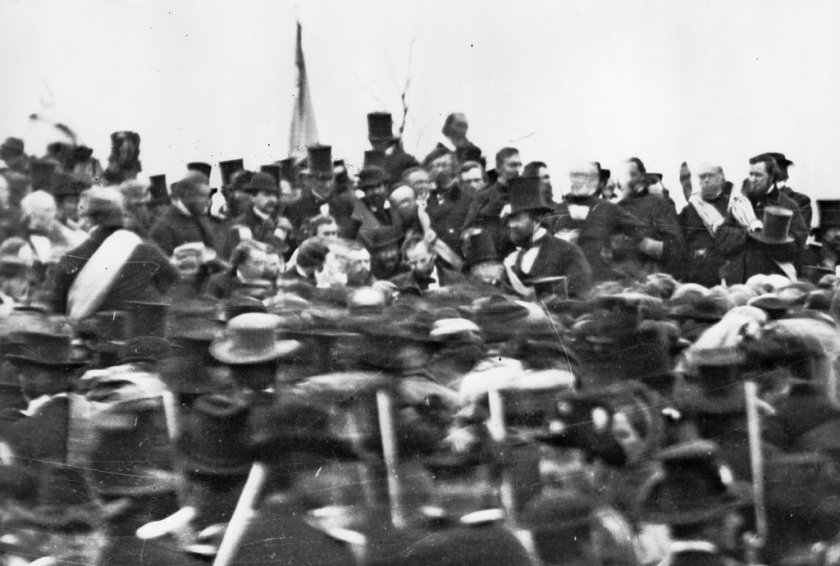
On November 18, 1863, the United States Marine Band accompanied President Abraham Lincoln to Gettysburg for the dedication of the Soldiers’ National Cemetery there, for which Lincoln was to deliver his celebrated Gettysburg Address.
Lincoln and the band traveled by train from Washington, by way of Baltimore and Hanover Junction. Directed by Francis M. Scala, the 27-member ensemble, which included trombonist Antonio Sousa, father of John Philip Sousa, serenaded the president on route with a lunchtime concert.
The next day, November 19th, 157 years ago this afternoon, members of “The President’s Own” performed the “Old Hundred” at the consecration and dedication ceremony, with Lincoln honoring those who fell. According to an article in the Washington Daily Morning Chronicle, the music was played “with great effect, in all its grand and sublime beauty.”
Lincoln’s Address had a more divided reception – ironic, since this modest, three-minute speech is now ensconced as one of the most hallowed pieces of American oratory. We as Americans have revered Lincoln’s noble sentiments since childhood, for generations, as well we should. It is all the more striking, when viewed through the lens of the present, for not labeling those who laid down their lives as “losers” and for delivering a message of national unity – and respect – at a time of unprecedented national conflict. It doesn’t get more patriotic than that.
A copy of the Address, signed and dated by President Lincoln, is on display in the Lincoln Room at the White House – a room apparently never visited by the outgoing administration. Here is a reminder of what Lincoln said regarding the sacrifice of those who died.
“Four score and seven years ago our fathers brought forth on this continent, a new nation, conceived in Liberty, and dedicated to the proposition that all men are created equal.
“Now we are engaged in a great civil war, testing whether that nation, or any nation so conceived and so dedicated, can long endure. We are met on a great battle-field of that war. We have come to dedicate a portion of that field, as a final resting place for those who here gave their lives that that nation might live. It is altogether fitting and proper that we should do this.
“But, in a larger sense, we can not dedicate – we can not consecrate – we can not hallow – this ground. The brave men, living and dead, who struggled here, have consecrated it, far above our poor power to add or detract. The world will little note, nor long remember what we say here, but it can never forget what they did here. It is for us the living, rather, to be dedicated here to the unfinished work which they who fought here have thus far so nobly advanced. It is rather for us to be here dedicated to the great task remaining before us – that from these honored dead we take increased devotion to that cause for which they gave the last full measure of devotion – that we here highly resolve that these dead shall not have died in vain – that this nation, under God, shall have a new birth of freedom – and that government of the people, by the people, for the people, shall not perish from the earth.”
Abraham Lincoln
November 19, 1863
The Marine Band at Gettysburg:
http://tapsbugler.com/wp-content/uploads/2018/11/Lincoln-and-The-Marine-BAnd-at-Gettysburg.pdf
Copland’s “Lincoln Portrait,” narrated by James Earl Jones: