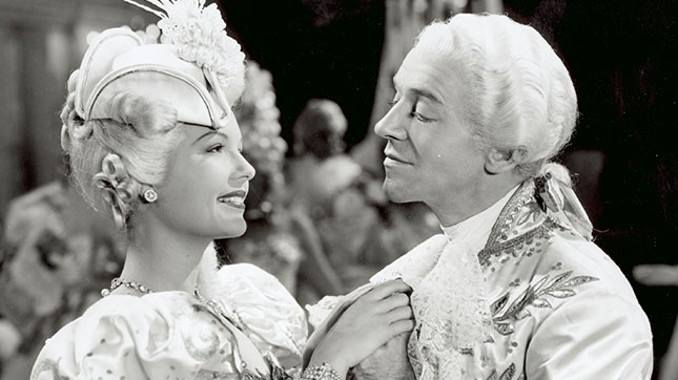
February 22. Washington’s birthday. Not the contemporary holiday (a.k.a. Presidents Day), mind you, but the actual anniversary of his birth.
Anybody else a fan of “Holiday Inn” (1942), with Bing Crosby and Fred Astaire? Irving Berlin astounds with a dozen songs constructed on holidays from the American calendar. Some have earned their immortality (“White Christmas” and “Easter Parade”). Others are completely forgettable. The song celebrating Washington’s Birthday falls soundly into the latter category – which, I argue, only makes it all the more enjoyable.
I find “Holiday Inn” vastly superior to its remake-of-sorts, “White Christmas” (1954), which pairs Crosby with Danny Kaye. Unfortunately Berlin’s celebration of Lincoln’s Birthday as a jaw-dropping black face number hasn’t aged particularly well. (At one point, Bing actually interjects, “Who dat?”) This number, more than anything, is probably what damns “Holiday Inn” to comparative obscurity – except for “White Christmas,” anyway – which is a shame, because the movie is very entertaining. These days, the segment is edited out of most television airings of the film, with the exception of those broadcast on TCM, which doesn’t attempt to whitewash history.
Washington’s Birthday is represented by “I Can’t Tell a Lie.” The number features Bing in a disheveled powdered wig, attempting to undermine Astaire, his rival in love, with a schizophrenic musical accompaniment that ping-pongs wildly (in the film) between 18th century minuet and 1940s big band.
Get a load of Berlin’s excruciatingly contrived lyrics. They can’t all be “White Christmas,” you know.
https://www.youtube.com/watch?v=Bxh52CY7EsU
Tag: Fred Astaire
-
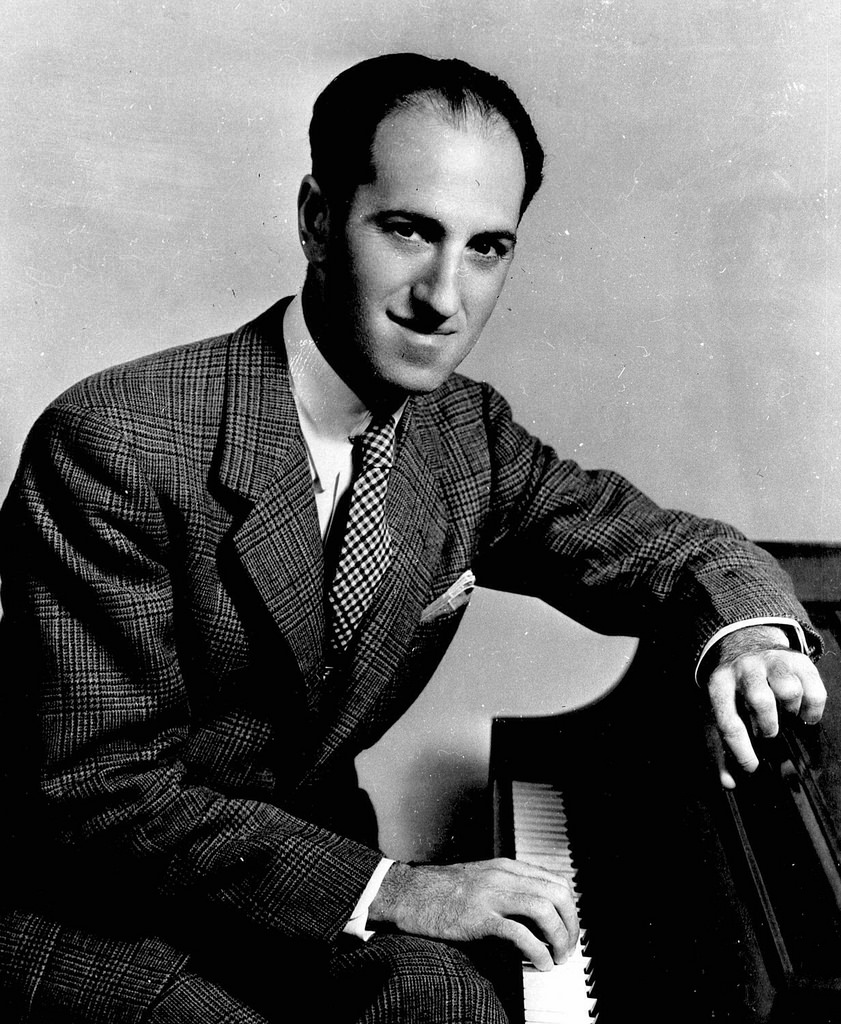
George Gershwin American Original
He began his career as a song plugger on New York’s Tin Pan Alley. He was “discovered” by Al Jolson, who gave him his biggest hit. He composed a string of successful stage musicals with lyrics by his brother, Ira.
Though he had classical training, he was turned away by both Nadia Boulanger and Maurice Ravel, on the grounds that they didn’t want to spoil his natural voice. He played tennis with Arnold Schoenberg, who also refused him lessons. He kept an autographed photo of Alban Berg in his apartment, next to one of Jack Dempsey.
His musical, “Of Thee I Sing,” was the first to win a Pulitzer Prize. His opera, “Porgy and Bess,” was a failure at its premiere. His songs graced elegant screen comedies of the 1930s. In the concert hall, he was America’s most authentic voice.
George Gershwin died of a brain tumor in 1937, at the age of 38. Reportedly, his last words were “Fred Astaire.”
All just the tip of the ice afloat in bathtub gin for this multifaceted American original. Happy 125, George!
Gershwin documentary that aired on the History Channel and was distributed by A&E – back when A&E was still A&E!
Clockwise from left: George himself; at the keyboard with Fred Astaire and Ira; painting a portrait of Arnold Schoenberg
-
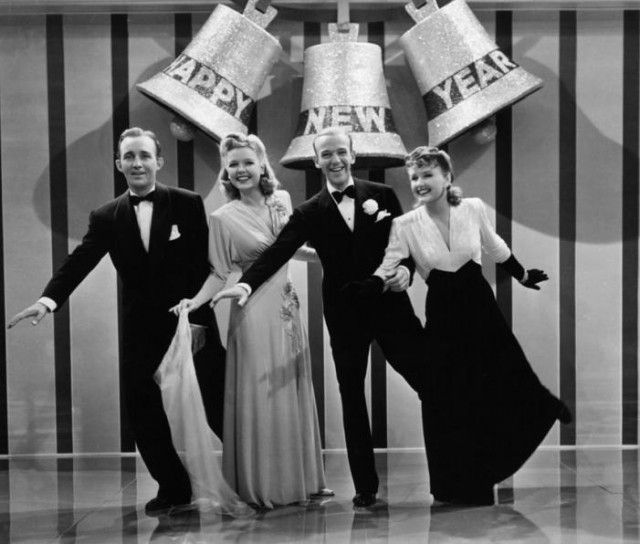
Ted Hanover Drinking Fred Astaire’s Funny Line
Ted Hanover (Fred Astaire): Then I had a drink…
Jim Hardy (Bing Crosby): A drink? Boy, you were fractured!
-
Dance Movie Magic for New Year’s Eve
Slip on your dancing shoes and get ready to welcome the new year! This week on “Picture Perfect,” it’s music from movies with a prominent role for dance.
“The Tales of Beatrix Potter” (1971) was inspired by the popular children’s stories, with anthropomorphized animals in hounds-tooth vests and that sort of thing. Conceived for film by Frederick Ashton, it features a buoyant pastiche score by John Lanchery, drawn from various sources, including works of Sir Arthur Sullivan, Michael Balfe, Leon Minkus and Jacques Offenbach.
Then relive the nightmare vision of “The Red Shoes” (1948). Written, directed and produced by the team of Michael Powell and Emeric Pressburger, this feverish dance film stars Scottish ballerina Moira Shearer. At its center is a story within the story, inspired by the Hans Christian Anderson tale about a girl whose vanity lends demonic power to her ruby footwear, with tragic consequences.
The music is by Brian Easdale, who conducted his own score. However, for the film’s ballet sequence, Easdale specifically requested the services of Sir Thomas Beecham, who leads the Royal Philharmonic Orchestra.
Screenwriter Ben Hecht worked on an astonishing number of Hollywood classics, including “Scarface,” “The Front Page,” “Nothing Sacred,” “His Girl Friday,” and Alfred Hitchcock’s “Spellbound.” Alongside his dozens of screen credits are uncredited contributions for work on films like “Stagecoach,” “Gone with the Wind,” “The Shop Around the Corner,” and “The Thing from Another World.” Because of his versatility, speed, and reliability, he became known as “the Shakespeare of Hollywood.”
Twice, he was given free rein to direct his own projects. One of these was a quirky ballet-noir, called “Specter of the Rose” (1946). The plot concerns an unbalanced ballet superstar, played by Ivan Kirov – who looks all the world like Steve Martin – who is suspected of murdering his first wife, his former dance partner. If so, will history repeat itself, with his new bride? With dialogue stylized to the point of absurdity, it’s a film that has to be seen to be believed. The music is by Trenton-born “Bad Boy of Music” George Antheil.
Much more considered is Luchino Visconti’s adaptation of Giuseppe di Lampedusa’s novel, “The Leopard” (1963). Burt Lancaster stars as a fading aristocrat around the time of Italian unification. The film’s memorable ballroom sequence occupies the last third of its three-hour running time. Nino Rota supplied the music.
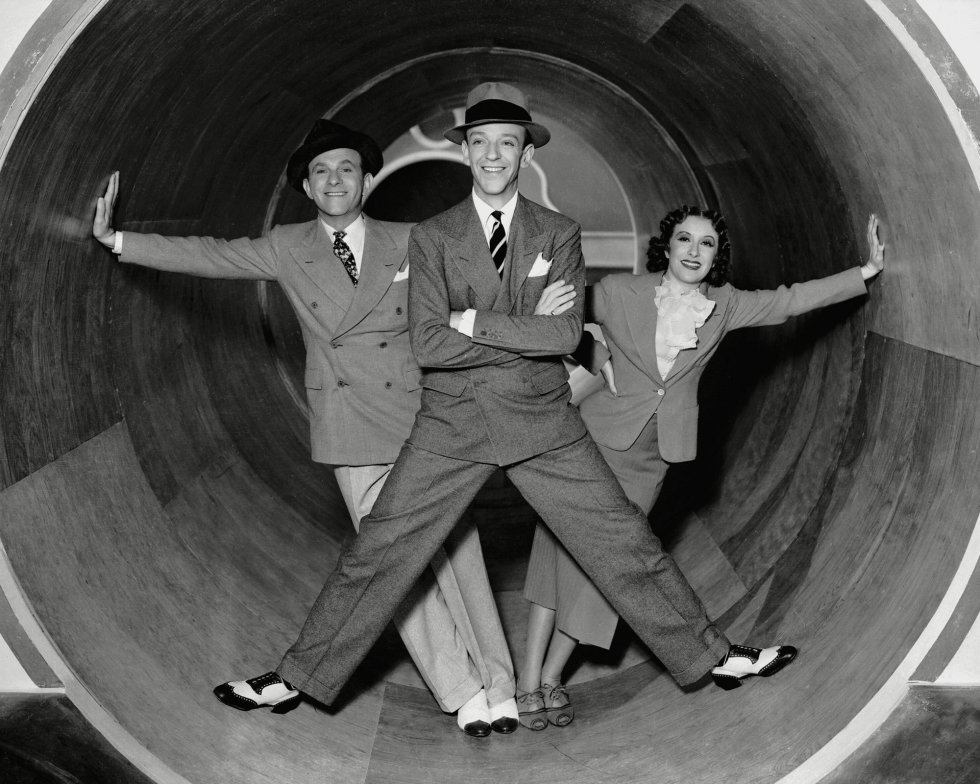
Finally, no show which purports to be about dance in the movies would be complete without music representative of Fred Astaire. Therefore, we’ll conclude with the funhouse dance sequence from “A Damsel in Distress” (1937). No Ginger Rogers in this one – rather Joan Fontaine, George Burns, and Gracie Allen. The energetic score is by George Gershwin.
Set the tone for celebration with tunes from movies with dance, on “Picture Perfect,” this Saturday evening – New Year’s Eve – at 6:00 EST, on WWFM – The Classical Network and wwfm.org!
-
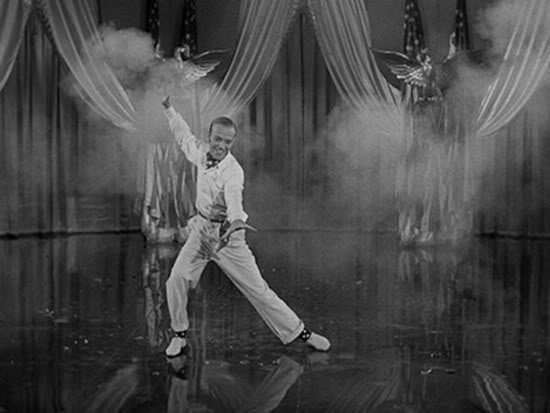
Irving Berlin’s Holiday Inn a Patriotic Dive
O that Irving Berlin.
I watch “Holiday Inn” once a year, whether I need it or not. If you don’t know the premise, worn-out crooner Jim Hardy (Bing Crosby) plans to retire from showbiz, but after a year of hard labor at his “retreat” on a Connecticut farm, he hits upon the idea to convert his home into a nightclub that’s only open (wait for it) ON HOLIDAYS.
Of course, along the way, there are plenty of farcical digressions, as he and his former partner, hoofer Ted Hanover (Fred Astaire), become involved in successive love triangles. The preposterous framework gives Berlin a chance to write a song for every festive occasion, and then some.
The results are a mixed bag. On the one hand we’ve got “White Christmas.” On the other, songs like “I Can’t Tell a Lie” (for Washington’s Birthday). And it’s best not even to bring up the Lincoln number in the 21st century.
That said, how can I pass on Bing as the Freedom Man?
https://www.youtube.com/watch?v=kEUBmmQrygU
Or Fred with firecrackers?
Celebrate responsibly, everyone, and have a happy 4th!
Tag Cloud
Aaron Copland (92) Beethoven (94) Composer (114) Film Music (117) Film Score (143) Film Scores (255) Halloween (94) John Williams (185) KWAX (228) Leonard Bernstein (99) Marlboro Music Festival (125) Movie Music (132) Opera (197) Philadelphia Orchestra (86) Picture Perfect (174) Princeton Symphony Orchestra (106) Radio (86) Ralph Vaughan Williams (85) Ross Amico (244) Roy's Tie-Dye Sci-Fi Corner (290) The Classical Network (101) The Lost Chord (268) Vaughan Williams (99) WPRB (396) WWFM (881)