Happy Birthday, Irving Berlin:
And Fred Astaire (whose birthday it was yesterday):
Happy Birthday, Irving Berlin:
And Fred Astaire (whose birthday it was yesterday):

February 22. Washington’s birthday. Not the contemporary holiday (a.k.a. Presidents Day), mind you, but the actual anniversary of his birth.
Anybody else a fan of “Holiday Inn” (1942), with Bing Crosby and Fred Astaire? Irving Berlin astounds with a dozen songs constructed on holidays from the American calendar. Some have earned their immortality (“White Christmas” and “Easter Parade”). Others are completely forgettable. The song celebrating Washington’s Birthday falls soundly into the latter category – which, I argue, only makes it all the more enjoyable.
I find “Holiday Inn” vastly superior to its remake-of-sorts, “White Christmas” (1954), which pairs Crosby with Danny Kaye. Unfortunately Berlin’s celebration of Lincoln’s Birthday as a jaw-dropping black face number hasn’t aged particularly well. (At one point, Bing actually interjects, “Who dat?”) These days, the segment is edited out of most television airings of the film, with the exception of those broadcast on TCM, which doesn’t attempt to white wash history.
This number, more than anything, is probably what damns “Holiday Inn” to comparative obscurity – next to “White Christmas,” anyway – which is a shame, because it is very entertaining. Every time I check YouTube, there’s not even a clip of Washington’s Birthday, which features Bing in a disheveled powdered wig attempting to undermine Astaire, his rival in love, with a schizophrenic musical accompaniment that ping-pongs wildly (in the film) between 18th century minuet and 1940s big band.
Oh well. At least we have this recording, with Berlin’s excruciatingly contrived lyrics. They can’t all be “White Christmas,” you know.

Today is the birthday of George Gershwin (1898-1937)
Here are a couple of fascinating documents, set down in 1926, of Fred and Adele Astaire singing with Gershwin at the piano.
The Astaires headlined two of Gershwin’s Broadway musicals, “Lady Be Good!” (1924) and “Funny Face” (1927). Adele married in 1932 and retired from show business. Fred later starred in the film musicals, “Shall We Dance”(1937) and “A Damsel in Distress” (1937), both at least partially scored by Gershwin.
Gershwin received his only Academy Award nomination for Best Original Song in 1937, for “They Can’t Take That Away from Me,” from “Shall We Dance.” The nomination was posthumous, as Gershwin had died of a brain tumor two months after the film’s release.
It’s a testament to the two men’s friendship, or at any rate their close working relationship, that reportedly Gershwin’s last words were… “Fred Astaire.”
PHOTO: Astaire (left) with George and Ira Gerswhin

Happy Birthday, America! Here’s Fred Astaire doing his thing, from “Holiday Inn.”
http://fan.tcm.com/_Holiday-Inn-Firecracker-dance/video/864017/66470.html?createPassive=true
Unfortunately, I couldn’t find any clips of Bing as the Freedom Man (pictured top).
As a footnote, here’s my article about this summer’s big goings-on in the Great Auditorium at Ocean Grove, in today’s Trenton Times:
http://www.nj.com/times-entertainment/index.ssf/2014/07/musicians_to_fill_ocean_groves.html
Be safe, everybody! Don’t do anything I would do.
In keeping with The Classical Network’s Americana-themed, end-of-the-fiscal-year fundraiser, “The Lost Chord” this week will focus on historic recordings of the music of George Gershwin.
Gershwin occupied a unique place in American music, rising from Tin Pan Alley scrapper to Broadway royalty. From there, he conquered the concert hall and even the opera house, with his blend of popular song, jazz, blues, spirituals and European classical forms.
Like Franz Schubert a hundred years before, Gershwin managed to churn out an astonishing amount of music over a comparatively brief span. His songs, in particular, have been of enduring interest. His gift of lyricism and invention defied early critics as he bestrode the worlds of popular and classical music like an American colossus.
Sadly, at the peak of his success, he died of a brain tumor at the age of 38.
We’ll sample Gershwin’s artistry in recordings of the era, including several songs performed by Al Jolson, Fred Astaire and Ella Logan. (So many excellent recordings to choose from!)
We’ll also have the world premiere recording of “An American in Paris” – performed by the Victor Symphony Orchestra (really members of the Philadelphia Orchestra), with the composer himself on the celesta – and the Concerto in F, performed as part of a memorial concert at the Hollywood Bowl, with the composer’s friend, Oscar Levant, as soloist.
Three of these recordings date from 1937, the year of the composer’s death. All are from his era.
That’s “Vintage Gershwin.” Enjoy it tonight on “The Lost Chord,” at 10 ET. As of July 4, the rebroadcast will move to 3 a.m. If that’s a bit late for you, feel free to listen to it as a webcast once it’s been archived at http://www.wwfm.org.
I hope you will continue to support the station. Thank you!
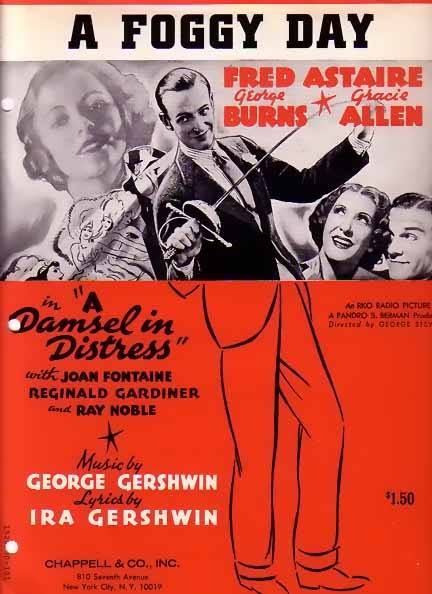
Here’s Fred Astaire singing “A Foggy Day (In London Town),” from “A Damsel in Distress”:
Aaron Copland (92) Beethoven (94) Composer (114) Film Music (117) Film Score (143) Film Scores (255) Halloween (94) John Williams (185) KWAX (228) Leonard Bernstein (99) Marlboro Music Festival (125) Movie Music (132) Opera (197) Philadelphia Orchestra (86) Picture Perfect (174) Princeton Symphony Orchestra (106) Radio (86) Ralph Vaughan Williams (85) Ross Amico (244) Roy's Tie-Dye Sci-Fi Corner (290) The Classical Network (101) The Lost Chord (268) Vaughan Williams (99) WPRB (396) WWFM (881)