Tag: George Bernard Shaw

  • Elgar’s Third Symphony A Lost Chord Rediscovered

    Elgar’s Third Symphony A Lost Chord Rediscovered

    This Sunday night on “The Lost Chord,” we mark the passing of an era in English history with music that had its origin in the twilight of another.

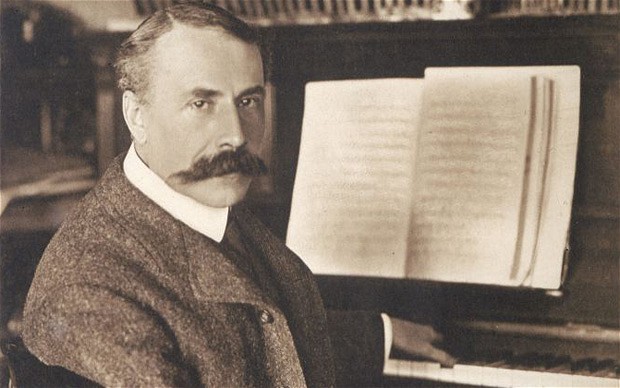
    Sir Edward Elgar produced no major works following the death of his wife in 1920. It was his friend and champion, George Bernard Shaw, who, in an attempt to keep one of England’s greatest composers from withering on the vine, persuaded the BBC to commission from Elgar a Third Symphony.

    Elgar, who died in 1934, worked at the piece during the last year of his life, jotting down his ideas – some merely a few bars in length; others, pages in full score. As his health deteriorated, he realized he would never be able to complete the work, and he made contradictory remarks concerning his intentions over the fate of the sketches.

    Another of his friends, the violinist W.H. Reed, passed many hours playing through what existed of the piece, with the composer at the piano. After Elgar’s death, Reed published 40 pages’ worth of sketches into a memoir, which kept the work at the periphery of the public consciousness.

    Several attempts were made over the decades to make something more of the sketches, but musicians and musicologists have always been stopped short by the Elgar estate.

    The composer Anthony Payne became interested in the fragments in 1972. For many years, he worked at a realization of the symphony, again meeting resistance from Elgar’s heirs, until it became apparent that, due to the publication of the sketches in Reed’s book, the material would soon fall into the public domain. The family opted to capitalize on what control it had left and finally authorized Payne’s efforts.

    Payne’s realization was given its premiere in 1998 and granted broad exposure through performances by major orchestras, particularly in England and the United States (including the Philadelphia Orchestra), and the piece has been recorded at least four times.

    The formal title is “Edward Elgar: The Sketches for Symphony No. 3 Elaborated by Anthony Payne,” or the “Elgar/Payne Symphony No. 3,” for short. It’s an uncanny piece of work, and you’ll have a chance to hear it tonight.

    It’s hard to believe, but the lives of Elgar and the long-lived Elizabeth actually did overlap. In 1930, the composer was commissioned to write a “Nursery Suite” for then-Princess Elizabeth and her sister Margaret. And what do you know, Payne actually quotes from one of the suite’s movements, “The Waggon Passes,” to conclude what would have been Elgar’s valedictory symphony. There are also quotations from the composer’s incidental music to Laurence Binyon’s dramatic account of “King Arthur.”

    Lots of history packed into this piece, then, which serves as a musical farewell – from our perspective, in more ways than one.

    I hope you’ll join me for “No Payne, No Gain,” this Sunday night at 10:00 EDT, on WWFM – The Classical Network and wwfm.org.

  • Shaw on Screen Film Music from GBS

    Shaw on Screen Film Music from GBS

    Prior to his death in 1950, George Bernard Shaw was granted complete creative control over a number of film adaptations of his stage works. Of course, he was also an astute and entertaining music critic. This week on “Picture Perfect,” enjoy an hour of Shavian delights. We’ll hear selections from scores from the films of GBS.

    It was the ambition of Hungarian producer Gabriel Pascal to create a series of films inspired by Shaw’s plays, beginning with “Pygmalion” in 1938. Shaw was skeptical at first, on account of some inferior adaptations by other hands which had already appeared. However, when he was granted final approval, he agreed. This led to several big screen collaborations. After “Pygmalion” (scored by Arthur Honegger) came “Major Barbara” (1941).

    Wendy Hiller plays the Salvation Army major, who is appalled to take donations from those who have made their fortunes on war and whiskey, and Robert Morley her father, a munitions manufacturer. Rex Harrison is the scholar who tries to persuade her of the benefits of capitalism. (Harrison, of course, would go on to star in the musical version of Shaw’s “Pygmalion,” “My Fair Lady.”)

    William Walton wrote the score. Still a few years shy of his knighthood, he was already one of Britain’s most famous composers.

    “Caesar and Cleopatra” (1945) would be the final Pascal-Shaw collaboration. (Following Shaw’s death, Pascal would film “Androcles and the Lion” in 1953.) Claude Rains and Vivien Leigh were cast in the title roles. Rains made history as the first actor ever to receive a million-dollar salary. The lavish Technicolor production wound up being the most expensive British film ever made, up until that time, and unlike “Pygmalion” and “Major Barbara,” it was not a success.

    Pascal had actually wanted Sergei Prokofiev to write the music, but when that didn’t go anywhere, he offered the assignment to Walton. When Walton turned it down, Arthur Bliss was engaged. Bliss, like Walton, was destined to receive a knighthood. In 1953, he would also be appointed Master of the Queen’s Music.

    Bliss may have been good enough for the Royal Family, but Pascal was evidently not pleased with him from the start. He had been Shaw’s choice, and the playwright encouraged him to eschew any Egyptianisms in his music. Rather, Shaw wanted the score to sound as “Bliss-ful and British” as possible.

    In the end, Pascal’s surliness, in no doubt exacerbated by production setbacks, ran Bliss out. The job was then offered to Benjamin Britten, but Britten wisely declined, acknowledging that his own temperament was a great deal less mild than Bliss’.

    The final cut sports a score by Georges Auric. Both Bliss’ and Auric’s scores have been recorded, so we’ll get to sample from both.

    Finally, we’ll turn to Otto Preminger’s adaptation of “Saint Joan” (1957). Graham Greene worked on the screenplay, produced seven years after Shaw’s death. The film featured a seasoned cast, including Richard Widmark, Anton Walbrook, John Gielgud, Felix Aylmer, and Finlay Currie. However, Jean Seberg, an unknown actress, reportedly selected from a casting call of 18,000 applicants, was widely panned for her alleged inability to carry the film.

    The music was by Mischa Spoliansky, not exactly a household name. Spoliansky was born in Bialystok. He moved with his family to Vienna, then was displaced from Koenigsberg to Berlin during the First World War. With the rise of fascism in Germany, he settled in London in 1933. Some of his songs were written for Paul Robeson, and he provided the complete underscore for the Robeson version of “King Solomon’s Mines,” in 1937. Whatever the film’s perceived faults, the music Spoliansky composed for “Saint Joan” is beautiful and evocative.

    In the classical music world, we’re used to encountering Shaw’s assessments of Wagner and Brahms and Parry and Elgar. One wonders what he would have made of these scores composed for his films.

    Shaw observed, “Most people go to their grave with their music inside them.” Hear some that made it to the big screen this week, on “Picture Perfect,” music for the movies, this Saturday evening at 6:00 EDT, on WWFM – The Classical Network and wwfm.org.


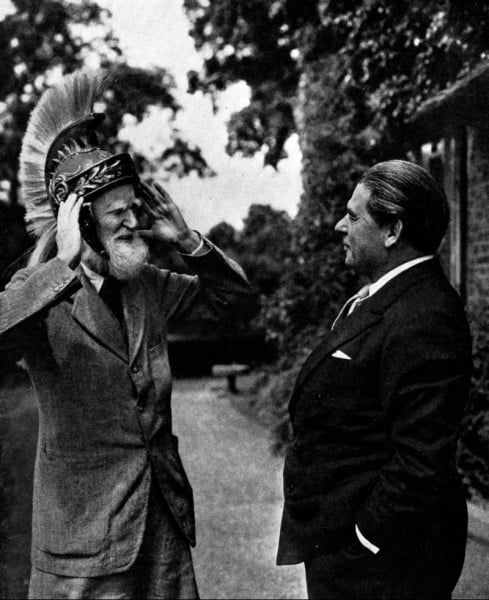
    PHOTO: Shaw models centurion headgear for Pascal

  • Focus Like Mahler Build a Composing Hut

    Focus Like Mahler Build a Composing Hut

    Have a hard time focusing? Can’t seem to get your work done? Get yourself a composing hut!

    Grieg had one. Mahler had several. Perhaps niftiest of all, George Bernard Shaw had a writer’s hut, which he could rotate with the sun.

    Yessiree. Get yourself a hut.

    Also, stay off the internet.

    Happy birthday, Gustav Mahler! Thank you for your productivity.

    Here’s a private video tour of Mahler’s Komponierhäuschen in Toblach, where he composed his 9th Symphony:

    And Leonard Bernstein conducting the 9th:

    PHOTOS: Huts belonging to Grieg (red), Shaw (pictured), and two used by Mahler

Tag Cloud

Aaron Copland (93) Beethoven (95) Composer (114) Film Music (126) Film Score (143) Film Scores (255) Halloween (94) John Williams (189) KWAX (229) Leonard Bernstein (101) Marlboro Music Festival (125) Movie Music (141) Mozart (87) Opera (203) Philadelphia Orchestra (89) Picture Perfect (174) Princeton Symphony Orchestra (107) Radio (87) Ross Amico (244) Roy's Tie-Dye Sci-Fi Corner (290) The Classical Network (101) The Lost Chord (268) Vaughan Williams (103) WPRB (396) WWFM (881)

DON’T MISS A BEAT

Receive a weekly digest every Sunday at noon by signing up here


RECENT POSTS