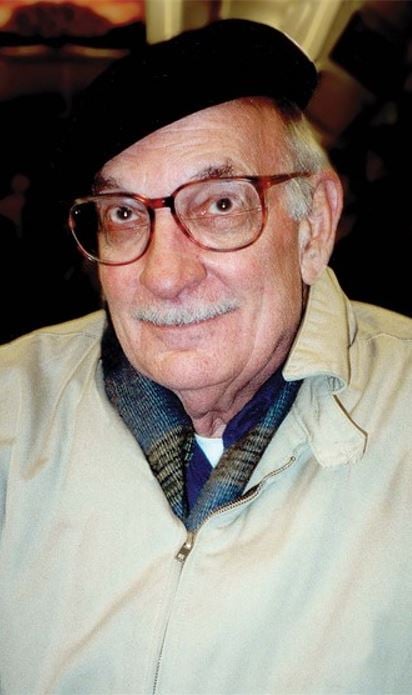
Tag: George Crumb

  • Richard Wernick Pulitzer Winner Almost Hit Me

    Richard Wernick Pulitzer Winner Almost Hit Me

    To my knowledge, Richard Wernick is the only Pulitzer Prize-winning composer ever to nearly run me down with a car.

    Wernick was a highly visible presence in Philadelphia when I attended musical events there in the 1980s and ‘90s, and for all I know, beyond. When I started working weekend mornings at a certain radio station in 1995, I had to get up at 3 or 4:00 in the morning. Ironically, it cut into my ability to attend concerts.

    For all the times I espied Wernick around Philadelphia, I only spoke to him once. He was in the company of fellow Pulitzer Prize-winner George Crumb at a student recital at the Curtis Institute of Music. Now, I adored Crumb, and having him there in the back of the room, especially with Wernick by his side, was rather intimidating. I so wanted to speak to him, but I was conflicted. I certainly didn‘t want to bug him at a concert, especially if he was with somebody, and doubly-especially if that somebody happened to be Richard Wernick. Little did I realize, until many years later, when we had multiple opportunities to meet during rehearsals and concerts of Orchestra 2001, just how much of a pussycat Crumb could be. On this particular day, he struck me as unapproachable and as terrifying as one of his Black Angels.

    Be that as it may, I couldn’t let the opportunity pass. It just so happened that I lived only about a block away, so I was able to dash back to my apartment and retrieve a CD on Bridge Records, Inc. that contained works by both composers.

    When I got back, I caught them just as they were leaving the building, and Crumb, likely nonplussed by this 20 year-old autograph hound, was kind enough to sign. Then I looked to Wernick sheepishly, and with Crumb’s signature already on the booklet, he couldn’t very well say no. I know I mumbled a few words of appreciation, but probably didn’t say much of worth. At best, I may have provided a source of amusement on their walk back to the car, as when they left I could see they were chuckling with one another.

    When I decided I would be writing about this, I wanted to get the time-line straight. Did the autograph encounter happen first, or was it after Wernick went “Death Race 2000” on me? It took me a while, but I decided the autograph had to have come first, because when I stepped off the curb into Market Street, as Wernick hurtled toward 15th Street at City Hall, I was essentially pulled back by a friend, a classmate and coworker I hadn’t become close to until a few years after the Curtis encounter. In fact, at the time, he confirmed what had already flashed before my eyes. “I’m pretty sure that was Richard Wernick!” he said.

    Wernick was always easily identifiable from his facial hair – a mustache and goatee – and an unmistakable, black-brimmed hat he wore. I don’t remember what he was driving, but I seem to remember it was a rather incongruously compact car to be holding such a flamboyantly-hatted figure.

    So it was somehow appropriate, in my case, that Wernick won the Pulitzer Prize for Music for his “Visions of Terror and Wonder” in 1977. (Crumb was recognized for “Echoes of Time and the River” in 1968.)

    Wernick served on the faculty of the University of Pennsylvania (with Crumb and George Rochberg) from 1968 to 1996. During Riccardo Muti’s tenure as music director of the Philadelphia Orchestra, he also served as a programming consultant, suggesting new works to the maestro, with a particular emphasis on American composers – hence his frequent presence at the Academy of Music.

    Wernick studied at Brandeis University with composers of the Boston School, including Irving Fine, Harold Shapero, Arthur Berger, and Leonard Bernstein. He received further lessons in composition at Tanglewood from Ernst Toch, Aaron Copland, and Boris Blacher. His own music sounds like none of these. In fact, his music steadfastly refuses to meet an audience halfway. Make of that what you will. You’ll find plenty of it posted on YouTube.

    I didn’t know him as a man. For all I know, he could have exuded warmth and humor. I don’t hear any of that in his compositions. Still, I recognize his significance, and I am sorry to see him go, since, as I say, he was such a presence during a certain period of my life.

    Wernick died on Friday at the age of 91. Which means he was probably about my age as he barreled down on me! How did I get stuck in this time-loop?

    R.I.P.


    Wernick interview with Bruce Duffie:

    https://www.kcstudio.com/wernick.html


    CLOCKWISE FROM LEFT: Wernick, Rochberg and Crumb; amiable-looking Wernick; Wernick in the Chapeau of Doom; Wernick’s autograph

  • American Gothic Halloween Music on KWAX

    American Gothic Halloween Music on KWAX

    Ask for me tomorrow, and you shall find me a grave man!

    This week on “The Lost Chord,” with Hallowe’en lurking like a mad clown astride a vampiric spider around a Caligari corner, we’ll seek our thrills in the comparative safety of three American experiments in controlled terror.

    Wander the creepy cornfields of the overactive imagination with music by George Crumb (“A Haunted Landscape”), Morton Gould (“Jekyll and Hyde Variations”), and Dominick Argento (“Le Tombeau d’Edgar Poe”).

    All three composers have fairly local connections. Crumb, born in Charleston, West Virginia, on October 24, 1929, made his home outside Philadelphia for some 57 years. He died in Media, PA, in 2022. Argento, born in York, PA, on October 27, 1927, died in Minneapolis in 2019. Gould, born in Queens on December 10, 1913, died in Orlando in 1996.

    These tricksters were treated to the Pulitzer Prize for Music – Crumb in 1968, Argento in 1975, and Gould in 1995.

    Walk softly around three spine-tingling exercises in American Gothic. Join me, if you dare, for “Grave Endeavors,” on “The Lost Chord,” now in syndication on KWAX, the radio station of the University of Oregon!


    Clip and save the start times for all three of my recorded shows:

    PICTURE PERFECT, the movie music show – Friday at 8:00 PM EDT/5:00 PM PDT

    SWEETNESS AND LIGHT, the light music program – ALL NEW! – Saturday at 11:00 AM EDT/8:00 AM PDT

    THE LOST CHORD, unusual and neglected rep – Saturday at 7:00 PM EDT/4:00 PM PDT

    Stream them, wherever you are, at the link!

    https://kwax.uoregon.edu/

  • George Crumb’s “Black Angels”: Halloween’s Dark Sound

    George Crumb’s “Black Angels”: Halloween’s Dark Sound

    In New York the other night at Old John’s Luncheonette, prior to catching a performance of Ralph Vaughan Williams’ Symphony No. 8 with the New Conductors Orchestra, I was asked by my companion for the evening, the filmmaker H. Paul Moon, off the top of my head, for the quintessential piece of Halloween music. With my back to the wall, I blurted out George Crumb’s “Black Angels.”

    This spinetingling piece, for electric string quartet, has lived in my head and fired my imagination for some 40 years. The first time I ever encountered it was on George Diehl’s “Music Through the Centuries,” on Philadelphia’s late, lamented classical music station, WFLN. Diehl, one time program director of the station, who also provided program notes for the Philadelphia Orchestra, engagingly introduced Crumb’s otherworldly, often hair-raising piece by placing it in context, deftly illuminating its structure, and supplementing it with recordings of other works referenced within. This was fascinating radio. I have no hesitation in crediting “Music Through the Centuries” as a principal influence on my own radio show, “The Lost Chord.” So, thank you, George Diehl, wherever you are!

    Sure, “Black Angels,” subtitled “Thirteen Images from the Dark Land,” was conceived as a reaction to the Vietnam War, but real-life horrors aside, this is one haunting, magical piece. It’s not for nothing that it was embraced by David Bowie, that it inspired David Harrington to form the Kronos Quartet (after he too encountered it on the radio), and that William Friedkin included a passage in “The Exorcist.”

    There are references to Schubert’s “Death and the Maiden,” Tartini’s “The Devil’s Trill,” and the medieval plainchant “Dies Irae” (“Day of Wrath”) – quoted in so many works by Berlioz, Liszt, Rachmaninoff, and others, as well as making an appearance under the opening credits of Stanley Kubrick’s “The Shining.”

    But it was not Crumb’s intention to evoke jeering demons, necessarily. The composer saw it as “a kind of parable on our troubled contemporary world. The numerous quasi-programmatic allusions in the work are therefore symbolic, although the essential polarity – God versus Devil – implied more than a purely metaphysical reality. The image of the ‘black angel’ was a conventional device used by early painters to symbolize the fallen angel.”

    Its thirteen movements are divided into three larger groups.

    I. Departure

    1. Threnody I: Night of the Electric Insects (tutti)
    2. Sounds of Bones and Flutes (trio)
    3. Lost Bells (duo)
    4. Devil-music (solo)
    5. Danse Macabre (duo)

    II. Absence

    1. Pavana Lachrymae (trio)
    2. Threnody II: Black Angels! (tutti)
    3. Sarabanda de la Muerte Oscura (trio)
    4. Lost Bells (Echo) (duo)

    III. Return

    1. God-music (solo)
    2. Ancient Voices (duo)
    3. Ancient Voices (Echo) (trio)
    4. Threnody III: Night of the Electric Insects (tutti)

    Each player is required to play a variety of instruments and to employ extended techniques.

    Violin 1

    • maraca
    • 7 crystal glasses
    • 6″ glass rod
    • 2 metal thimbles
    • metal pick (paper clip)

    Violin 2

    • 15″ suspended tam-tam and mallet
    • contrabass bow (for use on tam-tam)
    • 7 crystal glasses
    • 6″ glass rod
    • 2 metal thimbles
    • metal pick (paper clip)

    Viola

    • 6 crystal glasses
    • 6″ glass rod
    • 2 metal thimbles
    • metal pick

    Cello

    • maraca
    • 24″ suspended tam-tam, soft and hard mallets
    • contrabass bow

    Of course, Crumb was more than simply a “Halloween” composer, though his music can be creepy as hell. Many of his chamber works, especially those that employ percussion and voice, are models of economy and elegance. I always think of him as a kind of spiritual descendent of Charles Ives, in that many of the curious sonorities he explored, especially in the context of his song settings, seem to suggest truths beyond our workaday concerns.

    That said, here’s some sensational Crumb to play when you’re alone with the lights out.

    Crumb died last year at the age of 92. Remembering him, blackly, on his birthday.


    “Black Angels” in concert

    “Black Angels” with score

    “A Haunted Landscape”

    https://www.youtube.com/watch?v=XWa4eXg-Jdo

    “Star-Child” (Watch out for that “Musica Apocalyptica,” beginning at 11:47!)

    “Ancient Voices of Children” in concert (“Ghost Dance” at 17:55)

    George Crumb was the recipient of the Pulitzer Prize for Music in 1968, for “Echoes of Time and the River,” and a Grammy Award for Best Contemporary Composition in 2001, rather appropriately, for “Star-Child.” All or most of his music is available in the “Complete Crumb Edition,” an ongoing project on Bridge Records, Inc.

  • George Crumb Halloween Haunt

    George Crumb Halloween Haunt

    It is fortuitous indeed that George Crumb’s birthday falls so close to Halloween. It’s not for nothing that his work for electric string quartet, “Black Angels,” was used in “The Exorcist” (though it was actually inspired by the Vietnam War).

    It’s a piece I first encountered on a Friday night radio show, called “Music Through the Centuries,” broadcast on Philadelphia’s now-defunct classical music station, WFLN. The host, George Diehl, was at one time WFLN’s program director, if you can believe it. He also provided program notes for the Philadelphia Orchestra. I credit his show with having inspired my own radio program, “The Lost Chord,” on WWFM The Classical Network.)

    What made this particular episode so indelible (I heard it probably 35 years ago) is that Diehl introduced Crumb’s otherworldly, often hair-raising quartet by placing it in context, deftly illuminating its structure, and supplementing it with recordings of other works referenced within the piece. It was fascinating radio.

    Also, having cut my teeth on the station’s usual, more traditional fare, my mind was officially blown. “Black Angels” scared the hell out of me and enthralled me completely. I immediately determined to pick up everything I could find by George Crumb.

    A few years later, I heard “A Haunted Landscape” on a Philadelphia Orchestra concert, with William Smith conducting. On the same program was Maurice Ravel’s “Le tombeau de Couperin” and Ralph Vaughan Williams’ “A London Symphony!” By then, I already owned the work’s first recording, with Arthur Weisberg conducting the New York Philharmonic.

    Crumb didn’t compose that many orchestral works. He was more like a master jeweler, working in miniature, and revealing a surprising number of facets in his unique – and uniquely memorable – creations.

    Of course, he was more than just a “horror” composer, though his music could be creepy as hell. Many of his chamber works, especially those that employ percussion and voice, are models of economy and elegance. I always think of him as a kind of spiritual descendent of Charles Ives, in that many of the curious sonorities he explored, especially in the context of his song settings, seem to suggest truths beyond our workaday concerns.

    That said, here’s some sensational Crumb to play when you’re alone with the lights out.

    Happy birthday, George Crumb!


    “Black Angels” in concert

    “Black Angels” with score

    “A Haunted Landscape”

    https://www.youtube.com/watch?v=XWa4eXg-Jdo

    “Star-Child” (Watch out for that “Musica Apocalyptica,” beginning at 11:47!)

    “Ancient Voices of Children” in concert (“Ghost Dance” at 17:55)

  • Remembering George Crumb American Original

    Remembering George Crumb American Original

    I am very sorry to learn of the passing of George Crumb, a composer I have revered for nearly 40 years, since I first encountered his work for electric string quartet, “Black Angels,” on Philadelphia’s now-defunct classical music station, WFLN. The music scared the hell out of me and completely enthralled me.

    The context was a Friday night radio show, “Music Through the Centuries,” hosted by George Diehl. Diehl was at one time WFLN’s program director. He also provided program notes for the Philadelphia Orchestra. “Music Through the Centuries” was a big influence on my own Sunday night program (on WWFM The Classical Network), “The Lost Chord.”

    What made this particular episode so indelible is that Diehl introduced a recording of Crumb’s otherworldly, often hair-raising quartet – a reaction to the Vietnam War – by deftly placing it in context, illuminating its structure, and supplementing it with recordings of other works referenced within the piece.

    Having cut my teeth on the station’s usual, more traditional fare, my mind was officially blown. It’s not for nothing that William Friedkin incorporated “Black Angels” into “The Exorcist.” I immediately determined to pick up everything I could find on LP, and my enthusiasm continued into the CD era.

    The first time I met Crumb was at a recital at the Curtis Institute of Music in Philadelphia. He was there attending a student recital in the company of Richard Wernick. It just so happened that I lived about a block away, so I was able to dash home and retrieve a CD on Bridge Records that contained works by both composers. Both were on the faculty of the University of Pennsylvania. Both were Pulitzer Prize winners.

    I caught them as they were leaving the building, and Crumb, likely nonplussed by this 20 year-old autograph hound, was kind enough to sign. Wernick, who of course was with him, couldn’t very well say no. I was a little sheepish about it, and probably didn’t say much of worth. At best, I may have provided a source of amusement on their walk back to the car.

    It was another 20 years, then, I think, before I saw him again (although he may have been present when I heard his orchestral work, “A Haunted Landscape,” played by Philadelphia Orchestra in 1989, part of a knockout program also featuring Ravel’s “Le tombeau de Couperin” and Vaughan Williams’ “A London Symphony”). By that time, he had entered his “Grand Old Man of American Music” phase. Furthermore, he was closely affiliated with Orchestra 2001, a contemporary music ensemble founded at Swarthmore College, practically in Crumb’s back yard. Orchestra 2001 gave first performances of many of his later pieces.

    Among these were the seven cycles for voice and percussion that comprise his “American Songbook.” These are highly individual recastings of folk songs and hymns he recollected from his boyhood in West Virginia – especially effective, and affecting, when heard in concert, where the breadth and subtlety of the instrumentation can be fully appreciated.

    His daughter, Broadway actress Ann Crumb, was a frequent soloist. During this time, I got to meet them both and to speak with them under more relaxed circumstances, at cocktail hours and receptions. They were lovely people. George was unfailingly approachable, good-humored, soft-spoken, and surprisingly modest. Ann, who died much too young at 69, was warm and genuine and a real animal lover. She was always bringing home strays, so that the Crumb household was full of dogs (the most notorious being “bad dog” Yoda).

    It is perhaps an overused description, but George Crumb truly was an American original. He produced works with an economy and elegance that seemed to contradict – and yet, somehow, paradoxically, to reinforce – an Ivesian tendency to suggest greater vistas beyond their seemingly modest means. In the process, he anticipated the widespread proliferation of the percussion ensemble, which is now practically analogous to what the string quartet was to the 18th and 19th centuries.

    No matter how “respectable” he’s become, my own reactions will always be colored by that flush of youth, when I first fell under the spell of his eerie and at times horrifying invention.

    George Crumb was the recipient of the Pulitzer Prize for Music in 1968, for “Echoes of Time and the River,” and a Grammy Award for Best Contemporary Composition in 2001, rather appropriately, for “Star-Child.” All or most of his music is available in the “Complete Crumb Edition,” an ongoing project on Bridge Records, Inc.

    The composer died at his home earlier today at the age of 92.

    Thank you, sir, and R.I.P.


    “Black Angels” in concert

    “Black Angels” with score

    “Ancient Voices of Children” in concert

    “Star-Child”

    Crumb talks about “Mundus Canis;” performs “Fritzi” with guitarist David Starobin

    “Yoda” (from “Mundus Canis”)

    From “American Songbook,” sung by Ann Crumb:

    “Shall We Gather at the River”

    “All the Pretty Horses”

    “Poor Wayfaring Stranger”

    “One More River to Cross”

    “Give Me That Old Time Religion”

    Crumb interviewed by Gilbert Kalish

    Crumb at his home in 2020 (with yet more pooches)

Tag Cloud

Aaron Copland (92) Beethoven (95) Composer (114) Film Music (119) Film Score (143) Film Scores (255) Halloween (94) John Williams (185) KWAX (229) Leonard Bernstein (99) Marlboro Music Festival (125) Movie Music (134) Opera (198) Philadelphia Orchestra (87) Picture Perfect (174) Princeton Symphony Orchestra (106) Radio (87) Ralph Vaughan Williams (85) Ross Amico (244) Roy's Tie-Dye Sci-Fi Corner (290) The Classical Network (101) The Lost Chord (268) Vaughan Williams (102) WPRB (396) WWFM (881)

DON’T MISS A BEAT

Receive a weekly digest every Sunday at noon by signing up here


RECENT POSTS