
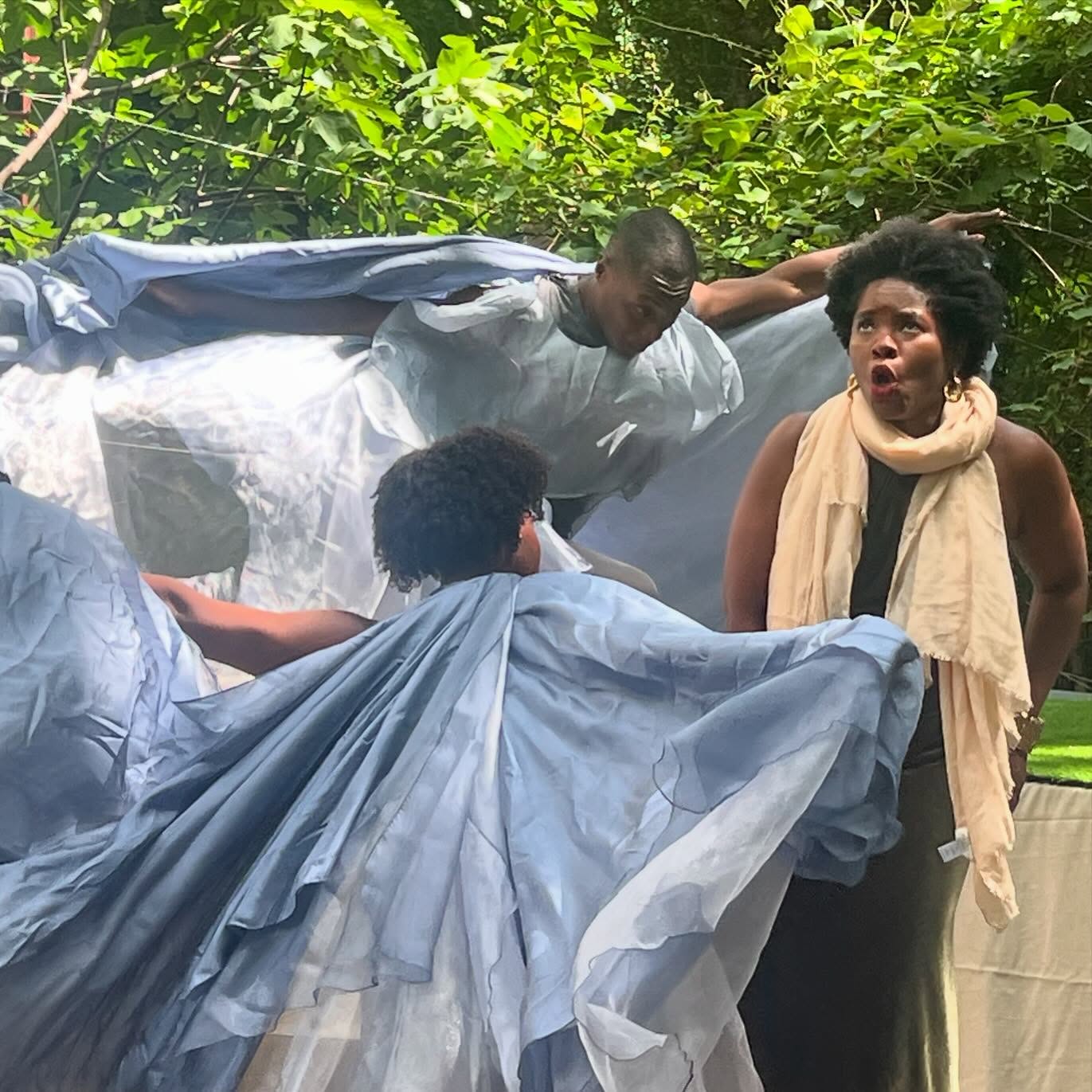
On George Frideric Handel’s birthday, check out these H. Paul Moon films documenting four of the composer’s operas tailored for outdoor performance in New York community gardens by Opera Essentia. The company’s artistic director, countertenor Jeffrey Mandelbaum, manages to get each of them down to about an hour. The operas are rarely-heard. The abridgments are tasteful. The productions are no-budget, bare-bones, and beautiful. I posted about “The Queen’s Heart,” the distillation of “Radamisto,” early in January. Hear all four here:
https://zenviolence.com/handel
Happy birthday, Handel!
Tag: George Frideric Handel
-
Handel in the Garden with Opera Essentia
H. Paul Moon wrapped up 2025 by quietly slipping a gift under the tree in the form of a posted film of an Opera Essentia performance of George Frideric Handel’s “Radamisto.” Countertenor Jeffrey Mandelbaum’s distillation of the composer’s 1720 opera seria in three acts manages to get it down to one hour as “The Queen’s Heart.”
I love this sort of quixotic endeavor, presenting tasteful abridgements of rare Handel operas in New York City neighborhoods for free. The productions are no-budget, bare-bones, and beautiful. Watching the wind rustle the leaves during this performance is magical.
Mandelbaum has appeared widely, in both concert hall and opera house, including at the Metropolitan Opera, alongside such singers as Joyce DiDonato and Placido Domingo.
H. Paul Moon’s feature-length documentary “Samuel Barber: Absolute Beauty” aired nationwide on PBS in 2017.
Opera Essentia performs in New York’s gardens, parks, and other neighborhood gathering spaces. “The Queen’s Heart” was filmed at Green Oasis Community Garden on May 24, 2025.
Enjoy it here:
To view other operas in the series, visit:
For more information about Opera Essentia, visit:
-

Handel at 340: Still Fresh, Still Thrilling
George Frideric Handel was born 340 years ago, and he’s still as fresh as a rose. Fresher. Actually, come to think of it, there is a climbing rose named after him…
For one thing, the standard of Handel performance has gotten so much better in recent decades. I guess you really don’t hit your stride as a composer until after the first 300 years.
For as much as I hold a nostalgic affection for Hamilton Harty’s ponderous take on the “Water Music” – a concert staple for over half a century – a modern orchestra gives little indication of just how thrilling Handel can be. At its best, his vocal stuff, in particular, can be sublime.
I didn’t always feel this way. When I attended a performance of “Ariodante” in Philadelphia, back in the 1989, even with the dream pairing of Benita Valente and Tatiana Troyanos, I was afraid I was going to give up the ghost. When it really doesn’t connect, three or four hours of Baroque opera can easily start to feel like too much of a good thing. My girlfriend at the time wanted to leave after the second act, but I insisted we stick it out. I was eager to witness the climactic swordfight, described in the synopsis – which, in the end, amounted to a single, slow-motion riposte. The weak pay-off earned me an evil glare.
The experience had the effect of putting me off Handel opera in much the same way that downing a bottle of Inver House whiskey in my teens put me off Scotch. Just as I later discovered, to my surprise and delight, how much I truly appreciate a fine single malt, when I had occasion to reacquaint myself with “Ariodante” at the Princeton Festival in 2010, I was astonished to find that I actually liked Handel opera after all.
A few years ago, when I wandered into a library book sale, I discovered that someone had dumped their entire collection of Handel operas and oratorios. I don’t know how many there were to begin with, but I walked out with everything that was left. Who knows if I’ll ever get through all of them before I die, but I am very happy to have them.
That said, I do find Handel’s operas work best when encountered live, in performance – whether seen in person or on screen – which is the opposite of what I would say about most of the operas I prefer. The images that are formed in my mind by the music far surpass anything that can be realized on a stage. When attending opera, it is the experience of the orchestra, the voices, and the sense of “theater” I enjoy. But the visuals are too mundane for my grandiose vision.
I also tend to get annoyed at modern stagings, with concepts that too often seem forced and undercut the vitality of the music. Again, Handel is different. David McVicar’s production of “Agrippina” must be one of the best things in the Met’s current repertoire.
Of course, there is always the possibility that it is not so much Handel who has changed – despite a pronounced shift toward “authentic” performance practice over the past 40 years or so. It could be that even a paragon such as myself, sprung fully-formed from the head of Zeus, might have evolved. I’m reminded of the famous Twain observation that, when he was 14, his father was so ignorant he could hardly stand it; but when he was 21, he was astonished by how much the old man had learned.
I’ve come a long way since my friends and I spent an ouzo-soaked 24 hours celebrating Handel’s tercentenary back in 1985. I recollect even now the six-mile round-trip I made with one of them, on foot, on a cold February evening, from Temple University campus to Center City Philadelphia and back, with a bottle nestled in his bag to keep us warm for an in-town performance of “Judas Maccabaeus.”
Everything old is new again. Handel grows wiser with the years, but also more thrilling.
Happy birthday, G.F.H.
Amanda Forsythe and Apollo’s Fire, with an aria from “Giulio Cesare”
Danielle de Niese with the same aria, staged:
Of course, there’s always Thomas Beecham, bringing it old school, to prove me wrong:
-

Hopkins is Handel in “King of Covent Garden”
Anthony Hopkins is to play composer George Frideric Handel in “The King of Covent Garden.” Allegedly, the film will be set in 1741, when Handel was at work on “Messiah.” The composer completed his most famous oratorio in just 24 days. He was 56 years old. Hopkins is now 86. Mezzo-soprano Katherine Jenkins is also attached to the project.
-

Vikings Handel and Jack Cardiff’s Cinema
In preparation for Roy and my discussion on Friday night about “The Vikings” (1958), on Roy’s Tie-Dye Sci-Fi Corner, I was brushing up on legendary cinematographer Jack Cardiff, who was responsible for the film’s breathtaking visuals (many of them captured on-location at the fjords of Hardanger, Norway). “The Vikings” was produced by Kirk Douglas and directed by Richard Fleisher (who helmed “20,000 Leagues Under the Sea,” “Fantastic Voyage,” and one of my favorite films noirs, “The Narrow Margin”). Cardiff also worked with Michael Powell & Emeric Pressburger on “Black Narcissus” and “The Red Shoes,” John Huston on “The African Queen,” and Alfred Hitchcock on “Under Capricorn.”
Occasionally, he took the director’s chair himself. Riding the box office success of “The Vikings,” he was given the opportunity to direct another Viking adventure, “The Long Ships” (which, alas, has little to do with the absurdly entertaining source novel by Frans G. Bengtsson). He received his greatest acclaim in that capacity for an adaptation of D.H. Lawrence’s “Sons and Lovers,” which was nominated for seven Academy Awards, including one for Best Director.
This is all preamble to the revelation of my discovery that Cardiff once lensed a film called “The Great Mr. Handel” (1942). Coincidentally, Friday, the day of our “Vikings” discussion, also happened to be George Frideric Handel’s birthday! Here’s a link to the film, surely an agreeable diversion for a Sunday afternoon. It looks like it may even include the episode in which the irascible composer threatened to drop a soprano out the window!
If you’re interested, Roy and I raise our drinking horns to Odin, as we converse about “The Vikings,” here:
Roy will welcome back filmmaker Jeffrey Morris, founder and CEO of FutureDude Entertainment, to update viewers on the progress of his current documentary, “The Eagle Obsession.” The film centers on the continued resonance of the iconic spacecraft created for the television series “Space: 1999.” Morris’ appearance will stream at a special time, on Facebook, YouTube, etc., this Wednesday evening at 8:30 EST.
https://www.facebook.com/roystiedyescificorner
We’ll be taking off on Friday. More time for me to catch up on half-forgotten composer biopics!
Tag Cloud
Aaron Copland (92) Beethoven (94) Composer (114) Film Music (116) Film Score (143) Film Scores (255) Halloween (94) John Williams (185) KWAX (228) Leonard Bernstein (99) Marlboro Music Festival (125) Movie Music (131) Opera (197) Philadelphia Orchestra (86) Picture Perfect (174) Princeton Symphony Orchestra (106) Radio (86) Ralph Vaughan Williams (85) Ross Amico (244) Roy's Tie-Dye Sci-Fi Corner (290) The Classical Network (101) The Lost Chord (268) Vaughan Williams (99) WPRB (396) WWFM (881)