Tag: George Frideric Handel

  • Anthony Roth Costanzo Returns to Princeton

    Anthony Roth Costanzo Returns to Princeton

    It’s been all high notes for countertenor Anthony Roth Costanzo since he graduated from Princeton University in 2004.

    This weekend, he returns a conquering hero – the winner of a 2022 Grammy Award (his third nomination), for his recording of John Corigliano’s “The Lord of Cries,” and the recipient of the Metropolitan Opera’s 2020 Beverly Sills Artist Award – to sing two works with the Princeton Symphony Orchestra.

    Costanzo will perform not only music by Baroque master George Frideric Handel – the aria “Quella fiamma” from the opera “Arminio” – but also a recent piece by Princeton alum Gregory Spears, “Love Story” – on a text by Tracy K. Smith, who served as U.S. Poet Laureate from 2017 to 2019 – written specifically for Costanzo on a commission from the New York Philharmonic in 2021.

    Princeton University graduate student Nina Shekhar’s “Lumina,” also premiered by the NYP, will open the program, which will conclude with a dramatic rollercoaster – and an audience favorite – Tchaikovsky’s Symphony No. 4.

    Music director Rossen Milanov will conduct at Richardson Auditorium, Saturday at 8 p.m. and Sunday at 4 p.m. A pre-concert talk will precede the Sunday performance at 3 p.m.

    In recent years, Costanzo has proved himself an Akhnaten for the ages, in New York and elsewhere. His performance in Philip Glass’ opera about the first monotheistic pharaoh was revelatory and a high point of the Met’s streaming during the pandemic.

    Costanzo headlined Corigliano’s Dracula opera at its debut in Santa Fe in 2021. He’s also created roles in Jimmy Lopez’s “Bel Canto” and Jack Heggie’s “Great Scott.” Clearly, opportunities for countertenors have expanded well beyond the 18th century.

    Witness Costanzo’s versatility firsthand this weekend with the PSO. For tickets and information, visit princetonsymphony.org.

  • Handel’s Messiah: History and Hallelujah!

    Handel’s Messiah: History and Hallelujah!

    Hallelujah!

    George Frideric Handel’s most famous oratorio, “Messiah,” was given its first performance in Dublin on this date in 1742. The work was presented as a charitable event, benefiting two hospitals and liberating 142 men from debtors’ prison.

    Eight years later, Handel revived the piece at London’s Foundling Hospital, a recently-instituted home for abandoned infants and children. He had already donated an organ to the hospital’s chapel, and the year before, recycled the “Hallelujah Chorus” as part of his “Foundling Hospital Anthem.” Again, Handel’s oratorio raised a ton of money. The charitable presentation became an annual event, with the composer returning every year for the remainder of his life. Handel’s relationship to the institution was cemented with an honorary title. When he died, he bequeathed the rights to “Messiah” to the hospital.

    “Messiah” falls into three parts, with a running time of roughly 2 ½ hours, often padded by intermissions. The famous “Hallelujah Chorus” comes at the end of Part II, which focuses on the Passion of Jesus, so really the oratorio is as much of an Easter piece as it is appropriate for Christmas – actually more so, midwinter tradition aside.

    Reaching the end of his manuscript, Handel inscribed the letters “SDG” – an acronym for “Soli Deo Gloria,” “To God alone the glory.” This, combined with the speed at which he composed it (Handel tossed off the entire oratorio in a mere 24 days), has contributed to a widespread belief that the music was conceived in a blaze of divine inspiration. The well-worn tale is that, as Handel composed the “Hallelujah Chorus,” “He saw all heaven before him.”

    For as beautiful as that sounds – and I would like it to be true – many of Handel’s large-scale works were composed within similar time frames. It was not unusual in those days for composers to just churn this stuff out. Handel’s next oratorio, “Samson,” begun within a week of his finishing “Messiah,” was completed in a month.

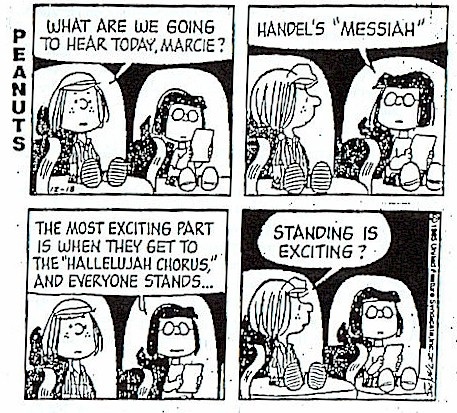
    The custom of standing for the “Hallelujah Chorus” is said to have originated at the work’s 1743 London premiere, when King George II, possibly drowsing through a rather somber stretch, sprang to his feet at the sudden exultant clamor, so that everyone in the hall was obliged to stand.

    When the legend becomes fact, print the legend. It’s good to be the king!

  • Handel: The Great Bear of Music

    Handel: The Great Bear of Music

    With enormous appetites to rival his formidable musicianship, a larger-than-life reputation, and an eccentric, much remarked-upon manner of walking, George Frideric Handel was affectionately nicknamed “The Great Bear.”

    Handel is fondly remembered for his “Water Music” and “Music for the Royal Fireworks,” his epic oratorios, his florid operas, and his copious concertos and chamber music.

    Though by many accounts a kind-hearted man with a good sense of humor, he was also prone to an explosive, bear-like temper. I imagine this would have gone unnoted during the several years he spent in Italy, but in England people tended to take heed.

    Music historian Charles Burney recalled Handel berating a chorister during rehearsals for “Messiah.” “… Handel let loose his great bear upon him; and after swearing in four or five languages, cried out in broken English….”

    During rehearsals for the opera “Ottone,” he once grabbed the soprano Francesca Cuzzoni and threatened to toss her out a window. Cuzzoni, looking to make the best impression with her London debut, had roused “the Bear” by pressing him for a replacement aria, the better to showcase her unique talents.

    But Cuzzoni could give as good as she got. During a Handel production of Giovanni Bononcini’s opera “Astianatte,” she and her costar, Faustina Bordoni, flew at one another in a fury and began tearing at their costumes. They had to be dragged off stage.

    Some years earlier, as a young man of 19, Handel was filling in as conductor at the premiere of Johann Mattheson’s opera “Cleopatra.” Mattheson also sang the tenor role of Antony, so while he was on stage, Handel was to sit at the harpsichord and keep order among the musicians.

    Trouble arose when Mattheson returned to the orchestra and Handel refused to cede his place. A power struggle ensued, as Mattheson sought to regain control, but Handel insisted on continuing to conduct. The performance was interrupted when Mattheson suggested the two take the quarrel outside. Swords were drawn, and one of Mattheson’s thrusts glanced off a button near Handel’s heart. This had the effect of dousing the combatants with cold water, and the two reconciled to become lifelong friends.

    It wasn’t all claws and teeth, to be sure. Ursine Handel could also be a bit of a teddy bear, and a generous one. One of his more enduring works, “Messiah” – penned in a mere 24 days – was given its first performance in Dublin, on April 13, 1742, as a charitable event. It benefited two hospitals and liberated 142 men from debtor’s prison.

    Eight years later, Handel revived the work at London’s Foundling Hospital, a recently-instituted home for abandoned infants and children. He had already donated an organ to the hospital’s chapel, and the year before, recycled the “Hallelujah Chorus” as part of his “Foundling Hospital Anthem.” Again, Handel’s oratorio raised a ton of money. The charitable presentation became an annual event, with the composer returning every year for the rest of his life. Handel’s relationship to the institution was cemented with an honorary title. After his death, he left the rights to the oratorio to the hospital.

    When Handel finally did die, blind but rich, in 1759, at the age of 74, his funeral was attended by 3,000 people. He never married, but filled his hours with composing – leaving 30 oratorios and 50 operas – and of course living the good life, with plenty of beer and food. He was interred at Westminster Abbey, a very great honor indeed.

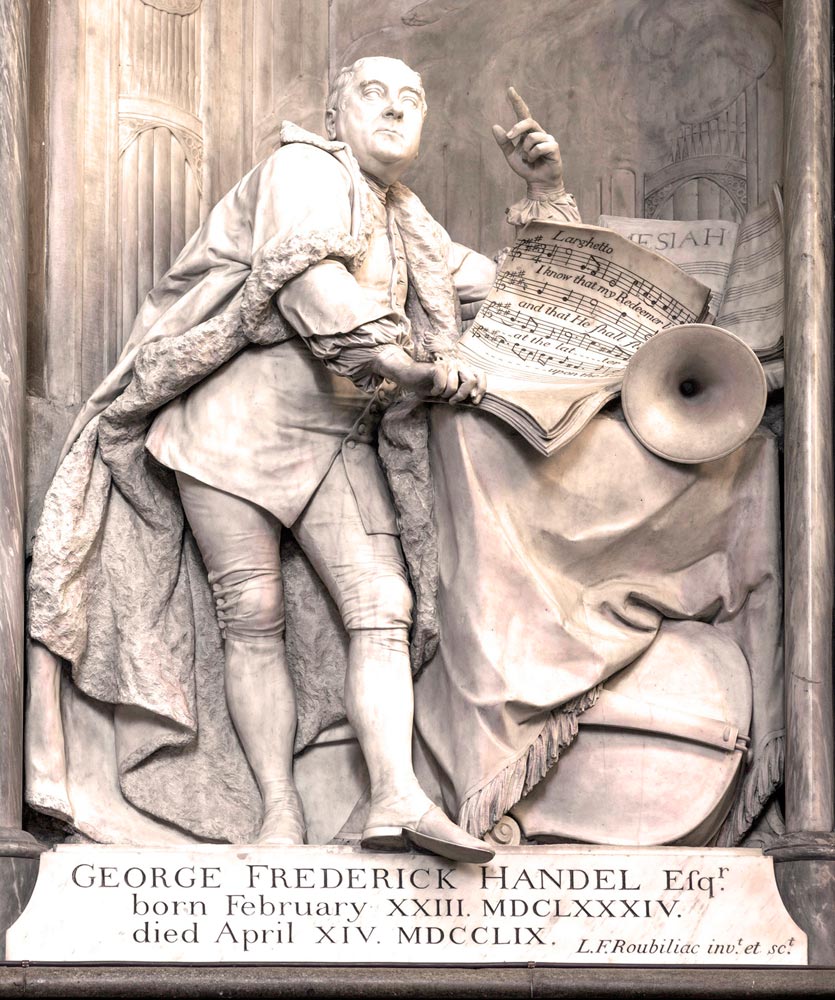
    Above his grave, there is a monument, a sculpture of Handel in the act of composing his cash cow, the oratorio “Messiah.” The bear may now be in hibernation, but every Christmas – and sometimes Lent – his music lives on.

    Happy birthday, Handel!


    CLOCKWISE FROM LEFT: Handel memorial at Westminster Abbey; unkind caricature of the composer as a fat boar (Joseph Goupy, “The Charming Brute,” 1743); Handel threatens to throw Francesca Cuzzoni out a window (Peter Jackson, “When They Were Young: Handel the Musician,” 1966); Handel crosses swords with Johann Mathesson (Andrew Howat, “Strange Tales,” 1977)

  • Handel: The Great Bear of Music and Temper

    Handel: The Great Bear of Music and Temper

    With enormous appetites to rival his formidable musicianship, a larger-than-life reputation, and an eccentric, much remarked-upon manner of walking, George Frideric Handel was affectionately nicknamed “The Great Bear.”

    Handel is fondly remembered for his “Water Music” and “Music for the Royal Fireworks,” his epic oratorios, his florid operas, and his copious concertos and chamber music.

    Though by many accounts a kind-hearted man with a good sense of humor, he was also prone to an explosive, bear-like temper. I imagine this would have gone unnoted during the several years he spent in Italy, but in England people tended to take heed.

    Music historian Charles Burney recalled Handel berating a chorister during rehearsals for “Messiah.” “… Handel let loose his great bear upon him; and after swearing in four or five languages, cried out in broken English….”

    During rehearsals for the opera “Ottone,” he once grabbed the soprano Francesca Cuzzoni and threatened to toss her out a window. Cuzzoni, looking to make the best impression with her London debut, had roused “the Bear” by pressing him for a replacement aria, the better to showcase her unique talents.

    But Cuzzoni could give as good as she got. During a Handel production of Giovanni Bononcini’s opera “Astianatte,” she and her costar, Faustina Bordoni, flew at one another in a fury and began tearing at their costumes. They had to be dragged off stage.

    Some years earlier, as a young man of 19, Handel was filling in as conductor at the premiere of Johann Mattheson’s opera “Cleopatra.” Mattheson also sang the tenor role of Antony, so while he was on stage, Handel was to sit at the harpsichord and keep order among the musicians.

    Trouble arose when Mattheson returned to the orchestra and Handel refused to cede his place. A power struggle ensued, as Mattheson sought to regain control, but Handel insisted on continuing to conduct. The performance was interrupted when Mattheson suggested the two take the quarrel outside. Swords were drawn, and one of Mattheson’s thrusts glanced off a button near Handel’s heart. This had the effect of dousing the combatants with cold water, and the two reconciled to become lifelong friends.

    It wasn’t all claws and teeth, to be sure. Ursine Handel could also be a bit of a teddy bear, and a generous one. One of his more enduring works, “Messiah” – penned in a mere 24 days – was given its first performance in Dublin, on April 13, 1742, as a charitable event. It benefited two hospitals and liberated 142 men from debtor’s prison.

    Eight years later, Handel revived the work at London’s Foundling Hospital, a recently-instituted home for abandoned infants and children. He had already donated an organ to the hospital’s chapel, and the year before, recycled the “Hallelujah Chorus” as part of his “Foundling Hospital Anthem.” Again, Handel’s oratorio raised a ton of money. The charitable presentation became an annual event, with the composer returning every year for the rest of his life. Handel’s relationship to the institution was cemented with an honorary title. After his death, he left the rights to the oratorio to the hospital.

    When Handel finally did die, blind but rich, in 1759, at the age of 74, his funeral was attended by 3,000 people. He never married, but filled his hours with composing – leaving 30 oratorios and 50 operas – and of course living the good life, with plenty of beer and food. He was interred at Westminster Abbey, a very great honor indeed.

    Above his grave, there is a monument, a sculpture of Handel in the act of composing his cash cow, the oratorio “Messiah.” The bear may now be in hibernation, but every Christmas – and sometimes Lent – his music lives on.

    Happy birthday, Handel!


    IMAGE: “When They Were Young: Handel the Musician. Handel threatens to throw the temperamental Italian opera singer out of his window.” (Peter Jackson, 1966)

  • Handel’s Ariodante Arias Celebrate His Birthday

    Handel’s Ariodante Arias Celebrate His Birthday

    Happy birthday, George Frideric Handel!

    The many moods of “Ariodante”:

    Scherza infida (Joyce DiDonato)

    Dopo notte (Emily D’Angelo)

Tag Cloud

Aaron Copland (92) Beethoven (95) Composer (114) Film Music (123) Film Score (143) Film Scores (255) Halloween (94) John Williams (187) KWAX (229) Leonard Bernstein (101) Marlboro Music Festival (125) Movie Music (138) Opera (202) Philadelphia Orchestra (89) Picture Perfect (174) Princeton Symphony Orchestra (106) Radio (87) Ralph Vaughan Williams (85) Ross Amico (244) Roy's Tie-Dye Sci-Fi Corner (290) The Classical Network (101) The Lost Chord (268) Vaughan Williams (103) WPRB (396) WWFM (881)

DON’T MISS A BEAT

Receive a weekly digest every Sunday at noon by signing up here


RECENT POSTS