Tag: George Szell

  • Rediscovering William Walton’s Genius

    Rediscovering William Walton’s Genius

    Sir William Walton is beloved for his coronation marches and film scores. But posterity has been woefully reductive. He also wrote operas, symphonies, concertos, chamber music, and choral works.

    This Sunday night on “The Lost Chord,” we’ll hear two long-out-of-print recordings of works composed more than three decades apart.

    At the time of the premiere of his Symphony No. 2, in 1957, Walton was perceived as something of a musical throwback. Indeed, despite the fact that it is more tightly argued, the piece has always been regarded as a poor stepsister of the Symphony No. 1, composed in 1935, a work full of grand gestures, written under the spell of Sibelius.

    What apparently escaped critics of the day was the subtlety of its craftsmanship. The finale, in particular, is a set of variations based on a twelve-note row, a technique not unlike that employed in the kind of serial composition so much in vogue at the time.

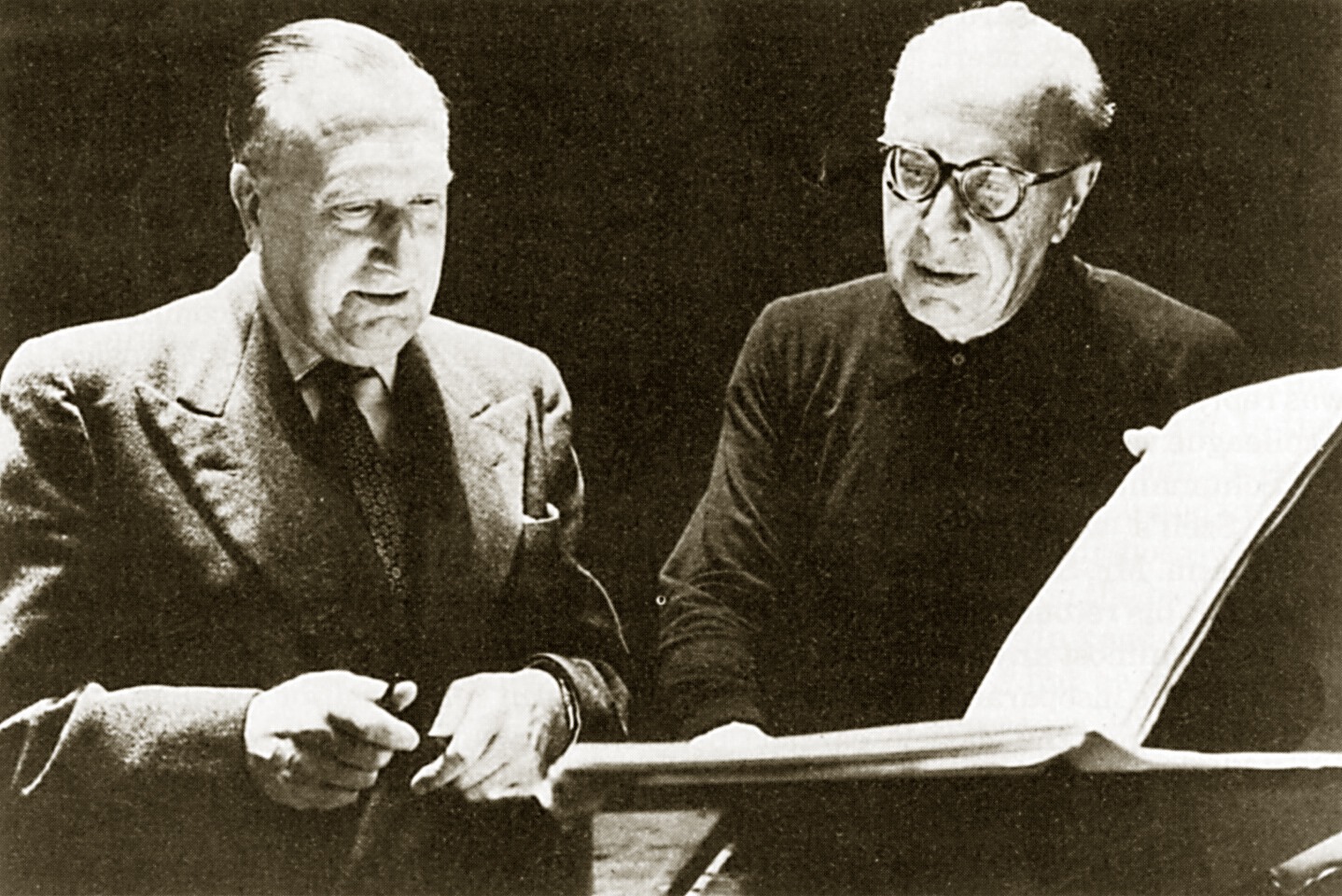
    George Szell (pictured, with the composer) gave the American premiere of the symphony, with the Cleveland Orchestra, in December of 1960. A few months later, they made the first recording.

    More than three decades earlier, Walton was viewed as an enfant terrible, when he set Edith Sitwell’s poetry as an entertainment, titled “Façade.” The work was first performed publicly in 1923. The premiere was a succès de scandale, with Sitwell herself speaking her poems into a megaphone protruding from the mouth of a painted face by John Piper, Walton conducting an ensemble of six instruments.

    The displeasure of performers, audience, and critics was evident, with Noel Coward ostentatiously marching out. However, the work quickly caught on, even becoming downright popular in a variety of arrangements. Within a decade, a purely orchestral version was choreographed by Frederick Ashton.

    We’ll hear selections from a treasured recording, unavailable in this country for many years, featuring Dame Peggy Ashcroft and Paul Scofield as the reciters. Both were noted Shakespearean actors, who did much of their best work on stage. Ashcroft received an Academy Award for Best Supporting Actress in 1985, for her part in David Lean’s final film, “A Passage to India,” and Scofield was honored with an Academy Award for Best Actor two decades earlier, in 1966, for his performance in “A Man for All Seasons.”

    I hope you’ll join me for “Will’s Wonders Never Cease” – rarely heard recordings of the works of William Walton – this Sunday night at 10:00 EDT, on WWFM – The Classical Network and wwfm.org.

  • Debussy’s La Mer Das Merde Szell Fails?

    Debussy’s La Mer Das Merde Szell Fails?

    One wag commented on a performance of Debussy’s impressionistic magnum opus conducted by George Szell, “He tried Debussy’s ‘La Mer’ once. It came out as ‘Das Merde.’”

    Great conductor. Great composer. But not all marriages are meant to be (as Debussy well knew).

    Happy birthday, Claude Debussy!

    Debussy in the W.C.?

  • George Rochberg A Centennial Celebration

    George Rochberg A Centennial Celebration

    Rock on, George!

    Today is the 100th birthday of George Rochberg (born in Paterson, NJ, in 1918; died in Bryn Mawr, PA, in 2005), for decades a staple of the University of Pennsylvania music department, which he chaired until 1968. He continued to teach there until 1983.

    Rochberg’s music underwent a compelling transformation, when, following the death of his teenage son in 1964, he suddenly found the serial palette he had up until then employed inadequate to express his grief. By the 1970s, he had begun incorporating tonal passages into his music, much to the dismay of his peers. Little did anyone realize at the time that this was the most avant garde approach Rochberg could have taken. His music heralded a return to tonality and the embrace of a new romanticism that has since become the norm.

    Here’s his Symphony No. 2 (1955-1956), which is serial but, contrary to his later concerns, still emotionally expressive. It’s conducted by George Szell, no less.

    https://www.youtube.com/watch?v=Mk74WLg8Iu4

    The Pachelbel variations from Rochberg’s String Quartet No. 6 (1978):

    And finally, his lovely “Transcendental Variations” (1971-1972, the third movement of the String Quartet No. 3, transcribed for string orchestra in 1975). Some of the variations have been blocked by Naxos, but there’s enough here to give a good idea. This luminous music could have been written at the turn of last century.

    Happy birthday, George Rochberg!


    PHOTOS: Rochberg (left) and a bust by his friend, the sculptor Christopher Cairns

  • Classical Music Surprise WWFM This Thursday

    Classical Music Surprise WWFM This Thursday

    Surprise!

    I’ll be filling in for David Osenberg this Thursday afternoon on The Classical Network, which means we’ll have three more hours together in which to enjoy some of our personal favorites.

    These are pieces drawn from the 88 playlists submitted for last week’s “Play It Again” membership campaign. Naturally, we couldn’t get to everything – we still won’t – but maybe some of your favorites will turn up alongside those of other WWFM listeners. Of course, we hope that we strike upon some of your favorites every day of the year and perhaps introduce you to some new ones.

    Your contributions have allowed us to discover new worlds and share music of fantastic beauty for the past 35. If you donated last week or at any time over the last twelve months (or, for that matter, within the entire existence of the station), you’re the best. If you have not donated, please consider doing so. It may seem like a bottomless pit, but if we’re to think of it that way, so is food shopping, a trip to the gas station, or putting a new roof on the house. And those things aren’t even fun! If not for the generosity of listeners like you, there would be no WWFM. I offer this as a gentle reminder that your contributions are always gratefully accepted at wwfm.org.

    We’ll begin today by sampling the artistry of LaShir, the Jewish Community Choir of Princeton. The choir’s director, Marsha Bryan Edelman, will be along to tell us all about the history of the organization – the oldest Jewish choir in Central Jersey that does not serve the liturgical needs of a synagogue – and its upcoming spring concert, which will take place at Westminster Choir College’s Hillman Hall this Sunday at 2 p.m. The program, which will be made up of repertoire sung in Hebrew, Yiddish, Ladino, and English, will be offered free and open to the public.

    In addition, we’ll be sure to celebrate the birthdays today of two fabulous conductors, George Szell and Neeme Järvi. I venture to guess there will be a little something for everyone, from 4 to 7 p.m. EDT, on WWFM – The Classical Network and wwfm.org.

  • Szell Järvi and Conductor Birthdays on WWFM

    Szell Järvi and Conductor Birthdays on WWFM

    It’s a conductor’s holiday! I hope you’ll join me for recordings of triple-threat George Szell, on the anniversary of his birth. We’ll hear Szell as conductor, pianist, and composer. It’s also the 80th birthday of Neeme Järvi. We’ll have more conductors (or better) than you can shake a stick at, today from 4 to 7 p.m., on WWFM – The Classical Network and wwfm.org.
Tag Cloud

Aaron Copland (92) Beethoven (95) Composer (114) Film Music (120) Film Score (143) Film Scores (255) Halloween (94) John Williams (185) KWAX (229) Leonard Bernstein (100) Marlboro Music Festival (125) Movie Music (135) Opera (198) Philadelphia Orchestra (88) Picture Perfect (174) Princeton Symphony Orchestra (106) Radio (87) Ralph Vaughan Williams (85) Ross Amico (244) Roy's Tie-Dye Sci-Fi Corner (290) The Classical Network (101) The Lost Chord (268) Vaughan Williams (103) WPRB (396) WWFM (881)

DON’T MISS A BEAT

Receive a weekly digest every Sunday at noon by signing up here


RECENT POSTS