Tag: Gunpowder Plot

  • Guy Fawkes Night William Byrd’s Secret Plot

    Guy Fawkes Night William Byrd’s Secret Plot

    Remember, remember, the Fifth of November. I imagine you’re putting the finishing touches on your effigies, as Guy Fawkes Night approaches. Have a great time. Just don’t burn my outhouse!

    https://en.wikipedia.org/wiki/Guy_Fawkes_Night

    William Byrd, a “Gentleman of the Chapel Royal,” was one of the best loved and certainly one of the most powerful musicians in England. In 1575, Queen Elizabeth granted him and Thomas Tallis – who had been a “Gentleman” from the time of Henry VIII – a 21-year monopoly on polyphonic music and a patent to print and publish music.

    Despite Byrd’s favored status within the Anglican Church, he converted to Catholicism, and even rubbed shoulders with Robert Catesby, who formulated the Gunpowder Plot to blow up Parliament in 1605, during the reign of James I, for which Guy Fawkes gained his undying notoriety.

    Though Byrd was never subject to imprisonment for his religion, he was involved in numerous lawsuits and subjected to heavy fines. Elizabeth interceded on his behalf at least once. He participated in illegal services, and the texts he chose to set to music could, at times, have a subversive edge. In particular, as a Catholic in a Protestant country, he became fond of texts related to persecution. Comparatively speaking, he went unmolested, because of his record of allegiance to the crown.

    Learn more about Byrd here:

    https://en.wikipedia.org/wiki/William_Byrd

    The secret life of William Byrd:

    https://www.telegraph.co.uk/news/religion/10323301/The-secret-life-of-William-Byrd.html?fbclid=IwAR3HQMCv8G7wQyUnhFgittM7ts3W9vHQg-L5frQkKDudFvqY46xETuXJiYQ

    Byrd’s motet, “Ne irascaris Domine” (“Do not be angry, Lord”), from his “Cantiones sacrae”


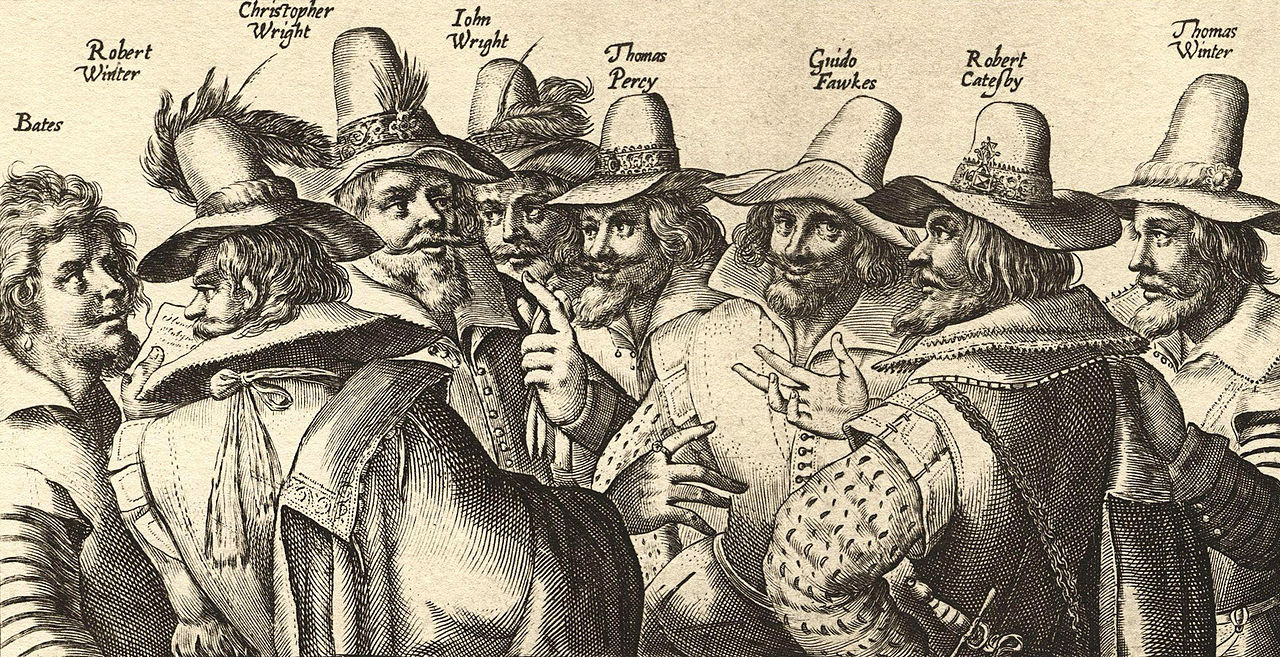
    PICTURED: Gunpowder Plot conspirators

  • Byrd Remembered A Belated Tribute

    Byrd Remembered A Belated Tribute

    Consider it a belated tribute to William Byrd.

    Byrd died 400 years ago, on July 4, 1623. I think it’s understandable that as an American – especially one born on the Fourth – I would have let the observance slip by, at a time when my head would have been a tug-of-war between fireworks and regret.

    Byrd is one albatross I will finally be able to address, this weekend on “The Lost Chord.”

    A “Gentleman of the Chapel Royal,” Byrd was one of the best loved and certainly one of the most powerful musicians in England. In 1575, Queen Elizabeth granted him and Thomas Tallis – who had been a “Gentleman” from the time of Henry VIII – a 21-year monopoly on polyphonic music and a patent to print and publish music.

    Not incidentally, Byrd has his own fireworks connection. Despite his favored status within the Anglican Church, he converted to Catholicism, and even rubbed shoulders with Robert Catesby. Catesby formulated the Gunpowder Plot to blow up Parliament in 1605, during the reign of James I, for which Guy Fawkes gained his undying notoriety.

    Though Byrd was never imprisoned for his religion, he was involved in numerous lawsuits and subjected to heavy fines. Elizabeth interceded on his behalf at least once. He participated in illegal services, and the texts he chose to set to music could, at times, have a subversive edge. In particular, as a Catholic in a Protestant country, he became fond of texts related to persecution. Comparatively speaking, he went unmolested, because of his record of allegiance to the crown.

    Glancing through my recorded shows, I note that Byrd makes a substantial appearance on one of them, by way of Gordon Jacob.

    Jacob, born in 1895, is perhaps best remembered these days as an orchestrator. He did a popular arrangement for full orchestra of Vaughan Williams’ “English Folk Song Suite,” originally composed for symphonic band; he orchestrated Sir Edward Elgar’s Organ Sonata; and his arrangement of the ballet “Les Sylphides” has been eclipsed only by that of Roy Douglas.

    But he was also a prolific composer himself. In all, he wrote some 400 works. In fact, when weighing the size of his output against his reputation, it’s tempting to underestimate – as the Angel did his Biblical namesake – Jacob’s tenacity.

    We’ll hear an example of his talent as an arranger, the “William Byrd Suite,” after virginal pieces by the Elizabethan master. The work was Jacob’s contribution to the celebrations in 1923 surrounding the tercentenary of Byrd’s death. The balance of the program will be devoted to one of his original compositions, the rarely-heard Symphony No. 1, dedicated to the memory of his brother, who died during the First World War.

    We’ll grapple with the range of Jacob’s accomplishments, even as I wing it with an impromptu tribute to Byrd, on “Wrestling Jacob,” this Saturday on “The Lost Chord,” now in syndication on KWAX, the radio station of the University of Oregon.

    For streaming information, see below.


    Keep in mind, KWAX is on the West Coast, so there’s a three-hour difference for the Trenton-Princeton area. Here are the respective air-times of my recorded shows (with East Coast conversions in parentheses):

    PICTURE PERFECT, the movie music show – Friday on KWAX at 5:00 PACIFIC TIME (8:00 PM EDT)

    THE LOST CHORD, unusual and neglected rep – Saturday on KWAX at 4:00 PACIFIC TIME (7:00 PM EDT)

    Stream them here!

    https://kwax.uoregon.edu/


    IMAGES (left to right): Jacob, Byrd, and Jacob

    BONUS: Follow the link for a witty survey ranking the various depictions of Jacob wrestling the angel in Western Art!

    https://the-toast.net/2014/09/16/famous-paintings-jacob-wrestling-angel-ranked-much-actions-resemble-slow-dancing/?fbclid=IwAR2IEewoVZtSngyVhY0VkprxjtH8x7oLoaJJf70Ye29G1Q1YfjKPKPP-EUA

  • Guy Fawkes Night William Byrd’s Secret Catholic Life

    Guy Fawkes Night William Byrd’s Secret Catholic Life

    Remember, remember, the Fifth of November – and don’t forget to turn your clocks for an extra hour of Guy Fawkes Night! Daylight Saving Time ends at 2 a.m. Sunday.

    https://en.wikipedia.org/wiki/Guy_Fawkes_Night

    William Byrd, a “Gentleman of the Chapel Royal,” was one of the best loved and certainly one of the most powerful musicians in England. In 1575, Queen Elizabeth granted him and Thomas Tallis – who had been a “Gentleman” from the time of Henry VIII – a 21 year monopoly on polyphonic music and a patent to print and publish music.

    Despite Byrd’s favored status within the Anglican Church, he converted to Catholicism, and even rubbed shoulders with Robert Catesby, who formulated the Gunpowder Plot to blow up Parliament in 1605, during the reign of James I, for which Guy Fawkes gained his undying notoriety.

    Though Byrd was never subject to imprisonment for his religion, he was involved in numerous lawsuits and subjected to heavy fines. Elizabeth interceded on his behalf at least once. He participated in illegal services, and the texts he chose to set to music could, at times, have a subversive edge. In particular, as a Catholic in a Protestant country, he became fond of texts related to persecution. Comparatively speaking, he went unmolested, because of his record of allegiance to the crown.

    Learn more about Byrd here:

    https://en.wikipedia.org/wiki/William_Byrd

    The secret life of William Byrd:

    https://www.telegraph.co.uk/news/religion/10323301/The-secret-life-of-William-Byrd.html?fbclid=IwAR0B5t2goruHDeCF0OVCahwfG-CMqjQNfN9CjF3dCuVUMVZlqwCQLmVlYmU

    Byrd’s motet, “Ne irascaris Domine” (“Do not be angry, Lord”), from his “Cantiones sacrae”


    PICTURED: Gunpowder Plot conspirators

  • Guy Fawkes Night William Byrd’s Secret Connection

    Guy Fawkes Night William Byrd’s Secret Connection

    Remember, remember, the Fifth of November – also, I hope you remembered to turn your clocks back so that you’re well-rested for Guy Fawkes Night!

    https://en.wikipedia.org/wiki/Guy_Fawkes_Night

    William Byrd, a “Gentleman of the Chapel Royal,” was one of the best loved and certainly one of the most powerful musicians in England. In 1575, Queen Elizabeth granted him and Thomas Tallis – who had been a “Gentleman” from the time of Henry VIII – a 21 year monopoly on polyphonic music and a patent to print and publish music.

    Despite Byrd’s favored status within the Anglican Church, he converted to Catholicism, and even rubbed shoulders with Robert Catesby, who formulated the Gunpowder Plot to blow up Parliament in 1605, during the reign of James I, for which Guy Fawkes gained his undying notoriety.

    Though Byrd was never subject to imprisonment for his religion, he was involved in numerous lawsuits and subjected to heavy fines. Elizabeth interceded on his behalf at least once. He participated in illegal services, and the texts he chose to set to music could, at times, have a subversive edge. In particular, as a Catholic in a Protestant country, he became fond of texts related to persecution. Comparatively speaking, he went unmolested, because of his record of allegiance to the crown.

    Learn more about Byrd here:
    https://en.wikipedia.org/wiki/William_Byrd

    The secret life of William Byrd:
    http://www.telegraph.co.uk/news/religion/10323301/The-secret-life-of-William-Byrd.html

    Byrd’s motet, “Ne irascaris Domine” (“Do not be angry, Lord”), from his “Cantiones sacrae”:


    PICTURED: Gunpowder Plot conspirators

  • Guy Fawkes Night William Byrd’s Secret Plot

    Guy Fawkes Night William Byrd’s Secret Plot

    Remember, remember, the Fifth of November – and don’t forget to turn your clocks for an extra hour of Guy Fawkes Night! Daylight Saving Time ends at 2 a.m. Sunday.

    https://en.wikipedia.org/wiki/Guy_Fawkes_Night

    William Byrd, a “Gentleman of the Chapel Royal,” was one of the best loved and certainly one of the most powerful musicians in England. In 1575, Queen Elizabeth granted him and Thomas Tallis (who had been a “Gentleman” from the time of Henry VIII) a 21 year monopoly on polyphonic music and a patent to print and publish music.

    Despite Byrd’s favored status within the Anglican church, he converted to Catholicism, and even rubbed shoulders with Robert Catesby, who formulated the Gunpowder Plot to blow up Parliament in 1605, during the reign of James I, for which Guy Fawkes gained his undying notoriety.

    Though Byrd was never subject to imprisonment for his religion, he was involved in numerous lawsuits and subject to heavy fines. Elizabeth interceded on his behalf at least once. He participated in illegal services, and the texts he chose to set to music could, at times, have a subversive edge. In particular, as a Catholic in a Protestant country, he became fond of texts relating to persecution. Comparatively speaking, he went unmolested, because of his record of allegiance to the crown.

    Learn more about Byrd here:

    https://en.wikipedia.org/wiki/William_Byrd

    The secret life of William Byrd:

    http://www.telegraph.co.uk/news/religion/10323301/The-secret-life-of-William-Byrd.html

    Byrd’s motet, “Ne irascaris Domine” (“Do not be angry, Lord”), from his “Cantiones sacrae”:


    PICTURED: Gunpowder Plot conspirators

Tag Cloud

Aaron Copland (92) Beethoven (94) Composer (114) Film Music (117) Film Score (143) Film Scores (255) Halloween (94) John Williams (185) KWAX (228) Leonard Bernstein (99) Marlboro Music Festival (125) Movie Music (132) Opera (197) Philadelphia Orchestra (86) Picture Perfect (174) Princeton Symphony Orchestra (106) Radio (86) Ralph Vaughan Williams (85) Ross Amico (244) Roy's Tie-Dye Sci-Fi Corner (290) The Classical Network (101) The Lost Chord (268) Vaughan Williams (101) WPRB (396) WWFM (881)

DON’T MISS A BEAT

Receive a weekly digest every Sunday at noon by signing up here


RECENT POSTS