Tag: Halloween

  • French Halloween Music the Lost Chord

    French Halloween Music the Lost Chord

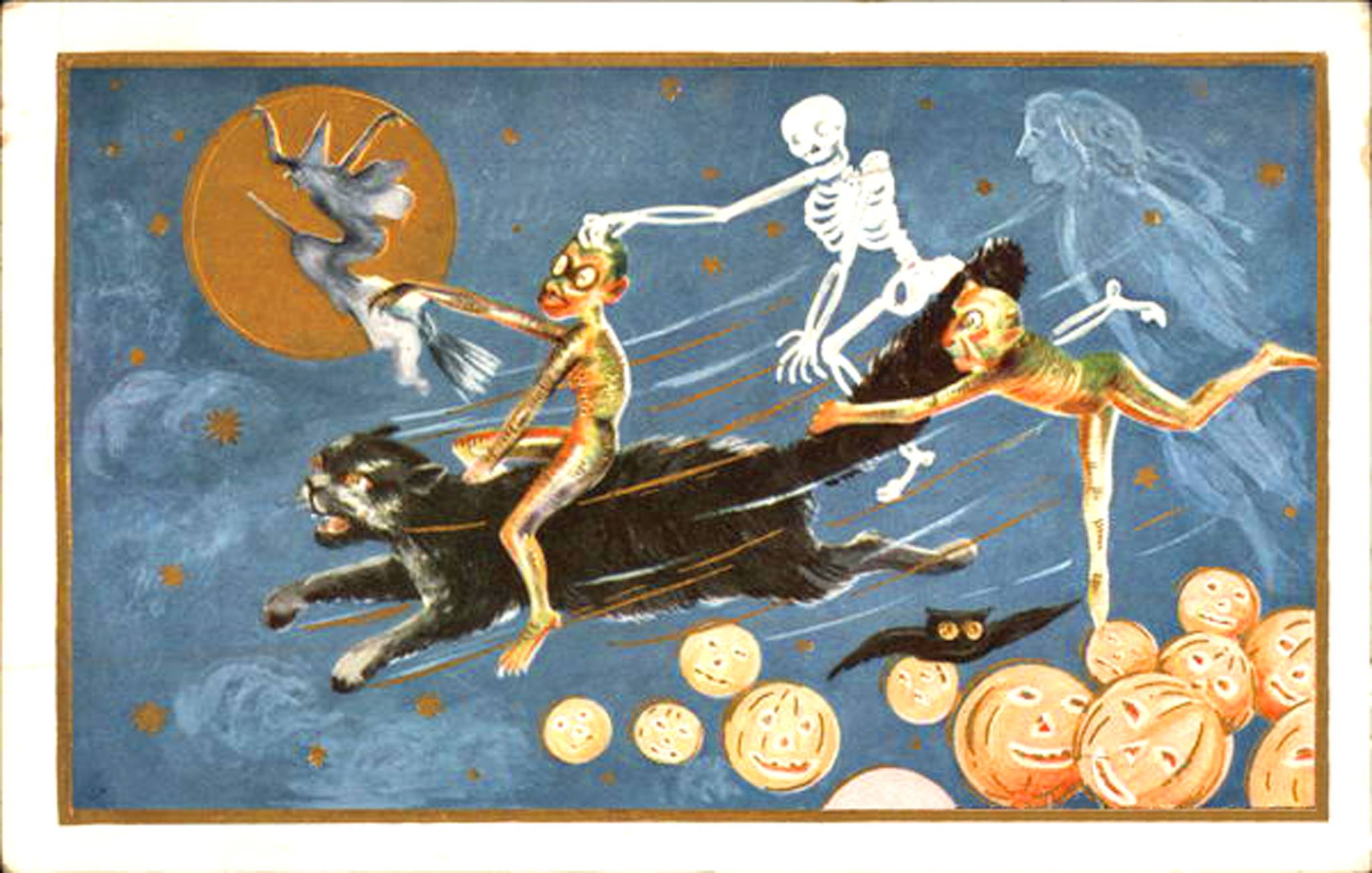
    On the whole the French don’t really celebrate Halloween (too American), but if you find one who does, don’t say “trick or treat.” Rather, demand “Des bonbons ou un sort!” – candy or a spell.

    While France might not be down with the whole Halloween thing, many of the country’s great artists, writers, and composers could totally conjure a Halloween vibe. Think Odilon Redon’s “The Smiling Spider,” Charles Baudelaire’s “Les Fleurs du mal,” or Camille Saint-Saëns’ “Danse macabre.”

    This week on “The Lost Chord,” we’ll have three pieces of French music totally suitable for the season.

    Maurice Ravel’s “Gaspard de la Nuit” (“Gaspard of the Night”) – musical responses to the weird and sinister poetry of Aloysius Bertrand – is a suite of creepy impressions of (1) a flirtatious water spirit, (2) a hanged man at sunset against the backdrop of a tolling bell, and (3) a vampiric dwarf named Scarbo. Gina Bachauer will be the pianist, and Sir John Gielgud will preface each of the movements with recitations of the Bertrand poems.

    Claude Debussy was enthralled by the writings of Edgar Allan Poe, which he knew through Baudelaire’s translations. At the time of his death, he left incomplete sketches for two operas after Poe stories – “The Fall of the House of Usher” and “The Devil in the Belfry.” We’ll hear fragments of the former, conducted by Georges Prêtre.

    Finally, we’ll listen to the third of the “Etudes in Minor Keys,” subtitled “Scherzo Diabolico,” by Charles-Valentin Alkan. Alkan, a sometimes neighbor of Chopin and Georges Sand, shared a home with his illegitimate son, two apes, and a hundred cockatoos. Franz Liszt is alleged to have commented, “Alkan had the finest technique I had ever known, but preferred the life of a recluse.”

    Best known is the story surrounding the circumstances of his death: while reaching for a copy of the Talmud, situated on a high shelf of a heavy bookcase, the case let go and crushed Alkan beneath it. It’s been suggested that the composer actually collapsed while in the kitchen – but when the legend becomes fact, print the legend. We’ll hear his etude in a recording by the late Michael Ponti.

    I hope you’ll join me for “Jacques o’ Lanterns” – lurid music by French composers for Halloween on “The Lost Chord,” now in syndication on KWAX, the radio station of the University of Oregon!


    Clip and save the start times for all three of my recorded shows:

    PICTURE PERFECT, the movie music show – Friday at 8:00 PM EDT/5:00 PM PDT

    SWEETNESS AND LIGHT, the light music program – Saturday at 11:00 AM EDT/8:00 AM PDT

    THE LOST CHORD, unusual and neglected rep – Saturday at 7:00 PM EDT/4:00 PM PDT

    Stream them, wherever you are, at the link!
    https://kwax.uoregon.edu/

  • Halloween Music on KWAX

    Halloween Music on KWAX

    This week on “Sweetness and Light,” we’ll be cutting holes in Mom’s best sheets for a light music trick-or-treat. Join me for 13 ghostly premonitions of a holiday I am happy to say I never outgrew.

    We’ll enjoy Halloween songs, selections from Halloween film scores, Halloween piano miniatures, and Halloween light music classics about a haunted ballroom, an ostracized imp, and a devil’s ride, all lovingly curated by you-know-who. Nothing too terribly terrible. It’s all in good fun. There will be no cowering before this disarming parade of spirits, reanimated corpses, witches, bogeymen, demons, and necromancers!

    I’ve carefully examined all the candy for pins and razor blades, so you mustn’t hesitate to indulge. It will be Smarties® and peanut butter cups for breakfast, when you join me for “Sweetness and Light,” this Saturday morning at 11:00 EDT/8:00 PDT, exclusively on KWAX, the radio station of the University of Oregon!

    Stream it wherever you are at the link:

    https://kwax.uoregon.edu/

    Aaah-OOOOOO!

  • Spooky Comedy Movie Soundtracks Halloween Mix

    Spooky Comedy Movie Soundtracks Halloween Mix

    Spooky comedies. A seeming oxymoron. Perhaps in an attempt to subvert our fears, or to generate laughter from tension, filmmakers have frequently juxtaposed humor with the supernatural – or at any rate death.

    This week on “Picture Perfect,” we’ll conjure some Hallowe’en spirit with music from four macabre comedies.

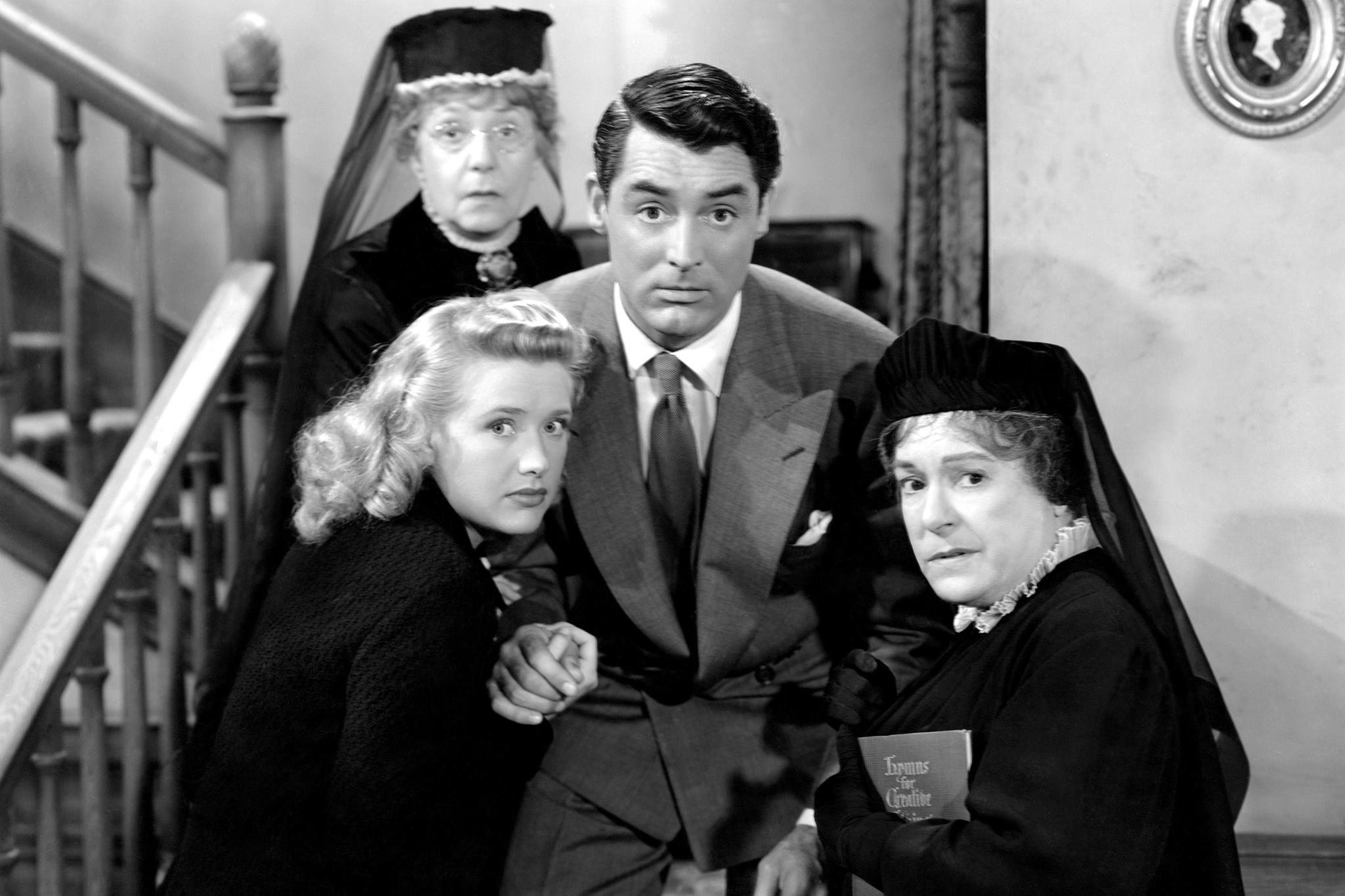
    Frank Capra’s screen adaptation of “Arsenic and Old Lace” (1944) was actually shot in 1941, but it could not be released until after the hit stage play, by Joseph Kesselring, had concluded its Broadway run.

    The film starred Cary Grant, Priscilla Lane, Raymond Massey, Peter Lorre, Jack Carson, and Capra favorites James Gleason and Edward Everett Horton.

    Two seemingly innocuous spinster aunts poison lonely old men and have them buried in their basement, by a family member who believes that he’s Teddy Roosevelt. (He thinks that he’s digging the Panama Canal.) Massey and Lorre play a murderer on the lam and his plastic surgeon, respectively, who hole up in the house, unaware that Massey’s body count pales next to that of his unwitting hosts.

    The score, by Max Steiner, is as manic as Grant’s performance – perhaps a mite overdone, with its breakneck allusions to familiar melodies – but it bears the same distinctive gloss as other Steiner classics like “Gone With the Wind” and “Casablanca.”

    Composer Bernard Herrmann will always be most closely associated with the films of Alfred Hitchcock. In particular, his music for the shower scene in “Psycho” has entered the popular consciousness as few other film scores have. Hitchcock and Herrmann collaborated on nine films in all. The first of these was a black comedy called “The Trouble with Harry” (1955), a droll farce about a corpse that materializes in a New England community and can’t seem to stay buried.

    Don Knotts and a haunted house – that’s the high concept behind “The Ghost and Mr. Chicken” (1966). How could it possibly miss? Knotts’ elastic-faced terror finds a goofy foil in Vic Mizzy’s score. Mizzy also wrote music for “The Addams Family.”

    Finally, in a kind of twist on “Topper,” Alec Baldwin and Geena Davis play a recently-deceased couple who try to scare off the inhabitants of their former home, in “Beetlejuice” (1988). In desperation, they enlist the services of a manic “bio-exorcist” (a loosy-goosy Michael Keaton) and things get seriously antic.

    The music is by Danny Elfman, as always a fan of Nino Rota, although he also pays homage to the Stravinsky of “The Soldier’s Tale” and frequently alludes to Raymond Scott. There’s even a touch of Bernard Herrmann in one of the tracks, as Elfman evokes the skeleton fight from “The Seventh Voyage of Sinbad.”

    I hope you’ll join me for a mishmash of horror and humor this week, on “Picture Perfect,” music for the movies, now in syndication on KWAX, the radio station of the University of Oregon!


    Clip and save the start times for all three of my recorded shows:

    PICTURE PERFECT, the movie music show – Friday at 8:00 PM EDT/5:00 PM PDT

    SWEETNESS AND LIGHT, the light music program – Saturday at 11:00 AM EDT/8:00 AM PDT

    THE LOST CHORD, unusual and neglected rep – Saturday at 7:00 PM EDT/4:00 PM PDT

    Stream them, wherever you are, at the link!

    https://kwax.uoregon.edu/

  • Halloween Radio Special on KWAX

    Halloween Radio Special on KWAX

    Since Halloween falls on a Friday this year – one week from today – I hope you’ll indulge me this weekend as all three of my radio shows will tie in to my favorite holiday.

    First, on “Picture Perfect,” music for the movies (Friday at 8:00 p.m. EDT/5:00 p.m. PDT), we’ll enjoy scores from spooky or macabre comedies, including “Arsenic and Old Lace” (Max Steiner), “The Trouble with Harry” (Bernard Herrmann), “The Ghost and Mr. Chicken” (Vic Mizzy), and “Beetlejuice” (Danny Elfman).

    Then, tomorrow on “Sweetness and Light” (Saturday morning at 11:00 EDT/8:00 PDT), it will be a light music Halloween, with spooktacular selections associated with haunted ballrooms, ostracized imps, reanimated skeletons, nimble witches, adept sorcerers, ghost removal specialists, consumerist zombies, dancing lunatics, boogey men, headless horsemen, boy wizards, and galloping devils.

    Finally, on “The Lost Chord” (Saturday at 7:00 p.m. EDT/4:00 p.m. PDT), écoutez to French music for the season, including Maurice Ravel’s “Gaspard de la nuit,” after grotesque poetry of Aloysius Bertrand (with pianist Gina Bachauer and narrator Sir John Gielgud), a fragment of an unfinished opera inspired by Edgar Allan Poe’s “The Fall of the House of Usher” by Claude Debussy, and an etude subtitled “Scherzo diabolico” by the misanthropic and reclusive Charles-Valentin Alkan.

    But wait! There’s more!

    Since “Picture Perfect” falls on a Friday, I’ll have one more chance next week, on Halloween proper, when I’ll offer a playlist of evocative and ear-catching vintage horror and science fiction scores from the 1950s, with enough narration and gaudy sound effects to provide the perfect soundtrack for your Trick-or-Treat.

    All air times for the above shows are reiterated below. Stream them wherever you are from KWAX, the radio station of the University of Oregon!

    https://kwax.uoregon.edu/


    PICTURE PERFECT, the movie music show – Friday at 8:00 PM EDT/5:00 PM PDT

    SWEETNESS AND LIGHT, the light music program – Saturday at 11:00 AM EDT/8:00 AM PDT

    THE LOST CHORD, unusual and neglected rep – Saturday at 7:00 PM EDT/4:00 PM PDT

  • Herrmann’s Fantasy Film Scores for Halloween

    Herrmann’s Fantasy Film Scores for Halloween

    Hallowe’en is fast approaching. This week on “Picture Perfect,” it’s high time we get the pumpkin rolling, with an hour of fantasy film scores of Bernard Herrmann.

    Just about everyone has some awareness of Herrmann’s fruitful run with Alfred Hitchcock, a collaborative relationship which yielded scores to “Vertigo,” “North by Northwest” and “Psycho,” among others. Concurrently, Herrmann worked with producer Charles H. Schneer to create a series of classic films on fantastic subjects, featuring special effects by stop-motion maestro Ray Harryhausen. We’ll be listening to selections from two of these.

    Jules Vernes’ novel, “Mysterious Island,” was a sequel of sorts to “20,000 Leagues under the Sea.“ During the American Civil War, a ragtag band of Union soldiers escape from a Confederate prison by hot air balloon. A storm sweeps them off to the titular island, where they encounter pirates, a castaway, and an orangutan. Indeed Captain Nemo turns up late in the narrative, though no giant creatures, as in the film (made in 1961). Herrmann has a field day characterizing an enormous crab, bee, and especially bird, for which he employs a fugue!

    Harryhausen’s skeleton fight from Schneer’s “Jason and the Argonauts” (1963) stands as one of the all-time classic fantasy sequences, a dream marriage of visuals and music. Herrmann, who always provided his own orchestrations, was well known for putting together unique combinations of instruments, the better to illustrate the special character of a given film. In the case of “Jason,” he went in the opposite direction from what he had taken with “Psycho,” stripping away the strings and concentrating instead on winds, brass and percussion.

    On a somewhat gentler note, Herrmann scored the beautiful spectral romance, “The Ghost and Mrs. Muir” (1947), with Gene Tierney as a young widow who moves with her daughter to a seaside village, where she encounters the ghost of salty Captain Gregg (played by Rex Harrison). Of course, their banter leads to a hopeless attraction developing between them. Herrmann was a master at creating musical evocations of yearning, and his score for “The Ghost and Mrs. Muir” is full of romantic longing.

    Criminally, for a composer whose career spanned over four decades, from “Citizen Kane” to “Taxi Driver,” Herrmann received only a single Oscar, for “The Devil and Daniel Webster” (released in 1941 as “All That Money Can Buy”). Walter Huston makes a meal of his role as Mr. Scratch in Stephen Vincent Benét’s recasting of the Faust legend, transferred to the New England countryside. Director William Dieterle, who had his roots in German Expressionism, creates some truly eerie visuals, and Herrmann’s score barn-dances deftly back and forth between dread and whimsy.

    Join me for fantasy film scores of Bernard Herrmann this week on “Picture Perfect,” music for the movies, now in syndication on KWAX, the radio station of the University of Oregon!


    Clip and save the start times for all three of my recorded shows:

    PICTURE PERFECT, the movie music show – Friday at 8:00 PM EDT/5:00 PM PDT

    SWEETNESS AND LIGHT, the light music program – Saturday at 11:00 AM EDT/8:00 AM PDT

    THE LOST CHORD, unusual and neglected rep – Saturday at 7:00 PM EDT/4:00 PM PDT

    Stream them, wherever you are, at the link!
    https://kwax.uoregon.edu/

Tag Cloud

Aaron Copland (92) Beethoven (94) Composer (114) Conductor (84) Film Music (106) Film Score (143) Film Scores (255) Halloween (94) John Williams (179) KWAX (227) Leonard Bernstein (98) Marlboro Music Festival (125) Movie Music (121) Mozart (84) Opera (194) Picture Perfect (174) Princeton Symphony Orchestra (102) Radio (86) Ross Amico (244) Roy's Tie-Dye Sci-Fi Corner (290) The Classical Network (101) The Lost Chord (268) Vaughan Williams (97) WPRB (396) WWFM (881)

DON’T MISS A BEAT

Receive a weekly digest every Sunday at noon by signing up here


RECENT POSTS