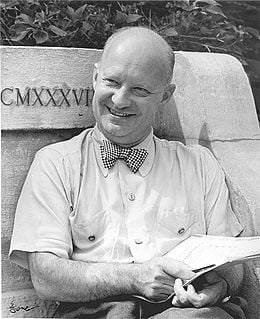
Who says Paul Hindemith didn’t have a sense of humor? Sure, his music could be as dry as dust, and he wrote too much of it, but the fact that he was so prolific practically guaranteed a trove of masterpieces amongst the stodgers.
This one’s no masterpiece, maybe, but it is marked by a certain amount of wit and therefore refreshingly engaging. The full title is “Overture to the Flying Dutchman as Sight-read by a Bad Spa Orchestra at 7 in the Morning by the Well” (1925). Less well-known than Mozart’s “A Musical Joke,” it hits many of the same marks. It’s the kind of painful Hindemith I can get behind.
Hindemith was kind of like a 20th century Telemann, spewing well-crafted music by the yard. But the price of such extraordinary productivity is that he often ran the risk of teetering into prolixity, and what we sometimes wind up with is an awful lot of spaetzle. Hindemith could be a real noodler. This one might be my most-hated Hindemith piece, “Gebrauchsmusik” at its worst:
But when he was on, he was on, and some of the orchestral pieces, especially, can be glorious, thrilling, and even transcendent in their luminosity.
My personal breakthrough with this composer came with an album released in the late 1980s, on London Records, with Herbert Blomstedt and the San Francisco Symphony. Not only does it contain the most exciting recording of Hindemith’s “Symphonic Metamorphosis of Themes by Carl Maria Weber” I have ever heard – and that’s saying something, since it must be his most-recorded work – but it also introduced me to an unexpectedly moving piece called “Trauermusik” (“Mourning Music,” or “Funeral Music”).
Hindemith, also a violist, was in London to give the UK premiere of his new concerto, “Der Schwanendreher,” scheduled for January 22, 1936. The timing was lousy. King George V died a few minutes before midnight on January 20. Not surprisingly, the concert was cancelled, but the BBC and conductor Sir Adrian Boult wanted to make use of Hindemith in whatever it was they decided to do in its place. The next morning, they set Hindemith up in a quiet office, with plenty of pencils and a stack of blank staff paper, and six hours later he emerged with a new concert piece, which he played the same night as part of a special memorial broadcast. That’s the kind of a composer Hindemith was.
Toward the end of the work Hindemith quotes a chorale by Johann Sebastian Bach, “Fur deinen Thron tret ich hiermet” (“Here I stand before Thy throne”). It was the composer’s great good fortune that the melody turned out to have added resonance, as it is widely recognized in England as “the Old 100th.” What could easily have been a mere occasional work, destined for a single performance and then lost to oblivion, actually turned out to be one of his most moving pieces.
Here is Hindemith that actually touches the heart. The violist is Geraldine Walther, then principal violist of the SFS.
Okay, Hindemith, so you have a soul. You’ve touched me with your humanity. Happy birthday.
Here’s another worthwhile Hindemith piece I discovered as part of an extensive set of his orchestral works recorded by Werner Andreas Albert – a Concerto for Woodwinds, Harp and Orchestra (1949). Note the quotation from Mendelssohn’s “Wedding March” in the last movement, a surprise for the composer’s wife. The premiere took place on their silver wedding anniversary.
Bernstein conducts the “Mathis der Maler” Symphony (1934) on TV in 1964
https://www.youtube.com/watch?v=aX7wW5P78w0
Hindemith conducts his “Symphonia serena” (1946):
Kammermusik No. 1 (1921). I’m pretty sure Goebbels didn’t like this one. (Hindemith was banned by the Nazis.)
Leon Fleisher plays the belated premiere of “Klaviermusik mit Orchester” (1923), rediscovered in a Pennsylvania farmhouse in 2002
Earl Wild plays the Piano Sonata No. 3 (1936)
Variations on an Old English Nursery Song, “A Frog He Went a-Courting” (1941)
Herbert Blomstedt conducts the “Symphonic Metamorphosis of Themes by Carl Maria von Weber” (1943). The last movement is pure pirate music!
Hindemith conducts his St. Francis of Assisi ballet, “Nobilissima visione” (1938)
PHOTO: Hindemith (de)pressing the sheets