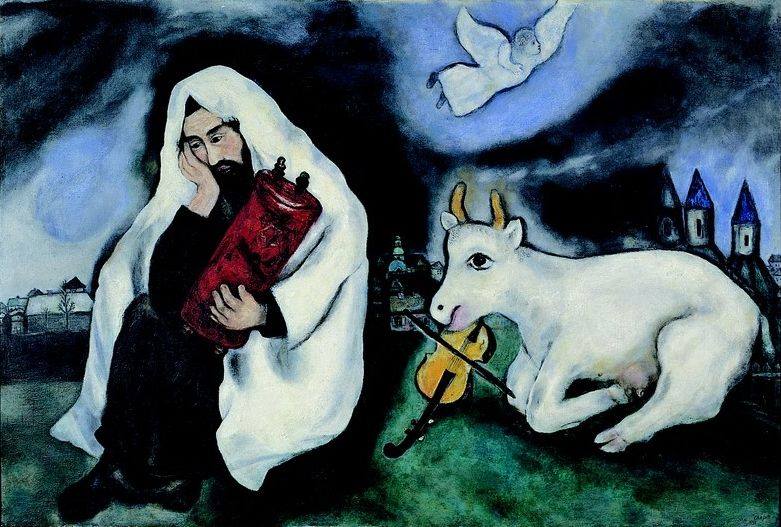
Yom Kippur begins tomorrow night at sundown. The Day of Atonement marks the culmination of ten days of awe and repentance. Observed with fasting and prayer, it is the holiest day on the Jewish calendar.
This week on “The Lost Chord,” we offer best wishes for a happy, healthy, and sweet new year with two complementary works inspired by the High Holidays.
Jacob Weinberg’s String Quartet, Op. 55, of 1950, falls into three movements: “Rosh Hashana” (the Jewish New Year), “Yom Kippur,” and “Sukkot.” “Yom Kippur” is based on the cantorial chant “Kol Nidre.” You know, the same melody employed by Max Bruch in his famous cello piece.
Ernest Bloch’s “Israel Symphony,” composed between 1912 and 1917, is more like an orchestral rhapsody in three sections – “Prayer in the Desert,” “Yom Kippur,” and “Succoth” [sic] – played continuously and culminating in parts for four vocal soloists.
Sukkot, which follows Yom Kippur by only five days, is the harvest festival, during which temporary dwellings (or sukkot) are erected to commemorate the Jews’ 40 years wandering in the desert after the Exodus from Egypt. In modern times, these are decorated with fruits and vines. In contrast to the austerity and fasting of Yom Kippur, Sukkot is a celebration of life and abundance. But in ancient Israel, it was a solemn affair, with sacrifices offered at the temple.
Welcome the year 5787, with musical reflections of the High Holidays, and then some, on “Totally Awesome,” on “The Lost Chord,” now in syndication on KWAX Classical Oregon.
G’mar chatima tova.
———-
Clip and save the start times for all three of my recorded shows:
PICTURE PERFECT, the movie music show – Friday at 8:00 PM EDT/5:00 PM PDT
SWEETNESS AND LIGHT, the light music program – Saturday at 11:00 AM EDT/8:00 AM PDT
THE LOST CHORD, unusual and neglected rep – Saturday at 7:00 PM EDT/4:00 PM PDT
Stream them, wherever you are, at the link.
https://kwax.uoregon.edu/
Tag: High Holy Days
-

Shana Tova Music for the Jewish High Holy Days
Shana tova!
This week on “The Lost Chord,” we welcome the year 5785 with an hour of music for the Jewish High Holy Days.
Herman Berlinski (1910-2001) was a prolific composer, who made his mark largely in the field of liturgical music. His “Shofar Service” (1964) is scored for baritone, shofar, two trumpets, organ, and chorus. The shofar, traditionally fashioned out of a ram’s horn, is sounded, as applies here, during the Rosh Hashana or New Year service. The text is compiled from the Union Prayer Book.
David Stock (1939-2015), a longtime resident of Pittsburgh, served on the faculty of Duquesne University. He was founder of the Pittsburgh New Music Ensemble, and acted as composer in residence for the Pittsburgh Symphony Orchestra and the Seattle Symphony. “Yizkor” (1999), Stock’s elegy for string orchestra, takes its name from the communal memorial service and prayer that honors the deceased. The custom is notably observed on Yom Kippur, or the Day of Atonement.
Finally, we’ll turn to “The Chagall Windows” (1974), luminous, strange, and beautiful impressions of stained glass tableaux from the synagogue of the Hadassah Medical Center in Jerusalem, by the English pianist and composer John McCabe (1938-2015). The windows depict the twelve sons of the patriarch Jacob and the Twelve Tribes of Israel. McCabe addresses the windows in interlinked sections, so as to give the work a more symphonic, perhaps less episodic, feel.
The world premiere recording was made for EMI in 1974. We’ll hear a live performance from the next year, captured in a more natural acoustic, with the London Philharmonic conducted by Bernard Haitink.
Best wishes for a sweet, happy, and healthy new year. It’s a fresh start, from tekeeyah to atonement, on “Shofar, So Good” – music for the High Holy Days – on “The Lost Chord,” now in syndication on KWAX, the radio station of the University of Oregon!
Clip and save the start times for all three of my recorded shows:
PICTURE PERFECT, the movie music show – Friday at 8:00 PM EDT/5:00 PM PDT
SWEETNESS AND LIGHT, the light music program – ALL NEW! – Saturday at 11:00 AM EDT/8:00 AM PDT
THE LOST CHORD, unusual and neglected rep – Saturday at 7:00 PM EDT/4:00 PM PDT
Stream them, wherever you are, at the link!
-

Jewish Film Music for the High Holy Days
This week on “Picture Perfect,” to coincide with the Jewish High Holy Days, we’ll have music from movies and television series informed by aspects of the Jewish experience.
We’ll begin with “Exodus” (1960), based on the bestselling novel by Leon Uris, about the founding of the State of Israel. The book is said to have been the biggest seller in the United States since “Gone with the Wind.” The film was directed by Otto Preminger. Paul Newman and Eva Marie Saint lead an all-star cast. Ernest Gold’s stirring music was recognized with an Academy Award and is probably his best-known achievement.
Barry Levinson’s semi-autobiographical “Avalon” (1990) explores the immigrant experience and, for better or worse, the assimilation of a Jewish family into American culture. Alongside his work on “The Natural,” Randy Newman’s score is probably one of his best-loved.
The balance of the hour will be devoted to music from two acclaimed television scores: one for the NBC miniseries “Holocaust” (1978), written by the esteemed concert composer Morton Gould, and the other, the PBS series “Heritage: Civilization and the Jews” (1984), by Emmy Award-winning composer John Duffy.
I hope you’ll join me for a “new year” sampler of films about the Jewish experience this week, on “Picture Perfect,” music for the movies, this Saturday evening at 6:00 EDT, on WWFM – The Classical Network and wwfm.org.
-

Shana Tova High Holy Days Music on “The Lost Chord”
Shana Tova! Best wishes for a happy, healthy, and sweet new year. Because of last week’s 9/11 memorial, I’m only finally getting around to acknowledging the Jewish High Holy Days. This Sunday night on “The Lost Chord,” we mark the observance with two complementary works.
Jacob Weinberg’s String Quartet, Op. 55, of 1950, falls into three movements: “Rosh Hashana,” “Yom Kippur” and “Sukkot.” “Yom Kippur” is based on the cantorial chant “Kol Nidre.” (You know, the same melody employed by Max Bruch in his famous cello piece.)
Ernest Bloch’s “Israel Symphony,” composed between 1912 and 1917, is more like an orchestral rhapsody in three sections – “Prayer in the Desert,” “Yom Kippur” and “Succoth” – played continuously and culminating in parts for four vocal soloists.
Sukkot, which follows Yom Kippur by only five days, is the harvest festival, during which temporary dwellings (or sukkot) are erected to commemorate the Jews’ 40 years wandering in the desert after the Exodus from Egypt. In modern times, these are decorated with fruits and vines. In contrast to the austerity and fasting of Yom Kippur, the Day of Atonement, Sukkot is a celebration of life and abundance. But in ancient Israel, it was a solemn affair, with sacrifices offered at the temple.
The High Holidays are a period of reflection, ten days of awe and repentance. Welcome the year 5782, on “Totally Awesome” – one hour later than usual, due to the length of today’s opera (Wagner’s “Parsifal”?????) – this Sunday night at 11:00 EDT, on WWFM – The Classical Network and wwfm.org.
-
Shana Tova High Holy Days Music
Shana tova!
This Sunday night on “The Lost Chord,” we welcome the year 5781 with an hour of music for the Jewish High Holy Days.
Herman Berlinski (1910-2001) was a prolific composer, who made his mark largely in the field of liturgical music. His “Shofar Service” (1964) is scored for baritone, shofar, two trumpets, organ, and chorus. The shofar, traditionally fashioned out of a ram’s horn, is sounded, as applies here, during the Rosh Hashana or New Year service. The text is compiled from the Union Prayer Book.
David Stock (1939-2015), a longtime resident of Pittsburgh, served on the faculty of Duquesne University. He was founder of the Pittsburgh New Music Ensemble, and acted as composer in residence for the Pittsburgh Symphony Orchestra and the Seattle Symphony. “Yizkor” (1999), Stock’s elegy for string orchestra, takes its name from the communal memorial service and prayer that honors the deceased. The custom is notably observed on Yom Kippur, or the Day of Atonement.
Finally, we’ll turn to “The Chagall Windows” (1974), luminous, strange, and beautiful impressions of stained glass tableaux from the synagogue of the Hadassah Medical Center in Jerusalem, by the English pianist and composer John McCabe (1938-2015). The windows depict the twelve sons of the patriarch Jacob and the Twelve Tribes of Israel. McCabe addresses the windows in interlinked sections, so as to give the work a more symphonic, perhaps less episodic, feel.
The world premiere recording was made for EMI in 1974. We’ll hear a live performance from the next year, captured in a more natural acoustic, with the London Philharmonic conducted by Bernard Haitink.
Best wishes for a sweet, happy, and healthy new year. It’s a fresh start, from toot to atonement, on “Shofar, So Good” – music for the High Holy Days – this Sunday night at 10:00 EDT, on WWFM – The Classical Network and wwfm.org.
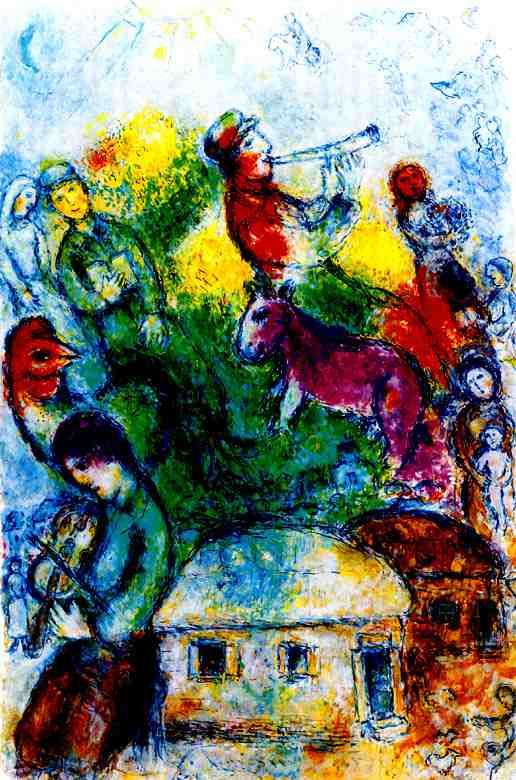
NOT one of the stained glass windows: Marc Chagall’s “Shofar”
Tag Cloud
Aaron Copland (94) Beethoven (95) Composer (114) Film Music (151) Film Score (143) Film Scores (255) Halloween (103) John Williams (198) KWAX (233) Leonard Bernstein (105) Marlboro Music Festival (125) Movie Music (166) Mozart (91) Opera (217) Philadelphia Orchestra (91) Picture Perfect (174) Princeton Symphony Orchestra (110) Radio (90) Ross Amico (244) Roy's Tie-Dye Sci-Fi Corner (290) The Classical Network (101) The Lost Chord (269) Vaughan Williams (107) WPRB (397) WWFM (881)