Tag: Hollywood Composers

  • Castelnuovo-Tedesco From Exile to Hollywood

    Castelnuovo-Tedesco From Exile to Hollywood

    I always felt a mix of compassion and wonder when reading about all those artists and intellectuals in the 1930s and ‘40s, who were driven away from everything they ever knew, becoming refugees well into their adult years, and forced to reinvent themselves in strange lands. Of course, their loss was our gain, as, in particular, they made the United States a better place, bringing all their expertise to bear in their respective fields, ensuring the country was alive with fresh ideas and influences, making us a leader in medical, technological, academic, artistic, and other fields. But it was a hell of price for them to pay.

    Now I wonder if history is repeating itself, and many will be forced to flee in the opposite direction, if they can.

    Mario Castelnuovo-Tedesco was 44 when he came to the U.S., fleeing persecution, as a Jew, under Mussolini’s antisemitic policies. He was sponsored by none other than Arturo Toscanini, who loathed fascism. Castelnuovo-Tedesco had many empathetic, well-placed musical friends, including Jascha Heifetz, Andrés Segovia, and Gregor Piatigorsky, who understood his true worth.

    In addition to being a prolific concert composer, Castelnuovo-Tedesco wound up making a nice chunk of change in Hollywood. He wrote music for some 200 movies, including “And Then There Were None,” starring Barry Fitzgerald, and “The Loves of Carmen,” with Rita Hayworth. As a teacher, his students included André Previn, Nelson Riddle, Herman Stein, Henry Mancini, Jerry Goldsmith, and John Williams.

    I first to got to know Castelnuovo-Tedesco’s music through his guitar concertos, which live in the sweet spot between Italian lyricism and cinematic splendor. Just about everything I’ve ever heard by him goes straight to the heart. The slow movements make you sigh, and later, when you’re doing the dishes, they make you want to sing.

    Today marks the 130th anniversary of Castelnuovo-Tedesco’s birth, and more and more his music is being recorded all the time. Good for him. The man brought a hell of a lot of beauty to the world.

    Happy birthday, Mario C-T!


    Guitar Concerto No. 1

    With Passover right around the corner, this one’s always been a favorite of mine this time of year: the Violin Concerto No. 2 “The Prophets” (its three movements: “Isaiah,” “Jeremiah,” “Elijah”)

    A new discovery for me: “Ballata dall’Esilio”

    Shakespeare overtures. Pick any one of them.
  • Jerry Goldsmith Overshadowed Genius

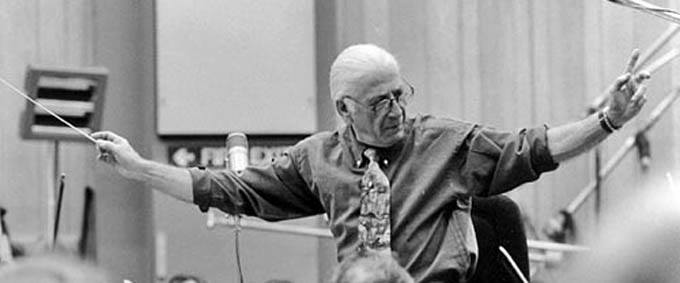
    Jerry Goldsmith Overshadowed Genius

    Two days after John Williams’ birthday falls the anniversary of the birth of Jerry Goldsmith. Unfortunately, this would essentially become the story of Jerry’s life, as despite being three years Williams’ senior and having cracked the A-list ahead of his younger colleague, Goldsmith often seemed to be caught in Williams’ wake.

    Sure, he distinguished himself with some of the great film scores of his time, including those for “The Sand Pebbles” (1966), “The Blue Max” (1966), “The Flim-Flam Man” (1967), “Planet of the Apes” (1968), “Patton” (1970), “Papillon” (1973), “Chinatown” (1974), “The Wind and the Lion” (1975), “MacArthur” (1977), “The Boys from Brazil” (1978), “The Great Train Robbery” (1979), “Alien” (1979, butchered in the sound editing), and “Star Trek: The Motion Picture” (1979). For television, he wrote for “Dr. Kildare,” “The Twilight Zone,” “Gunsmoke,” “The Man from U.N.C.L.E.,” and “The Waltons.”

    But by the 1980s, the films began to get weaker. It seemed like Goldsmith was always getting tossed the projects Williams passed on, or cheap knockoffs of Williams’ successes. By his final decade, he was stuck writing for such garbage as “The Mummy” (1999), “The Haunting” (1999), and “Looney Tunes: Back in Action” (2003). A notable exception was “L.A. Confidential” (1997), but rarely were his later projects up to his talent. I can recall many a moviegoing experience in which Goldsmith’s music wound up being the only redeeming quality.

    Furthermore, he had a reputation for being able to compose at white heat, so he was frequently called upon to write replacement scores for films like “The River Wild” (1994), “Air Force One” (1997), and “The 13th Warrior” (1999). He composed and recorded the score to “Chinatown,” one of the best of the 1970s, in only ten days.

    Criminally, he was honored with but a single Academy Award, for his influential score to “The Omen” (1976).

    Goldsmith died in 2004, at the age of 75. If he were to come back today, he would mop the joint with all the Hans Zimmers of this world. Like the John Henry of Hollywood composers, he’d be churning out quality film scores to put all the cheap-ass computer steam-drillers to shame.

    Happy birthday, Jerry Goldsmith!


    The Man from U.N.C.L.E.

    Planet of the Apes

    Patton

    Chinatown

    The Wind and the Lion

    The Omen

    Star Trek: The Motion Picture

  • Remembering Jerry Goldsmith Film Music Legend

    Remembering Jerry Goldsmith Film Music Legend

    When he was a kid, Jerry Goldsmith loved going to the movies to enjoy the music – just the way I loved going to the movies as a kid to enjoy Jerry Goldsmith!

    Goldsmith, born on this date in 1929, wrote indelible scores for dozens of films, such as “The Sand Pebbles” (1966), “The Blue Max” (1966), “The Flim-Flam Man” (1967), “Planet of the Apes” (1968), “Patton” (1970), “Papillon” (1973), “Chinatown” (1974), “The Wind and the Lion” (1975), “MacArthur” (1977), “The Boys from Brazil” (1978), “The Great Train Robbery” (1979), “Alien” (1979, butchered in sound editing), and “Star Trek: The Motion Picture” (1979).

    For television, he wrote for “Dr. Kildare,” “The Twilight Zone,” “Gunsmoke,” “The Man from U.N.C.L.E.” and “The Waltons.”

    By the 1980s, the films began to get weaker. It seemed like Goldsmith was always getting tossed the projects John Williams passed on, or cheap knockoffs of Williams’ successes. By his final decade, he was stuck writing for such garbage as “The Mummy” (1999), “The Haunting” remake (1999), and “Looney Tunes: Back in Action” (2003). A notable exception was “L.A. Confidential” (1997), but rarely were his later projects up to his talent.

    Goldsmith had a reputation for being able to compose at white heat, so he was frequently called upon to write replacement scores for films like “The River Wild” (1994), “Air Force One” (1997) and “The 13th Warrior” (1999). He composed and recorded the score to “Chinatown,” one of the best of the 1970s, in only ten days.

    Incredibly, he was honored with but a single Academy Award (of 18 nominations), for his influential score to “The Omen” (1976). Goldsmith died in 2004, at the age of 75. If he were to come back today, he would mop the joint with all the moody droners and computer noodlers, with their narrow palettes and paucity of inspiration.

    Happy birthday, Jerry. I hope they’re still making good movies wherever you are.


    Goldsmith discusses film music, circa 1986

    Documentary from 1993

    https://www.youtube.com/watch?v=qUemenAQYQ4

    Introducing and conducting his music with the National Philharmonic in 1989

    Introducing and conducting his music, and others’, with the BBC Concert Orchestra in 1994

    Part 1 https://www.youtube.com/watch?v=SR6c8QWIh90

    Part 2 https://www.youtube.com/watch?v=oqofviC4PG4

  • Max Steiner & Dimitri Tiomkin Birthday Film Scores

    Max Steiner & Dimitri Tiomkin Birthday Film Scores

    May 10th is bursting with birthday energy! Turn down the lights for a celebration of those two silverbacks of the silver screen, Max Steiner and Dimitri Tiomkin.

    Steiner (1888-1971), the literal godson of Richard Strauss, was instrumental in transplanting the sound of fin de siècle Vienna to the realm of cinematic dreams. He composed over 300 film scores for RKO and Warner Brothers, earning 24 Academy Award nominations and winning three – for “The Informer,” “Now, Voyager” and “Since You Went Away” – though he is unquestionably better remembered today for his work on “King Kong,” “Gone with the Wind” and “Casablanca.”

    Tiomkin (1894-1979), a pupil of Alexander Glazunov, was born in Ukraine. He settled in the United States, where he composed music for films in all genres, though in the 1950s he enjoyed particular success writing for Westerns, including the Academy Award-winning “High Noon.” When asked why this would be the case, that a composer born halfway around the world would have such a command of this distinctly American idiom, Tiomkin replied, “A steppe is a steppe is a steppe.”

    Tiomkin was honored with four Academy Awards – three for Best Original Score (for “High Noon,” “The High and the Mighty” and “The Old Man and the Sea”) and one for Best Original Song (“The Ballad of High Noon”).

    Here’s a transcript of his acceptance speech, delivered after being handed the Oscar for “The High and the Mighty” in 1955:

    “Lady and gentlemen, because I working in this town for twenty-five years, I like to make some kind of appreciation to very important factor what make me successful to lots of my colleagues in this town. I’d like to thank Johannes Brahms, Johann Strauss, Richard Strauss, Beethoven, Mozart, George Gershwin, Jerome Kern, Wagner, Tchaikovsky, Rimsky-Korsakov. Thank you.”

    You can watch it here:

    Though Steiner and Tiomkin were both very well-connected in the wider musical world, comparatively speaking, neither left very much in the way of classical concert music. In 2019, Intrada Records put out a diverting 2-CD set of Tiomkin’s brightly-scored ballet music, dances composed in Paris for his wife, Albertina Rasch, in 1927-1932, prior to his work in film. It would be wonderful for afternoon drive-time – if only I had a live air shift! You can sample some of it by following the link. Already detectable is Tiomkin’s trademark snarling brass, in a number titled “Mars” (the second track in this YouTube playlist):

    In 2020, Oxford University Press published a book by Steven C. Smith, “Music by Max Steiner: The Epic Life of Hollywood’s Most Influential Composer.” Read my impressions of this authoritative biography, unbelievably the first full-length treatment of Steiner’s life and achievements, here. Then get yourself a copy!

    Also in 2020, while I was twiddling my thumbs, waiting to get back to work, I put together a Steiner-Tiomkin crossword puzzle. The clues not only allude to specifics of their respective lives and careers, but they should also be of ample interest, I hope, to classic movie buffs. So even if you’re convinced you don’t know a lot about music, do check it out if, like me, you happen to watch a lot of movies from the ‘30s, ‘40s, and ‘50s.

    To fill out the puzzle, follow the link and select “solve online” at the bottom of the page. You’ll then be able to type directly into the squares. Once you feel you’ve exhausted the puzzle, you’ll find the solutions by clicking on “Answer Key PDF.”

    https://www.armoredpenguin.com/crossword/Data/2020.05/1007/10071219.977.html?fbclid=IwAR1pIAkaVZccK4LXQ5yTMtwJ7kzNlQeOPjgyn3Fkx4X4NcAvd1Cxp52iahw

    Happy birthday to Max Steiner and Dimitri Tiomkin, two composers who enriched generations of movie lovers by keeping it “reel!”

    Steiner’s “Now, Voyager”

    Tiomkin’s “Land of the Pharaohs”

    A great, two-part interview with Steiner:

    Part 1 https://www.youtube.com/watch?v=eQuNnzH6_g8
    Part 2 https://www.youtube.com/watch?v=jmJLTn_6UOY

    The official Dimitri Tiomkin website:

    Welcome to DimitriTiomkin.com


    PHOTOS (counter-clockwise from top): Screen credits for their work on “Lost Horizon” (1937); Steiner conducting; Frank Capra (in coat) with Steiner and Tiomkin on the podium; Tiomkin composing

  • Ernest Gold Hollywood’s Viennese Master

    Ernest Gold Hollywood’s Viennese Master

    This Sunday night on “The Lost Chord,” we’re on the quest for Gold – Ernest Gold, that is.

    July 13 marks the composer’s centenary. Gold, who won an Academy Award for his work on “Exodus” in 1960, wrote nearly 100 film scores, including those for “The Defiant Ones,” “Inherit the Wind,” and “It’s a Mad, Mad, Mad, Mad World.” He was perhaps Hollywood’s last major musical link with Old Vienna.

    Though from the start his ambition was to write for film like his hero, Max Steiner, for a time he eked out a livelihood in New York, where he had settled following the Anschluss in 1938. There, he found work as a piano accompanist and a writer of popular songs. He used the income to formally study harmony and orchestration. He wrote a symphony in 1941. It was never performed in his lifetime, though his Piano Concerto made it to Carnegie Hall. It was damned by the critics for sounding like movie music, but Gold embraced the endorsement, packed his bags, and struck out for the West Coast. Eventually he would secure a foothold at Columbia Studios, where he worked with directors like Stanley Kramer and Otto Preminger.

    Despite his love of film, he never lost his enthusiasm for composing absolute music. The result was a piano sonata, a Symphony for Five Instruments, and one of the works I’ll be featuring this evening, his String Quartet No. 1 from 1948. It had been Gold’s intention that it would be a very serious piece, of an uncompromising, modernist bent. But he soon struck up against a mental block and realized that the only way to go was to write from the heart.

    For 19 years, Gold was married to Marni Nixon, the second of his three wives. If you’re a fan of screen musicals of the 1950s and ‘60s, you probably know that Nixon dubbed the singing voices of lead actresses in films like “The King and I,” “West Side Story,” and “My Fair Lady.”

    Gold wrote his “Songs of Love and Parting” expressly for Nixon in 1963. The texts were drawn from a variety of sources, the better to convey the universality of love and the heartache of separation, including poetry by James Thomson, William Shakespeare, Robert Burns, Emily Dickinson, Edna St. Vincent Millay, and Percy Bysshe Shelley.

    In the few minutes remaining at the end of the hour, we’ll also have time for a couple of Gold’s classic film themes. I hope you’ll join me for “Unalloyed Gold,” a remembrance of Ernest Gold in advance of his centenary, this Sunday night at 10:00 EDT, on WWFM – The Classical Network and wwfm.org.

Tag Cloud

Aaron Copland (92) Beethoven (95) Composer (114) Film Music (120) Film Score (143) Film Scores (255) Halloween (94) John Williams (185) KWAX (229) Leonard Bernstein (100) Marlboro Music Festival (125) Movie Music (135) Opera (198) Philadelphia Orchestra (88) Picture Perfect (174) Princeton Symphony Orchestra (106) Radio (87) Ralph Vaughan Williams (85) Ross Amico (244) Roy's Tie-Dye Sci-Fi Corner (290) The Classical Network (101) The Lost Chord (268) Vaughan Williams (103) WPRB (396) WWFM (881)

DON’T MISS A BEAT

Receive a weekly digest every Sunday at noon by signing up here


RECENT POSTS